AnaGain vs Redensyl vs Procapil — Which Biotech Hair Growth Active Is Worth Your Money? (2025)
These three names appear on nearly every premium hair serum in India right now. They are not interchangeable — each works through a completely different biological mechanism, each has a different clinical evidence profile, and each is best suited to a different type of hair fall. This is the honest head-to-head that the marketing copy leaves out: mechanisms, clinical data, and who actually benefits from each.
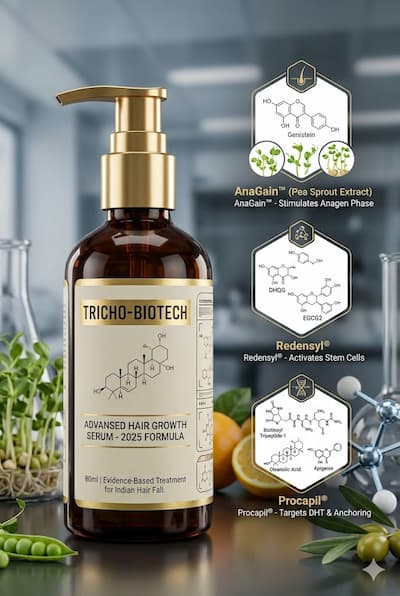
The premium hair serum market in India is now essentially a Redensyl, AnaGain, and Procapil market. Walk into any pharmacy or browse any beauty marketplace and you will find these three names on the majority of hair serums priced above ₹500. Sometimes one. Sometimes two. Occasionally all three.
But most buyers choose between them based on branding, price, or which name they have seen most — not based on which mechanism addresses their specific type of hair loss. This is a problem, because the three work in entirely different ways:
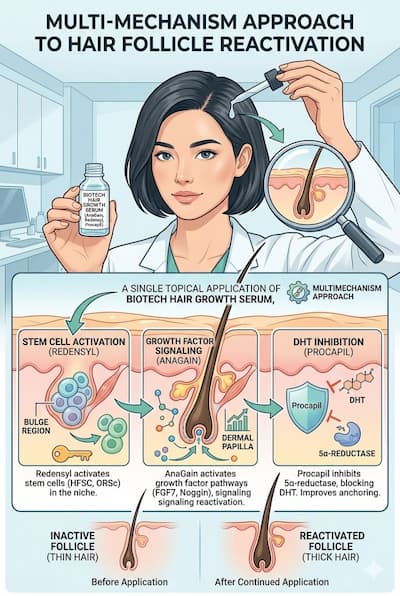
- Redensyl is a stem cell activator — it wakes up dormant hair follicle stem cells
- AnaGain is a growth factor pathway activator — it amplifies the biological signal that tells a follicle to enter and sustain the growth phase
- Procapil is a DHT modulator + follicle anchor — it directly addresses the miniaturisation mechanism of pattern hair loss while strengthening the follicle's hold
Using the wrong one for your hair fall type is not dangerous — but it is less effective than using the right one. And using all three together is more effective than any single one alone. This guide tells you exactly why.
Redensyl — The Stem Cell Activator
Redensyl: Fast Facts
- Developer
- Induchem AG (Switzerland)
- INCI Name
- Dihydroquercetin Glucoside (DHQG) + Epigallocatechin Gallate Glucoside (EGCG2)
- Key Source
- Larch tree (DHQG), green tea (EGCG2)
- Target Cell
- ORSm (outer root sheath) hair follicle stem cells
- Effective %
- 3% in clinically tested formulas
- Clinical Trial
- 3-month RCT; 29% increase in anagen hairs vs. 15% for Minoxidil 2%
- Best For
- Diffuse hair fall, telogen effluvium, early AGA, post-treatment recovery
How Redensyl Works
Hair follicles, like most tissues in the body, are maintained by a population of adult stem cells. In a healthy follicle, these stem cells in the outer root sheath (ORSm cells) divide and differentiate to produce new hair matrix cells at the start of each anagen cycle. In hair fall — particularly in diffuse shedding and early androgenetic alopecia — these stem cells become increasingly quiescent: they receive insufficient activation signals and remain dormant, meaning the follicle spends more time in telogen and less time in anagen.
Redensyl's DHQG component directly activates the ORSm stem cells via a specific LHCGR (luteinising hormone/choriogonadotropin receptor) independent signalling pathway, pushing them from quiescence into active division. EGCG2 (the stabilised, cell-membrane-permeable form of green tea's most potent active) supports this activation by protecting the dividing cells from the oxidative stress of rapid division and modulating the mitotic signalling environment.
The clinical result: in the published 3-month randomised controlled trial on Redensyl, subjects showed a 29% increase in anagen hair ratio — more follicles in active growth phase — compared to baseline, versus a 15% increase in the Minoxidil 2% control group. The Redensyl group also showed a 17% reduction in daily hair count.
AnaGain — The Growth Factor Pathway Activator
How AnaGain Works
AnaGain takes a fundamentally different approach to the same problem. Where Redensyl works at the stem cell level, AnaGain works at the growth factor signalling level — specifically activating the EGFR (epidermal growth factor receptor) and NRG1 (Neuregulin-1) pathways in the dermal papilla cells.
The dermal papilla is the command centre of the hair follicle: a cluster of specialised fibroblasts at the base of the follicle that send instructional signals to the hair matrix cells above them, directing whether the follicle should be in anagen, catagen, or telogen. EGFR signalling in the dermal papilla is one of the primary molecular switches that initiates and sustains anagen. NRG1 signalling supports the communication between the dermal papilla and the epithelial cells of the hair matrix.
AnaGain achieves its EGFR/NRG1 activation effect through a standardised pea sprout (Pisum sativum) extract. Pea shoots at a specific developmental stage (8 days after germination) produce a distinctive blend of peptides and phytochemicals that potently activate these growth factor receptors. Mibelle Biochemistry identified and standardised this extract after observing that dermal papilla cells cultured with pea sprout extract showed dramatically upregulated expression of growth factor pathway genes.
Clinical data: in a double-blind placebo-controlled study over 3 months, 1% AnaGain produced a 78% increase in the anagen/telogen ratio — the proportion of follicles in active growth vs. resting phase — compared to placebo. This is a significant figure. It does not mean 78% more hairs grow; it means the ratio of growing to resting follicles improves by 78%.
AnaGain: Fast Facts
- Developer
- Mibelle Biochemistry (Switzerland)
- INCI Name
- Pisum Sativum Sprout Extract
- Key Source
- Organic pea sprouts (8-day germination stage)
- Target Pathway
- EGFR + NRG1 signalling in dermal papilla cells
- Effective %
- 1% in clinically tested formulas
- Clinical Trial
- 3-month double-blind RCT; 78% improvement in anagen/telogen ratio
- Best For
- Gradual density loss, stress-driven fall, prolonged diffuse thinning
Procapil — The DHT Modulator & Follicle Anchor
Procapil: Fast Facts
- Developer
- Sederma (France)
- Components
- Biotinoyl Tripeptide-1 + Apigenin + Oleanolic Acid
- Sources
- Biotinylated peptide; Chamomile (apigenin); Olive/Rosemary (oleanolic acid)
- Mechanisms
- 5α-reductase inhibition + vasodilation + follicle anchoring
- Effective %
- 0.5–2% in formulas
- Clinical Trial
- 4-month study; 121% improvement in hair resistance to traction; comparable results to Minoxidil 2% in some studies
- Best For
- Pattern hair loss (AGA), weak follicle anchoring, androgenic hair fall, receding hairline
How Procapil Works
Procapil is a three-molecule complex — each component addressing a different aspect of follicle vulnerability:
Head-to-Head: AnaGain vs Redensyl vs Procapil
| Criteria | Redensyl | AnaGain | Procapil |
|---|---|---|---|
| Primary mechanism | Stem cell activation (ORSm cells) | Growth factor pathway activation (EGFR/NRG1) | DHT inhibition + follicle anchoring + vasodilation |
| Clinical evidence | 3-month RCT; 29% anagen ratio increase (vs. Minoxidil 2% at 15%) | 3-month double-blind RCT; 78% improvement in anagen/telogen ratio | 4-month study; 121% hair resistance improvement; comparable to Minoxidil 2% |
| Best hair fall type | Diffuse fall, telogen effluvium, general density loss | Stress/nutrition-driven fall, gradual density reduction | Pattern hair loss (AGA), androgenic thinning, receding hairline |
| Onset of results | 4–6 weeks (reduced shedding); 3–4 months (new growth) | 4–8 weeks (density feel); 3 months (ratio improvement) | 4–6 weeks (anchoring improvement); 3–4 months (regrowth) |
| Side effects | None reported in literature | None reported in literature | None reported; no systemic DHT effect (topical only) |
| Dependency risk | None | None | None |
| Works alone? | Yes — effective as sole active for non-AGA fall | Yes — effective as sole active for stress-driven fall | Yes — but paired with Redensyl/AnaGain for AGA is more comprehensive |
| Better together? | Yes — non-overlapping mechanisms mean all three work synergistically. One serum with all three addresses stem cell, growth factor, and DHT simultaneously. | ||
Which Active for Which Type of Hair Fall?
Stress/Post-Illness/Postpartum Hair Fall (Telogen Effluvium)
Best choice: Redensyl + AnaGain. Telogen effluvium shifts follicles into resting phase en masse — you need both stem cell reactivation (Redensyl) and growth factor pathway re-stimulation (AnaGain) to bring them back to anagen together. Procapil's DHT-blocking component is less relevant here (TE is not driven by DHT), but its follicle-anchoring peptide component provides useful support. Telogen effluvium guide →
Pattern Hair Loss / Receding Hairline (Androgenetic Alopecia)
Best choice: Procapil (primary) + Redensyl + AnaGain. AGA has a DHT component that Redensyl and AnaGain alone cannot address — Procapil's oleanolic acid (5-alpha reductase inhibitor) is essential. Saw Palmetto in the same formula compounds the DHT-blocking. All three together covers DHT inhibition, follicle anchoring, stem cell activation, and growth factor maintenance. Male AGA guide → | Female AGA guide →
General Thinning / Reduced Density Over Years
Best choice: All three. Long-term gradual density loss typically has multiple contributing causes — the combination of all three actives provides comprehensive coverage. AnaGain restores the growth factor signalling that was weakened; Redensyl reactivates stem cells that have been increasingly quiescent; Procapil's anchoring and vasodilation components improve the follicle's structural environment. Hair growth guide →
Postpartum or Post-COVID Hair Fall
Best choice: AnaGain + Redensyl. Both post-partum and post-COVID hair fall are telogen effluvium with a strong inflammatory/oxidative stress component. AnaGain's EGFR pathway re-activation is particularly valuable here because EGFR signalling is one of the pathways specifically suppressed by the inflammatory cytokine storm associated with severe COVID. Redensyl's stem cell reactivation helps restore the mass-shifted follicles. Postpartum hair fall guide → | Post-COVID hair fall guide →
The Case for All Three Together
The three mechanisms are completely non-overlapping: Redensyl targets stem cells → AnaGain targets growth factor receptors → Procapil targets DHT, anchoring, and blood supply. Using all three simultaneously is not redundant — it is addressing three distinct biological failure points in one formulation. Premium hair serums that include all three (like the Total Revival Hair Serum from Botani Bestie) do so because the clinical evidence shows synergistic benefit when multiple anagen-promoting mechanisms are activated simultaneously.
The Total Revival Hair Serum combines AnaGain + Redensyl + Procapil with Copper Peptides (GHK-Cu, which provides a fourth mechanism: connective tissue repair and local IGF-1 stimulation) and a base of Bhringraj + Brahmi Ayurvedic actives that support the same follicle growth pathways through complementary herbal mechanisms. It is the most comprehensive evidence-based hair growth serum formulation currently available in India. Total Revival Hair Serum — Full Ingredients →
Frequently Asked Questions
The Honest Biotech Summary
The marketing on most hair serums presents these actives as interchangeable "hair growth ingredients." They are not — they address completely different biological failure points. Choosing one over another without understanding your hair fall type is luck, not strategy.
The practical recommendation: for most people experiencing hair fall in India (a mix of stress-driven telogen effluvium, nutritional factors, and — for men especially — a DHT component), a serum containing all three actives is not overkill. It is comprehensive coverage for a multi-causal problem.
Combine biotech serum with a plant-based hair oil. The serum works at the follicle level; the oil works at the scalp surface (microbiome, sebum balance, blood flow from massage). Both are necessary. Neither alone is sufficient.
Shop Total Revival Hair Serum → Shop Total Restore Hair Oil →"Redensyl wakes the stem cell up. AnaGain tells it to grow. Procapil makes sure DHT can't put it back to sleep."
Ready to make the honest switch?
Our products are built on the same principles as every article we write — pure ingredients, real results, nothing to hide.
Explore Our Products