Oily Scalp — Causes, Common Myths, and How to Treat It Naturally
Washing your hair every day is probably making your oily scalp worse. The over-washing cycle is the most common mistake — and breaking it, combined with the right sebum-balancing ingredients, is how oily scalp is actually fixed.
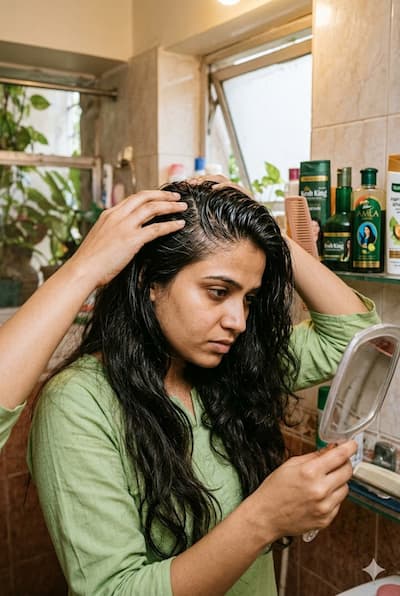
Oily scalp is one of the most common scalp complaints in India — and one of the most poorly managed. The instinct is to wash more frequently, use stronger shampoos, and avoid oiling entirely. Each of these responses makes the underlying problem worse.
Oily scalp is not a hygiene problem. It is a sebum regulation problem — driven by sebaceous gland overactivity that has specific biological causes. Addressing those causes, rather than aggressively stripping the output, is the only approach that produces lasting improvement.
This guide covers the sebum mechanism, why India's climate makes oily scalp more common and more persistent, the myths that keep people stuck in the wrong routines, and the natural ingredients with documented evidence for sebum regulation.
What Is Actually Happening: The Sebum Mechanism
Every hair follicle on the scalp is connected to a sebaceous gland — a specialised oil-secreting structure that produces sebum, a complex mixture of triglycerides, wax esters, squalene, and free fatty acids. Sebum is not a problem by design — it waterproofs the scalp, lubricates the hair shaft, maintains the scalp's mildly acidic pH, and has natural antimicrobial properties.
The problem is overproduction — when sebaceous glands secrete more than the scalp and hair shaft can distribute, the result is visible greasiness within hours of washing. The three primary drivers of overproduction:
DHT Stimulation
Dihydrotestosterone (DHT) — the potent androgen converted from testosterone by 5α-reductase — directly binds to androgen receptors in sebaceous gland cells and upregulates sebum production. This is why oily scalp is more common in men (higher baseline androgens), in women with PCOS (elevated androgens), and in people under hormonal stress. The same DHT that causes pattern hair loss also causes the oily scalp that often accompanies it.
The Over-Washing Rebound
Surfactant-based shampoos strip the scalp's sebum film. Sebaceous glands have a homeostatic feedback mechanism — when sebum is removed below a threshold, they increase production to compensate. This is why people who wash daily often find their scalp oily again within 12–18 hours — the stripping triggers accelerated sebum secretion. Each aggressive wash trains the gland to produce more, not less.
Heat, Stress & Genetics
Heat increases sebaceous gland secretion rate — body temperature elevation accelerates lipid secretion. In India's summer months (40°C+), sebum production measurably increases. Cortisol (the stress hormone) also stimulates sebaceous glands via CRH receptors. Genetic sebaceous gland density varies — some people have significantly more glands per cm² of scalp and produce more oil regardless of external factors.
Why India Makes Oily Scalp Harder to Manage
The India-Specific Factors
Heat (March–September)
Temperatures above 35°C elevate scalp temperature, accelerating sebaceous secretion. Head coverings (dupattas, helmets, caps) trap heat and humidity against the scalp — creating an environment of elevated temperature and reduced evaporation that compounds sebum accumulation.
Humidity (Coastal + Monsoon)
High humidity (60–90% in coastal cities and during monsoon) slows sebum evaporation — the scalp stays coated in the oil it produced rather than having it distribute down the hair shaft. Hair feels greasier faster even with the same gland activity.
Air Pollution (Delhi, Mumbai, Pune)
PM2.5 and PM10 particles settle on the scalp and mix with sebum, creating a dense, adhesive coating. This is often mistaken for pure sebum excess — it is partly sebum and partly environmental particulate. Hard water (high calcium/magnesium) deposits on the scalp create additional residue that mimics oiliness.
Traditional Heavy Oiling
Heavy coconut oil or mineral oil applied to an already oily scalp — and left overnight or for extended periods — adds to the sebum excess rather than replacing it. This compounds the Malassezia environment and is one of the most common contributors to oily scalp + dandruff in India.
Oily Scalp vs Dandruff: The Distinction That Changes Treatment
These two conditions are often confused because they frequently co-exist. But they are not the same, and treating the wrong one makes the other worse.
| Feature | Oily Scalp (Seborrhoea) | Dandruff (Pityriasis capitis) | Seborrheic Dermatitis |
|---|---|---|---|
| Primary cause | Sebaceous gland overactivity (DHT, heat, overwashing) | Malassezia overgrowth on oily scalp | Malassezia + severe scalp inflammation |
| Flaking | None | White/grey, loose, oily flakes | Thick, yellow, adherent greasy scales |
| Itching | Minimal or none | Moderate | Intense |
| Scalp appearance | Shiny, greasy but otherwise normal | Slightly red, flaky | Red, inflamed, thick plaques |
| Primary treatment lever | Sebum regulation (zinc, green tea, DHT blocking) | Antifungal (neem, ketoconazole, zinc pyrithione) + sebum control | Medical antifungal + anti-inflammatory |
| Oiling scalp? | Light, non-comedogenic oils only; pre-wash; 30 min | Neem/Tea Tree oil pre-wash; avoid heavy oils | Avoid scalp oiling until controlled |
The 5 Myths That Keep Oily Scalp Going
Myth 1: Wash daily for oily scalp
Daily washing is the most common and most damaging response. Each surfactant wash strips the scalp's sebum film below the homeostatic threshold, triggering accelerated compensatory production. Daily washers typically find their scalp oily again by the next morning — and over months, their glands are trained to produce more. The solution is gradually extending the wash interval while using a sebum-balancing (not stripping) shampoo.
Myth 2: Avoid oiling completely
Pre-wash scalp oiling with light, non-comedogenic oils (Bhringraj, Jojoba, or a lightweight Ayurvedic formula) for 30–45 minutes before washing does not worsen oily scalp. The short contact time and subsequent washing means no accumulation. What worsens oily scalp is overnight or 8+ hour heavy oil application — the prolonged contact feeds Malassezia. Massage without oil also benefits scalp circulation without adding to sebum load.
Myth 3: Baby shampoo is best for oily scalp
Baby shampoos are gentle but are not formulated for sebum regulation. They typically have no active sebum-controlling ingredients (no zinc, no salicylic acid, no antifungal actives). Their ultra-mild surfactants may not remove heavy sebum load effectively without multiple washes. For oily scalp, you need a shampoo that is gentle enough not to trigger compensatory production but contains active ingredients that directly address sebum levels.
Myth 4: Oily scalp is the same as dirty hair
Oily scalp is a physiological condition — not a result of insufficient hygiene. People with oily scalps wash more than average, not less. The stigma that oily scalp equals poor hygiene is factually wrong and leads people to wash more aggressively, worsening the cycle. Oily scalp is primarily genetic (gland density, androgen sensitivity) and hormonal — hygiene beyond a normal schedule plays a minor role.
Myth 5: Oily scalp and dry hair cannot coexist
They can and frequently do — especially in India. Sebum is produced at the scalp and moves down the hair shaft. On long hair, the sebum from the scalp rarely reaches the mid-lengths and ends before it is washed away — those areas receive no natural conditioning. The result is an oily scalp with dry, brittle mid-lengths and ends. Over-washing to address the oily scalp strips whatever moisture the ends had. This is extremely common in Indian women with long hair.
Myth 6: Dry shampoo fixes oily scalp
Dry shampoo absorbs surface sebum temporarily — it does not reduce sebum production and does not wash the scalp. Regular dry shampoo use without thorough washing causes build-up: starch particles, sebum, and dead skin cells compact on the scalp surface and in follicle openings. This is a significant cause of scalp congestion and follicle stress. Dry shampoo is a one-day emergency fix, not a routine scalp management tool.
Breaking the Over-Washing Cycle: A 4-Week Transition
The Gradual Interval Extension Method
The scalp's sebaceous glands can be re-trained to produce less. This takes 4–6 weeks and requires tolerating some oiliness during the transition — the temporary discomfort is what most people cannot push through. But within 4–6 weeks, sebum production normalises to a lower baseline.
Wash every other day instead of daily. Use a gentle, zinc-containing shampoo. Expect scalp to feel oilier than usual on non-wash days.
Extend to washing every 2 days. Add a leave-on scalp tonic or light oil massage once per week (pre-wash, 30 min). The oiliness on day 2 should be less severe than weeks 1–2.
Aim for 72–96 hours between washes. Scalp sebum production should be visibly lower. Hair stays fresh longer. Glands are rebalancing.
2–3 washes per week with sebum-balancing shampoo. Monthly scalp detox if build-up develops. Light pre-wash oil 1–2x per week.
Natural Ingredients That Actually Control Oily Scalp
| Ingredient | Mechanism for Oily Scalp | Evidence | Best Format |
|---|---|---|---|
| Zinc PCA | Inhibits 5α-reductase (reducing DHT-driven sebaceous stimulation); mild antifungal | Strong (multiple studies) | Shampoo, scalp tonic |
| Green Tea (EGCG) | Inhibits 5α-reductase; reduces androgen-driven sebaceous gland activity; antioxidant | Strong (in vitro, animal, human studies) | Shampoo, leave-on serum |
| Neem (Azadirachta indica) | Azadirachtin — antifungal (Malassezia inhibition); anti-inflammatory; sebum-regulating | Strong (Ayurvedic + clinical) | Shampoo, light pre-wash oil |
| Salicylic Acid (BHA) | Lipid-soluble; penetrates follicle openings and dissolves sebum plugs; exfoliates scalp surface | Strong (dermatology standard) | Scalp shampoo (0.5–2%) |
| Piroctone Olamine | Antifungal active against Malassezia; reduces the sebum-fed fungal overgrowth that worsens oiliness | Strong (clinical trials) | Anti-dandruff + oily scalp shampoo |
| Apple Cider Vinegar (diluted 1:4) | Restores scalp pH to mildly acidic range; suppresses Malassezia; removes residue | Moderate (traditional + in vitro) | Pre-shampoo rinse or post-wash diluted rinse |
| Jojoba Oil | Wax ester structure mimics sebum — scalp may sense adequate oil and reduce production; non-comedogenic | Moderate (anecdotal + mechanism) | Light pre-wash scalp application (30 min) |
The Correct Oily Scalp Routine for India
- Optional: Light pre-wash oil (30 min before). Apply a small amount of lightweight oil (Bhringraj oil or Jojoba) to the scalp. Massage for 3–4 minutes. The massage improves circulation — a key benefit — without the heavy prolonged coat that feeds Malassezia.
- Shampoo with a sebum-balancing formula. Look for: Zinc PCA, Piroctone Olamine, Neem, Green Tea, or Salicylic Acid. Avoid SLS in the first ingredient position — SLS as the primary surfactant is too stripping. Let shampoo sit for 60–90 seconds before rinsing — active ingredients need contact time.
- Condition mid-lengths and ends only. Never apply conditioner to the scalp — adds oils and residue to an already oily environment. Apply only from mid-shaft to ends.
- Cool water final rinse. Warm water keeps scalp pores slightly dilated; a cool rinse tightens them and slows sebum secretion slightly.
- Allow hair to air dry where possible. Heat from blow dryers elevates scalp temperature and stimulates sebaceous secretion.
- Resist washing — this is where the rebalancing happens. Each day you go without washing trains the gland to produce less.
- If scalp feels itchy or very oily: apply a diluted ACV rinse (1 tablespoon in a glass of water) to the scalp, leave 5 minutes, rinse with plain water — this does not reset the sebum cycle the way shampoo does.
- Avoid touching the scalp repeatedly during the day — fingers transfer bacteria and stimulate glands.
- Avoid tight updos that trap scalp heat. Loose hairstyles allow better airflow and lower scalp temperature.
Even with the correct routine, sebum, dead skin cells, and hard water minerals accumulate on the scalp over 3–4 weeks. A monthly scalp detox with a clarifying or exfoliating treatment removes this build-up and resets the scalp surface.
Method: Apply a pre-wash clarifying treatment (or a paste of multani mitti/fuller's earth with ACV) to dry scalp, leave 15–20 minutes, then wash with shampoo. Once per month is sufficient — more frequent clarifying strips the scalp and restarts the over-washing cycle.
- High glycaemic index foods (maida, white rice, sugary drinks): Spike insulin, which elevates IGF-1, which increases sebaceous gland activity — the same mechanism that worsens acne. Switching to lower GI foods (whole grains, legumes) reduces sebum production over 4–8 weeks.
- Dairy: Milk proteins increase IGF-1 levels — associated with elevated sebum production. Particularly relevant in India where chai with full-fat milk is consumed multiple times daily.
- Omega-3 deficiency: Low Omega-3 to Omega-6 ratio is associated with increased scalp inflammation and sebum production. Include flaxseed, walnuts, or fish in the diet.
- Zinc-deficient diet: Zinc regulates 5α-reductase. Inadequate zinc from diet increases DHT-driven sebum production. Sesame seeds, pumpkin seeds, and lentils are good zinc sources in Indian diets.
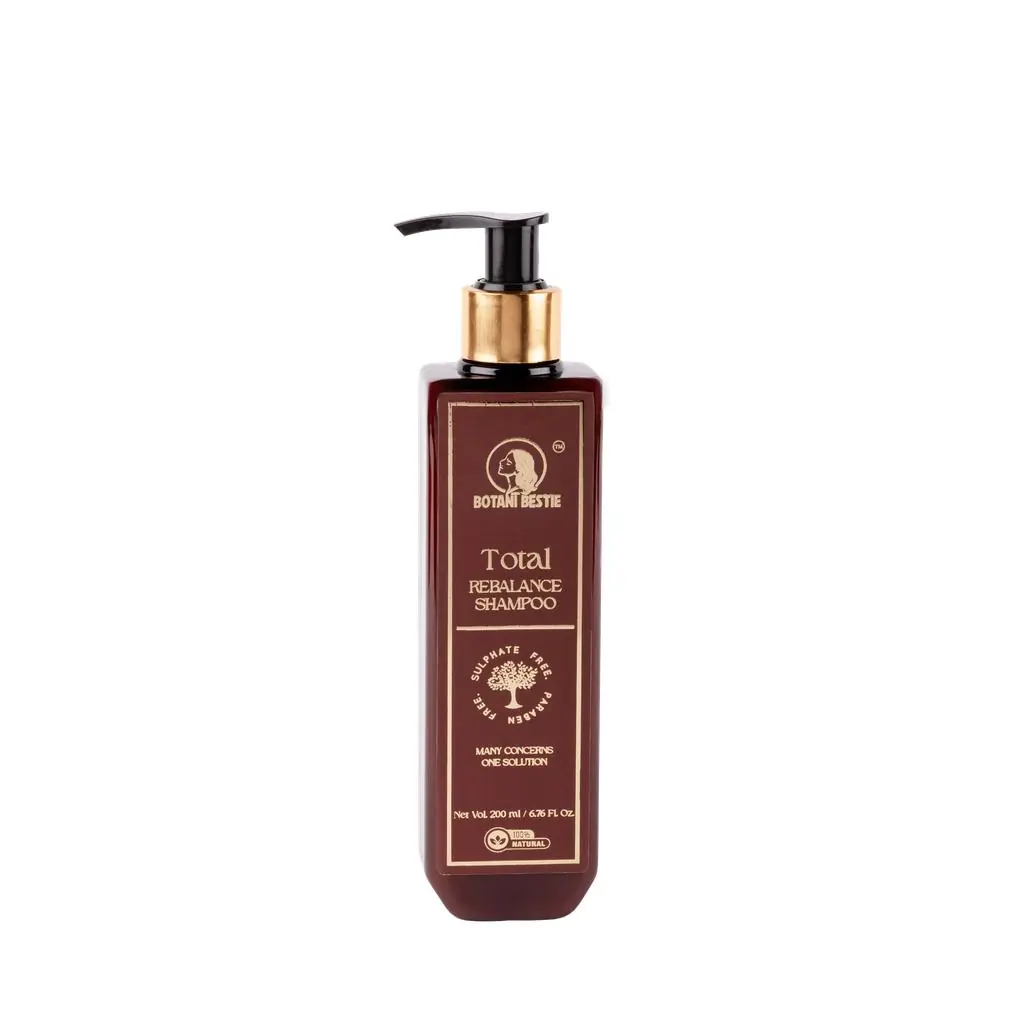
Total Rebalance Shampoo
by Botani Bestie — Scalp-balancing sulfate-free shampoo
Formulated specifically for Indian scalps dealing with excess sebum: Neem (antifungal + anti-inflammatory), Piroctone Olamine (Malassezia control), Zinc PCA (5α-reductase inhibition + sebum regulation), and Green Tea EGCG (androgen-driven gland suppression) — in a gentle, sulfate-free base that cleanses without the over-stripping that triggers compensatory sebum production.
- No SLS/SLES — cleanses without triggering the rebound cycle
- Zinc PCA + Piroctone Olamine — clinical-grade sebum and antifungal actives
- Neem + Green Tea — Ayurvedic + biotech sebum regulation
- Appropriate wash interval: every 2–3 days for oily scalp
Frequently Asked Questions
"Oily scalp is not a cleanliness problem — it is a sebum regulation problem. Washing more does not solve it. The right ingredients do."
Ready to make the honest switch?
Our products are built on the same principles as every article we write — pure ingredients, real results, nothing to hide.
Explore Our Products