Tea Tree Oil for Scalp — The Antifungal Science Behind India's Most Underused Scalp Active
Tea tree oil has more clinical evidence for scalp antifungal efficacy than most Ayurvedic herbs — a 5% tea tree shampoo outperformed placebo in a randomised controlled trial for dandruff, itching, and scalp greasiness. Yet it remains underused in Indian hair care, where Neem gets all the antifungal attention. This guide covers what tea tree oil actually does, how to use it safely, and how it fits into an Ayurvedic scalp routine.
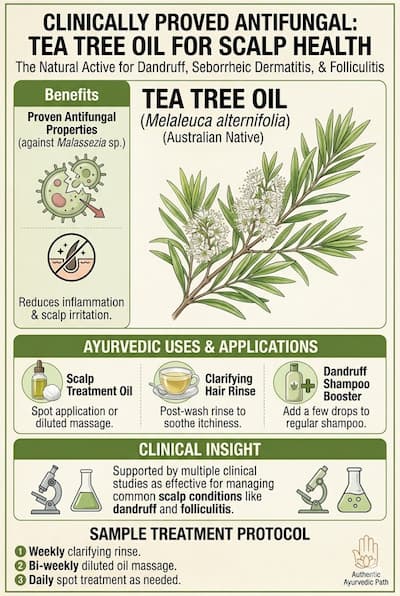
Tea tree oil comes from the leaves of Melaleuca alternifolia — an Australian native plant with a documented history of use as an antiseptic by the indigenous Bundjalung people. It was introduced to modern dermatology primarily through its remarkable antimicrobial spectrum: effective against bacteria, fungi, and some viruses at low concentrations with minimal development of resistance.
For scalp health specifically, tea tree oil's most important property is its antifungal activity against Malassezia species — the lipid-dependent yeasts that cause dandruff, seborrheic dermatitis, and contribute to the scalp inflammation associated with hair fall. This activity is well-characterised at the mechanistic level and has been confirmed in multiple randomised controlled trials.
This guide explains the science, the correct protocols for using it safely at home, and how tea tree oil complements the Ayurvedic scalp care framework built around herbs like Neem, Bhringraj, and Shikakai.
The Science: What Makes Tea Tree Oil Antifungal
Terpinen-4-ol: The Primary Active Compound
| Botanical source | Melaleuca alternifolia (tea tree) |
| Primary active | Terpinen-4-ol (comprises 30–48% of high-quality tea tree oil) |
| Secondary actives | γ-terpinene, α-terpineol, 1,8-cineole (concentration matters — high 1,8-cineole = more irritating) |
| Antifungal mechanism | Disrupts Malassezia cell membrane integrity; alters membrane permeability; inhibits fungal ergosterol synthesis |
| Antibacterial spectrum | Effective against S. aureus, S. epidermidis, P. acnes, E. coli — broad Gram-positive and Gram-negative coverage |
| Clinical evidence | Satchell et al. 2002 (JAAD) — 5% TTO shampoo: 41% improvement in dandruff vs 11% placebo (p<0.001) |
| Safe dilution for scalp | 2–5% in carrier oil; 5–10% in shampoo base (never apply undiluted) |
Terpinen-4-ol works by disrupting the phospholipid bilayer of Malassezia's cell membrane — essentially punching holes in the fungal cell wall, causing cytoplasmic leakage and cell death. Unlike pharmaceutical antifungals (ketoconazole, fluconazole) which target a single specific enzyme, terpinen-4-ol's membrane-disruption mechanism makes it difficult for Malassezia to develop resistance through single-gene mutations — an important advantage for long-term scalp maintenance.
4 Clinically Supported Benefits for Scalp Health
1. Dandruff Treatment (Clinically Proven)
The Satchell et al. 2002 randomised controlled trial — the gold standard for tea tree oil scalp evidence — enrolled 126 participants with mild to moderate dandruff. The 5% tea tree oil shampoo group showed 41% improvement in dandruff severity score vs 11% in the placebo group (statistically significant at p<0.001). Itch scores and scalp greasiness also improved significantly in the treatment group.
This level of evidence — a properly randomised, double-blinded, placebo-controlled trial — is rare for natural ingredients and makes tea tree oil one of the most evidence-supported natural dandruff treatments available.
2. Seborrheic Dermatitis Management
Seborrheic dermatitis is an inflammatory skin condition driven by Malassezia overgrowth — a more severe form of dandruff involving red, scaly, and itchy patches on the scalp (and sometimes face, chest, and behind the ears). The same antifungal mechanism that reduces dandruff is effective against the Malassezia component of seborrheic dermatitis.
Multiple smaller studies and case series support 5% tea tree oil shampoo for seborrheic dermatitis maintenance. It is best used as part of a protocol that also addresses scalp pH (acidic cleansers), anti-inflammatory herbs (Bhringraj, Brahmi), and washing frequency.
3. Scalp Folliculitis (Bacterial)
Scalp folliculitis — bacterial infection of the hair follicle openings, presenting as small pustules, itching, and hair fall — is commonly caused by Staphylococcus aureus. Tea tree oil's broad antibacterial activity (MIC values documented against S. aureus at 0.25–0.5% in vitro) makes it effective for mild bacterial folliculitis when applied as a diluted scalp treatment.
Note: for fungal folliculitis (pityrosporum folliculitis), the same antifungal mechanism applies — this is particularly relevant in India's hot and humid climate, where fungal folliculitis is underdiagnosed as acne.
4. Scalp Inflammation Reduction (Indirect Hair Fall Benefit)
Scalp inflammation from Malassezia, bacterial overgrowth, or dermatitis creates a pro-inflammatory environment around the hair follicle. This inflammation produces cytokines (IL-1β, TNF-α) that signal follicles to prematurely enter the telogen (resting/shedding) phase — causing hair fall not from any DHT or nutritional cause but from chronic low-level scalp inflammation.
By reducing the Malassezia and bacterial load causing that inflammation, tea tree oil indirectly reduces the telogen shift — stopping one specific, commonly overlooked cause of hair fall in people who present with dandruff and concurrent hair shedding.
Safety First: How to Dilute Tea Tree Oil Correctly
Preparation: Add 10 drops of 100% pure tea tree essential oil to 100ml of your sulfate-free shampoo base (or existing shampoo). Shake well. This creates approximately a 5% dilution — the clinically studied concentration.
Application: Apply to wet hair and scalp. Massage thoroughly into the scalp, focusing on the most affected areas. Leave on for 3–5 minutes before rinsing. The leave-on time is important — studies showing efficacy used a contact time of at least 3 minutes. Rinse thoroughly.
Frequency: 2–3 times per week for 4–6 weeks (treatment phase). Then reduce to once per week for maintenance.
What to watch for: If you experience scalp stinging, redness, or increased itching, reduce to 3–5 drops per 100ml (2.5% dilution) and reassess. Some individuals are sensitive to tea tree oil's terpene components.
Preparation: Add 4–6 drops of tea tree essential oil to 1 teaspoon (5ml) of carrier oil — Jojoba (non-comedogenic, closest to sebum), or a light-weight oil like Sesame or diluted Neem. This creates a 2–3% dilution. Never use coconut oil as the carrier if treating dandruff — its fat content can worsen Malassezia growth.
Application: Part hair in sections. Apply the diluted oil directly to the scalp using a dropper or fingertips. Massage in gently with circular motions. Focus on the areas of most dandruff or inflammation.
Leave on: 30–60 minutes before washing with a gentle shampoo. Can also be applied the night before washing (overnight) — in which case cover with a shower cap to prevent transfer to bedding.
Frequency: 2 times per week alongside your normal hair oil routine.
For more stubborn dandruff or seborrheic dermatitis — combining tea tree's terpinen-4-ol with Neem's azadirachtin provides broader antifungal coverage through complementary mechanisms:
- 5ml Jojoba oil (base)
- 4 drops tea tree essential oil
- 4 drops Neem essential oil (or 0.5ml cold-pressed Neem oil)
- 2 drops Rosemary essential oil (optional — adds anti-inflammatory and circulation benefit)
Blend together and apply to scalp sections. Leave 30–45 minutes before washing. Use 2 times per week during a dandruff flare; reduce to once per week for maintenance. The combination creates a multi-mechanism antifungal approach that is harder for Malassezia to develop resistance to than single-compound treatments.
What Tea Tree Oil Cannot Do — Important Limitations
It Does Not Grow Hair
Tea tree oil has no direct follicle-stimulating mechanism. It reduces scalp inflammation — which can indirectly reduce inflammation-driven hair fall. But it does not activate follicle stem cells, extend the anagen phase, or block DHT. For hair growth stimulation, combine it with Bhringraj, Redensyl, Rosemary essential oil (separate from tea tree) or a dedicated hair serum.
It Will Not Fix Hormonal or Nutritional Hair Fall
Tea tree oil addresses scalp-surface causes of hair fall (fungal, bacterial, inflammatory). It has no effect on the underlying causes of androgenetic hair loss (DHT miniaturisation), PCOS-related hair fall, thyroid-related shedding, or nutrient deficiency hair loss — these require systemic intervention, not topical antifungals.
It Is Not Safe for Everyone
Tea tree oil can cause contact dermatitis and sensitisation in some individuals, particularly those with pre-existing eczema or sensitive skin. Always patch test: apply the diluted preparation to the inner forearm and wait 24 hours before scalp application. Avoid use during pregnancy (limited safety data for essential oils). Keep away from children — tea tree oil is toxic if ingested, even in small amounts.
Product Quality Varies Enormously
The quality of tea tree oil varies widely. Look for 100% pure Melaleuca alternifolia essential oil with terpinen-4-ol content >30% and 1,8-cineole <15% (higher cineole = more skin irritation, less antifungal benefit). Avoid "tea tree oil blends" or products where tea tree is listed far down the ingredient list — these are often too dilute to be effective.
Where Tea Tree Oil Fits in an Ayurvedic Hair Care Routine
| Scalp Step | Ayurvedic Herb | Tea Tree Oil's Role |
|---|---|---|
| Pre-wash scalp oil | Bhringraj oil, Sesame oil, Amla | Add 2–3% tea tree to the pre-wash oil blend for antifungal coverage during the oil treatment phase |
| Shampoo | Shikakai, Reetha, ACV rinse | Add tea tree to a Shikakai/herbal shampoo base for a combined low-pH + antifungal wash |
| Dandruff treatment | Neem, Shikakai, ACV | Strongest antifungal active in this stack — use as the primary antifungal alongside Neem; ACV for pH management |
| Scalp microbiome support | ACV rinse, fermented rice water | Reduces the Malassezia load that disrupts healthy microbiome balance; acidic rinses then restore pH |
| Hair growth actives | Bhringraj, Brahmi, Redensyl serum | Tea tree creates the clean, inflammation-free scalp environment in which growth actives can work effectively |
For a complete scalp rebalancing shampoo — with antifungal actives (Neem, ACV), pH management (Shikakai, ACV), and Ayurvedic herbs — in a ready-to-use sulfate-free formula.
See Total Rebalance Shampoo →Frequently Asked Questions
The Bottom Line
Tea tree oil is one of the most evidence-backed natural scalp actives available — with randomised controlled trial data showing its efficacy for dandruff, seborrheic dermatitis, and scalp folliculitis. Its mechanism (terpinen-4-ol membrane disruption of Malassezia) is well-understood and its results are consistent.
The caveats are real: it must be diluted correctly (never undiluted), it does not grow hair, and it does not address non-scalp causes of hair fall. But for anyone experiencing dandruff-associated hair shedding, itchy scalp, or seborrheic dermatitis — which is a significant proportion of India's hair fall cases — tea tree oil at 5% is one of the most effective and accessible natural treatments available.
Used alongside Neem, ACV, and Shikakai in an Ayurvedic scalp routine, it creates a layered antifungal approach that is more effective than any single ingredient alone — and more sustainable than pharmaceutical antifungals for long-term scalp maintenance.
Shop Total Rebalance Shampoo → Free Hair Consultation"A clean scalp is not squeaky clean. It is fungal-balanced, pH-preserved, and inflammation-free — and that is what grows hair."
Ready to make the honest switch?
Our products are built on the same principles as every article we write — pure ingredients, real results, nothing to hide.
Explore Our Products