Keratin for Hair — What It Is, Why You Lose It, and Why Plant-Based is Better
Your hair is approximately 95% keratin. Every chemical treatment, heat styling session, hard water wash, and UV exposure degrades it. Salon keratin treatments promise to restore it — but the formaldehyde inside them is now linked to cancer. There is a better way.
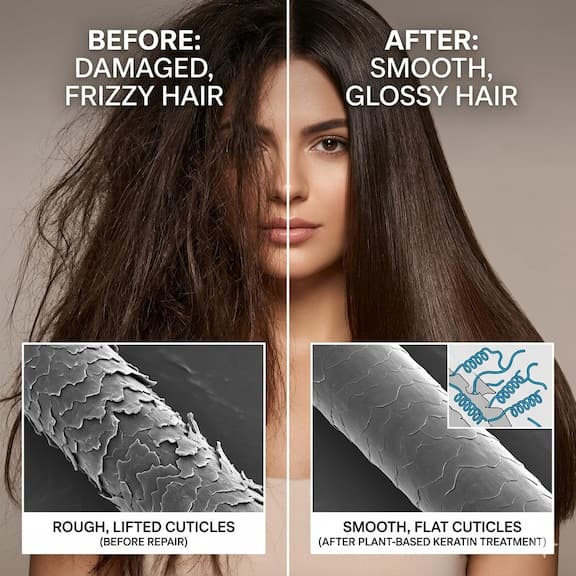
If you have ever walked out of a salon after a Brazilian blowout or keratin treatment with impossibly smooth, glossy hair — only to find it returning to frizzy chaos three months later — you have experienced the fundamental limitation of chemical keratin treatments. They work. Then they stop. And the process of getting them involves exposing yourself to chemicals that have been linked in peer-reviewed research to serious long-term health consequences.
Meanwhile, plant-based keratin has been quietly building a credible scientific case for itself in daily-use hair care formulations — shampoos, conditioners, and serums that deliver consistent, cumulative protein repair with every single wash, without formaldehyde, without heat sealing, and without the risk.
This guide explains what keratin actually is at a molecular level, exactly how hair loses it, what chemical keratin treatments do (and what they risk), and why plant-based keratin in a well-formulated shampoo is not just a safer alternative — it is a more sustainable and ultimately more effective one for Indian hair conditions.
💡 Is Your Hair Keratin-Depleted? Identify Your Pattern.
Different types of keratin damage present differently. Identify yours to understand which section of this guide is most relevant:
👉 Scroll to your damage type to understand the specific keratin repair mechanism most relevant to your hair.
What is Keratin — The Molecular Architecture of Your Hair
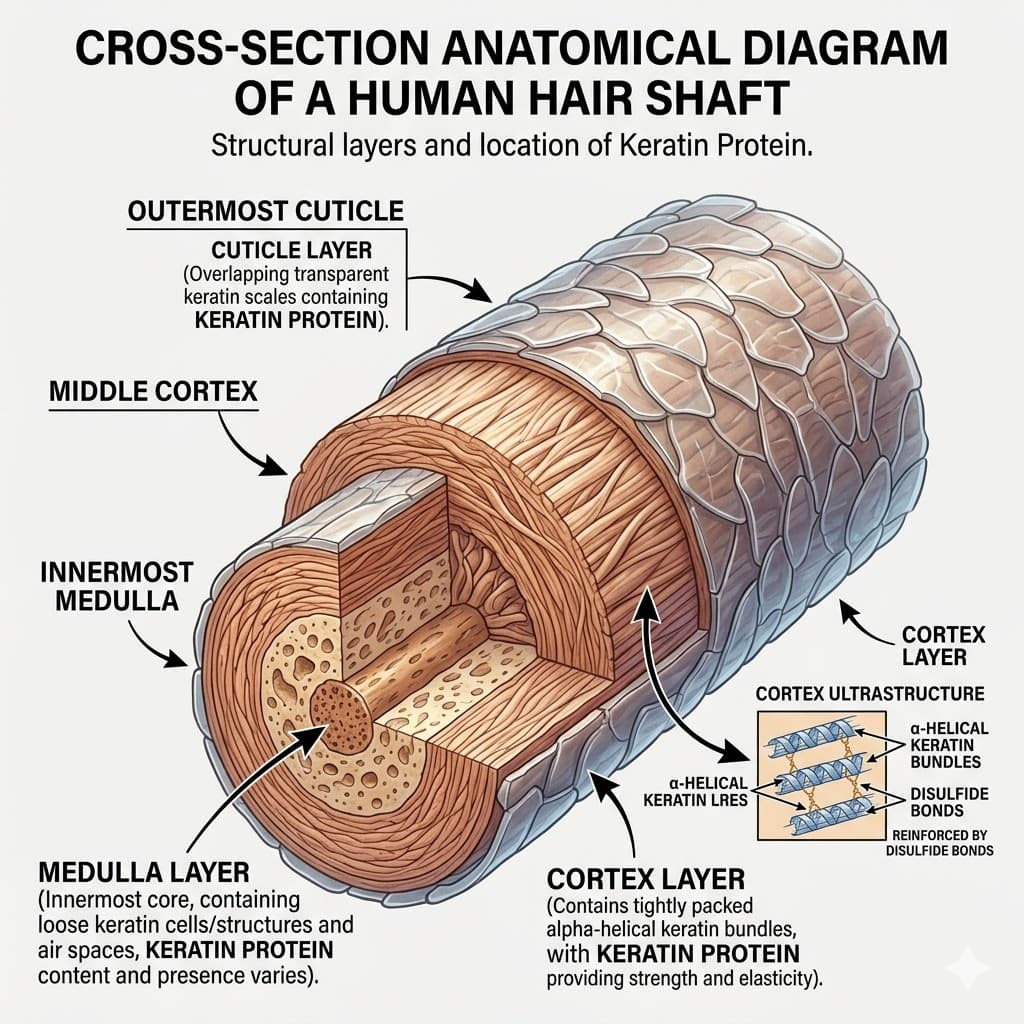
Keratin is a fibrous structural protein — the most abundant protein in the human body after collagen. It is produced by specialised cells called keratinocytes in the hair follicle matrix and forms the primary structural material of the hair shaft, comprising approximately 95% of hair's dry weight.
Your body produces 54 different types of keratin. For hair specifically, the relevant forms are the trichocyte (hard) keratins — proteins organised into compact alpha-helical coil structures that give hair its strength and resilience. These helical protein chains are reinforced by disulfide bonds formed between sulfur-rich cysteine amino acids — the same cross-links that chemical straightening treatments break to permanently alter hair shape.
| Hair layer | Keratin's role | What damage looks like |
|---|---|---|
| Cuticle (outer scales) | Flat overlapping transparent keratin cells protect the inner cortex; smooth cuticle = shine, frizz resistance | Lifted, rough scales → frizz, dullness, breakage |
| Cortex (inner bulk) | Tightly packed alpha-helical keratin bundles + disulfide bonds provide tensile strength and elasticity | Degraded cortex → snapping, reduced stretch, breakage |
| Medulla (innermost core) | Soft keratin provides structural support; more prominent in thick hair types | Rarely damaged in everyday scenarios |
Beyond its structural role, a 2024 review (Hwang & Kang, Longdom Publishing) confirmed that keratin plays an active biological role in follicle signalling — not just passive structure. Keratin fragments released during hair cycling can influence dermal papilla cell behaviour, follicle development, and stem cell differentiation. This explains why keratin depletion affects not just the appearance of existing hair but also the quality of hair produced in subsequent growth cycles.
How Your Hair Loses Keratin — The 4 Damage Pathways
Understanding how each type of damage depletes keratin helps you understand which repair strategy is most relevant for your hair:
Relevant for: Most people in India — UV index 8–11 year-round
UV radiation — particularly UVB — directly degrades the disulfide bonds and protein chains that give keratin its structural integrity. In India's high-UV environment, this is a daily, cumulative process. The 2025 PMC study (Zhang et al., received December 2024) investigated this mechanism rigorously: untreated hair exposed to UV radiation lost 14.32% of its tensile strength compared to unexposed controls. UV-irradiated hair showed increased porosity, roughened cuticle surface, and reduced elasticity — all direct consequences of keratin photodegradation.
The same study found that hydrolysed keratin treatment prevented this tensile strength loss entirely: treated hair maintained its tensile strength after UV exposure, while untreated hair showed the 14.32% reduction. The mechanism: hydrolysed keratin deposits on the cuticle surface to form a UV-reducing film, and during UV exposure, it photodegrades into smaller peptides and amino acids that penetrate more deeply into the cortex — actually strengthening internal chemical bonds by 6.56% after UV exposure. This "UV-induced degradation-penetration mechanism" is a novel and important finding for Indian hair care specifically, where UV exposure is unavoidable.
Relevant for: Anyone using flat irons, blow-dryers, or curling tongs regularly
Heat is one of keratin's most destructive enemies. Flat irons operating at 180–230°C break hydrogen bonds and, at higher temperatures, begin to permanently alter disulfide bonds — the cross-links that give the hair cortex its tensile strength and shape. Blow-drying at high heat causes rapid moisture loss from inside the hair shaft, which contracts the protein structure abruptly and causes microscopic cuticle cracking. The 2025 MDPI comprehensive review (Cosmetics journal) confirmed that repeated heat application progressively depletes cortical protein — contributing directly to the brittle, snapping hair that heat-styling users experience over months and years.
Each heat styling session is a deposition of mechanical and thermal stress that removes a small but cumulative amount of protein from the hair shaft. Plant-based keratin in a daily-use shampoo replenishes this protein continuously — providing the ongoing repair that weekly or monthly salon treatments cannot maintain consistently.
Relevant for: Coloured, bleached, relaxed, or permed hair
Chemical treatments are the most aggressive form of keratin damage. Studies show that chemically processed hair can lose up to 40% of its protein content, with cuticle damage visible under electron microscopy at magnifications of 2500x. The mechanisms differ by treatment type:
- Hair colour and bleaching: Hydrogen peroxide opens the cuticle and oxidises the melanin in the cortex — simultaneously degrading keratin protein chains and breaking disulfide bonds. Bleaching is the most destructive: it can remove up to 40% of the hair's protein in a single application.
- Relaxers and chemical straighteners: Sodium hydroxide (in relaxers) or ammonium thioglycolate (in perms) permanently break and reform the disulfide bonds that give the hair its structural integrity — leaving the cortex structurally weaker with every application.
- SLS-based shampoos: Repeated washing with sodium lauryl sulfate disrupts the hair's lipid barrier (the 18-MEA fatty acid layer on the cuticle surface) and progressively extracts protein from the hair shaft — a slower but cumulative form of chemical damage that affects every wash.
For chemically treated hair, plant-based keratin in every wash provides continuous, measured protein replenishment that partially counteracts the structural losses from chemical processing.
Relevant for: Most Indian cities — Bangalore, Delhi, Chennai, Hyderabad, Noida, Gurgaon
Hard water's calcium and magnesium ions deposit on the hair shaft with every wash — physically roughening the cuticle surface and progressively increasing hair porosity. A higher-porosity hair shaft loses moisture and protein more easily, accelerating keratin depletion in subsequent washes. The combination of hard water (which opens and roughens the cuticle) and SLS-based shampoos (which strip protein from the now-more-accessible cortex) is particularly destructive for Indian hair in hard water zones. See our complete hard water hair guide →
PM2.5 and urban pollution particles also deposit reactive oxygen species (ROS) on the hair surface — the same oxidative chemistry as UV radiation, causing progressive keratin oxidation and structural degradation. In Indian cities with high pollution indices (Delhi's AQI regularly exceeds 300 in winter), this is a significant, cumulative keratin damage pathway that most people do not account for.
💡 Want plant-based keratin + soy protein + silk protein repairing your hair shaft with every single wash — without formaldehyde, heat sealing, or salon visits?
See Total Rebalance Shampoo →The Problem with Salon Keratin Treatments — What the Research Actually Shows
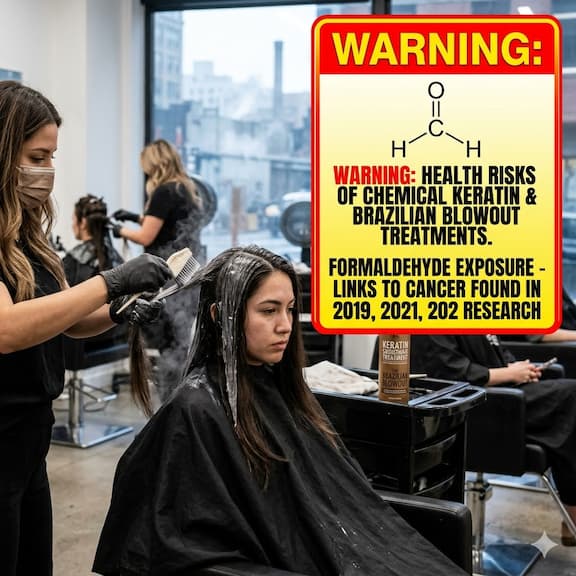
Salon keratin treatments — marketed as Brazilian blowouts, keratin smoothing treatments, or straightening treatments — work by applying a formaldehyde-containing (or formaldehyde-releasing) solution to the hair and then heat-sealing it with a flat iron at 180–230°C. The formaldehyde creates new cross-links between keratin proteins, effectively restructuring the hair shaft into a temporarily smoother configuration.
The results are real and impressive — for 3–6 months. The health concerns, however, are equally real:
| Study | Finding |
|---|---|
| Breast cancer link, 2019 | Women who used chemical straighteners every 5–8 weeks had a 31% higher risk of breast cancer |
| Ovarian cancer link, 2021 | Researchers noted an increased risk of ovarian cancer in women who used chemical straighteners |
| Uterine cancer link, 2022 | Women who used a chemical straightening product in the previous 12 months had an 80% higher adjusted risk of uterine cancer |
| Kidney injury case report, 2021 | A 13-year-old experienced severe kidney injury from a product marketed as "formaldehyde-free" |
| FDA warning letters | FDA has issued warning letters to brands whose products contained unsafe formaldehyde levels or did not disclose its presence |
Formaldehyde-free alternatives — using glyoxylic acid instead — carry fewer documented health risks but are less effective at smoothing and straightening, require more frequent reapplication, and still use heat sealing at high temperatures that independently degrades the hair over time.
What is Plant-Based Keratin — And How Does it Actually Work?
Plant-based keratin (phytokeratin) is produced by hydrolyzing plant proteins — primarily from wheat, soy, corn, or sweet almond — using enzymatic or chemical processes that break the proteins into smaller peptide fragments. The resulting hydrolysate does not contain keratin in the strict molecular sense — plants do not produce trichocyte keratin. However, the process creates an amino acid and peptide profile that closely mirrors human hair keratin, particularly in its cysteine, glutamic acid, and serine content.
Wheat Protein
Rich in glutamine, proline, and glycine — fills cuticle gaps and improves moisture retention. Particularly effective for softness and frizz reduction.
Soy Protein
High in cysteine and arginine — the amino acids most similar to human keratin's composition. Strengthens disulfide bond structure and improves tensile strength.
Silk Protein
Fibroin peptides with exceptional film-forming properties — coats the cuticle surface to produce intense shine and smoothness with reduced friction between strands.
The key mechanism that makes plant-based keratin effective in a rinse-off product like shampoo is its low molecular weight from hydrolysis. Large intact protein molecules cannot penetrate the hair shaft — they can only coat the surface. Hydrolysed proteins broken into smaller peptide fragments (typically 500–5,000 Daltons) are small enough to penetrate through the cuticle scales and into the cortex, where they fill structural gaps, reinforce weakened protein regions, and restore the internal architecture of damaged hair.
The 2025 PMC study specifically confirmed this penetration mechanism for hydrolysed keratin: "Scanning Electron Microscopy (SEM) and fluorescent penetration experiments verified that hydrolysed keratin can deposit on the hair cuticles to form a film and partly penetrate into the hair cortex." The internal bond enhancement (6.56% increase in weak chemical bonds after treatment) confirms that the penetration delivers real structural benefit — not just surface coating.
Myth vs. Truth — What Most People Get Wrong About Keratin for Hair
| Common Myth | The Scientific Truth |
|---|---|
| Keratin supplements make your hair stronger | The Cleveland Clinic confirms: there are no studies that conclude oral keratin supplements make hair stronger. The keratin you eat is digested into amino acids and used throughout the body — not directed specifically to hair. Topical application of hydrolysed keratin is the evidence-based route for hair shaft repair. |
| Salon keratin treatments are safe if they say "formaldehyde-free" | A 2021 case study reported severe kidney injury in a 13-year-old from a product explicitly marketed as formaldehyde-free. Many "formaldehyde-free" treatments release formaldehyde when heated to the high temperatures required for heat sealing. The FDA has issued warning letters to brands for undisclosed formaldehyde in products claiming to be formaldehyde-free. |
| Plant-based keratin is inferior to animal-derived keratin because plants don't produce keratin | Technically accurate — plants produce protein, not keratin. But the amino acid profile of hydrolysed plant proteins (particularly soy) closely mirrors human hair keratin, and the low molecular weight from hydrolysis allows genuine cuticle penetration and structural repair. The 2025 PMC study confirmed internal bond enhancement of 6.56% and UV tensile strength protection from hydrolysed keratin treatment. |
| You need to use keratin as a leave-on treatment for it to work in a shampoo | Hydrolysed proteins with low molecular weight can adsorb (attach to) the hair shaft even during brief contact time in a wash. While leave-on treatments do deliver higher sustained concentrations, rinse-off shampoos with hydrolysed keratin deliver consistent, cumulative protein deposition with every wash — the regularity of which makes up for the shorter contact time. |
| Protein treatments make hair stiff and brittle | Protein overload — using too many heavy protein treatments too frequently — can make hair stiff. But the moderate, consistent protein delivery in a well-formulated shampoo does not cause overload. The key is balance: protein (keratin) strengthens; moisture (coconut milk, Aloe Vera) maintains flexibility. Both together produce stronger, healthier hair — not stiffness. |
Plant-Based Keratin vs. Chemical Salon Treatment — The Complete Comparison
| Factor | Chemical Salon Keratin Treatment | Plant-Based Keratin in Shampoo |
|---|---|---|
| Active ingredient | Animal-derived keratin + formaldehyde or glyoxylic acid | Hydrolysed wheat, soy, corn, or silk proteins |
| How it works | Formaldehyde creates new cross-links; heat-sealed at 230°C to restructure hair | Low molecular weight peptides penetrate cuticle gaps and fill cortex defects; no heat required |
| Duration of results | 3–6 months; then hair reverts — sometimes worse than before | Ongoing — cumulative repair with every wash |
| Health risks | Significant: 31–80% increased cancer risk (breast, uterine, ovarian); kidney injury risk; carcinogen exposure | None documented — no formaldehyde, no heat chemicals, no carcinogens |
| Hair damage | High heat (230°C) degrades hair over time; hair weakens with repeated treatments | Progressively repairs damage — no heat, no further degradation |
| Cost | ₹3,000–15,000+ per treatment; every 3–6 months | Included in shampoo price — every wash |
| Suitable for colour-treated hair | Often strips colour faster due to heat and chemicals | Safe for colour-treated hair — protein repair without colour stripping |
| Suitable for all hair types | Not suitable for very fine, fragile, or heavily damaged hair | Suitable for all hair types — concentration and frequency adjustable |
Which Hair Types Benefit Most from Plant-Based Keratin?
🎨 Chemically Treated Hair (Colour, Bleach, Relaxer)
Highest benefit. Chemical processing removes up to 40% of hair's protein. Plant-based keratin in every wash continuously replenishes the protein lost during and between treatments, preventing the progressive structural collapse that makes chemically treated hair break faster with each application. Use with ACV-containing shampoo for pH restoration alongside protein repair.
Best combination: Plant-based Keratin + Soy Protein + Silk Protein + ACV (pH restoration) in a sulfate-free base.
🌡️ Heat-Damaged Hair (Flat Iron, Blow-Dry)
Excellent benefit. Regular heat styling progressively depletes cortical keratin. Plant-based keratin peptides penetrate the cortex during each wash to fill the protein-depleted areas — gradually restoring the tensile strength and elasticity that heat styling removes. Most users notice reduced breakage within 2–4 weeks of switching to a keratin-containing sulfate-free shampoo.
Best combination: Plant-based Keratin + Fermented Rice Water (inositol for elasticity) in every wash.
🌊 Frizzy, High-Porosity Hair
Excellent benefit. High-porosity hair — where the cuticle scales are permanently raised — loses moisture rapidly and absorbs humidity aggressively, causing frizz. Plant-based keratin fills the gaps between the raised cuticle scales, physically smoothing the surface and creating a more uniform moisture barrier. This directly reduces frizz, improves shine, and makes the hair more manageable in India's humid climate.
Best combination: Plant-based Keratin + Silk Protein (film-forming cuticle smoothing) + Coconut Milk (deep moisture).
🌞 UV and Hard Water Damaged Hair
Very good benefit. The 2025 PMC study confirmed hydrolysed keratin prevents the 14.32% tensile strength loss from UV exposure. For Indian hair — simultaneously exposed to high UV, pollution-generated ROS, and hard water mineral damage — plant-based keratin in every wash provides the most practical and continuous defence against the specific damage types most relevant to India's environment. See our hard water guide →
Best combination: Plant-based Keratin + ACV (chelates mineral deposits) + Amla (antioxidant against ROS).
📅 What to Expect — A Realistic Timeline for Plant-Based Keratin Results
| Timeframe | What You'll Notice | What's Happening |
|---|---|---|
| Week 1–2 | Hair feels slightly softer and smoother after washing. Drying time may reduce marginally. Frizz slightly reduced. | Silk and soy proteins coating the cuticle surface. Initial gap-filling of superficial cuticle damage. Surface friction reduction begins. |
| Week 3–4 | Noticeably less breakage during combing. Hair feels stronger. Shine visibly improved. Frizz more manageable. | Low molecular weight peptides progressively penetrating cortex. Internal bond enhancement accumulating. 2025 PMC study confirms 6.56% internal bond increase within this timeframe. |
| Week 6–8 | Significant reduction in breakage. Hair retains moisture better. Overall texture noticeably improved. UV-exposed hair shows less progressive damage. | 2025 MDPI review: clinical studies show 30–50% hair loss reductions with keratin hydrolysate use. Cortical protein levels rebuilt progressively with every wash's protein deposition. |
| Week 12+ | Maintained strength improvement with continued use. Substantially less breakage than before switching. New growth emerges stronger and more resilient. | New hair produced during this period forms in a better-maintained follicle environment. Consistent protein supply supports healthier, stronger hair shaft construction in new growth cycles. |
Your Hair is Losing Keratin Every Day — Here is How to Give It Back.
The most effective approach to keratin maintenance for Indian hair is not a ₹10,000 salon treatment every three months. It is a daily, consistent, low-level protein repair system that works with every wash — using the right combination of plant-based proteins, at the right pH, without the ingredients that strip the protein away at the same time they are supposed to be adding it.
The Total Rebalance Shampoo was formulated with exactly this principle: a sulfate-free base that does not strip protein, paired with plant-based keratin, soy, and silk proteins that repair with every wash, alongside ACV to restore the scalp pH that makes protein absorption most effective.
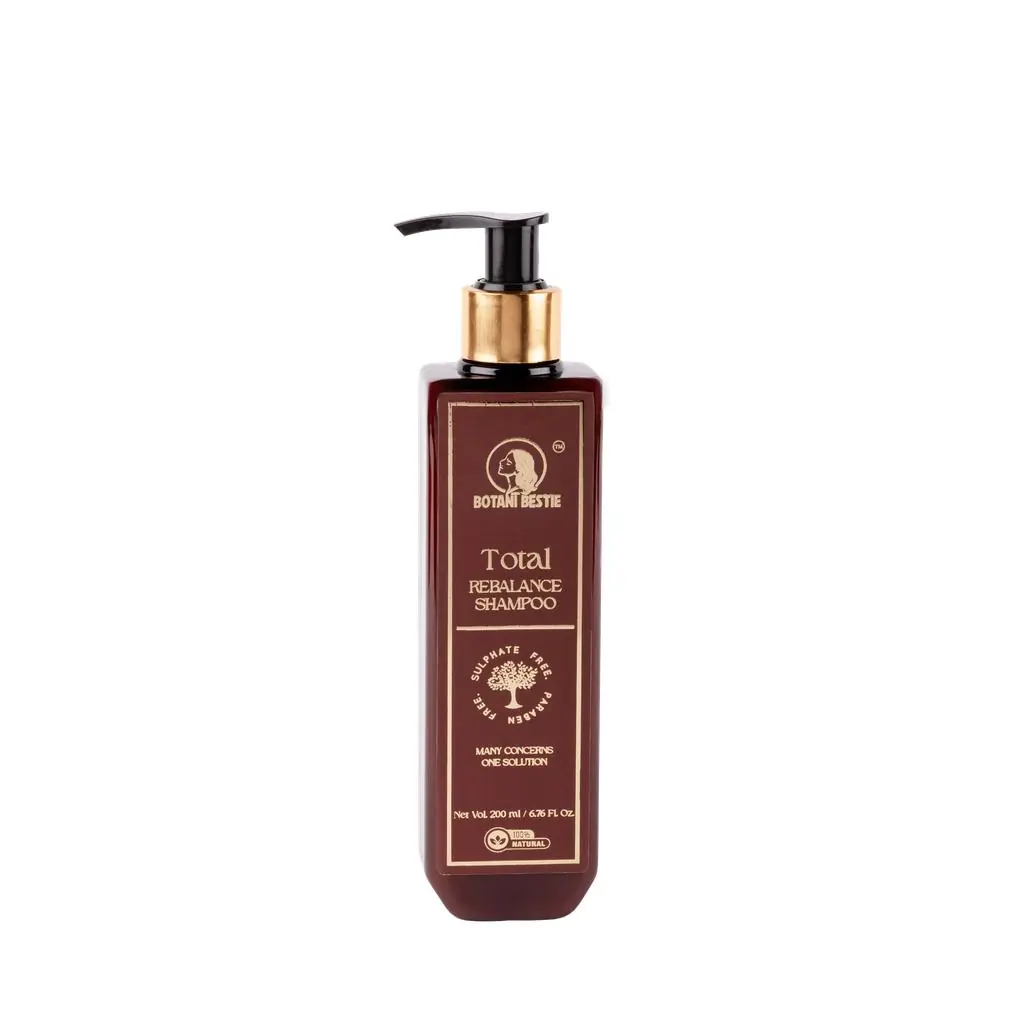
Total Rebalance Shampoo
by Botani Bestie — ₹599 (MRP ₹799)
The protein repair stack — clinically grounded, zero formaldehyde:
- ✔ Plant-Based Keratin — hydrolysed plant proteins with amino acid profile closely matching human hair keratin; low molecular weight for cuticle penetration and cortex repair; no heat, no chemicals, no cancer risk
- ✔ Soy Protein — highest cysteine and arginine content of plant proteins; reinforces disulfide bond structure; 2025 MDPI review confirms soy protein hydrolysates improve tensile strength
- ✔ Silk Protein (Fibroin peptides) — exceptional film-forming; coats the cuticle surface for intense shine and smoothness; reduces inter-strand friction that causes tangling and breakage
- ✔ Fermented Rice Water (Inositol) — penetrates the hair shaft to improve elasticity and reduce breakage from within; clinically confirmed to remain inside the shaft even after rinsing
- ✔ Apple Cider Vinegar — restores scalp and hair pH to 4.5–5.5; the mildly acidic environment that makes protein absorption most effective and closes the cuticle for maximum protein retention
- ✔ Coconut Milk — balances protein treatment with deep moisture; prevents the stiffness that over-proteining without hydration causes; lauric acid penetrates the shaft for internal conditioning
- ✔ 13+ Ayurvedic herbs (Bhringraj, Amla, Brahmi, Methi + more) — address the root-level hair fall alongside the shaft-level protein repair
Completely sulfate-free — no SLS or SLES stripping the protein away on the same wash it is added. Paraben-free, silicone-free, alcohol-free.
Plant-based keratin shampoo vs chemical keratin treatment — for everyday use:
| Feature | Chemical Keratin Treatment | Total Rebalance Shampoo |
|---|---|---|
| Plant-based protein repair (no formaldehyde) | ❌ | ✅ |
| Safe for daily use | ❌ Every 3–6 months | ✅ Every wash |
| Safe during pregnancy | ❌ Not recommended | ✅ |
| Safe for colour-treated hair | ⚠️ Can strip colour | ✅ No colour stripping |
| pH-balanced for protein absorption (ACV) | ❌ | ✅ |
| Ayurvedic hair fall herbs alongside protein | ❌ | ✅ |
| Cost per use | ❌ ₹3,000–15,000+ per treatment | ✅ ₹599 for 200ml |
| Free dermatologist consultation | ❌ | ✅ Included |
Join the growing community of customers across India choosing clean, science-backed protein repair for their hair.
🎁 Not Sure Which Protein Treatment is Right for Your Hair?
Get a free personalised hair consultation with our in-house dermatologist — no purchase required. Tell us your hair type, damage history, and concerns for a targeted routine recommendation built specifically for you.
Book Free Hair Consultation → WhatsApp UsFrequently Asked Questions
The Verdict: The Best Keratin Treatment is the One in Your Shampoo
Salon keratin treatments offer one thing: a dramatic, temporary result with a significant health cost. Plant-based keratin in a well-formulated shampoo offers something more valuable: consistent, cumulative, daily protein repair that progressively rebuilds the structural integrity of your hair — wash after wash, without formaldehyde, without heat chemicals, and without ₹10,000+ every three months.
The 2025 clinical data is clear: hydrolysed keratin protects against UV-induced tensile strength loss, enhances internal chemical bonds, and forms a protective film on the cuticle. The 2025 MDPI review confirms 30–50% hair loss reductions from keratin hydrolysate use in clinical studies. The phytokeratin-specific independent RCT data is still catching up — but the mechanistic basis is sound, the health profile is clean, and the practical benefits for Indian hair conditions are real.
Your hair is losing keratin every day — from the sun, from hard water, from every heat styling session. Give it back. Consistently. Starting with every wash.
Repair Your Hair — Try Total Rebalance → Free Hair Consultation"Your hair is 95% keratin. Every day, your environment removes some of it. The question is simply whether your routine is giving any back."
Ready to make the honest switch?
Our products are built on the same principles as every article we write — pure ingredients, real results, nothing to hide.
Explore Our Products