Hard Water and Hair Fall — How to Fix It: The Complete India Guide
If you moved cities and your hair fall suddenly got worse — hard water is almost certainly part of the reason. Over 70% of Indian cities have water hardness levels that damage hair with every single wash. Here is exactly what is happening, and exactly how to fix it.
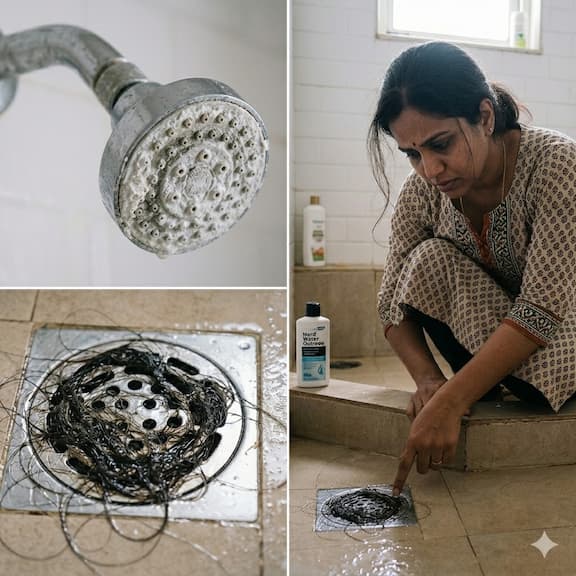
You follow a careful hair care routine. You oil regularly, use a decent shampoo, eat reasonably well. And yet, the hair fall doesn't stop. The drain catches more strands than it should. Your hair feels rougher after washing than before. Conditioner barely seems to help.
If this sounds familiar — and if you live in Bangalore, Delhi, Chennai, Hyderabad, Noida, Pune, or any of the dozens of other Indian cities with notoriously hard water — your tap water may be silently sabotaging every effort you make.
Hard water is one of the most overlooked causes of hair fall in India, largely because its damage is cumulative, invisible, and easy to blame on other things. In this guide, we explain exactly what hard water does to your hair at a microscopic level, which Indian cities are worst affected, how to tell if hard water is the culprit in your case, and the seven most effective fixes — including several that cost nothing and work immediately.
What Is Hard Water — And How Hard Is Yours?
Water "hardness" refers to the concentration of dissolved mineral salts — primarily calcium carbonate (CaCO₃) and magnesium sulphate (MgSO₄) — that are picked up as water passes through rock and soil. The more minerals dissolved, the "harder" the water.
Water hardness is measured in parts per million (ppm) of calcium carbonate equivalent, or milligrams per litre (mg/L). Here is how the standard classification works:
| Classification | CaCO₃ (ppm / mg/L) | Hair & Skin Impact |
|---|---|---|
| Soft | 0–60 ppm | Minimal — lathers well, hair feels soft after washing |
| Moderately hard | 61–120 ppm | Minor buildup; some dryness in sensitive scalps |
| Hard | 121–180 ppm | Noticeable mineral deposit; shampoo lathers poorly; hair feels rough |
| Very hard | 180+ ppm | Significant breakage; scalp dryness and irritation; increased shedding |
The BIS (Bureau of Indian Standards) recommends a maximum acceptable limit of 300 mg/L for drinking water in India — but large areas of Delhi, Bangalore, and other metros routinely exceed this in both drinking and bathing water supplies.
India's Hard Water Problem — Is Your City Affected?
India's hard water problem is not uniform — it varies dramatically by city, locality, and water source (municipal pipeline vs. borewell groundwater). Here is the current picture based on reported TDS and hardness data across major Indian cities:
- Bangalore — IT hubs like Bellandur, Whitefield, Marathahalli exceed 500 ppm; 24% of city areas officially receive hard water above permissible limits
- Chennai — groundwater reaches 300–600 ppm; coastal areas worsened by evaporation effects
- Hyderabad — groundwater 250–700 ppm depending on locality
- Noida / Gurgaon — consistently among India's hardest water zones due to groundwater dependence
- Delhi — municipal supply averages 400–800 ppm; borewell dependent areas significantly higher
- Pune — 200–500 ppm; areas like Hadapsar and Pimpri-Chinchwad on borewell supply most affected
- Ahmedabad — 400–800 ppm; over 50% of city blocks report hardness above permissible limits
- Jaipur / Lucknow — groundwater hardness regularly exceeds BIS limits
- Mumbai — municipal supply relatively softer (150–400 ppm); but older buildings with borewell backup can see spikes
- Kolkata — surface water supply generally softer; groundwater dependent areas harder
- Punjab / Haryana — groundwater in many districts exceeds 800–1,200 ppm due to agricultural chemical runoff and depletion
- Mumbai (central BMC supply) — one of India's relatively softer metro supplies
- Hill stations & river-fed towns — Shimla, Manali, Coorg, Shillong typically have naturally softer water from glacial or rainfall-fed sources
- Coastal Kerala — many riverine and coastal areas have softer surface water
What Does Hard Water Actually Do to Your Hair? The Microscopic Truth
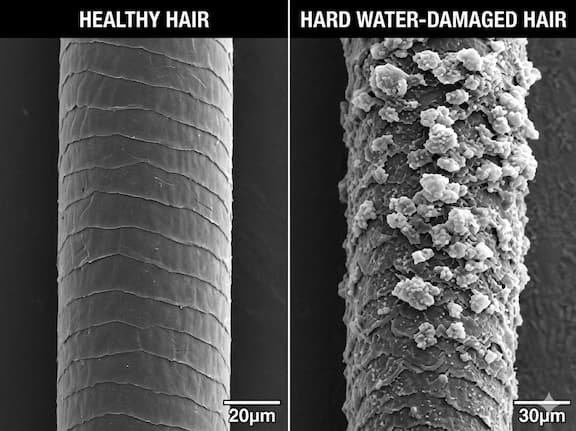
A scanning electron microscopy (SEM) study published in the International Journal of Dermatology gave researchers the first visual confirmation of what hard water does at the hair fibre level. The findings were striking:
- Calcium deposition on hard water-treated hair was measured at 0.804% — compared to just 0.26% on distilled water-treated hair. That is more than 3 times the mineral load.
- Magnesium deposition was 0.34% in hard water-treated samples vs. 0.078% in controls — a statistically significant difference (P = 0.001).
- Hard water-treated hair had a "ruffled appearance" under the microscope — lifted, rough cuticle scales rather than the flat, smooth scales of healthy hair.
- Hair thickness was measurably reduced: 72.78 μm in hard water samples vs. 78.14 μm in distilled water samples — a 7% reduction in strand thickness from 30 days of hard water exposure alone.
A separate PMC study using the INSTRON universal strength tester confirmed that hard water-treated hair showed reduced tensile strength and elasticity — making it measurably more prone to snapping under the everyday stress of combing, styling, and sleeping.
Here is the full chain of damage hard water causes, step by step:
Hair has a pH above 5.5 when wet — and at this pH, the cuticle swells slightly and opens its scales, allowing entry of ions from the surrounding water. Hard water's positively charged calcium (Ca²⁺) and magnesium (Mg²⁺) ions are actively absorbed into the negatively charged protein structure of the hair shaft — not just sitting on the surface, but integrating into the hair's chemical matrix.
These deposits accumulate with every wash. Over weeks and months, the mineral load on the hair shaft increases significantly, weighing it down, roughening the surface texture, and disrupting the hydrogen bonds that give hair its flexibility and strength.
A healthy hair cuticle consists of overlapping, flat, tile-like scales that lie smooth and flat — reducing friction between strands and locking in moisture. When calcium and magnesium deposits accumulate between and under these scales, they physically lift the cuticle away from the hair shaft, creating a rough, ruffled texture.
This has several consequences: the hair feels rough and tangles more easily; friction between strands increases, causing mechanical damage during brushing; and the open cuticle allows moisture to escape, leading to chronic dryness. Dry, rough hair is dramatically more prone to snapping — which is why hard water hair fall often presents as breakage (short, jagged broken strands) rather than root-level shedding.
Hard water typically has a high pH — often between 7.5 and 8.5. The scalp's natural, healthy pH sits at 4.5–5.5 (mildly acidic). Washing repeatedly with alkaline hard water raises the scalp's pH above this optimal range, disrupting the acid mantle — the thin, protective film that prevents bacterial and fungal overgrowth.
A scalp with an elevated pH becomes a more hospitable environment for Malassezia fungus, the primary driver of dandruff and seborrheic dermatitis. Dandruff causes scalp inflammation, which in turn triggers follicle-level hair shedding — this is where hard water crosses from causing breakage into causing genuine hair fall at the root. Studies confirm that water hardness above 120 ppm is commonly associated with scalp irritation, dandruff, and increased shedding.
Hard water reacts with the surfactants in shampoo to form insoluble calcium and magnesium "soaps" — essentially a curd-like residue that does not rinse away cleanly. This is why shampoo lathers poorly in hard water, and why hair often feels coated or waxy after washing even when thoroughly rinsed.
This residue, left on the scalp with every wash, accumulates in follicles, blocking them and impeding healthy hair growth. It also creates an occlusive film that prevents moisturising ingredients in conditioners and treatments from reaching the hair shaft — meaning your entire hair care routine becomes less effective the harder your water is.
Is Hard Water Causing Your Hair Fall? 8 Signs to Look For
Hard water's damage accumulates gradually, making it easy to attribute to other causes. Here are the telltale signs that hard water is specifically at play:
Signs in your hair:
- Hair feels rough, stiff, or straw-like after washing — even with conditioner
- Hair looks dull, flat, and lacks shine regardless of products used
- Increased tangling and breakage during combing
- Shampoo produces very little lather despite using a normal amount
- Hair fall that began or worsened after moving to a new city or apartment
Signs in your bathroom:
- White chalky deposits (limescale) on taps, showerheads, and bathroom tiles
- A white film or ring around your bathroom basin and bathtub
- Your kettle has white scale deposits inside
- Clothes come out of the wash feeling stiff or looking dull
- Skin feels dry and itchy after showering despite using moisturiser
7 Proven Fixes for Hard Water Hair Fall
The good news: hard water hair damage is largely reversible, and several of the most effective solutions cost almost nothing. Here they are, ranked from immediate to longer-term:
This is the single most impactful change you can make, and it works from your very first wash. Apple Cider Vinegar contains acetic acid, which is a natural chelating agent — meaning it binds to the calcium and magnesium ions deposited on the hair shaft and lifts them away during washing. Simultaneously, ACV lowers the rinse water's effective pH, sealing the cuticle and restoring the scalp's natural acid mantle.
A shampoo with ACV as a core ingredient achieves this with every wash — no DIY preparation required. The results are immediately noticeable: hair feels softer, lathers better (because mineral deposits are being cleared), and looks shinier within 2–3 washes.
Look for: Apple Cider Vinegar listed in the first third of the ingredient list, combined with Bhringraj and Keratin to simultaneously address root strengthening. Avoid sulfate-based shampoos entirely — in hard water, sulfates react with mineral ions to form the waxy residue that makes hair fall worse.
If you want an immediate fix using what you likely already have at home: dilute one tablespoon of raw, unfiltered apple cider vinegar in one cup of water and pour it through your hair as a final rinse after shampooing. Leave on for 3–5 minutes, then rinse with cool water.
The acetic acid chelates existing mineral deposits on the hair shaft, the lower pH seals the cuticle, and the result is noticeably smoother, shinier hair from the very first use. Use once or twice a week — not every wash, as overuse can cause slight dryness.
Note: Use raw, unfiltered ACV (the "mother" variety) for the highest acetic acid content. Plain white vinegar also works for mineral removal but lacks ACV's additional vitamins and amino acids.
Fix 3 — Weekly Chelating Pre-Wash Treatment
Once a week, before shampooing, massage a small amount of diluted ACV (or lemon juice, which also has chelating properties from citric acid) directly into the scalp and through the hair. Leave on for 10 minutes, then shampoo as normal.
This deeper-contact treatment is especially useful in cities with very high water hardness (above 400 ppm), where a single in-shampoo dose of ACV may not fully offset the daily mineral accumulation.
Fix 4 — Regular Deep Conditioning with a Protein Treatment
Hard water-damaged hair has compromised cuticle integrity and reduced protein structure. A weekly deep conditioning treatment containing hydrolysed keratin, soy protein, or silk amino acids helps rebuild the damaged cuticle from within — filling the gaps and microsurface damage left by mineral deposits.
Follow the protein treatment with a moisture-rich conditioner — protein strengthens, but over-proteining without moisture leads to brittleness. Balance is key: protein treatment once a week, deep moisture mask every 2–3 weeks.
Fix 5 — Pre-Wash Hair Oiling (Protective Barrier)
Applying a nourishing hair oil 30–60 minutes before washing creates a protective barrier on the hair shaft that reduces the direct contact between hard water minerals and the hair's protein structure. This is why the traditional Indian practice of oiling before washing is particularly valuable in hard water areas — it was solving this problem long before the science caught up.
Look for oils containing Coenzyme Q10, Vitamin E, and Bhringraj — ingredients that both protect the hair from mineral damage and nourish the follicle for stronger regrowth.
Fix 6 — Install a Shower Filter
For cities with very high TDS (Bangalore, Chennai, Hyderabad, Noida, Gurgaon), a shower filter can meaningfully reduce chlorine, sediment, and some mineral content in your shower water. Shower filters are available from ₹800–3,000 on Amazon India and most require no professional installation.
Important limitation: Standard shower filters reduce chlorine effectively but have limited capacity for calcium and magnesium ions — the primary hair-damaging culprits. Look for filters specifically marketed for hard water with KDF-55 or polyphosphate filtration media. For the highest TDS areas (above 400 ppm), combine a shower filter with chelating shampoo and ACV rinses for the most comprehensive approach.
Fix 7 — Final Cool Water Rinse
Always finish your hair wash with the coolest water you can tolerate. Cool water contracts the cuticle scales flat — counteracting the lifting effect of hard water's alkaline pH — and improves the sealing of any conditioning ingredients applied in the previous steps. It also reduces the residual mineral deposition, as mineral ions bind more readily to hair in warm water than in cool.
This is the simplest, zero-cost step that most people skip — and it makes a measurably noticeable difference in how the hair feels and looks after washing with hard water.
Quick Reference — The Hard Water Hair Fall Fix Plan
| Fix | Cost | Frequency | Impact |
|---|---|---|---|
| ACV-based chelating shampoo | ₹599 | Every wash | ⭐⭐⭐⭐⭐ Highest |
| ACV rinse (DIY) | Free (₹50 ACV bottle) | 1–2x per week | ⭐⭐⭐⭐ High |
| Pre-wash chelating treatment | Free (ACV or lemon juice) | Once a week | ⭐⭐⭐⭐ High |
| Pre-wash hair oiling | ₹650 | Before each wash | ⭐⭐⭐ Moderate-high |
| Deep protein conditioning | ₹200–500 | Once a week | ⭐⭐⭐ Moderate |
| Shower filter | ₹800–3,000 | Ongoing (replace 6 months) | ⭐⭐⭐ Moderate |
| Final cool water rinse | Free | Every wash | ⭐⭐ Low-moderate |
The Shampoo Built for India's Hard Water Problem
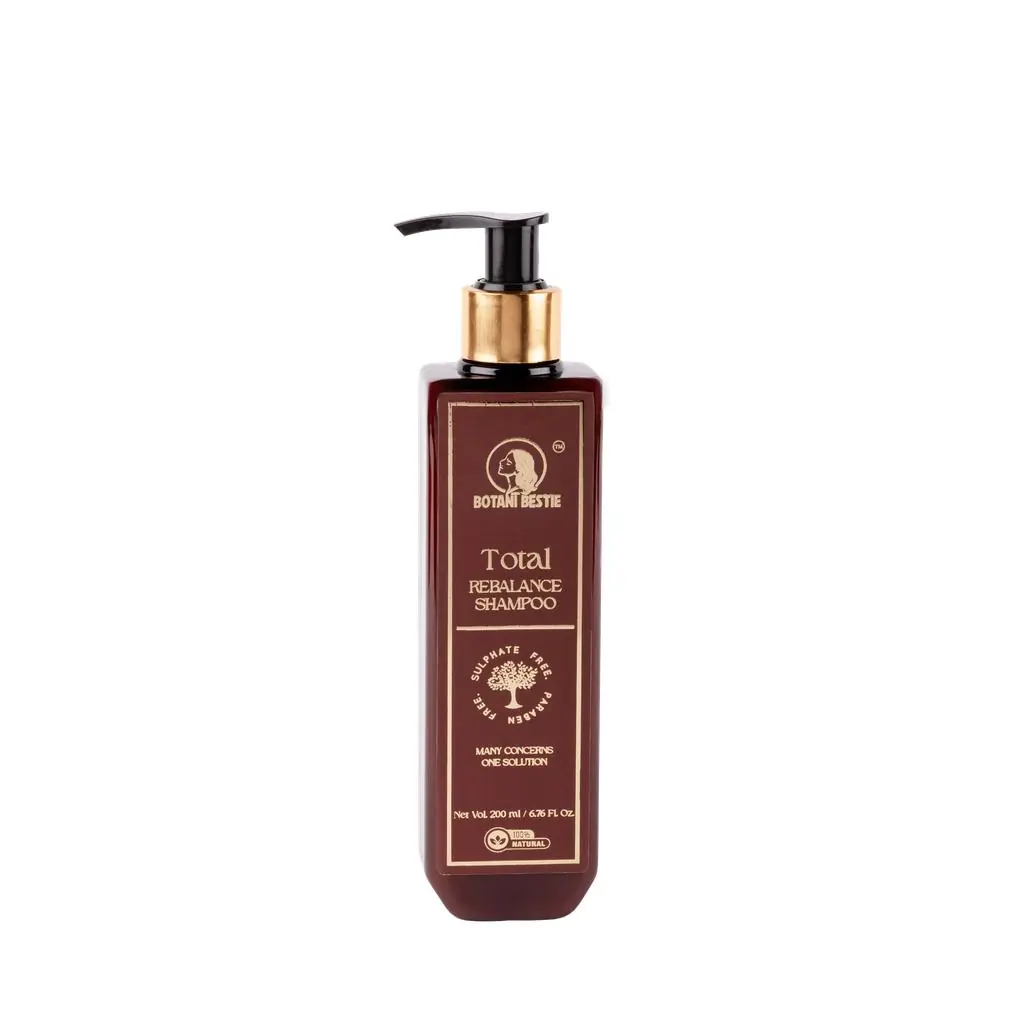
Total Rebalance Shampoo
by Botani Bestie — ₹599 (MRP ₹799)
Every ingredient in the Total Rebalance Shampoo addresses a specific part of the hard water hair fall problem — making it the most targeted single fix available for Indian hard water conditions:
- Apple Cider Vinegar — chelates calcium and magnesium deposits from the hair shaft with every wash; restores scalp pH to its optimal 4.5–5.5 range; inhibits dandruff-causing fungal growth
- Fermented Rice Water — delivers inositol to repair the cuticle damage caused by mineral buildup; improves elasticity and dramatically reduces breakage
- Coconut Milk — deep hydration that counteracts the chronic dryness hard water causes; seals the cuticle against further mineral penetration
- 13+ Ayurvedic herbs (Bhringraj, Amla, Brahmi, Methi) — address the follicle-level hair fall that scalp inflammation from hard water triggers; strengthen roots and reduce shedding
- Plant-Based Keratin + Soy & Silk Proteins — rebuild structural damage to the hair shaft from months or years of hard water exposure
Sulfate-free, paraben-free, silicone-free — no ingredients that make hard water residue worse.
Frequently Asked Questions

The Good News: Hard Water Hair Damage is Reversible
Unlike some forms of hair damage, hard water damage is not permanent. The mineral deposits that are weakening your hair shaft can be chelated away. The cuticle damage can be repaired with the right proteins. The scalp pH can be restored. The inflammation driving root-level shedding can be calmed.
The key insight is this: you cannot out-condition hard water damage if you keep adding more mineral deposits with every wash. The solution must start in the shower — with a shampoo that actively removes the problem rather than masking it.
Fix the foundation, and everything else in your hair care routine begins to work properly again.
Shop Total Rebalance Shampoo → Free Hair Consultation"Fix what touches your hair every single day — and everything else follows."
Ready to make the honest switch?
Our products are built on the same principles as every article we write — pure ingredients, real results, nothing to hide.
Explore Our Products