Dandruff and Hair Fall — What's the Real Connection? The Complete Science-Backed Answer
People with dandruff lose between 100 and 300 hairs per day — compared to 50–100 for those without. That is not a coincidence. There is a direct, clinically confirmed biological chain from dandruff to hair fall — and most people treating the two as separate problems are missing half the solution.
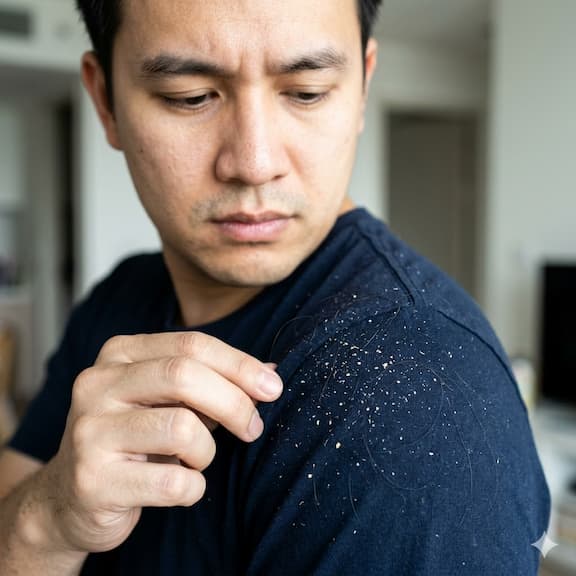
You are treating your hair fall with oil massages, protein-rich diets, and hair serums. Your partner is treating their dandruff with a medicated shampoo. But what if these are actually the same problem presenting through two different symptoms?
An estimated 50% of the Indian adult population has dandruff at any given time — making it the single most prevalent scalp condition in the country. And yet it remains profoundly underdiagnosed as a cause of hair fall. Most people see the flakes. Most people see the hair in the drain. They rarely connect the two.
In this guide, we explain the exact biological chain — from the Malassezia yeast on your scalp to the inflammatory cytokines that push your follicles into premature rest — and give you a practical, clinically grounded plan to break the cycle and address both problems simultaneously.
💡 Is Your Hair Fall Linked to Dandruff? Identify Your Pattern.
Dandruff-driven hair fall has distinct characteristics that differentiate it from other types. Check which of these apply to you:
👉 If 2 or more of these match your experience, dandruff is very likely a significant contributor to your hair fall. Scroll to the mechanism sections to understand exactly why.
The Numbers First — How Much More Hair Do Dandruff Sufferers Actually Lose?
Before explaining the mechanism, the clinical data makes the scale of the problem clear:
Healthy scalp (no dandruff)
Dandruff scalp — up to 3x more
affected by dandruff at any time
Source: Gupta et al., 2025 JEADV Clinical Practice; Indian population dandruff prevalence, International Journal of Research in Dermatology, 2025
What is Dandruff — And What Actually Causes It?
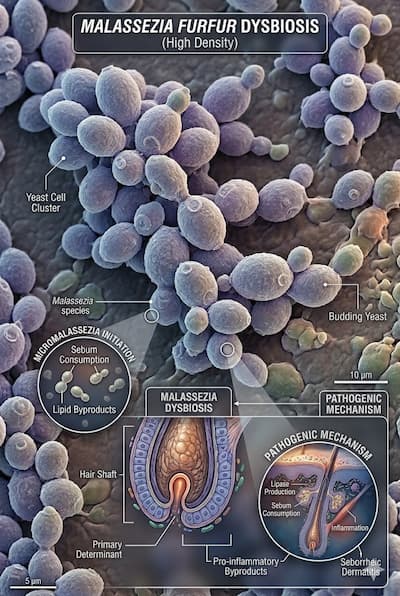
Dandruff (pityriasis capitis) and its more severe form, seborrheic dermatitis (SD), are not caused by a dry scalp — a widespread misconception. They are caused by an imbalance in the scalp's microbial ecosystem, specifically the overgrowth of Malassezia yeast — a genus of fungi that naturally inhabits every human scalp.
Two species are primarily responsible: Malassezia globosa and Malassezia restricta. These yeasts are lipophilic (they live on fats) — which is why dandruff is more common on oily scalps and in India's warm, humid climate where sebum production is naturally higher. In a healthy scalp, Malassezia coexists with protective bacteria including Cutibacterium acnes and Staphylococcus epidermidis without causing problems.
When the balance shifts — triggered by excess sebum, humidity, a weakened scalp barrier, stress, or hormonal fluctuations — Malassezia multiplies beyond its normal population. The Malassezia globosa and Malassezia restricta yeasts naturally exist on everyone's scalp, but excessive sebum and warm conditions allow them to multiply. These yeasts break down scalp oils into oleic acid, which penetrates the skin and causes irritation. This is when the flaking, itching, and redness begin — and when hair fall accelerates.
The Biological Chain — Exactly How Dandruff Causes Hair Fall
The connection between dandruff and hair fall is not vague or theoretical. It is a documented, step-by-step biological cascade — confirmed by multiple peer-reviewed studies from 2024 and 2025. Here is every link in the chain:
The cascade begins with an enzyme. Malassezia secretes lipase enzymes that break down the triglycerides in scalp sebum into free fatty acids — primarily oleic acid. Oleic acid is an irritant: it penetrates the scalp's epidermal barrier, disrupting the skin's tight junction proteins and breaking down the protective lipid layer that normally keeps the scalp sealed against microbial invasion.
The 2025 JDD consensus paper (Hordinsky, Andriessen, Day et al.) described this precisely: "Malassezia yeast colonization in a susceptible individual produces and releases irritating free fatty acids from sebum and subsequent inflammation, hyperproliferation of the stratum corneum, and further scalp barrier disruption."
Once the scalp barrier breaks down, three things happen simultaneously: the scalp becomes more permeable to further Malassezia colonisation; inflammatory signals are released into the deeper layers of the skin; and the exfoliation rate of scalp keratinocytes accelerates — producing the characteristic white or yellowish flakes of dandruff.
Importantly, a damaged scalp barrier is also far less effective at maintaining the slightly acidic pH (4.5–5.5) that keeps harmful microbes in check — creating a self-perpetuating cycle where barrier damage enables more Malassezia growth, which causes more barrier damage.
The oleic acid and lipid peroxides released by Malassezia trigger a cascading immune response in the scalp tissue. Keratinocytes — the primary skin cells of the scalp — detect these irritants and respond by releasing a wave of pro-inflammatory cytokines. The 2025 JDD consensus paper identified the specific mediators: IL-1α, IL-1β, IL-2, IL-4, IL-6, IL-8, IL-10, IL-12, and TNF-α — a broad-spectrum inflammatory signal that stimulates keratinocyte hyperproliferation (causing the rapid flaking) and disrupts the follicle microenvironment.
This is the critical link between dandruff and hair fall. Hair follicles exist in the dermis — directly below the inflamed epidermis. The same inflammatory cytokines that cause scalp irritation and flaking also reach the follicle, where they exert direct biological effects:
- IL-1α and TNF-α are established inhibitors of hair follicle growth — they have been shown in controlled studies to suppress the anagen phase and accelerate the transition to catagen (regression) and telogen (resting).
- TNF-α specifically constricts the blood vessels supplying the follicle, reducing nutrient and oxygen delivery to the dermal papilla — the master regulator of hair growth.
- The combined inflammatory load creates a hostile follicular environment in which the hair growth cycle is disrupted, shortened, and eventually suppressed.
The result is telogen effluvium — widespread, diffuse hair shedding across the scalp as follicles are prematurely pushed into the resting phase. This is confirmed by the 2025 JEADV data: dandruff patients losing 100–300 hairs per day versus 50–100 for those without.
Beyond the cytokine pathway, Malassezia causes a second, parallel form of follicle damage through oxidative stress. Malassezia, particularly M. globosa and M. restricta, produce metabolites that generate oxidative stress on the scalp. Trueb and colleagues investigated the role of Malassezia as a source of oxidative damage leading to premature hair loss. They suggested that hair care products containing active Malassezia inhibitory agents may reduce premature hair loss.
Reactive oxygen species (ROS) generated by Malassezia metabolites cause direct cellular damage to follicle structures — including the dermal papilla cells that regulate the growth cycle, the outer root sheath cells that form the follicle wall, and critically, the follicle melanocytes that produce hair pigment. This is one of the reasons that persistent dandruff is associated not only with hair fall but also with premature greying — the same oxidative damage that disrupts follicle cycling also depletes the melanocyte population responsible for hair colour.
The 2024 PMC scalp condition review confirmed: "Both dandruff and seborrheic dermatitis have clear signs of oxidative stress as indicated by perturbed surface and systemic antioxidant enzyme levels... observations of elevated lipid peroxidation accompanying dandruff and seborrheic dermatitis." This oxidative component explains why antioxidant-containing shampoos — niacinamide, green tea, Amla — provide clinically meaningful benefit for dandruff-related hair fall beyond their primary anti-inflammatory actions.
The hair growth cycle has four phases: anagen (growth), catagen (regression), telogen (rest), and exogen (shedding). During exogen, the hair shaft detaches from the follicle and falls out. In a healthy scalp, exogen is a controlled, timed process — each hair detaches at the right moment, and the follicle immediately begins a new anagen cycle.
The 2025 JEADV Clinical Practice review (Gupta et al.) confirmed a specific and particularly important finding: dandruff can disrupt the exogen phase of the hair cycle, which involves hair shedding from the scalp. When the scalp inflammatory environment disturbs the exogen phase regulation, hair shafts detach prematurely — before the follicle has completed its normal telogen rest period and initiated a new growth cycle. The result is that more hairs are shed simultaneously, and the follicle's return to active growth is delayed.
This exogen disruption mechanism is distinct from the telogen effluvium pathway — it is a more direct mechanical consequence of the inflammatory scalp environment acting on the follicle's shedding timing. It explains why dandruff patients often experience sudden, alarming increases in hair shedding during flare-ups — not a gradual progression but a sudden flush of premature shedding driven by the exogen disruption.
Beyond the biochemical mechanisms, dandruff contributes to hair fall through a direct mechanical pathway that is frequently overlooked: scratching. The pruritus (itching) caused by scalp inflammation from Malassezia is one of the most distressing symptoms of dandruff — and the instinctive response is to scratch.
Persistent itching and scratching further damage the scalp barrier, aggravating irritation and causing micro-injuries that hinder follicle recovery. These micro-injuries can also expose the scalp to bacterial and fungal overgrowth, intensifying inflammation. Each scratch also physically pulls at hairs in the telogen phase — hairs that might have remained anchored to the follicle until the next growth cycle begins are mechanically dislodged.
Reducing the itch through effective antifungal and anti-inflammatory treatment is therefore not just about comfort — it directly prevents a significant category of mechanical hair fall that accompanies the biochemical shedding increase. A 2024 PMC scalp microbiome RCT confirmed that reducing scalp pruritus was one of the first and most significant improvements measured after antifungal shampoo treatment.
💡 Want Bhringraj + Amla + ACV + 10 more antifungal and anti-inflammatory herbs in one sulfate-free formula designed for India's dandruff and hair fall challenges?
See Total Rebalance Shampoo →Myth vs. Truth — What Most People Get Wrong About Dandruff and Hair Fall
| Common Myth | The Scientific Truth |
|---|---|
| Dandruff is caused by a dry scalp | Dandruff is primarily caused by Malassezia yeast overgrowth on an oily scalp — not dryness. The flakes are caused by accelerated keratinocyte shedding driven by inflammation, not by a lack of moisture. Heavy moisturising products on the scalp can actually worsen dandruff by increasing the sebum load that feeds Malassezia. |
| Dandruff and hair fall are two separate, unrelated problems | Clinically confirmed to be related. The 2025 JEADV data shows dandruff patients lose 2–3x more hair daily. The inflammatory cytokines (IL-1α, TNF-α) that cause dandruff symptoms also directly suppress follicle growth and disrupt the exogen phase. Treating both simultaneously is more effective than treating either in isolation. |
| Once dandruff is gone, it will not come back | Dandruff (especially seborrheic dermatitis) is a chronic, recurrent condition in most people. Malassezia is a permanent resident of the scalp microbiome — the goal is to maintain balance, not eliminate it entirely. Consistent use of a gentle antifungal and anti-inflammatory shampoo is the evidence-based approach to long-term control. |
| Medicated anti-dandruff shampoos are the only effective option | Natural ingredients including Bhringraj (antifungal via triterpenoid saponins), Amla (antioxidant, anti-inflammatory), ACV (pH restoration that inhibits Malassezia), and Liquorice (glycyrrhizin anti-inflammatory) have documented anti-Malassezia and scalp-protective properties. A 2025 International Journal of Research in Dermatology study confirmed that a polyherbal Ayurvedic hair treatment produced significant anti-dandruff activity comparable to established treatments. |
| Using oil on the scalp helps dandruff | This is one of the most entrenched but counterproductive practices for dandruff-prone scalps. Malassezia thrives on oils — adding more oil to the scalp increases the substrate for Malassezia growth and worsens both dandruff and the inflammatory hair fall it causes. Oil should be used as a pre-wash treatment, not left on the scalp for extended periods if dandruff is present. |
What the Clinical Research Actually Shows
| Study | Design | Key Finding | Strength |
|---|---|---|---|
| Gupta et al., 2025 JEADV Clinical Practice — ketoconazole review |
Comprehensive clinical review | Non-dandruff patients: 50–100 hairs/day loss; dandruff patients: 100–300 hairs/day. Dandruff disrupts the exogen phase of the hair cycle. Anti-Malassezia treatment directly reduces hair shedding. | High — 2025 peer-reviewed review |
| 2024 PMC Scalp Microbiome RCT PMC — antifungal SD shampoo vs neutral shampoo, 10 weeks |
Randomised, controlled, 10-week study | Anti-SD shampoo significantly reduced dandruff, erythema, and pruritus; significant reduction in Malassezia and Staphylococcus; increased beneficial microbiome diversity; improvements sustained during 8-week maintenance phase | High — 2024 RCT, 10 weeks |
| Piérard-Franchimont et al. PMC — ketoconazole vs Minoxidil for AGA |
Comparative study, male AGA patients | 2% ketoconazole shampoo improved hair density, hair size, and proportion of anagen follicles at levels comparable to 2% Minoxidil — even in the absence of significant dandruff. Confirmed that anti-Malassezia treatment has direct hair growth benefits. | High — human comparative study |
| Hordinsky, Andriessen, Day et al., 2025 Journal of Drugs in Dermatology — consensus paper |
Expert consensus + literature review | Confirmed Malassezia lipase → oleic acid → IL-1α, IL-1β, IL-6, IL-8, TNF-α pathway; antioxidant ingredients (niacinamide, panthenol, caffeine) demonstrated improvement in hair shedding, hair count, and scalp barrier in a clinical trial; confirmed importance of antifungal + anti-inflammatory combined approach | High — 2025 expert consensus, JDD |
| 2024 BioRxiv Microbiome Study BioRxiv — scalp microbiome in D/SD vs healthy |
Microbiome sequencing, D/SD vs healthy follicles | D/SD follicles: Malassezia MRA = 0.36 vs healthy scalp; significantly reduced Cutibacterium (protective bacteria). Confirmed that microbiome dysbiosis extends inside the hair follicle — not just on the scalp surface. | Moderate — 2024 pre-print, microbiome |
| Madhavi MSL et al., 2025 Int J Research in Dermatology — Ayurvedic hair treatment |
Open pilot clinical trial, Ayurvedic scalp treatment | Ayurvedic scalp leave-on treatment showed significant reduction in hair fall from Week 1 to regression week (combing test); confirmed antifungal Ayurvedic herbs provide measurable anti-dandruff and anti-hair-fall activity | Moderate — human pilot, Ayurvedic |
Who Is Most at Risk in India — And Why
Several factors make dandruff-driven hair fall disproportionately common in India compared to Western populations:
🌡️ Hot, humid climate year-round
Malassezia thrives in warm, humid conditions — the same environment that drives excess sebum production. India's average annual humidity (60–90% in most cities) creates near-ideal conditions for Malassezia overgrowth. Cities like Mumbai, Chennai, Kolkata, and Bangalore are particularly high-risk zones.
💧 Hard water disrupting scalp pH
Most Indian cities have hard water with pH above 7. Repeated washing with alkaline water raises the scalp pH above its optimal 4.5–5.5 range — creating a more alkaline environment in which Malassezia colonises more aggressively. See our hard water guide →
🏙️ Urban pollution and oxidative stress
PM2.5 particulate pollution in Indian cities deposits oxidative stressors on the scalp surface that weaken the skin barrier and trigger pro-inflammatory responses — worsening the Malassezia-driven inflammatory cycle and amplifying follicle damage from oxidative stress.
🧴 SLS-based shampoos
Most low-cost Indian shampoos contain sodium lauryl sulfate — a harsh surfactant that strips the scalp barrier, raises pH, and creates the disrupted barrier environment in which Malassezia most easily colonises. Switching to a sulfate-free formula is one of the most important interventions for breaking the dandruff-hair fall cycle.
How to Break the Dandruff-Hair Fall Cycle — The Evidence-Based Approach
Effective management of dandruff-driven hair fall requires addressing all five steps of the biological chain simultaneously — not just one or two. Here is the complete evidence-aligned approach:
-
Use an antifungal + anti-inflammatory shampoo — consistently.
The 2024 PMC scalp microbiome RCT confirmed that the combination of antifungal and anti-inflammatory agents in a shampoo is what restores scalp microbiome balance — neither component alone is as effective. Bhringraj (triterpenoid saponin antifungal activity), Amla (antioxidant + anti-inflammatory), ACV (pH restoration to 4.5–5.5 that inhibits Malassezia), and Liquorice (glycyrrhizin anti-inflammatory) address multiple steps of the cascade simultaneously. Use 3–4 times per week consistently — not just during flare-ups. -
Restore scalp pH with Apple Cider Vinegar.
The scalp's optimal pH (4.5–5.5) is the first line of defence against Malassezia overgrowth. Hard water, SLS shampoos, and frequent washing all push scalp pH above 6 — into the alkaline range where Malassezia colonises more aggressively. ACV's acetic acid chelates mineral deposits from hard water and restores the scalp's acid mantle. Use as a diluted post-shampoo rinse (1 tbsp in 1 cup water) 1–2 times per week, or choose a shampoo that includes ACV as a primary ingredient. See our complete scalp pH guide → -
Switch to a sulfate-free shampoo.
SLS and SLES destroy the scalp barrier — the exact environment Malassezia needs to escalate. A sulfate-free formula using mild surfactants (Sodium Cocoyl Isethionate, Decyl Glucoside) cleanses effectively without disrupting the acid mantle or skin barrier. This single switch removes a major contributor to the dandruff-hair fall cycle. -
Add antioxidant protection.
The 2025 JDD consensus paper confirmed that antioxidant ingredients — niacinamide, panthenol — demonstrated improvement in hair shedding, total hair count, and scalp barrier in a clinical trial alongside anti-dandruff treatment. Amla (richest natural Vitamin C source), Green Tea (EGCG antioxidant), and Liquorice (glabridin ROS scavenger) provide the scalp antioxidant environment that counteracts Malassezia-generated oxidative stress. -
Use pre-wash oil — but correctly.
Traditional oiling is beneficial for hair strength, but for dandruff-prone scalps, technique matters critically. Apply a Bhringraj-containing hair oil 30–60 minutes before washing — and wash it out completely. Do not leave oil on the scalp overnight if dandruff is present. The oil's antifungal herbs (Bhringraj, Neem) provide targeted anti-Malassezia benefit; leaving heavy oil on the scalp provides additional food substrate for the fungus. -
Be consistent — the microbiome takes time to rebalance.
The 2024 PMC RCT used a 10-week protocol: 2 weeks intensive (4x per week) + 8 weeks maintenance (2x per week). Most people see significant improvement in dandruff symptoms within 2–4 weeks, but microbiome normalisation and the resulting reduction in hair fall take 6–12 weeks to fully manifest. Stopping treatment when the flakes disappear is the most common reason dandruff — and its associated hair fall — returns.
📅 What to Expect — A Realistic Timeline
| Timeframe | What You'll Notice | What's Happening |
|---|---|---|
| Week 1–2 | Reduced itching. Scalp feels cleaner and less irritated. Flaking may temporarily increase as existing build-up is cleared. | ACV restoring scalp pH. Antifungal herbs beginning to reduce Malassezia load. Anti-inflammatory compounds calming cytokine cascade. |
| Week 2–4 | Flaking visibly reduced. Itching substantially reduced. Scratching-related hair fall decreases. Scalp redness (if present) fading. | 2024 PMC RCT: significant improvement in dandruff severity, erythema, and pruritus by Week 2 of intensive phase. Malassezia population reducing. |
| Week 4–8 | Daily hair shedding noticeably reduced. Scalp environment healthier — less oily, better pH. Hair feels stronger at the roots. | Inflammatory cytokines reducing — follicles returning from premature telogen to anagen. Exogen phase disruption resolving. Microbiome rebalancing. |
| Week 8–12 | Hair shedding approaching normal range (50–100/day). Visible improvement in hair density. New growth visible at hairline and parting. | 2024 RCT: improvements significantly better than control at Week 10. Follicles that were pushed into premature telogen beginning active growth cycle. Scalp microbiome diversity restored. |
| Week 12+ | Maintained control with continued maintenance washing (2x per week). Hair density maintained. Dandruff recurrence prevented. | Malassezia kept at population balance through ongoing antifungal and pH-supporting routine. Consistent use prevents the rebalancing reversal that causes recurrence. |
Your Hair Fall Won't Improve Until Your Scalp Does — Here is the Formula Built for Both.
Most anti-dandruff shampoos address the fungus. Most hair fall shampoos address the follicle. The Total Rebalance Shampoo was formulated with the clinical understanding that these are the same problem — and built to address every step of the dandruff-to-hair-fall chain simultaneously.
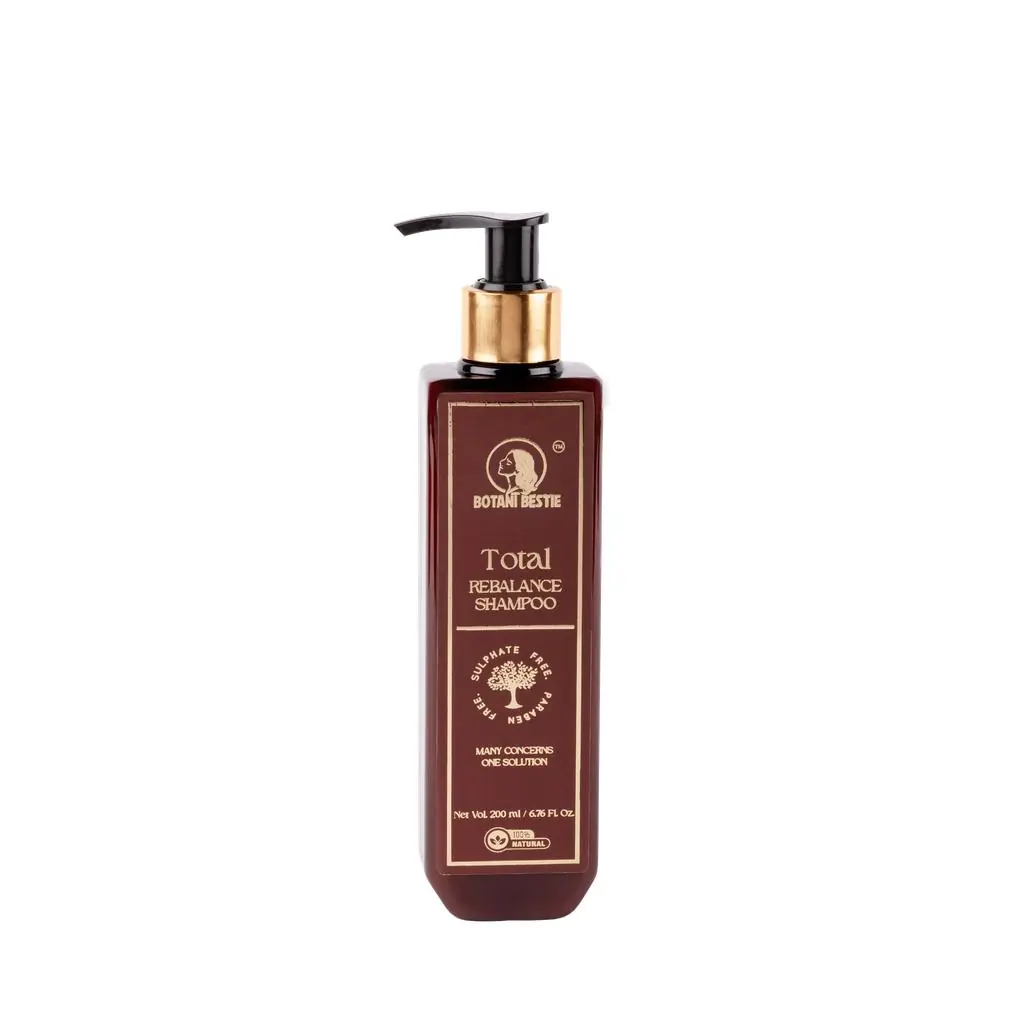
Total Rebalance Shampoo
by Botani Bestie — ₹599 (MRP ₹799)
How each ingredient addresses the dandruff-hair fall chain:
- ✔ Apple Cider Vinegar — restores scalp pH to 4.5–5.5, inhibiting Malassezia colonisation; chelates hard water mineral deposits that raise scalp pH and worsen dandruff
- ✔ Bhringraj — direct antifungal activity against Malassezia via triterpenoid saponins; anti-inflammatory scalp action (inhibits TNF-α and IL-1β); Wnt/β-catenin follicle stimulation for hair regrowth
- ✔ Amla — richest natural Vitamin C source; powerful antioxidant that neutralises Malassezia-generated ROS; anti-inflammatory protection for the follicle microenvironment
- ✔ Liquorice Root Extract — glycyrrhizin anti-inflammatory action (clinically acknowledged by Japan's Ministry of Health); sebum regulation that reduces the oil substrate Malassezia feeds on
- ✔ Brahmi + Methi + 8 more Ayurvedic herbs — adaptogenic stress reduction; DHT blocking; scalp circulation improvement; follicle nourishment
- ✔ Fermented Rice Water — inositol for hair shaft strength and reduced breakage; amino acids for follicle nutrition
- ✔ Coconut Milk — deep moisture without feeding Malassezia; lauric acid has documented antifungal properties
- ✔ Plant-Based Keratin + Soy & Silk Proteins — cuticle repair and strand fortification for the weakened hair that dandruff-driven inflammation produces
100% sulfate-free, paraben-free, silicone-free, alcohol-free, and synthetic fragrance-free — no ingredients that disrupt the scalp barrier or worsen Malassezia growth.
Anti-dandruff + anti-hair fall: how it compares:
| Feature | Generic anti-dandruff shampoo | Generic hair fall shampoo | Total Rebalance Shampoo |
|---|---|---|---|
| Antifungal (Malassezia control) | ✅ | ❌ | ✅ ACV + Bhringraj |
| Scalp pH restoration (ACV) | ❌ | ❌ | ✅ |
| Follicle stimulation (Bhringraj) | ❌ | ⚠️ Sometimes | ✅ |
| Anti-inflammatory scalp action | ⚠️ Partial | ❌ | ✅ Liquorice + Brahmi |
| Antioxidant ROS protection (Amla) | ❌ | ❌ | ✅ |
| Sulfate-free formula | ❌ Usually SLS | ❌ Usually SLS | ✅ |
| Free dermatologist consultation | ❌ | ❌ | ✅ Included |
Join the growing community of customers across India addressing dandruff and hair fall together — for the first time.
🎁 Not Sure if Dandruff is Causing Your Hair Fall?
Get a free personalised hair and scalp consultation with our in-house dermatologist — no purchase required. Tell us your scalp condition, hair fall pattern, and duration, and receive a targeted treatment plan built specifically for you.
Book Free Scalp Consultation → WhatsApp UsFrequently Asked Questions
The Verdict: Dandruff and Hair Fall are the Same Problem — Treat Them Together
The biological evidence is clear. Dandruff is not just a cosmetic nuisance — it is an active scalp condition that produces inflammatory cytokines suppressing follicle growth, oxidative stress damaging follicle cells, barrier disruption enabling further Malassezia colonisation, and exogen phase disruption causing premature shedding. Treating hair fall without treating dandruff is working against a biological headwind that neutralises half your effort.
The good news: dandruff-driven hair fall is reversible, and it responds well to the right consistent treatment. Break the Malassezia-inflammation-shedding cycle with an antifungal, anti-inflammatory, sulfate-free formula — and give it 8–12 weeks of consistency. The science is clear on what works. The only variable is whether you will give it enough time to work.
Fix Both Problems — Try Total Rebalance → Free Scalp Consultation"A healthy scalp is not the absence of dandruff. It is a balanced ecosystem — where the right microbes, the right pH, and the right inflammation level allow your follicles to do what they are designed to do."
Go Deeper — Related Scalp & Dandruff Guides
Ready to make the honest switch?
Our products are built on the same principles as every article we write — pure ingredients, real results, nothing to hide.
Explore Our Products