Female Pattern Hair Loss (Androgenetic Alopecia): Causes, Stages & Ayurvedic Treatment
A widening parting. A crown that looks thinner in every mirror. Hair that used to be thick now coming away in the comb. Female pattern hair loss is not vanity — it is a hormonal process at the follicle level that gets worse the longer it is left untreated. Understanding what is actually happening is the first step to reversing it.
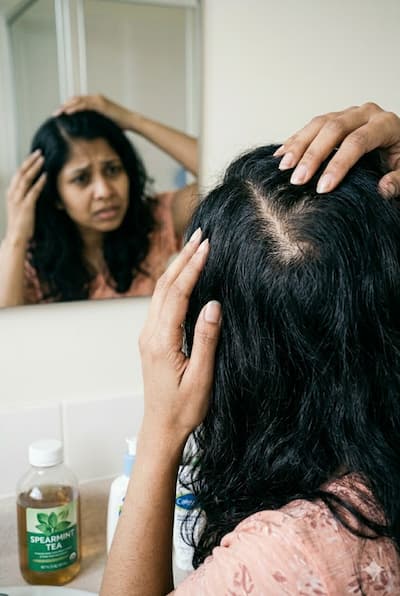
Female pattern hair loss (FPHL) — also called androgenetic alopecia — affects an estimated 40% of women by age 50, and an increasing number in their 20s and 30s, particularly those with PCOS or a family history of hair thinning. In India, early onset is more common than most realise, often dismissed as "normal" seasonal shedding for years before the actual pattern becomes visible.
Unlike the dramatic sudden shedding of telogen effluvium, FPHL is a slow, progressive process. Each hair growth cycle produces a slightly shorter, finer strand. Over months and years the overall density drops, the central parting widens, and the crown thins — while the frontal hairline usually stays intact.
The good news: follicles in the early stages are miniaturised but not dead. Targeted intervention at the right time can halt progression and genuinely reverse the miniaturisation. This guide explains the mechanism, the stages, the triggers, and exactly which Ayurvedic actives address the root cause — DHT sensitivity at the follicle.
What Exactly is Female Pattern Hair Loss?
Androgenetic alopecia in women is driven by a single mechanism: follicular miniaturisation triggered by dihydrotestosterone (DHT). Understanding this mechanism is essential — because every effective treatment, whether Ayurvedic or pharmaceutical, works by targeting one step in this chain.
The DHT Miniaturisation Cascade
The enzyme 5-alpha reductase converts testosterone into dihydrotestosterone (DHT) — a potent androgen 5× stronger than testosterone.
DHT binds to androgen receptors in genetically sensitive follicles — primarily those at the crown and central parting.
Each hair cycle becomes shorter. The follicle produces a finer, lighter, shorter strand with each successive cycle — miniaturisation.
Without intervention, the follicle eventually stops producing visible hair entirely. Early action reverses this; advanced cases may be permanent.
Men with androgenetic alopecia typically have elevated DHT levels systemically. Women with FPHL often have normal DHT blood levels — but their scalp follicles are genetically more sensitive to DHT, or have more 5-alpha reductase enzyme activity locally at the scalp. This is why blood tests for androgens often come back "normal" in women with FPHL, and why the condition is frequently missed or misattributed. The problem is at the follicle receptor, not always in circulation.
The Ludwig Scale: Stages of Female Pattern Hair Loss
The Ludwig classification system is the most widely used tool for grading the severity of FPHL. Knowing your stage helps you understand the urgency of treatment — and how much reversibility is realistically possible.
| Stage | What You See | Follicle Status | Reversibility |
|---|---|---|---|
| Ludwig I (Mild) | Slightly wider central parting; some thinning at the crown visible in bright light or when hair is wet. Frontal hairline preserved. | Follicles miniaturised but actively cycling. Fine vellus hairs present in thinning areas. | High — most cases respond well |
| Ludwig II (Moderate) | Noticeably widened central parting; visible scalp at the crown; significant reduction in overall volume. Hair may feel limp and thin throughout. | Significant miniaturisation; a mix of terminal and vellus hairs. Some follicles approaching dormancy. | Moderate — meaningful improvement possible with consistent treatment |
| Ludwig III (Advanced) | Extensive thinning across the entire crown; scalp clearly visible; hair is very sparse at the top. Frontal hairline may begin to recede. | Most follicles dormant or scarred. Few vellus hairs remaining at the affected area. | Low — medical intervention (minoxidil, PRP) may be needed alongside natural care |
| Ludwig Frontal | Thinning that also involves the frontal hairline — a recession at the temples and frontal zone in addition to crown thinning. Common in PCOS and post-menopausal FPHL. | Androgen-sensitive frontal follicles additionally affected. | Depends on stage and duration of frontal involvement |
What Triggers Female Pattern Hair Loss in Indian Women
Genetics loads the gun — but these triggers pull it. Many Indian women carry the genetic predisposition for FPHL without it manifesting until one of these factors accelerates the process.
The most common trigger in women under 35 in India. PCOS elevates circulating androgens (testosterone, DHEA-S), increasing DHT conversion at the scalp. Often accompanied by facial hair, acne, and irregular cycles. Managing insulin resistance and inflammation at the root level is as important as scalp treatment.
Both hypothyroidism and hyperthyroidism disrupt the hair growth cycle. Hypothyroidism (very common in Indian women) lowers metabolism and reduces the follicle's energy supply, pushing hairs into telogen prematurely — and in women with underlying FPHL sensitivity, this accelerates miniaturisation.
As oestrogen levels decline in the 40s and 50s, the protective effect of oestrogen on scalp follicles diminishes. The relative balance shifts toward androgens even without absolute elevation in androgen levels — which unmasks or accelerates underlying FPHL that was previously suppressed by oestrogen.
Sustained high cortisol directly suppresses hair follicle cycling and depletes key nutrients (zinc, ferritin, B vitamins) essential for follicle function. Cortisol also promotes the conversion of androgens toward DHT. Stress-related hair loss and FPHL frequently co-exist and amplify each other.
The dramatic drop in oestrogen after delivery triggers telogen effluvium in most women — but in those with FPHL genetics, this shedding event can unmask underlying androgenetic miniaturisation that continues even after the telogen effluvium resolves. Post-partum is often when women first notice FPHL.
Iron deficiency (ferritin below 40 ng/mL), low zinc, Vitamin D deficiency, and insufficient protein intake are extremely prevalent in Indian women and each impairs follicular function. These deficiencies do not cause FPHL independently but significantly worsen its severity and reduce the hair's ability to recover.
Ayurvedic Ingredients That Target the Root Cause of FPHL
The most effective natural approach to female pattern hair loss focuses on two mechanisms: inhibiting 5-alpha reductase (blocking DHT formation) and extending the anagen phase (reversing miniaturisation directly at the follicle). The following Ayurvedic actives have research backing for one or both mechanisms.
| Ingredient | Mechanism Against FPHL | Evidence | How to Use |
|---|---|---|---|
| Bhringraj Eclipta prostrata |
Extends anagen phase; anti-androgenic activity reducing DHT binding at follicle receptors; promotes follicular proliferation | Comparable to 2% minoxidil in follicle density studies; significant anagen prolongation in androgenetic models | Scalp oil 3–4× weekly as pre-wash treatment; also in shampoo |
| Amla Phyllanthus emblica |
Inhibits 5-alpha reductase (blocks DHT production); tannins and ellagic acid reduce follicular inflammation; antioxidant protection against oxidative follicle damage | In vitro 5-alpha reductase inhibition documented; Vitamin C content (highest of any natural source) supports collagen around follicle | In hair oil, serum, and shampoo formulas; also as amla powder scalp mask |
| Brahmi Bacopa monnieri |
Adaptogenic — reduces cortisol-driven hair loss; improves scalp microcirculation; anti-inflammatory at the follicle dermal papilla | Documented adaptogenic and cortisol-lowering effects; used in traditional Ayurveda specifically for stress-pattern hair loss | Scalp oil or serum; particularly effective when FPHL is stress-triggered or stress-worsened |
| Rosemary Rosmarinus officinalis |
Inhibits 5-alpha reductase; improves follicular microcirculation (comparable mechanism to minoxidil — vasodilatory); antioxidant protection | RCT (2015): rosemary oil equivalent to 2% minoxidil for hair density after 6 months, with less scalp itch side effect | 2–3 drops in a carrier oil applied to scalp; 5–10 minute scalp massage before washing |
| Methi (Fenugreek) Trigonella foenum-graecum |
Contains diosgenin — a phytosterol that competes with DHT at androgen receptors; also rich in protein and lecithin that strengthen the hair shaft | Diosgenin's anti-androgenic activity documented in hormonal studies; traditional use for PCOS-related hair loss well established | Fenugreek seed paste as weekly scalp mask; or in oil infusions |
| Jatamansi Nardostachys jatamansi |
Promotes hair growth by extending anagen phase; demonstrated superior results to minoxidil in some animal studies for anagen prolongation; adaptogenic | Study (2009) showed Jatamansi extract promoted more hair follicles into anagen phase than 2% minoxidil in a mouse model | In Ayurvedic hair oil blends; best combined with Bhringraj for androgenetic application |
| Neem Azadirachta indica |
Azadirachtin and nimbolide have mild anti-androgenic properties; antifungal and anti-inflammatory action keeps scalp microbiome healthy — a critical but overlooked factor in FPHL | Anti-androgenic properties documented; widely used in Ayurvedic formulations for androgenetic hair loss | In shampoo or scalp oil; particularly useful if FPHL is accompanied by dandruff or scalp inflammation |
Total Restore Hair Oil
by Botani Bestie
Bhringraj, Amla, Brahmi, Jatamansi, and Rosemary — the five most evidence-backed ingredients for DHT-driven hair loss — all in a single formula. Without mineral oil or silicones that would sit on top of the scalp instead of reaching the follicle.
Targets DHT at the follicle.
Pre-wash scalp treatment, 3–4× weekly.
Free shipping · 30-Day Money-Back Guarantee
What Makes Female Pattern Hair Loss Worse
FPHL is a progressive condition — these habits accelerate the miniaturisation process and undo the work of any treatment you apply.
- Sulfate shampoos — disrupt scalp pH and barrier, increasing inflammation around follicles
- Tight hairstyles (traction) — ponytails, buns, and braids add physical stress to already-miniaturised follicles
- Daily heat styling — damages the cuticle and stresses the follicle at its weakest point
- High-glycaemic diet — spikes insulin, which raises androgen levels and increases DHT conversion
- Mineral oil hair products — block the scalp pores through which active ingredients need to reach the follicle
- Ignoring nutritional deficiencies — iron, zinc, and Vitamin D deficiency severely impairs follicle response to treatment
- Consistent scalp oil massage — 5–10 minutes, 3–4× weekly with DHT-blocking herbs
- Sulfate-free, pH-balanced shampoo — preserves scalp barrier and reduces follicular inflammation
- Check and correct nutritional deficiencies — ferritin, zinc, Vitamin D, B12 blood tests
- Protein-adequate diet — hair is 95% keratin; 0.8–1g protein per kg body weight daily minimum
- Manage the underlying trigger — PCOS, thyroid, or stress treatment is non-negotiable alongside topical care
- Start early and stay consistent — 3–6 months minimum before evaluating any natural treatment
A Practical Ayurvedic Routine for Female Pattern Hair Loss
This routine is designed around the two core goals: blocking DHT at the scalp and optimising the conditions for follicular recovery.
| Frequency | Step | What to Use | Why It Helps FPHL |
|---|---|---|---|
| 3–4× weekly | Pre-wash scalp oil treatment | Bhringraj + Amla + Brahmi oil blend; apply to scalp with fingertips, massage 5–10 minutes, leave 30–60 min under warm towel | Delivers DHT-blocking and anagen-extending actives directly to the follicle; scalp massage improves microcirculation to follicle dermal papilla |
| Every wash day | Sulfate-free shampoo | Shampoo with Bhringraj, Amla, and fermented rice water; free from SLS/SLES and silicones | Maintains scalp pH 4.5–5.5; reduces follicular inflammation; allows active ingredients to penetrate between washes |
| Post-wash | Lightweight serum to lengths | Keratin and silk protein serum (silicone-free) applied to mid-lengths and ends | Reduces breakage of already-fragile miniaturised strands; keeps existing hair intact while new growth emerges |
| Weekly | ACV scalp rinse | 1 tbsp apple cider vinegar in 250ml water as a post-shampoo rinse; leave 1–2 min, rinse out | Closes cuticle, chelates hard water mineral deposits, mildly anti-fungal — all reduce scalp inflammation that worsens FPHL |
| Ongoing | Nutritional support | Check ferritin (target >70 ng/mL), zinc, Vitamin D, B12; supplement if deficient; adequate dietary protein | No topical treatment works at full capacity if the follicle is starved of the micronutrients it needs to produce hair |
Total Rebalance Shampoo
by Botani Bestie
Fermented Rice Water, Bhringraj, and Amla in the first 5 ingredients. SLS-free and silicone-free — so it cleans without stripping the scalp barrier that miniaturised follicles depend on. A shampoo that works with your treatment routine, not against it.
Protects the scalp barrier.
Delivers actives on every wash day.
Free shipping · 30-Day Money-Back Guarantee
How Long Does Treatment Take?
This is the most important thing to understand about treating FPHL naturally — and the most common reason women give up too early.
Scalp health improves. Inflammation reduces. No visible hair changes yet — this is the foundation phase. Do not evaluate results here.
Shedding may temporarily increase as the growth cycle resets and weaker miniaturised hairs shed to make way for stronger regrowth. This is normal and expected.
First visible signs of new growth — short, fine hairs along the parting and crown. Overall density begins to improve. Hair feels stronger and fuller.
Meaningful density recovery in Ludwig I–II cases. New growth matures from fine vellus to terminal hair. Continue treatment — FPHL requires long-term management, not a one-time course.
Seek a dermatologist or trichologist if: you notice rapid, sudden onset thinning (suggests telogen effluvium or alopecia areata rather than FPHL); you have not had bloodwork to rule out thyroid disease, iron deficiency anaemia, or PCOS; or you are at Ludwig III and see no response to 6 months of consistent treatment. A dermatologist can assess whether PRP (platelet-rich plasma) therapy or prescription minoxidil is appropriate alongside your natural care routine.
Frequently Asked Questions
Not Sure What's Causing Your Hair Loss?
Take the Free 5-Min Hair & Skin Test
Tell us about your hair loss pattern, cycle, and health history. We will identify whether your hair fall is androgenetic, telogen effluvium, or another cause — and recommend the right formula for your specific case.
Start Free Hair Test"FPHL is not a sentence — it is a signal. The follicle is asking for intervention. Give it the right actives early enough, and it will respond."
Ready to make the honest switch?
Our products are built on the same principles as every article we write — pure ingredients, real results, nothing to hide.
Explore Our Products