Sunscreen for Indian Skin — The Complete Honest Guide: SPF, PA Rating, White Cast & What Actually Works (2025)
SPF only measures UVB protection — it says nothing about UVA, the ray that drives pigmentation, dark spots, and collagen loss in Indian skin. PA++++ is the rating that actually matters for dark marks. Here is the complete honest breakdown: what SPF numbers really mean, which filters work without white cast, and why most Indian skin needs a hybrid formula, not a mineral-only one.
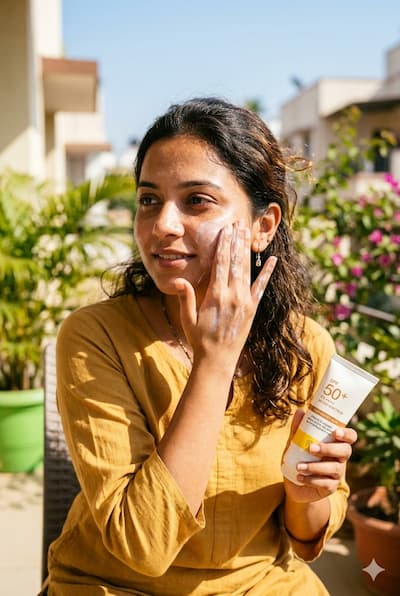
Sunscreen is the single most searched skincare topic in India — and also the most misunderstood. The labelling is technical (SPF 50 PA++++), the marketing is contradictory, and one persistent myth — "dark skin doesn't need sunscreen" — has convinced a significant portion of the Indian population to skip the one step that dermatologists universally agree matters most.
Here is the honest reality: India's UV index routinely reaches 8–11+ across most of the country, year-round. At these levels, unprotected exposure causes measurable skin damage in minutes, not years. And the primary damage for Indian skin is not the sunburn most people think of — it is something far more relevant: accelerated pigmentation, worsening dark spots and melasma, and deeper, faster collagen loss.
This guide explains what SPF actually measures, what PA rating means, how to choose between chemical and mineral filters without getting a white cast, and what Indian skin specifically needs from a sunscreen — based on the science, not the marketing.
⚡ Sunscreen for Indian Skin — Quick Reference
| Rating | What It Measures | For Indian Skin | Why It Matters |
|---|---|---|---|
| SPF 30 | Blocks 96.7% of UVB rays | Minimum for low-UV / indoor-dominant days | UVB causes sunburn; some vitamin D synthesis |
| SPF 50 | Blocks 98% of UVB rays | Standard for Indian daily use | Meaningful additional margin at India's UV index 8–11+ |
| PA+++ | PPD 8–16x (UVA protection) | Minimum for Indian skin | UVA drives pigmentation, melasma, collagen loss — the #1 UV concern for Indian skin |
| PA++++ | PPD 16x+ (UVA protection) | Strongly preferred | Maximum available OTC UVA protection; essential for melasma, PIH, and outdoor lifestyles |
What SPF Actually Measures — And What It Doesn't
SPF stands for Sun Protection Factor, and it measures one specific thing: how much longer you can stay in the sun before UVB rays cause your skin to redden, compared to unprotected skin. That is the entire definition. SPF says nothing about UVA rays, pigmentation, tanning, or collagen damage. Only UVB. Only sunburn.
The SPF Math Most People Get Wrong
SPF numbers are not linear — they follow a logarithmic curve:
- SPF 15: blocks 93.3% of UVB (lets through 6.7%)
- SPF 30: blocks 96.7% of UVB (lets through 3.3%)
- SPF 50: blocks 98% of UVB (lets through 2%)
- SPF 100: blocks 99% of UVB (lets through 1%)
Going from SPF 30 to SPF 50 cuts UVB transmission by 40% — not "double the protection." Going from SPF 50 to SPF 100 halves the remaining transmission again. The practical difference between SPF 50 and SPF 100 is far smaller than the numbers suggest, which is why dermatologists worldwide say SPF 50 is sufficient.
The more important point: none of these numbers tell you anything about UVA protection. That is where the PA rating becomes essential — and for Indian skin, it is the more critical number.
The Critical Gap in SPF-Only Thinking
India receives intense solar radiation year-round. UVB varies with season, time of day, and altitude. But UVA is present at near-constant intensity from sunrise to sunset, 365 days a year — regardless of season, cloud cover, or whether you are indoors near a window. A high-SPF sunscreen with poor UVA coverage blocks your sunburn signal while allowing the rays that drive dark spots, melasma, and collagen breakdown to pass through substantially unimpeded.
In clinical practice, this pattern — high SPF use without adequate PA rating — often explains why patients develop worsening pigmentation despite "using sunscreen every day." The fix is simple: check both the SPF number AND the PA rating. SPF 50 PA++++ provides comprehensive protection. SPF 50 with no PA rating or only PA+ has a significant UVA gap.
UVA vs UVB — Why UVA Is the Greater Threat for Indian Skin
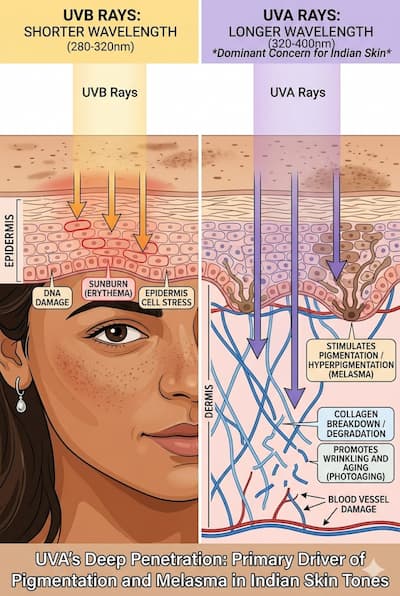
Of the UV reaching Earth's surface, approximately 95% is UVA and 5% is UVB. Despite constituting the vast majority of reaching UV, UVA has historically received far less attention in sunscreen marketing — partly because its damage is invisible, cumulative, and apparent only years later.
UVB — The Sunburn Ray
- Wavelength: 280–315nm (shorter, higher energy)
- Penetrates to the epidermis only
- Primary cause of sunburn and redness
- Varies with season, time of day, altitude
- Blocked by most window glass
- Drives vitamin D synthesis
- What SPF measures
UVA — The Pigmentation & Ageing Ray
- Wavelength: 315–400nm (longer, lower energy per photon)
- Penetrates deep into the dermis where collagen lives
- Does not cause redness — damage is invisible and cumulative
- Present year-round, sunrise to sunset, regardless of season
- Penetrates window glass — you are exposed indoors
- Primary driver of pigmentation, melasma, dark spots, photoageing
- What PA rating measures
Why UVA Is the Dominant Concern for Indian Skin Specifically
Indian and South Asian skin (Fitzpatrick types III–V) has higher baseline melanin content than lighter skin types. This provides meaningful protection against UVB-driven sunburn — studies estimate natural UVB protection equivalent to approximately SPF 2–4. Against UVA, however, melanin provides far less protection.
Here is the paradox that most people miss: higher melanin content means more active melanocytes, which means a stronger pigmentation response when those melanocytes are stimulated by UVA radiation. Dark spots, melasma, and post-inflammatory hyperpigmentation (PIH) are significantly more pronounced and longer-lasting in Indian skin precisely because the pigmentation machinery is more robust. UVA stimulation triggers this machinery more powerfully in darker skin — not less.
The net result: Indian skin is relatively protected against sunburn, but highly susceptible to UVA-driven pigmentation. A sunscreen strategy focused solely on SPF addresses the lower-priority concern while leaving the primary vulnerability substantially unaddressed. For Indian skin, PA rating is not optional. It is the primary criterion.
The PA Rating System — Fully Explained
The PA (Protection Grade of UVA) system was developed in Japan and is widely adopted across Asia. It is based on the PPD (Persistent Pigment Darkening) test — measuring how much UVA exposure causes darkening in skin protected by the sunscreen versus unprotected skin.
| PA Rating | PPD Value | UVA Protection Level | For Indian Skin |
|---|---|---|---|
| PA+ | PPD 2–4 | Minimal | Insufficient — minimal defence against India's UV load |
| PA++ | PPD 4–8 | Moderate | Borderline — adequate only for very indoor-dominant lifestyles |
| PA+++ | PPD 8–16 | High | Minimum recommended for daily Indian use |
| PA++++ | PPD 16+ | Very high — maximum OTC available | Strongly preferred — essential for melasma, outdoor exposure, pigmentation-prone skin |
Chemical vs Mineral vs Hybrid Filters — And the White Cast Problem
Sunscreen filters fall into two broad categories — chemical (organic) and mineral (physical/inorganic) — with hybrid formulations combining both. For Indian skin, the choice has a direct practical consequence: white cast.
How they work: Chemical filters absorb UV radiation and convert it to heat energy that dissipates harmlessly. They are transparent on application — no white cast — and typically lightweight in texture. This is their primary advantage for Indian skin.
Key filters to know:
- Avobenzone: Excellent UVA coverage but photounstable — degrades in UV light within hours without a stabiliser. Must be paired with octisalate, octocrylene, or Tinosorb to maintain UVA protection through the day.
- Tinosorb S and M (Bisoctrizole, Bemotrizinol): Broad-spectrum, photostable, approved in Europe and India. Cover both UVA and UVB with excellent stability — among the best chemical filter choices available.
- DHHB (Uvinul A Plus): UVA-specific, photostable, widely used in Indian PA++++ formulations.
- Octinoxate and Oxybenzone: Effective but increasingly replaced in premium formulations due to environmental concerns and ongoing scrutiny around systemic absorption.
White cast: None — the primary advantage for Indian skin tones.
How they work: Zinc oxide and titanium dioxide sit on the skin surface and physically scatter and absorb UV radiation before it reaches the skin. They are photostable, have an excellent safety profile, and are the only UV filters approved for use on infants.
UV coverage: Zinc oxide provides broad-spectrum UVA and UVB coverage. Titanium dioxide covers UVB and shorter UVA wavelengths well, but has a gap in longer UVA1 wavelengths (340–400nm) — making zinc oxide the superior mineral filter for comprehensive UVA protection.
The white cast problem: Zinc oxide and titanium dioxide are inherently white particles. On light skin, they blend to near-invisibility. On medium to dark Indian skin (Fitzpatrick III–V), the contrast between the white particle layer and natural pigmentation creates an obvious chalky or grey cast that most people find cosmetically unacceptable for daily use. Iron oxide-tinted formulas partially address this for specific skin tone ranges only.
Best use case for Indian skin: Mineral sunscreens are ideal for babies, children, and very sensitive or acne-prone skin where chemical filter sensitivity is a concern. For most Indian adults, the white cast makes pure mineral sunscreen impractical for daily professional or social use.
Hybrid sunscreens combine chemical and mineral filters — typically using chemical filters as the primary UV-blocking system while including a lower concentration of mineral filters for photostabilisation and enhanced broad-spectrum coverage. The result: comprehensive protection with no perceptible white cast on Indian skin.
Why hybrid is often the right call for Indian skin:
- No white cast — the chemical filter backbone provides coverage without mineral particle opacity
- More photostable than chemical-only — mineral components stabilise avobenzone and other photolabile filters against UV degradation, maintaining UVA protection throughout the day
- Broad-spectrum coverage across the full UVA and UVB spectrum
- Suitable for most skin types — less stinging than pure chemical filters, without the cosmetic limitations of pure mineral formulas
What to look for: A hybrid sunscreen lists both chemical filter names (avobenzone, Tinosorb, DHHB) and mineral filter names (zinc oxide, titanium dioxide) in the ingredients. Look for SPF 50 PA++++ with a lightweight texture suited to India's humidity.
Debunking "Dark Skin Doesn't Need Sunscreen" — The Most Harmful Skincare Myth
The biological basis for the myth: melanin provides some UV protection — approximately SPF 2–4 equivalent for UVB. A person with deep brown skin does burn slower than a very fair-skinned person under the same sun. That part is true. Everything that follows from it is wrong.
- SPF 2–4 is inadequate against a UV index of 8–11+: The deficit between natural melanin protection and India's actual UV exposure is 2–5x. Even the darkest natural skin tone is significantly under-protected without sunscreen in Indian conditions.
- Melanin provides minimal UVA protection: The same melanin that partially blocks UVB provides far less protection against UVA — the ray causing the dark spots, melasma, and hyperpigmentation that are the primary skin concerns for Indian people. The myth conflates two separate UV wavelength problems.
- More melanin = more reactive melanocytes: This is the most counterintuitive part. Darker skin has more active melanocytes, which produce a stronger pigmentation response to UV stimulation. Dark spots, PIH, and melasma are more pronounced and more persistent in Indian skin precisely because the pigmentation response is more robust. Sunscreen prevents UV-triggered melanocyte activation — making it more relevant for pigmentation-prone darker skin, not less.
- Tanning is damage, not safety: A tan is visible evidence of melanocyte stress — the skin producing melanin as a defensive response to UV injury. There is no such thing as a safe tan.
- Skin cancer in darker skin is underdiagnosed: While rates are lower in darker skin tones, when skin cancers do occur they are typically diagnosed at a later, more dangerous stage because warning signs are harder to identify against darker pigmentation.
Myth vs Reality
Myth: Dark skin has enough natural protection and doesn't need sunscreen.
Reality: Natural melanin = SPF 2–4 against UVB. India's UV index = 8–11+. That is a 2–5x protection deficit every day.
Myth: Sunscreen is a Western concept, not relevant for Indian skin.
Reality: The primary reason for Indian skin to wear sunscreen — pigmentation prevention — is actually more acute in darker, more reactive skin tones. The darker the skin, the stronger the melanocyte response to UV.
Myth: If I don't burn, I don't need SPF.
Reality: Burning is a UVB signal. UVA — the pigmentation and ageing ray — causes no immediate redness or burning. You can be receiving significant UVA-driven skin damage with zero subjective discomfort.
How to Choose the Right Sunscreen for Your Indian Skin Type
Oily / Combination Skin
Look for: Gel or water-based formula; "matte finish" or "oil-free" labelling; non-comedogenic; lightweight texture for India's humidity.
Avoid: Heavy cream bases; silicone-dense formulas that feel occlusive; fragranced formulations that can trigger breakouts.
Target: SPF 50 PA++++. Reapplication is especially important for oily skin in summer heat as sebum causes runoff.
Acne-Prone Skin
Look for: "Non-comedogenic" label; lightweight, fast-absorbing texture; niacinamide-containing formula (doubles as sebum regulation and barrier support).
Avoid: Heavy mineral formulas (high-concentration zinc oxide can be comedogenic); fragranced formulas; alcohol-heavy formulas that disrupt the barrier and worsen PIH.
Note: SPF is critical for acne-prone skin — every unprotected spot that heals will leave a darker PIH mark. Consistent SPF prevents new marks from forming and allows existing ones to fade.
Dry / Dehydrated Skin
Look for: Cream or lotion base; hyaluronic acid, glycerin, or ceramide-containing formula; moisturising sunscreens that double as the moisturiser step.
Avoid: Gel formulas with significant alcohol content; matte-finish formulas optimised for oil control over hydration.
Layering: Apply moisturiser first, allow 1–2 minutes to absorb, then apply sunscreen as the final step before going out.
Sensitive / Reactive Skin
Look for: Fragrance-free; mineral or low-chemical-filter hybrid; calming ingredients (centella asiatica, allantoin, aloe vera); minimal ingredient list.
Avoid: Oxybenzone, PABA, and octinoxate (most common chemical filter sensitisers); synthetic fragrances and dyes.
Testing: Patch test any new sunscreen on the inner arm for 48 hours before full face application.
Melasma / Active Hyperpigmentation
Look for: SPF 50 PA++++ — non-negotiable; iron oxide-tinted formula (iron oxide also blocks visible light, which can trigger melasma in darker skin); niacinamide or tranexamic acid for additional brightening.
The visible light issue: Growing evidence indicates visible light — including blue light from screens — can also trigger melasma in darker skin. Iron oxide in tinted sunscreens is the only common sunscreen ingredient that blocks visible light.
Reapplication: Every 2 hours when outdoors, regardless of cloud cover. UVA passes through clouds.
Under Makeup / Daily Office Use
Look for: Quick dry-down (30–60 seconds to touch-dry); no white cast; non-greasy finish; low-slip formula that allows makeup to adhere; primer-like texture.
Reapplication under makeup: Use a setting spray with SPF or powder sunscreen for mid-day reapplication over makeup — applying liquid sunscreen over a full face of makeup is not practical.
Reality check: SPF in your foundation does not count as sunscreen unless you are applying foundation at a 1-teaspoon dose — which no one does. Use a dedicated sunscreen under makeup.
How to Apply Sunscreen Correctly — The Details That Matter
The Underapplication Problem
SPF ratings are tested at 2mg/cm² — approximately 1 teaspoon (5ml) for the face and neck combined, or the amount that fills two finger-lengths (index and middle finger from base to tip). Consumer studies consistently find people apply 20–50% of this dose. Applying SPF 50 at half the required quantity gives approximately SPF 7 in real-world protection. If your sunscreen bottle lasts more than 2–3 months for daily face-only application, you are almost certainly underapplying.
Apply more than feels natural. The protection is in the dose.
- Cleanse first. Apply sunscreen to clean skin — residue from overnight skincare, sweat, or morning sebum reduces both sunscreen adhesion and the performance of pH-dependent active ingredients in the formula.
- Complete your morning skincare routine first. Sunscreen is the final step — applied after serum, moisturiser, and any treatment products. Allow previous layers to absorb for 1–2 minutes before applying sunscreen over them.
- Apply enough. Use the two-finger rule. Cover every area of exposed skin uniformly — face, neck, ears, décolletage, backs of hands. The neck and hands show photoageing earlier than the face because they are most often forgotten.
- Apply 15–20 minutes before sun exposure. Chemical filters require 15–20 minutes to bind to the skin before providing full protection. Most hybrid formulas should also be applied before going outdoors.
- Reapply every 2 hours outdoors. SPF degrades with UV exposure and is physically removed by sweating, sebum, and touching. Indoors near windows: reapplication every 4 hours provides reasonable UVA protection through glass.
- Cloudy days are not rest days. Up to 80% of UVA and 50–80% of UVB passes through cloud cover. Apply sunscreen every morning regardless of visible sky brightness.
💡 Using SPF daily but dark spots are still worsening? Our dermatologist can assess your UVA protection strategy, PA rating, and pigmentation management routine.
Book Free Skin Consultation →The Step That Comes Before Sunscreen — And Makes It Work
Sunscreen is the final step of your morning routine — applied to clean, prepared skin. But the morning cleanse does more than remove overnight residue. Done right, it also begins addressing the existing dark spots that sunscreen is working to prevent from getting worse. A cleanser with the right actives at the right pH prepares the skin for sunscreen absorption while actively managing pigmentation every morning — making it part of the same routine, not a separate step.
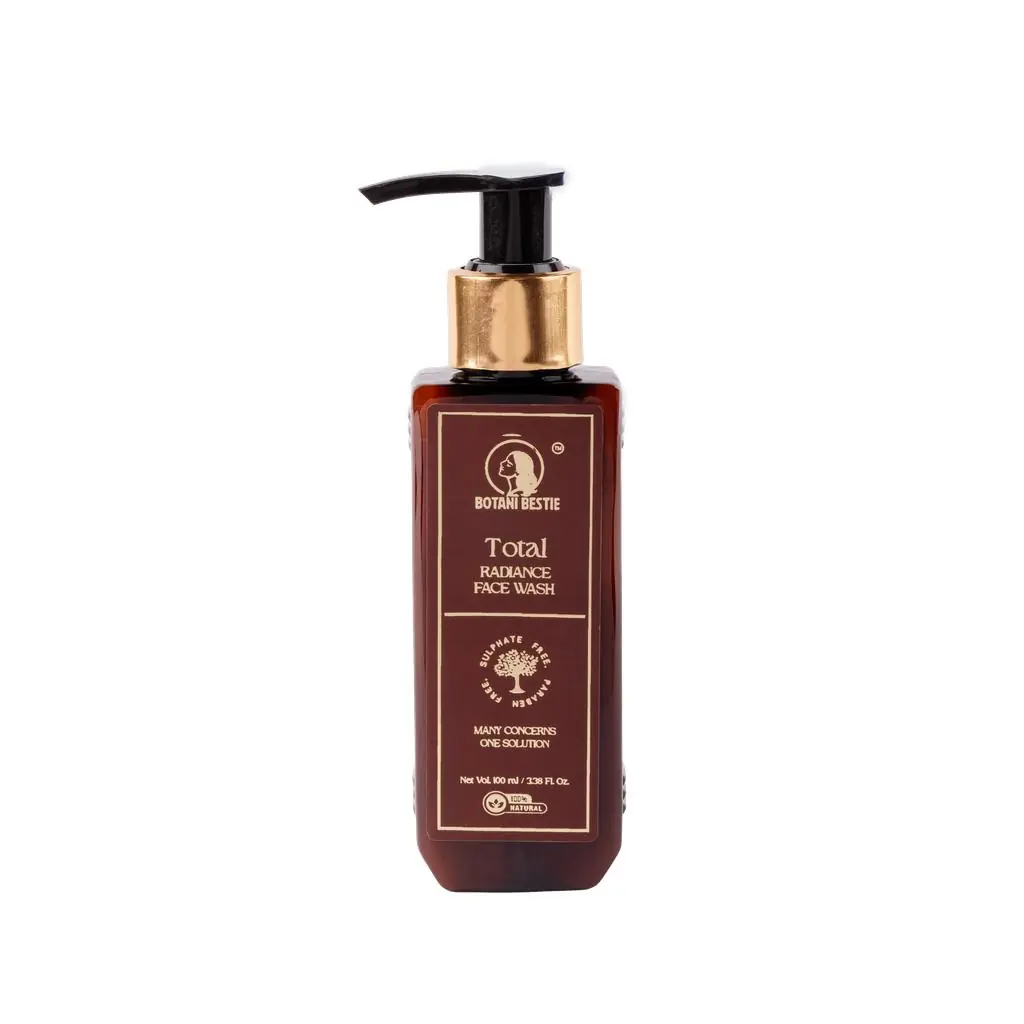
Total Radiance Face Wash — Cleanse, Then Protect
pH 5.0 Balanced · Niacinamide + Salicylic Acid + Sandalwood + Green Tea EGCG
Designed for the hyperpigmentation challenges most common in Indian skin — acne-driven PIH, sun damage, uneven tone. At pH 5.0, it prepares the skin's acid mantle for maximum sunscreen filter performance. Niacinamide blocks melanosome transfer — interrupting the biological step that creates new dark spots at the same time UV is creating the stimulus. Salicylic Acid accelerates cell turnover, clearing the congestion that traps sunscreen components and causes breakouts. Sandalwood reduces UV-induced pigmentation at the skin surface. Green Tea EGCG quenches UV-generated free radicals that sunscreen filters do not fully neutralise. Sulphate-free, paraben-free, fragrance-free.
Shop Total Radiance Face Wash →Persistent Pigmentation Despite Daily SPF? Get a Targeted Assessment
If you are using sunscreen daily but dark spots, melasma, or uneven tone are not improving — the issue may be inadequate PA rating, underapplication, reapplication gaps, or a missing active in your routine. SPF alone is never sufficient; it needs the right supporting actives for visible pigmentation change. Our dermatologist identifies the specific gap and builds a protocol that addresses it. No purchase required.
Book Free Consultation → WhatsApp UsFrequently Asked Questions
The Bottom Line — Sunscreen Is the Foundation, Not the Finish
Every brightening ingredient in your skincare routine — niacinamide, Vitamin C, liquorice, tranexamic acid — works to fade dark spots. Unprotected UV exposure undoes that work every day you step outside without adequate SPF and PA coverage. Sunscreen is not a finishing step; it is the foundation that makes every other step viable.
For Indian skin specifically: verify that your sunscreen carries PA+++ or PA++++ — not just a high SPF number. Check that you are applying enough (the two-finger rule). Reapply during outdoor exposure. And recognise that cloudy days are not rest days — UVA penetrates clouds as effectively as it penetrates glass.
The skin concern most Indians actually care about — hyperpigmentation, dark spots, melasma — is primarily a UVA problem. PA rating is the solution. SPF without PA is protection with a critical gap.
Shop Total Radiance Face Wash → Free Skin Consultation"Niacinamide fades dark spots. Vitamin C brightens. Without SPF PA++++, UV undoes both — every single morning."
Ready to make the honest switch?
Our products are built on the same principles as every article we write — pure ingredients, real results, nothing to hide.
Explore Our Products