Frizzy Hair in India — Why It Happens, What Drives It, and How to Actually Fix It (2025 Humidity & Monsoon Guide)
Frizz in India is not one problem — it is four distinct problems occurring simultaneously, each requiring its own targeted solution. Treating "frizzy hair" as a single issue is why most anti-frizz products produce temporary improvement that reverses by day 2. This guide identifies your specific frizz type and gives you the protocol that produces long-term improvement rather than daily damage control.

India is climatically hostile to hair. The combination of high humidity (coastal and monsoon India reaching 85–95% relative humidity seasonally), hard water in most cities, intense UV and heat, and pollution particulate accumulation creates a perfect storm for frizz, dullness, and damage. Adding to this: most hair care products sold in India are formulated for Western climates and hair types — they manage frizz by heavy silicone coating, which produces 2–3 days of improvement followed by weeks of buildup that worsens underlying porosity.
The fundamental physics of frizz: hair frizzs when different sections of the same strand absorb atmospheric moisture at different rates, causing uneven swelling that creates the lifted, kinked, puffed appearance. The degree to which this happens depends on the hair's porosity (how many gaps exist in the cuticle for moisture to enter) and the degree of humidity differential between the hair's internal moisture and the ambient air.
This means frizz control has two levers: lower the porosity (close the cuticle, fill the cortex, remove mineral deposits) and manage moisture exchange (use ingredients that allow gradual, controlled moisture exchange rather than sudden uncontrolled absorption in humidity). Both levers require different approaches depending on your specific frizz type.
The India-specific context: hard water mineral deposits that prevent the cuticle from closing; monsoon humidity that is more extreme than most haircare brands account for; and the Ayurvedic ingredient library that has been managing this exact climate-hair challenge for thousands of years.
The 4 Types of Frizz in India
Type 1: Humidity Frizz (Most Common — Coastal Cities + Monsoon India)
What it looks like: Hair is relatively smooth and manageable in dry air or air-conditioned environments, but puffs up, lifts, and becomes unruly within minutes of going outside in humid conditions. Gets dramatically worse during monsoon (June–September). The frizz is surface-level — the hair puffs outward uniformly rather than having individual strands breaking or snapping.
Why it happens: The hair cuticle (the overlapping scale layer on the outside of each strand) is slightly open or rough. When ambient humidity is high, water molecules from the air are absorbed through the cuticle into the cortex. Different strands absorb at different rates. Each strand swells by 15–20% in diameter as it absorbs water. This uneven swelling at different rates on different strands creates the kinked, puffed appearance.
The fix: Lower the moisture exchange rate. Pre-wash coconut oil fills the cortex before the hair contacts atmospheric moisture — coconut oil penetrates the shaft and occupies the hygral fatigue swelling space, leaving less room for water absorption in humidity. A light post-wash application of aloe vera gel + serum creates a flexible humectant barrier that manages (rather than blocks) moisture exchange. The goal is gradual, controlled moisture exchange — not a silicone block that traps moisture and eventually causes worse frizz when the coating breaks down.
Protocol for Humidity Frizz
- ✓ Pre-wash coconut oil (every wash, 30 min minimum)
- ✓ Cool water final rinse (closes cuticle)
- ✓ Aloe vera gel leave-in on damp hair
- ✓ Serum to seal over aloe
- ✓ Air dry — do not brush while drying
- ✗ Avoid heavy silicone serums
- ✗ Avoid touching hair while drying
- ✗ Avoid SLS shampoos (raise cuticle pH)
Type 2: Damage Frizz (Heat, Chemical, or Hard Water Damage)
What it looks like: Hair is frizzy even in low humidity or air-conditioned rooms. The frizz does not dramatically worsen in humidity — it is consistently frizzy. Individual strands stick out in different directions. Hair texture has changed from what it used to be. Frizz along the entire length, not just the surface layer.
Why it happens: Physical damage to the cuticle scales — from heat tools above 180°C, chemical bleaching or straightening, or repeated mechanical damage from brushing — permanently lifts, chips, or removes cuticle scales. A damaged cuticle cannot close even in low humidity, leaving the cortex exposed and causing constant frizz regardless of weather. Hard water mineral deposits on the cuticle have a similar effect: the mineral layer physically prevents the cuticle from lying flat.
The fix: Structural repair. This frizz type requires actual repair of the cuticle — not just coating it. Weekly protein treatments (egg yolk + castor oil, or a commercial hydrolysed keratin mask) fill the cuticle gaps. A serum with copper peptides supports cross-link rebuilding in the cortex. Monthly citric acid chelation removes mineral deposits so the cuticle can actually close. Progressive trimming of the most damaged ends. This is a 2–4 month protocol, not a quick fix. Full damaged hair repair guide →
Protocol for Damage Frizz
- ✓ Weekly protein mask (egg + castor oil)
- ✓ Monthly chelation (citric acid)
- ✓ Serum with hydrolysed keratin + copper peptides
- ✓ Progressive trimming (1 cm per month)
- ✓ Zero heat tools during recovery
- ✗ Stop: SLS shampoos
- ✗ Stop: brushing wet hair
- ✗ Stop: silicone build-up (monthly clarifying)
Type 3: Hard Water Frizz (Delhi, Mumbai, Bangalore, and Most Indian Cities)
What it looks like: Hair becomes progressively rougher and frizzier over weeks even without any new damage. Newly washed hair does not feel clean — it feels rough even immediately after washing. Conditioners and masks seem to do nothing. Colour, if any, turns brassy or dull. A white or grey buildup may be visible at the scalp or on the hair. This is the frizz that treatments don't fix because you are applying treatments on top of the mineral layer, not on the hair itself.
Why it happens: Hard water (above 200 ppm calcium carbonate equivalent) deposits ionic mineral compounds on the hair cuticle with every wash. Over time, these deposits accumulate, preventing the cuticle from lying flat and physically blocking every treatment applied after washing from reaching the actual hair surface. A 2016 study in the International Journal of Trichology confirmed that hard water exposure significantly increases hair breakage force and reduces elasticity compared to soft water.
The fix: Chelation, then maintenance. One citric acid treatment (1 tablespoon citric acid in 1 litre warm water, applied after shampooing, left 5 minutes, rinsed) removes months of buildup in a single application. Most people are shocked by how much softer and shinier their hair is after the first chelation. Monthly chelation prevents reaccumulation. Install a shower filter to reduce mineral load with every future wash. Full hard water guide →
Protocol for Hard Water Frizz
- ✓ Monthly citric acid chelation (dissolves mineral deposits)
- ✓ Monthly clarifying shampoo (removes product buildup)
- ✓ Shower head filter installation (₹1,500–3,000)
- ✓ ACV rinse (1:10) as final rinse (mild chelation)
- ✓ Pre-wash oil coat (reduces mineral adhesion)
- ✗ Skip chelation and wonder why masks don't work
Type 4: Product-Induced Frizz (Wrong Routine for Indian Hair)
What it looks like: Hair is frizzy despite using anti-frizz products. The products work for the first day then frizz returns or worsens. Hair feels coated or heavy. Scalp is oily but lengths are dry. This frizz pattern is very common in Indian women who have adopted Western hair care routines that are mismatched to Indian hair type and climate.
Why it happens: Several common product mistakes that worsen frizz: (1) SLS shampoos raise hair pH above 7 (hair's natural slightly acidic state), permanently lifting the cuticle with every wash. (2) Heavy silicone-rich anti-frizz serums mask frizz initially but build up on the cuticle within 2–3 washes, adding stiffness and weight that creates a different kind of frizz. (3) Protein overload from too-frequent protein treatments stiffens hair without the balancing moisture that allows the cuticle to lie flat. (4) Applying heavy conditioner at the roots rather than mid-lengths/tips, weighing down roots while lengths remain dry and porous.
The fix: Simplify and rebalance. Switch to a sulphate-free, pH-balanced shampoo. Do a one-time clarifying wash to remove silicone buildup. Rebalance protein and moisture with the alternating protocol. Use a lightweight serum (not a heavy silicone cream) as leave-in.
Protocol for Product Frizz
- ✓ One-time clarifying wash (removes silicone buildup)
- ✓ Switch to sulphate-free, pH-balanced shampoo
- ✓ Conditioner on mid-lengths to tips only (never roots)
- ✓ Alternate protein (week 1) + moisture mask (week 2)
- ✓ Lightweight serum, not heavy cream
- ✗ Stop: SLS shampoos
- ✗ Stop: daily silicone serum without clarifying
India Climate-Specific Frizz Calendar
| Season | Frizz Driver | Intensity | Protocol Adjustment |
|---|---|---|---|
| Monsoon (Jun–Sep) | Peak humidity (85–95% RH); wet-dry cycle; physical moisture exposure from rain | Very High | Pre-wash oil every wash; increase to daily aloe + serum leave-in; protective hairstyles; avoid all heat; increase wash frequency if scalp becomes oily from humidity+sweat |
| Pre-monsoon / Summer (Mar–May) | Rising humidity + extreme UV + heat (air temperature causes scalp sweat = oily roots + dry lengths) | High | Monthly chelation; UV-protecting leave-in (aloe has mild UV-absorbing properties); increase wash frequency; scalp focus on breathability |
| Post-monsoon (Oct–Nov) | Humidity dropping; hair recalibrating from monsoon-elevated moisture content; seasonal hair fall period | Moderate | Protein mask focus (rebuild fibre strength after monsoon hygral fatigue); oil massage weekly; trim monsoon damage |
| Winter (Dec–Feb) | Low humidity in North India (Delhi 30–40% RH); AC removes remaining moisture; static electricity increases | Low-Moderate | Increase moisture focus (aloe, hyaluronic acid leave-in); anti-static: avoid nylon hair accessories; increase oil frequency; less chelation needed (less humidity means less mineral compound activation) |
| Year-round (Coastal cities) | Mumbai, Chennai, Kolkata: humidity stays above 65% year-round; hard water compounds this | Consistently High | Year-round pre-wash oil routine; shower filter essential; monthly chelation; lightweight serum over aloe year-round; no silicone buildup tolerance |
Best Ingredients for Frizz Control in Indian Climate
Coconut Oil (Pre-wash)
The single most impactful frizz intervention for Indian hair. Penetrates the cortex and fills hygral-fatigue swelling space, so atmospheric moisture in humidity causes less shaft swelling. Use as pre-wash treatment (30 min–overnight) every wash day. Not as a post-wash styling product in high humidity (can attract more atmospheric moisture if applied heavily to dry hair).
Aloe Vera Gel (Leave-in)
The ideal frizz leave-in for Indian humidity. Aloe's mucopolysaccharides form a flexible, breathable film on the cuticle that manages moisture exchange (allows gradual, controlled absorption) rather than blocking it (which silicones attempt — and fail — to do in Indian humidity levels). Aloe also has a slight pH-lowering effect that keeps the cuticle marginally more closed. Apply to damp hair after washing.
Hibiscus (Conditioning)
Hibiscus flower mucilage is a natural cuticle smoother — its anionic polysaccharides coat the cuticle with a negatively charged film that repels airborne particles and manages the cuticle surface charge that contributes to frizz-causing static in dry winter conditions. Hibiscus also conditions the hair shaft with its organic acids, producing a natural slip that helps hair dry in a smoother pattern.
Citric Acid / ACV (Cuticle Closing)
Acid rinses (citric acid in water, or ACV at 1:10 dilution) temporarily close the cuticle by lowering the hair's pH back toward its natural acidic state (pH 4.5–5.5). After washing with alkaline shampoo (SLS raises hair pH to 7+, lifting cuticle), an acid rinse closes the cuticle mechanically before you exit the shower into humid air. A closed cuticle absorbs atmospheric moisture more slowly and uniformly — less frizz.
Hydrolysed Keratin (Serum)
Small keratin protein fragments penetrate the cuticle gaps and cortex voids, filling the porosity that allows rapid moisture absorption in humidity. This is the structural fix for humidity-frizz — reducing porosity means less ability to absorb atmospheric moisture unevenly. Applied in a leave-in serum post-wash, hydrolysed keratin provides immediate frizz reduction and cumulative repair with regular use.
Argan Oil (Finishing)
A few drops of argan oil (not silicone serum) applied over damp, aloe-coated hair seals the surface and adds shine without the buildup of silicones. Argan's high oleic acid content provides a lightweight, non-greasy finish that slows the rate of atmospheric moisture absorption without fully blocking it — the "controlled exchange" approach that works in Indian humidity levels where full blocking is impossible anyway.
Frequently Asked Questions
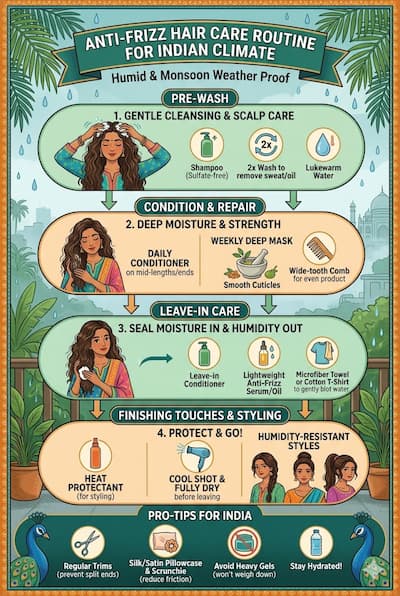
The Complete Anti-Frizz Routine for India
The three-product combination that addresses all four frizz types in Indian conditions: a sulphate-free, pH-balanced shampoo (stops the weekly cuticle-lifting from alkaline washing), a pre-wash hair oil with coconut + herbal base (fills the cortex before water contact), and a lightweight post-wash serum that seals the cuticle without silicone buildup.
Our Total Rebalance Shampoo is pH-balanced and sulphate-free, formulated specifically not to strip the natural acids that keep the cuticle marginally more closed. Total Restore Hair Oil provides the pre-wash coconut + Bhringraj + Brahmi treatment. Total Revival Hair Serum provides the post-wash sealing layer with amino acids and copper peptides that fill porosity rather than just coat it.
"Indian hair doesn't need more product. It needs the right product in the right sequence — and a shower filter."
Ready to make the honest switch?
Our products are built on the same principles as every article we write — pure ingredients, real results, nothing to hide.
Explore Our Products