Biotin for Hair Growth — What It Actually Does, Who Needs It, and the Honest Truth About Biotin Supplements (2025 India)
Biotin (Vitamin B7) is a genuine hair growth nutrient — it is a required cofactor for keratin synthesis. But supplementation only works if you are actually deficient, and most people searching for biotin tablets for hair growth in India are not deficient. This guide gives you the biology, the honest deficiency criteria, the best Indian food sources, and when supplementation is actually warranted — so you spend your money on solutions that match your actual problem.
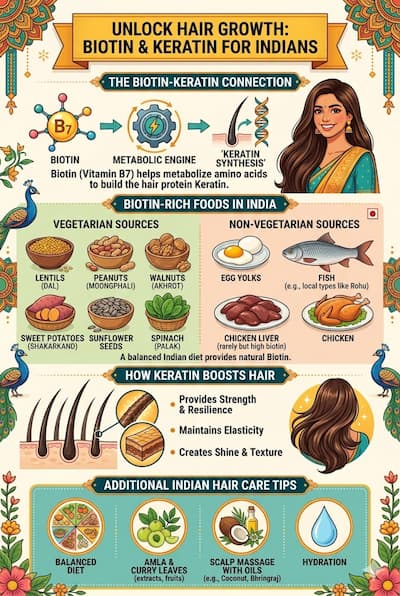
Biotin is one of the most-searched hair loss solutions in India, with supplement sales growing dramatically — but the scientific evidence behind biotin supplementation for hair growth in non-deficient individuals is significantly weaker than the marketing suggests. Understanding the distinction between "biotin corrects a deficiency" and "biotin acts as a hair growth booster" is the most important thing you can take away from this article.
The honest picture: biotin is a B-complex vitamin (Vitamin B7) that functions as a cofactor for five carboxylase enzymes involved in fatty acid synthesis, amino acid metabolism, and gluconeogenesis. The link to hair specifically is through its role in keratin synthesis — the process by which follicle cells produce the keratin protein that makes up the hair fibre. When biotin is insufficient, keratin production is impaired and hair becomes thin, weak, and eventually falls out.
This means supplementation produces hair improvement specifically by restoring deficient biotin to adequate levels — not by "boosting" keratin production beyond normal. A person with adequate biotin levels supplementing with 5,000 mcg daily is not producing more keratin than a person who gets 30 mcg from their daily diet. They are just excreting more biotin in their urine.
With that established: biotin deficiency is real, its hair effects are real, certain Indian populations are at higher risk, and correcting a genuine deficiency does produce meaningful hair improvement. This guide shows you how to know which category you are in.
What Biotin Does in the Hair Follicle
Keratin Synthesis Cofactor
Biotin is an essential cofactor for acetyl-CoA carboxylase — the enzyme that is the rate-limiting step in fatty acid synthesis, which in turn provides the lipid components of the follicle sebum and hair shaft structure. More directly relevant to keratin: biotin supports the metabolism of amino acids (especially leucine and isoleucine) that are structural components of the keratin protein chain. Without adequate biotin, the amino acid building blocks for keratin are processed less efficiently, and the resulting keratin protein is structurally weaker — producing thinner, more brittle hair fibre.
Cell Proliferation in the Matrix
The hair matrix (the rapidly dividing cell layer at the base of the follicle) has among the fastest cell division rates in the human body — comparable to gut epithelium. Biotin's role in DNA replication and cell proliferation through its support of carboxylase activity means adequate biotin is required for the sustained, rapid cell division that produces the hair fibre continuously during anagen. Biotin deficiency slows this cell turnover, shortening anagen duration and producing thinner, shorter hair fibres that shed before reaching full length.
Scalp Sebum and Fatty Acid Balance
Biotin's role in fatty acid synthesis affects scalp sebum quality. Sebum is the scalp's natural moisturiser and forms the first layer of scalp barrier protection. Biotin deficiency impairs the fatty acid synthesis pathway, leading to sebum abnormalities — the scalp becomes either too dry (causing flaking and follicle exposure) or the sebum composition becomes dysregulated, providing a more hospitable environment for Malassezia fungus (the primary driver of dandruff-associated hair fall). Normalising biotin restores healthy sebum production and scalp barrier function.
Nail and Skin Biomarker
An easy self-assessment of biotin status: your nails. Nails are keratin-based like hair, and biotin deficiency affects nails at the same time as hair — producing brittle, soft nails that peel or break easily. If your nails are strong and healthy, your biotin status is almost certainly adequate and a biotin supplement will not improve your hair. Conversely, if you have simultaneously thinning hair AND brittle, peeling nails AND the skin symptoms noted in the deficiency section, biotin deficiency is worth investigating. This nail-hair-skin triad is the classic presentation of true biotin deficiency.
Who Is Actually Deficient in India?
| Risk Group | Why Deficient | Prevalence in India |
|---|---|---|
| Pregnant and lactating women | Pregnancy increases biotin catabolism (breakdown) by 2–3×. Studies show 50% of pregnant women have marginal biotin deficiency by third trimester even with adequate diet. Biotin is also preferentially transferred to the foetus, further depleting maternal levels. | Very common — routine prenatal vitamins in India often underdose biotin at 30 mcg; consider 150 mcg/day during pregnancy under doctor guidance |
| Raw egg white consumers | Avidin in raw egg white is a biotin-binding glycoprotein — it binds dietary biotin in the gut with extremely high affinity and prevents absorption. Regular raw egg white consumption (gym bodybuilders, health enthusiasts drinking raw egg shakes) causes progressive biotin depletion. Cooked eggs do not have this problem — heat denatures avidin completely. | Moderate — raw egg protein shake consumption is rising in Indian gym culture |
| Long-term antibiotic users | The gut microbiome synthesises a meaningful fraction of biotin — broad-spectrum antibiotics (especially those taken for months, e.g. for acne, UTI recurrence, or post-surgery) deplete the biotin-producing bacteria. Post-antibiotic hair fall is partly explained by this mechanism alongside the well-known telogen effluvium trigger. | Common — tetracycline and minocycline for acne are widely prescribed for 3–6 month courses |
| People on anticonvulsant medications | Phenytoin, carbamazepine, and valproic acid all impair biotin absorption and increase biotin turnover. Long-term anticonvulsant use is a well-documented cause of biotin deficiency. Hair loss is a known side effect of valproic acid specifically. | Relevant for the estimated 12+ million Indians with epilepsy on long-term anticonvulsants |
| Chronic alcohol use | Alcohol impairs biotin absorption in the small intestine and accelerates its renal clearance. Gut dysbiosis from alcohol consumption also reduces microbial biotin synthesis. Hair fall is a common presentation in people with chronic alcohol use disorders. | Relevant for approximately 16% of Indian adult males with harmful alcohol use patterns (WHO data) |
| IBD and malabsorption conditions | Crohn's disease, ulcerative colitis, and other conditions causing intestinal malabsorption impair biotin absorption alongside other B vitamins. Hair loss in IBD patients often has a biotin + iron + zinc deficiency triad. | Relevant for the estimated 1.5 million Indians with IBD |
| Strict vegans without varied diet | Plant foods are generally lower in biotin than animal sources, and plant-source biotin has lower bioavailability. A strict vegan who does not eat varied legumes, seeds, and nuts daily may have marginal intake — though true deficiency from veganism alone requires multiple concurrent dietary gaps. | Low risk if the person is eating a nutritionally complete vegan diet; higher risk with monotonous plant-based diets |
Top Biotin Food Sources in India
| Food | Biotin per Serving | % of Daily AI (30 mcg) | Notes |
|---|---|---|---|
| Sunflower seeds (30g / small handful) | ~20 mcg | 66% | One of the highest plant biotin sources; easy to add to chaat or dal |
| Roasted peanuts (30g) | ~5 mcg | 17% | Very accessible and affordable; peanut chutney or chikki counts |
| Whole egg (1 cooked, ~50g) | ~10 mcg | 33% | Yolk is the biotin source; white alone provides almost none; must be cooked to avoid avidin blocking |
| Almonds (30g) | ~4–6 mcg | 13–20% | Bajra and roti with almonds is a high-biotin breakfast combination |
| Cooked rajma / kidney beans (100g) | ~19 mcg | 63% | One of the best plant biotin sources; rajma chawal is nutritionally excellent for hair |
| Cooked chana dal (100g) | ~14 mcg | 47% | Regular dal consumption significantly covers daily biotin needs |
| Cooked moong dal (100g) | ~11 mcg | 37% | Sprouted moong may have higher bioavailability |
| Sweet potato (100g cooked) | ~8 mcg | 27% | Shakarkandi chaat is both enjoyable and a meaningful biotin source |
| Walnuts (30g) | ~5 mcg | 17% | Also provides omega-3 fatty acids that support scalp health |
| Full-fat paneer (100g) | ~3–5 mcg | 10–17% | Biotin plus protein makes paneer a dual-action hair food |
The Practical Takeaway on Food
A typical Indian diet of 2 eggs at breakfast + dal at lunch + rajma or chana at dinner covers 100%+ of the daily biotin adequate intake from food alone — without any supplement. The person who benefits from biotin supplementation is the one who falls into the risk groups above (pregnant, antibiotic use, IBD, etc.), not the average person who eats a mixed Indian diet and is experiencing hair fall from other causes (stress, hormonal, nutritional gap in iron or zinc, hard water, etc.).
Biotin Supplements: What the Evidence Actually Shows
When Biotin Supplements Work
- You have confirmed biotin deficiency (serum test showing low levels)
- You are pregnant or breastfeeding
- You have been on broad-spectrum antibiotics for 3+ months
- You regularly consume raw egg whites
- You have biotinidase deficiency (genetic condition)
- You have IBD with known malabsorption
- You are on anticonvulsant medications long-term
In these cases: 30–100 mcg daily is sufficient for most adults. Pregnant women may benefit from 150 mcg/day under medical supervision.
When Biotin Supplements Won't Work
- You eat eggs, lentils, and nuts regularly and have normal nails
- Your hair fall is due to iron deficiency (very common in Indian women — iron should be tested first)
- Your hair fall is due to thyroid dysfunction
- Your hair fall is androgenetic (DHT-driven pattern thinning)
- Your hair fall is from stress or telogen effluvium
- Your hair fall is from hard water mineral damage
- You are taking mega-dose biotin (5,000–10,000 mcg) hoping for amplified results
In these cases: biotin will not address the actual cause of fall, and the supplement budget is better spent elsewhere.
Biotin vs. Other Hair Nutrients: What Should You Actually Test?
| Nutrient | Hair Deficiency Rate in Indian Women | Test to Confirm | Priority vs. Biotin |
|---|---|---|---|
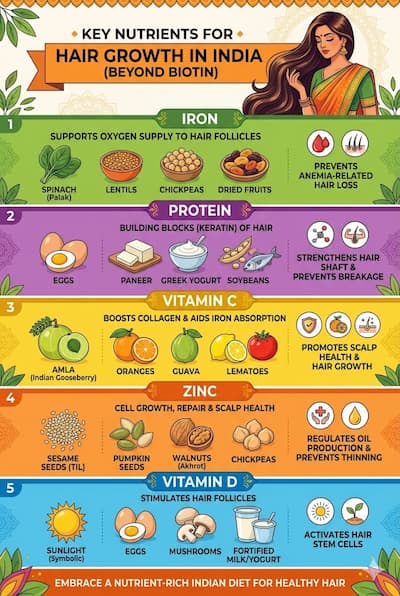
| Iron (ferritin) | Extremely common — 51% of Indian women of reproductive age are iron-deficient (NFHS data) | Serum ferritin (target >40 ng/mL for hair growth) | Test iron FIRST — the single most common correctable hair fall cause in Indian women |
| Vitamin D | Very common — 70–90% of Indians are Vitamin D insufficient despite strong sunlight; VDR receptors on follicles are required for anagen | 25-OH Vitamin D blood test (target >30 ng/mL) | Test second — widespread deficiency with direct follicle impact |
| Zinc | Common — 25–30% of Indian adults have inadequate zinc intake; zinc is required for follicle cell division | Serum zinc | Test with iron panel; zinc and iron deficiency frequently co-occur |
| Thyroid (TSH) | India has one of the highest thyroid dysfunction rates globally — both hypo and hyperthyroidism cause significant hair loss | TSH + Free T3, T4 | Test early — treatable thyroid dysfunction is a major missed diagnosis in hair fall cases |
| Biotin | Uncommon in mixed-diet eaters; more common in specific risk groups listed above | Serum biotin (or indirect: urine 3-hydroxyisovaleric acid) | Test only if in a risk group or if iron, D, zinc, and thyroid are normal and deficiency symptoms (brittle nails, perioral rash) are present |
Frequently Asked Questions
What Actually Helps Indian Hair
For most Indians with hair fall, the highest-value interventions are: iron deficiency correction (test serum ferritin — target above 40 ng/mL), Vitamin D restoration (target above 30 ng/mL), thyroid normalisation if TSH is abnormal, and topical Ayurvedic and biotech ingredients applied directly to the follicle where absorption is most targeted.
Our Total Restore Hair Oil delivers Bhringraj, Brahmi, and Jatamansi directly to the follicle via the scalp — the Ayurvedic adaptogens that support HPA axis health and reduce the cortisol-driven fall that is India's most common hair fall trigger. The Total Revival Hair Serum delivers Redensyl, AnaGain, and Copper Peptides — biotech actives that activate dermal papilla stem cells and support the follicle biology that biotin supplementation cannot address.
Shop Total Restore Hair Oil → Shop Total Revival Hair Serum →"Test before you supplement. Iron and Vitamin D deficiency are far more common causes of hair fall in India than biotin deficiency."
Ready to make the honest switch?
Our products are built on the same principles as every article we write — pure ingredients, real results, nothing to hide.
Explore Our Products