Pollution & Hair Fall — How Delhi, Mumbai & Bangalore Air Is Silently Damaging Your Scalp (2025)
For years, the link between air pollution and hair fall was suspected but mechanistically unclear. In 2019, a landmark study by Kim et al. finally explained exactly how it works: PM2.5 particles activate the Aryl hydrocarbon Receptor (AhR) in scalp cells, directly suppressing the proteins responsible for keeping follicles in their growth phase. India's major cities expose millions of scalps to PM2.5 concentrations 20–50x above WHO safe limits, every single day. This is the complete, science-backed guide to what is happening to your scalp — and what actually protects it.
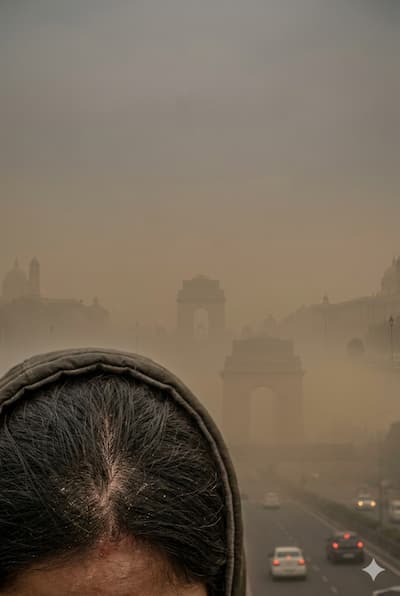
Delhi's average annual PM2.5 concentration is approximately 100 µg/m³ — twenty times the WHO annual guideline of 5 µg/m³. During winter temperature inversions, levels regularly exceed 300–500 µg/m³ for days at a time. During Diwali and post-harvest stubble burning peaks, readings above 900 µg/m³ have been recorded.
These are not abstract air quality statistics — they are scalp exposure doses. The scalp has the highest sebaceous gland density of any body surface area, making it a uniquely efficient trap for lipophilic pollutant particles. The follicular openings are natural access points for fine particles. And the dermal papilla cells at the base of each follicle — which determine whether a hair grows or sheds — express the AhR receptor that PM2.5 directly activates.
This guide covers the complete biology of pollution-driven hair loss, the specific challenges of Delhi, Mumbai, and Bangalore's distinct pollution profiles, and the evidence-based protocol for protecting your scalp — without harsh cleansers that paradoxically make the problem worse.
⚡ Pollution & Hair Loss — Quick Reference
| Pollutant | Source | Scalp Mechanism | Hair Effect |
|---|---|---|---|
| PM2.5 (fine particles) | Vehicle exhaust, construction dust, crop burning (Delhi), industrial emissions | AhR receptor activation → β-catenin, VEGF, CDK2 suppression in dermal papilla | Premature catagen entry; reduced anagen duration; diffuse shedding |
| PAHs (polycyclic aromatic hydrocarbons) | Diesel/petrol combustion; cigarette smoke; coal burning | High-affinity AhR activation → CYP1A1/1B1 induction → ROS generation → direct follicle DNA damage | Accelerated androgenetic alopecia; oxidative damage to hair shaft proteins |
| Heavy metals (Pb, Cd, As) | Industrial emissions; leaded petrol legacy; industrial effluents; water supply contamination | Compete with Zn and Cu at enzyme binding sites → impair keratin synthesis; generate scalp-specific oxidative stress | Brittle, slow-growing hair; diffuse shedding; accelerated greying |
| Ozone (O₃) | Secondary pollutant from NOₓ + UV reactions; elevated in summer afternoons | Reacts directly with squalene and Vitamin E in the scalp surface lipid layer → generates lipid peroxides → scalp barrier disruption | Compromised scalp barrier; increased follicle vulnerability to particle penetration |
| Nitrogen Dioxide (NO₂) | Traffic emissions; power generation | Oxidative stress mediator; amplifies PM2.5 and PAH-driven AhR activation; impairs scalp antioxidant capacity | Compounding effect on AhR-mediated hair loss; accelerated oxidative ageing of hair shaft |
The AhR Pathway — The Mechanism That Explains Everything
Before 2019, the link between air pollution and hair loss was epidemiological — observed in populations but not explained at a molecular level. The 2019 study by Kim et al. in the International Journal of Molecular Sciences changed this, providing the complete mechanistic explanation for why PM2.5 causes hair loss at the follicle level.
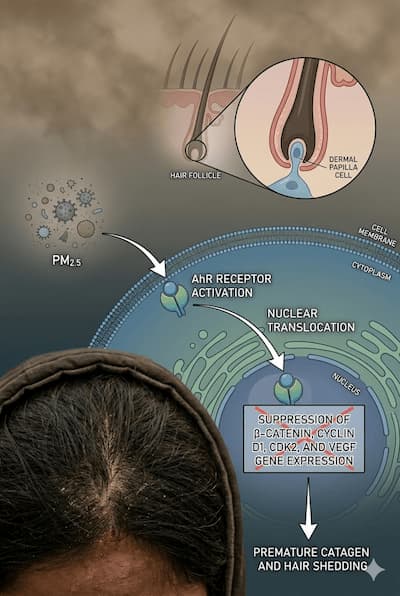
How PM2.5 Activates AhR to Cause Hair Fall
The Aryl hydrocarbon Receptor (AhR) is a transcription factor expressed in scalp dermal papilla cells and outer root sheath keratinocytes. It evolved as a sensor for environmental toxins — when activated by xenobiotic compounds (including PM2.5 particle-associated chemicals and PAHs), it translocates to the nucleus and reprogrammes gene expression.
When PM2.5-associated compounds bind AhR in scalp cells, the activated AhR complex suppresses the expression of four proteins that are essential for follicle growth:
- β-Catenin (Wnt signalling effector): The master regulator of anagen initiation and maintenance. Reduced β-catenin causes the follicle to exit anagen prematurely and enter catagen (regression).
- Cyclin D1: A cell cycle regulator required for matrix cell proliferation in the actively growing follicle. Suppression slows the cell division that produces the hair shaft.
- CDK2 (Cyclin-Dependent Kinase 2): Works with Cyclin D1 to advance the cell cycle. Reduced CDK2 → impaired matrix cell proliferation → thinner, slower-growing hair.
- VEGF (Vascular Endothelial Growth Factor): Maintains the capillary network supplying the dermal papilla with oxygen and nutrients. VEGF suppression impairs scalp microcirculation specifically around active follicles.
The result of simultaneous suppression of all four: the follicle exits anagen early, the matrix cells stop dividing, and the hair sheds. At PM2.5 concentrations experienced in Delhi during winter inversions, this effect is occurring continuously and simultaneously across millions of scalp follicles.
The PAH–AhR Connection: More Potent than PM2.5 Alone
Polycyclic aromatic hydrocarbons (PAHs) — produced by the incomplete combustion of fossil fuels in vehicle engines, diesel generators, and industrial burners — are among the most potent known activators of the AhR receptor. Their binding affinity for AhR is 10–100x higher than most PM2.5-associated pollutants. PAH exposure activates AhR at far lower concentrations than PM2.5, and additionally induces CYP1A1 and CYP1B1 enzymes (phase I metabolic enzymes) that convert PAHs into reactive epoxides — directly damaging follicle cell DNA. India's vehicle fleet (dominated by older diesel trucks, two-stroke vehicles, and diesel auto-rickshaws in tier-2 cities) produces high PAH emissions compared to Euro-6 equivalent European fleets. In Delhi, PAH concentrations in urban air regularly exceed health threshold values by 10–15x.
EGCG from green tea is one of the few compounds with documented AhR antagonist activity — meaning it directly competes with PAHs and PM2.5 compounds for AhR binding, blocking the downstream gene suppression that causes hair loss. This is one of the most specific mechanistic justifications for including EGCG in scalp products for Indian urban residents.
Heavy Metal Accumulation — The Slow Scalp Poisoning
India's industrial legacy and ongoing urbanisation have created heavy metal contamination in urban air, water, and soil at concentrations significantly above safe limits. Lead (from the decades of leaded petrol use before 2000 and ongoing battery industry emissions), cadmium (from industrial effluents and battery manufacturing), and arsenic (from groundwater contamination and coal fly ash) accumulate in urban scalp tissue through air deposition and water exposure.
| Metal | Scalp Mechanism | Hair Effect | India-Specific Source |
|---|---|---|---|
| Lead (Pb) | Competes with calcium at intracellular signalling sites; displaces zinc in zinc-dependent enzymes (including 5α-reductase); accumulates in hair shaft keratin — measurable in hair analysis | Impaired keratin synthesis; weakened hair shaft; disrupted follicle cycling; accelerated miniaturisation in AGA-susceptible men | Legacy soil lead from pre-2000 leaded petrol; battery recycling industry; lead-based paints in older buildings |
| Cadmium (Cd) | Directly impairs zinc and copper absorption — both essential cofactors for hair follicle enzymes; triggers oxidative stress in dermal papilla cells; documented to reduce follicle size in animal models | Secondary zinc and copper deficiency at the follicle level; reduced hair shaft diameter; diffuse shedding | Phosphate fertiliser manufacture; battery industry (Nicad batteries); industrial electroplating in urban industrial zones |
| Arsenic (As) | Inhibits pyruvate dehydrogenase and other mitochondrial enzymes critical for energy production in the high-demand hair matrix cells; causes keratinocyte apoptosis at micromolar concentrations | Diffuse alopecia; abnormal hair texture; accelerated greying; keratinocyte death produces rapid shedding at high exposures | Groundwater arsenic contamination (widespread in West Bengal, Bihar, UP); coal fly ash from thermal power plants |
| Mercury (Hg) | Binds to sulphydryl groups in keratin and scalp enzymes; disrupts the disulphide bonds that give hair its structural strength; found in some skin-lightening products sold in India | Brittle, structurally weak hair; breakage before shedding; dermatitis and follicular inflammation in high exposure | Chlor-alkali industry; artisanal gold mining in some states; illegally formulated skin-lightening creams |
Delhi, Mumbai & Bangalore — Three Cities, Three Pollution Profiles
🏭 Delhi — South Asia's Most Polluted Major City
Annual average PM2.5: 90–110 µg/m³ (WHO limit: 5 µg/m³; 18–22x over limit)
Winter peak PM2.5: 300–900+ µg/m³ during inversion events
Primary pollutant sources: 11+ million registered vehicles (largest fleet of any Indian city), crop residue burning from Punjab/Haryana (Oct–Nov), construction dust (NCR expansion), industrial emissions from Faridabad/Noida corridor
Scalp-specific risk factors:
- Winter temperature inversions trap pollutants at ground level — residents inhale and their scalps are exposed to peak concentrations for 8–12 hours daily during November–January
- Diwali night: PM2.5 spikes to 10–20x annual average in a single night — AhR activation event of extraordinary intensity across the entire Delhi population simultaneously
- High PAH concentrations from the diesel-dominated older vehicle fleet — particularly severe AhR pathway activation
Delhi-specific defence protocol:
- Cover the scalp with a dupatta, cap, or scarf during outdoor exposure in October–February — highest particle density period
- Wash hair every 2 days during winter with sulphate-free shampoo — do not extend to 3–4 days in peak pollution periods
- Apply scalp oil on wash-day evenings to restore barrier lipids removed by the cleansing step
- EGCG-containing products are specifically valuable for Delhi residents — AhR antagonism provides targeted defence against the PAH-AhR pathway dominant in Delhi's diesel pollution
- Add oral antioxidant support during October–January: Amla extract, Vitamin C, Zinc — the peak pollution window depletes scalp antioxidant reserves faster than baseline
🌊 Mumbai — High Humidity, Pollution Adhesion, and Sea-Salt Compounding
Annual average PM2.5: 45–65 µg/m³ (9–13x above WHO limit — significantly cleaner than Delhi but still severely elevated)
Primary pollutant sources: Mumbai port (ship diesel and heavy fuel oil — extremely high PAH content), traffic in the island city (Dharavi industrial corridor), construction dust from ongoing metro and coastal road projects
Mumbai's unique scalp challenge — the humidity problem: Mumbai's year-round high relative humidity (70–90% for most of the year) fundamentally changes how pollutants interact with the scalp. In high humidity, PM2.5 particles attract water molecules, swelling and becoming stickier — dramatically increasing their adhesion to scalp sebum and hair shaft surfaces. The result: the same PM2.5 concentration produces greater scalp deposition and retention in Mumbai's humid environment than in Delhi's drier winter air. Sea salt aerosols from the Arabian Sea additionally disrupt the scalp's lipid barrier — acting as a co-irritant that amplifies pollutant penetration.
Mumbai-specific defence protocol:
- The scalp's sebum acts as a pollution trap in high humidity — washing every 2 days during monsoon and summer months is even more important in Mumbai than the standard recommendation
- After each wash, apply a lightweight scalp oil (not heavy oil) to restore barrier function without re-saturating the sebum trap
- Sea salt contributes to scalp dehydration despite high atmospheric humidity — hyaluronic acid in the scalp care routine addresses the osmotic dehydration paradox
- Port area and eastern Mumbai residents face higher PAH exposure from ship emissions — EGCG topical application is specifically relevant for these areas
🏗️ Bangalore — Construction Dust, Organochlorines, and the Rapid Urbanisation Problem
Annual average PM2.5: 30–50 µg/m³ (6–10x above WHO limit — the cleanest of the three major metros discussed, but worsening rapidly with urbanisation)
Primary pollutant sources: Massive ongoing construction activity (metro expansion, IT corridor development, flyovers), traffic in the absence of Metro completion, Bellandur and Varthur lake foam events (organochlorine and ammonia compounds), and burning of biomass waste in peripheral areas
Bangalore's unique challenge — construction dust and organochlorines: Construction dust generates a high proportion of PM10 and coarse particles, but also produces significant PM2.5 from concrete and masonry dust containing calcium, silicon, and aluminium compounds. These calcium-rich particles have a distinct inflammatory effect on the scalp compared to carbon-soot PM2.5 — triggering keratinocyte irritation and contributing to scalp barrier disruption independent of the AhR pathway. Bellandur Lake's notorious foam — documented to contain organochlorine compounds, ammonia, and phosphates — creates specific scalp toxic exposure for residents in the Sarjapur-Whitefield corridor during foam drift events.
Bangalore-specific defence protocol:
- Construction site proximity significantly elevates personal PM2.5 exposure — route planning to avoid active construction during commute is meaningful scalp protection
- Bangalore's weather is relatively cool and dry compared to Mumbai — particle adhesion is lower, but summer winds carry construction dust effectively
- Bellandur/Varthur area residents should wash hair after any foam drift event with a gentle shampoo and follow immediately with scalp oil — organochlorine compounds require lipid-based emulsification for removal
- Despite being the cleanest of the three metros, Bangalore's PM2.5 is rising year-on-year as the city's vehicle fleet and construction activity expand — the AhR pathway defence protocol is becoming increasingly relevant
The Complete Pollution Hair Fall Protection Protocol
Physical scalp covering during outdoor pollution exposure is the simplest and most immediately effective intervention. A dupatta, scarf, hat, or cap intercepts PM2.5 and coarse particle deposition before it reaches the scalp surface and follicular openings. A single layer of tightly woven fabric reduces scalp particle deposition by 60–80% for PM10 and 30–50% for PM2.5.
Practical priority: morning commute (peak traffic PAH and NO₂), outdoor exposure during Delhi's October–January period (peak AhR-activating pollution concentrations), and any outdoor exposure during Diwali and the week following. Two-wheeler riders who are outdoors for 30+ minutes daily in urban traffic are receiving among the highest urban pollution scalp doses — a helmet liner combined with a scarf significantly reduces this.
Pollution particles on the scalp surface generate reactive oxygen species continuously — the longer they remain, the greater the cumulative AhR activation and oxidative damage. Regular washing removes the accumulated particle burden before it causes maximum damage. The correct frequency in high-pollution environments is every 2–3 days — not daily (which causes scalp barrier disruption) and not every 4–5 days (which allows excessive particle accumulation and AhR activation).
The shampoo paradox: SLS/SLES sulphate shampoos remove pollution particles effectively — but they also strip the scalp's protective lipid barrier and acid mantle. A stripped scalp is more porous to the next day's pollution particles, creating a cycle where aggressive cleansing increases vulnerability. Sulphate-free cleansers at pH 4.5–5.5 remove pollution while preserving the barrier that is the first line of defence against particle penetration. This is the most important product choice decision in the pollution hair fall prevention protocol.
Post-wash timing: Apply scalp oil or serum immediately after washing while the scalp is still slightly damp — the cleansing step removes both pollution and protective sebum, and prompt barrier restoration with oil prevents the window of maximum vulnerability to the next pollution exposure.
EGCG (epigallocatechin gallate from green tea) is the only widely available, well-evidenced AhR antagonist in topical skincare and hair care formulations. By occupying the AhR receptor's ligand-binding domain, EGCG blocks the binding of PM2.5-associated compounds and PAHs, preventing the downstream nuclear translocation that suppresses β-catenin, VEGF, Cyclin D1, and CDK2.
This is a directly mechanistic, targeted protection: EGCG blocks the precise receptor that pollution uses to damage hair follicles. The protective effect requires topical application to the scalp (not just oral consumption of green tea) — systemic EGCG reaches the scalp through the bloodstream at lower concentrations than direct application. However, oral green tea extract supplementation (400–800 mg EGCG/day) provides systemic antioxidant support that complements the topical AhR antagonism.
Additional EGCG benefits relevant to pollution hair fall: independently promotes dermal papilla cell proliferation via the IGF-1 pathway (counteracting the CDK2 suppression caused by AhR activation); inhibits 5α-reductase type I (addressing the androgenetic alopecia acceleration that pollution compounds); and provides anti-inflammatory activity that reduces the scalp inflammatory response triggered by particle deposition.
Pollution particles that do reach the scalp surface generate ROS through Fenton reactions (iron and other metals in PM2.5 catalyse the conversion of H₂O₂ to hydroxyl radicals) and through CYP1A1/1B1 enzyme-mediated metabolism of PAHs into reactive epoxide intermediates. These ROS oxidise the scalp's barrier lipids, penetrate to the follicle, and cause direct follicle cell DNA damage.
Amla (Phyllanthus emblica) is the most potent natural antioxidant available for scalp application in India. The emblicanin A and B content — ellagitannins unique to Amla with the highest ORAC (Oxygen Radical Absorbance Capacity) values measured in any plant compound — directly quenches the hydroxyl and superoxide radicals generated by pollution particle Fenton reactions. Amla also provides significant Vitamin C (ascorbic acid), which reduces heavy metal ions through chelation at the scalp surface, partially preventing their penetration to the follicle.
The combination principle: EGCG blocks the AhR receptor (upstream prevention), while Amla antioxidants quench the ROS that particles generate after penetrating the first defence (downstream protection). Neither is sufficient alone; both together provide a two-layer defence that matches the two primary mechanisms of pollution-induced hair loss.
Pollution suppresses VEGF in the dermal papilla — one of the key mechanisms by which it damages follicles. VEGF maintains the scalp's capillary network, and VEGF suppression means reduced oxygen and nutrient delivery to the follicle. Scalp massage directly addresses this by mechanically increasing scalp blood flow and lymphatic drainage — improving nutrient delivery independent of the VEGF pathway.
A 2016 study in ePlasty found that 4 minutes of daily scalp massage increased hair shaft thickness and reduced hair loss counts over 24 weeks. In the context of pollution, scalp massage with an antioxidant-rich oil (Bhringraj + Amla) provides the double benefit of mechanical microcirculation improvement and topical antioxidant delivery to the follicle during the massage penetration window. Apply the oil before washing (2–3x weekly), massage firmly for 4–5 minutes, and wash off after 30–60 minutes — not overnight (overnight oil accumulation increases sebum trapping of the next day's pollution particles).
💡 Increased hair fall since moving to Delhi, Mumbai, or Bangalore? Our dermatologist can assess the pollution-specific component and build a personalised protocol.
Book Free Hair Consultation →Products for Pollution-Exposed Indian Scalps
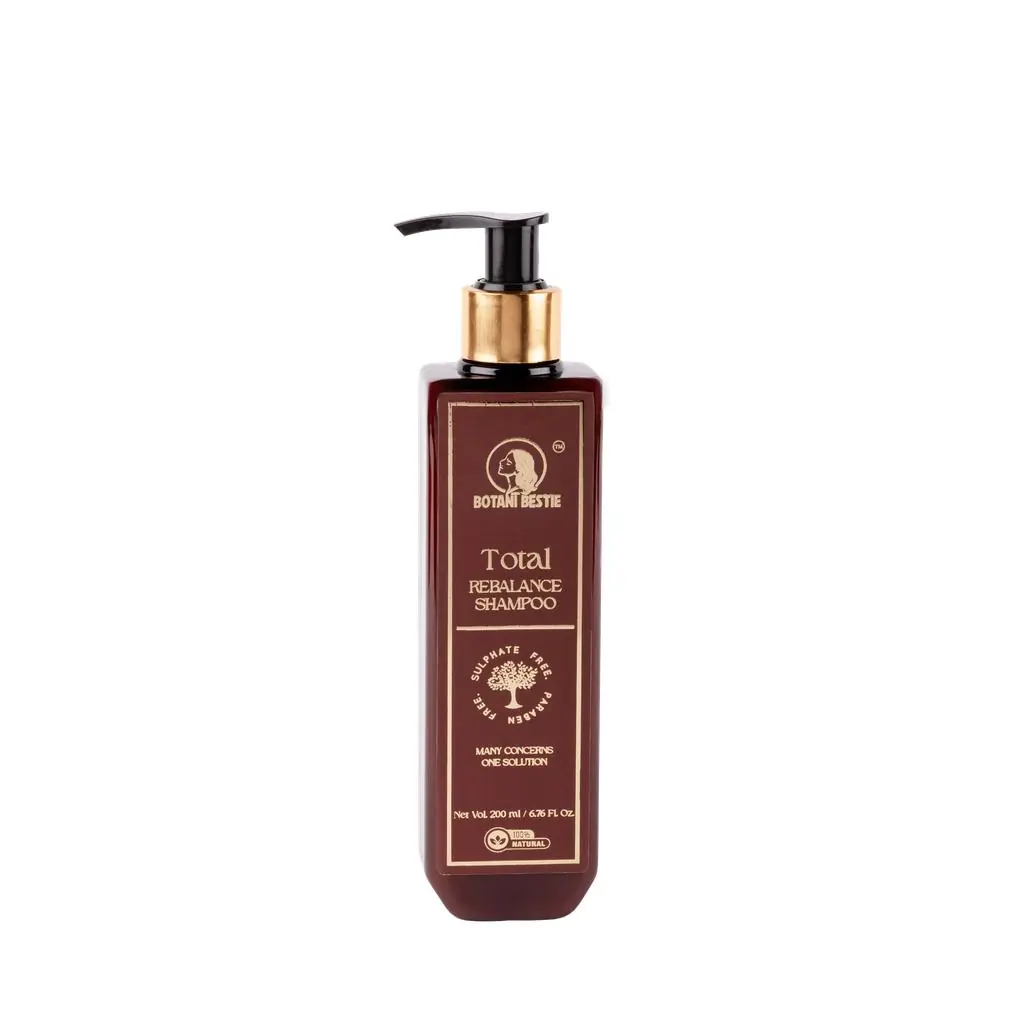
Total Rebalance Shampoo
Sulphate-Free — Every 2–3 Days
Sulphate-free formula removes pollution particle accumulation without stripping the protective acid mantle or barrier lipids that are the first defence against the next day's exposure. Green tea EGCG delivers AhR antagonism at the scalp surface during the wash — blocking the receptor that PM2.5 and PAHs use to suppress hair growth proteins. Bhringraj extract (eclipta prostrata) reduces the scalp inflammatory response triggered by particle deposition. Rice water inositol repairs the cuticle surface oxidised by pollution-generated ROS. pH-balanced to 4.5–5.5 — preserving the acid mantle that prevents pollutant bacteria from colonising a stripped, alkaline scalp.
Shop Total Rebalance Shampoo →
Total Restore Hair Oil
Pre-Wash Scalp Oil — 2–3x weekly
The post-wash barrier restoration and pre-wash AhR/ROS defence. Amla (emblicanins — highest ORAC antioxidants + Vitamin C for heavy metal chelation), Bhringraj (anti-inflammatory + 5α-R inhibition — directly counteracting pollution's androgenetic acceleration), Green Tea EGCG (AhR antagonism in the carrier), and Jatamansi (melanocyte protection against pollution-accelerated greying). Applied to the scalp 2–3x weekly before washing: the antioxidant-rich oil creates a protective layer that quenches ROS generated by pollution particles already on the scalp before they penetrate to the follicle, then is washed off with accumulated particles. Apply immediately after washing to restore barrier lipids removed by the cleanse.
Shop Total Restore Hair Oil →Worsening Hair Fall in a Polluted City? Get a Targeted Assessment
Pollution hair fall often co-exists with nutritional deficiency (pollution-driven zinc and copper depletion), androgenetic alopecia (pollution accelerates DHT-driven miniaturisation), and scalp inflammatory conditions. Our dermatologist identifies every contributing factor and builds a protocol that addresses them all simultaneously. No purchase required.
Book Free Consultation → WhatsApp UsFrequently Asked Questions

The Bottom Line: Pollution Is a Real Hair Loss Cause — and the Defence Is Specific
Until 2019, the link between air pollution and hair fall was suspected but unproven at the molecular level. The AhR pathway discovery changed that. We now know exactly which receptor is activated, which proteins are suppressed, and what the resulting follicle-level consequence is. The biology is clear; the mechanism is targetable.
For the majority of urban Indians — especially Delhi residents in winter, Mumbai residents year-round, and Bangalore residents in areas of active construction — pollution is not a vague, unmeasurable background risk. It is an active, daily dose of AhR activators, PAHs, and heavy metals landing on the scalp's most vulnerable structure: the follicular openings that lead directly to the cells that determine whether your hair grows or sheds.
The defence is specific: EGCG blocks the AhR receptor; Amla quenches the ROS; sulphate-free washing removes the deposits without compounding the damage; scalp covering reduces the dose. None of these measures is individually sufficient. Together, they substantially reduce pollution's cumulative impact on the follicle — in a country where avoiding pollution entirely is not an available option.
Shop Total Rebalance Shampoo → Free Hair Consultation"Delhi's air is writing a story on your scalp every day. The question is whether your routine is erasing it fast enough."
Ready to make the honest switch?
Our products are built on the same principles as every article we write — pure ingredients, real results, nothing to hide.
Explore Our Products