Retinol is the most clinically validated anti-ageing skincare ingredient that exists. Decades of peer-reviewed research confirm it increases collagen production, accelerates cell turnover, reduces hyperpigmentation, and visibly reduces fine lines. No other over-the-counter ingredient comes close to its evidence base.
But the standard retinol advice — "start low, go slow, use at night, wear SPF" — was developed primarily for lighter skin tones (Fitzpatrick I–III). For Indian skin (predominantly Fitzpatrick IV–VI), there is a specific risk that the standard advice glosses over: any irritation from retinol — redness, peeling, even mild dryness — can trigger melanocytes to deposit excess pigment, leaving dark marks that last months. This is post-inflammatory hyperpigmentation (PIH), and it is dramatically more common and more severe in darker skin tones.
This doesn't mean retinol is unsafe for Indian skin. It means the introduction protocol needs to be more conservative, the ingredients you pair it with matter more, and your morning cleanser is not an afterthought — it is part of the retinol equation.
The Retinoid Family: What's the Difference?
All retinoids are vitamin A derivatives. The skin converts them to retinoic acid — the active form that actually binds to nuclear receptors and drives gene expression changes. The fewer conversion steps required, the more potent and faster-acting (and more irritating) the retinoid.
| Retinoid | Conversion Steps to Retinoic Acid | Relative Potency | Availability in India | Best For |
|---|---|---|---|---|
| Retinyl Palmitate / Retinyl Acetate | 3 steps | Mildest | OTC — in many moisturisers | Retinol-sensitive skin, maintenance |
| Retinol | 2 steps | Moderate | OTC — most common beginner form | Best starting point for Indian skin |
| Retinal (Retinaldehyde) | 1 step | ~11× retinol | OTC — growing availability | Retinol veterans (6+ months tolerance) |
| Tretinoin (Retinoic Acid) | 0 steps (already active) | Highest | Prescription only | Dermatologist-managed treatment |
| Adapalene | Synthetic, receptor-selective | Moderate, acne-specific | OTC (0.1%) / Prescription (0.3%) | Acne and comedonal acne primarily |
What Retinol Actually Does (The Mechanism)
Understanding the mechanism explains both why retinol works so well and why it causes the side effects it does.
Increased Cell Turnover
Retinol binds to nuclear receptors (RARs and RXRs) and activates gene transcription that accelerates keratinocyte division. Skin cells that normally turn over every 28–40 days in adult Indian skin begin turning over every 14–21 days. This pushes out pigmented, sun-damaged, and congested cells faster — producing smoother, brighter skin over 8–12 weeks.
Collagen Synthesis
Retinol stimulates fibroblasts to produce Type I and Type III collagen — the structural proteins that give skin its firmness. Simultaneously, it inhibits matrix metalloproteinases (MMPs), the enzymes that break down existing collagen. The net result over 16–24 weeks of consistent use is measurably thicker dermis and reduced fine line depth.
Hyperpigmentation Reduction
By accelerating turnover, retinol moves melanin-rich cells from the deeper epidermis to the surface where they are shed. Over time this reduces the appearance of sun spots, PIH, and uneven skin tone. This is the mechanism that makes retinol paradoxically beneficial for dark spots — but irritation during the process can add new PIH, temporarily worsening the issue before it improves.
Sebum Regulation
Retinol reduces sebaceous gland activity by downregulating lipogenic gene expression in sebocytes. This is why it's effective for acne-prone and oily skin in the long term — but explains the "purging" phase in the short term, where accelerated turnover clears existing congestion rapidly, temporarily mimicking a breakout.
Why Indian Skin Needs a Different Approach
Indian skin spans Fitzpatrick types III to VI — predominantly IV and V. This melanin-rich profile confers significant photoprotection (Indian skin has natural SPF equivalent of approximately 10–15) but creates one major vulnerability: the melanocytes are hyperreactive.
When skin experiences inflammation — from retinol irritation, a pimple, friction, or anything that disrupts the epidermis — melanocytes respond by producing excess melanin as a protective response. In lighter skin (Fitzpatrick I–III), this produces temporary redness that fades in days. In Indian skin (IV–VI), it deposits melanin granules that remain visible as a dark patch for weeks to months — sometimes over a year without treatment.
This is PIH, and it is the primary reason retinol must be introduced more carefully in Indian skin than the standard advice suggests.
| Factor | Standard Retinol Advice (Fitzpatrick I–III) | Indian Skin Adjustment (Fitzpatrick IV–VI) |
|---|---|---|
| Starting concentration | 0.025–0.1% | 0.025% or lower — lowest available |
| Starting frequency | 2–3× per week | Once per week for first 4 weeks |
| Purging management | Continue through purging | Slow down if active inflammation — PIH risk is real |
| Barrier support | Recommended | Essential — non-negotiable to prevent PIH cascade |
| SPF usage | Strongly recommended | Mandatory — UV exposure on retinol-sensitised skin massively amplifies PIH |
| Upgrade to retinal/tretinoin | After 3 months tolerance | After 6+ months consistent retinol tolerance — and ideally under dermatologist guidance |
The Sandwich Method: The Correct Way to Start Retinol for Indian Skin
The sandwich method reduces retinol's irritation potential by buffering it between two layers of moisturiser. The mechanism: moisturiser on the skin before retinol application dilutes the retinol's contact concentration slightly and maintains the skin barrier during application. Moisturiser on top locks in hydration and limits transepidermal water loss that retinol's exfoliation mechanism can trigger.
Cleanse (PM only)
Gentle, low-pH cleanser. Pat skin dry — do not rub. Wait 20–30 minutes after cleansing before applying retinol. This is called the "wait time rule": freshly washed skin with an open acid mantle absorbs retinol more aggressively, increasing irritation risk. The wait allows the skin's surface pH to return to its natural 4.5–5.5.
First moisturiser layer (the bottom bread)
Apply a thin layer of a fragrance-free moisturiser with barrier-supporting ingredients (ceramides, hyaluronic acid, glycerin). Let it absorb for 1–2 minutes. This creates a slight buffer between your skin's surface and the retinol.
Retinol (the filling)
Use a pea-sized amount for the entire face — never more. Apply in upward, outward strokes. Avoid the eye area, sides of the nose, and corners of the mouth — these thin-skinned areas are most irritation-prone. Do not apply to broken skin, active pimples, or areas with eczema.
Second moisturiser layer (the top bread)
Apply the same or a richer moisturiser on top immediately after retinol. This seals the retinol application, limits transepidermal water loss overnight, and supports barrier repair during sleep — when most retinol metabolism occurs.
Morning after: SPF 50+ — non-negotiable
Retinol thins the stratum corneum and dramatically increases photosensitivity. UV exposure the morning after a retinol application — even brief — produces inflammation that triggers PIH in Indian skin. SPF 50+ broad-spectrum sunscreen, every single morning, is not optional while using retinol. This is the most skipped step and the most consequential one for Indian skin users.
Purging vs Breakout: How to Tell the Difference
This is the question most first-time retinol users in India get wrong — and the consequence of misreading it can mean months of PIH.
- Appears within weeks 2–6 of starting retinol
- Pimples appear in areas you already break out (chin, forehead, nose)
- Small, close-to-the-surface bumps or whiteheads
- Resolves on its own within 4–8 weeks of continued use
- Skin quality improves after it clears
- No new areas affected over time
- Appears after 6–8+ weeks with no improvement
- Pimples appear in new areas (cheeks, neck, jawline) you don't normally break out
- Deep, cystic, or inflamed lesions rather than surface bumps
- Worsens progressively rather than peaking and declining
- Accompanied by increased redness, burning, or tightness
- Skin quality does not improve after 10 weeks
What to Pair With Retinol (and What to Avoid)
When Not to Use Retinol
Absolute Contraindications
- Pregnancy — all retinoids, including OTC retinol, are contraindicated in pregnancy due to teratogenic risk
- Breastfeeding — avoid as a precaution; topical absorption is low but systemic safety data is limited
- Active rosacea flare — retinol will aggravate active inflammation
- Active eczema or psoriasis on the face — compromised barrier cannot handle retinol irritation
Proceed with Extra Caution
- Active sunburn — wait until healed completely
- Pre/post waxing — avoid for 48 hours before and after facial waxing
- Pre/post facial procedures — laser, chemical peel, microneedling — pause retinol 1 week before and after
- Very dry or dehydrated skin — restore barrier first before adding retinol
Why Your Morning Cleanser Matters When Using Retinol
Most retinol guides end with "apply SPF in the morning." They rarely explain that what you wash your face with before that SPF is equally critical — especially for Indian skin.
Retinol's accelerated cell turnover means the skin's outermost layer is newer, thinner, and more permeable than normal. A harsh face wash in the morning — high pH, heavy sulfates, physical scrubbing — strips the acid mantle from already-sensitised skin, increasing transepidermal water loss and making the skin more reactive to anything that touches it that day, including UV radiation through SPF.
A gentle, low-pH face wash in the morning preserves the acid mantle, maintains the barrier retinol is working to remodel, and reduces the total daily irritation load — a critical variable for preventing PIH in Indian skin.
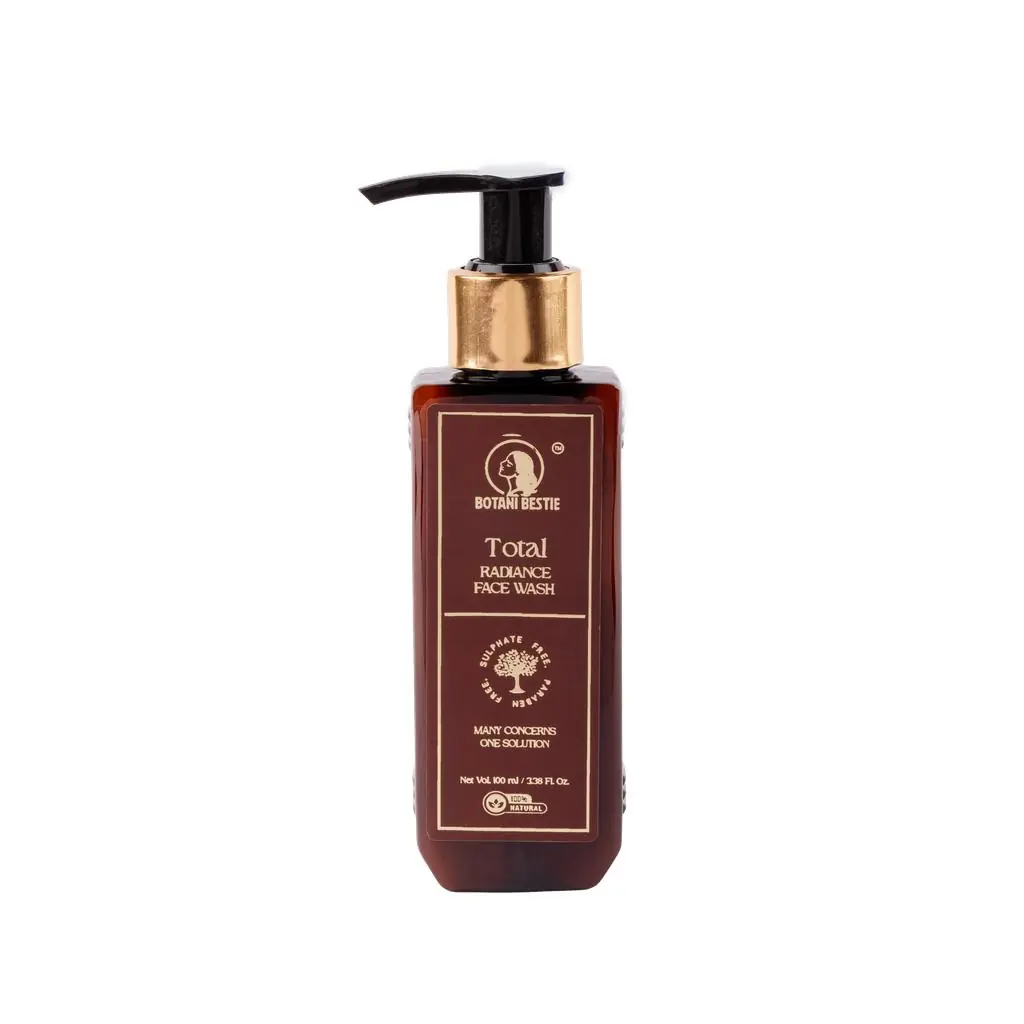
Total Radiance Face Wash
Formulated to cleanse without stripping — specifically important for retinol users whose skin barrier is in active remodelling. Free from harsh sulfates and high-pH soap bases that disrupt the acid mantle. Contains Turmeric and Vitamin C to independently address the PIH and brightening goals that most Indian skin retinol users have — so your morning routine works with your retinol rather than against it.
View Total Radiance Face WashReady to make the honest switch?
Our products are built on the same principles as every article we write — pure ingredients, real results, nothing to hide.
Explore Our Products