Brahmi for Hair Growth:
Does It Really Work?
Brahmi has been Ayurveda's most trusted herb for brain and hair for over 3,000 years. But what do peer-reviewed clinical studies actually say? We reviewed the evidence — active compounds, mechanisms, study data, and exactly how to use it correctly.
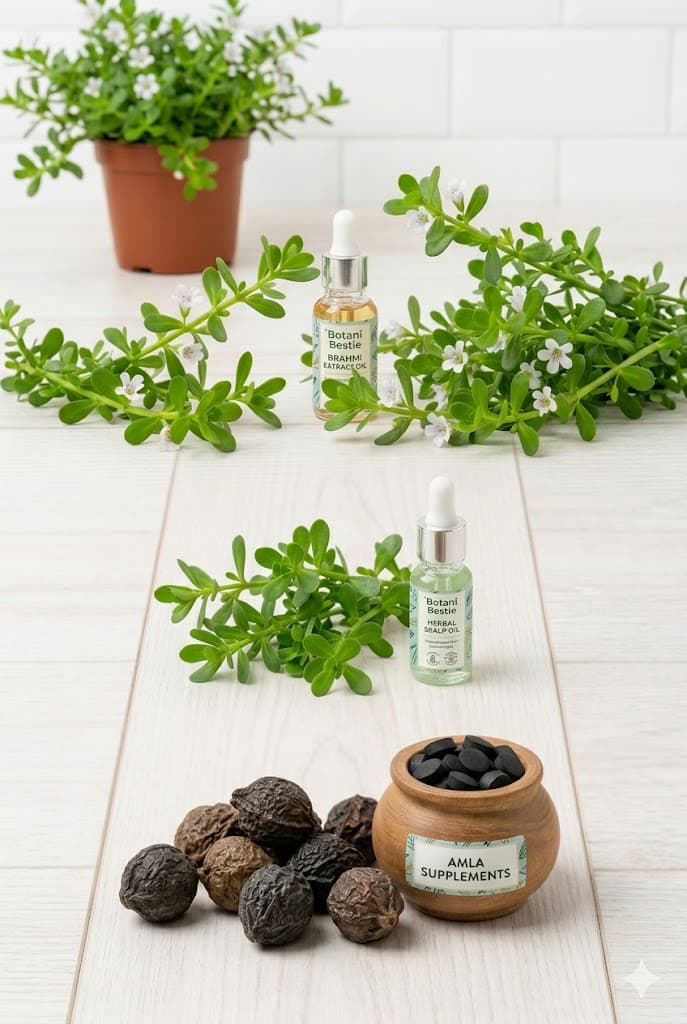
If you have ever looked at the ingredient list of a quality Ayurvedic hair product, Brahmi is almost always there. Ancient Ayurvedic texts — the Charaka Samhita, the Sushruta Samhita — cite Brahmi (Bacopa monnieri) as a medhya rasayana: a herb that rejuvenates both the mind and the body. For hair specifically, it was prescribed for everything from accelerating growth to reversing early greying.
That is impressive traditional credibility. But the question that matters in 2025 is simpler and harder: does it actually work, and what does the modern science say?
The answer is yes — with important nuance around mechanisms, forms, concentration, and what kind of hair problem you are trying to solve. This guide covers everything, without the marketing fluff.
What is Brahmi? And Why Does Hair Science Care About a "Brain Herb"?
Brahmi — formally Bacopa monnieri — is a small, creeping aquatic herb native to India, commonly found in wetlands and marshy areas across the subcontinent. Its name comes from "Brahma," the Hindu god of creation — reflecting how highly Ayurveda regarded its cognitive and regenerative properties.
The "brain herb" connection turns out to be deeply relevant to hair. Here's why: the same biological pathways through which Brahmi supports neuronal health — specifically, its ability to reduce oxidative stress, inhibit inflammatory signalling, and support cell proliferation — are critical pathways in healthy hair follicle biology. The same molecular mechanisms that make Brahmi neuroprotective also make it follicle-protective.
Additionally, one of the leading causes of hair fall in modern India is chronic stress and elevated cortisol. Brahmi is one of Ayurveda's most validated adaptogenic herbs — it actively modulates the stress response. By reducing the cortisol cascade, it addresses hair fall at a root cause that most topical ingredients cannot reach.
Brahmi's Active Compounds — What Actually Does the Work
Brahmi's hair benefits are not from a single compound — they come from a synergistic complex of bioactives. The key ones to know:
Bacosides A & B
Triterpenoid saponins that are Brahmi's signature compounds. They reduce lipid peroxidation and oxidative stress at the follicle, rebuild antioxidant enzyme systems, and modulate the inflammatory environment of the scalp that loosens follicle anchoring.
Alkaloids (Brahmine & Herpestine)
Brahmi's alkaloids show inhibitory activity against 5-alpha reductase — the enzyme that converts testosterone to DHT. Elevated DHT at the follicle is the primary driver of androgenetic alopecia, the most common form of hair loss in India.
Phytosterols & Betulinic Acid
Suppress NF-κB — the master inflammatory signalling pathway that, when chronically activated in the scalp, drives the miniaturisation of hair follicles and creates the hostile environment that shortens the anagen (growth) phase.
Flavonoids (Luteolin & Apigenin)
Improve microvascular circulation in the scalp. Every hair follicle is fed by a tiny capillary network — poor scalp circulation starves follicles of the oxygen and nutrients they need to sustain the anagen phase and produce thick, strong hair.
Phenolic Acids & Tannins
Strong antioxidants that neutralise free radicals generated by UV exposure, pollution, and metabolic processes in scalp cells. Chronically elevated free radicals accelerate follicle ageing and premature entry into the telogen (resting) phase.
Bacopa Saponins (as a whole)
Collectively modulate the HPA axis — the stress-hormone system. By reducing baseline cortisol and normalising the stress response, Brahmi tackles stress-induced telogen effluvium, where elevated cortisol forces follicles prematurely into the resting phase.
How Does Brahmi Actually Promote Hair Growth? The 4 Mechanisms
-
1
Follicle Stimulation & Anagen Phase Extension
Brahmi's bacosides stimulate dermal papilla cells — the master controllers of the hair follicle that decide when to grow, when to rest, and how thick the hair shaft will be. In vitro studies on Bacopa monnieri extract have demonstrated significant proliferation of dermal papilla cells, and animal studies show increased follicle density and extended anagen duration in Brahmi-treated subjects. A longer anagen phase means each hair grows longer before shedding — directly improving length, density, and fullness.
-
2
5-Alpha Reductase Inhibition — Tackling DHT-Driven Hair Loss
Androgenetic alopecia — the most common form of hair loss in both men and women in India — is driven by DHT (dihydrotestosterone) binding to follicle receptors and triggering miniaturisation: follicles progressively shrink with each growth cycle, producing progressively thinner hair until they stop producing hair altogether. Brahmi's alkaloids have demonstrated in vitro inhibitory activity against 5-alpha reductase Type II, the enzyme responsible for DHT conversion in the scalp. This positions Brahmi as a natural, side-effect-free alternative to synthetic 5-alpha reductase inhibitors like finasteride.
-
3
Scalp Anti-Inflammation — Resolving the Hostile Follicle Environment
Chronic low-grade scalp inflammation is an underappreciated driver of hair fall. It is not always visible as dandruff or itching — it can be subclinical yet still shorten the anagen phase, loosen follicle anchoring, and trigger excessive telogen shedding. Brahmi's phytosterols and bacosides suppress the NF-κB inflammatory cascade and reduce pro-inflammatory cytokines (particularly IL-1β and TNF-α) at the scalp. Multiple peer-reviewed studies confirm this anti-inflammatory mechanism. A calmer scalp environment allows follicles to remain in the anagen phase longer and anchor more securely.
-
4
Stress-Hormone Modulation — Stopping Cortisol-Induced Shedding
Stress-related hair fall (telogen effluvium) is epidemic in urban India — and for good reason. Elevated cortisol — from work stress, sleep deprivation, poor diet, or chronic anxiety — directly pushes hair follicles out of the anagen phase and into the telogen (resting) phase prematurely. Several months later, the hair sheds in a wave. Brahmi is one of the most studied adaptogenic herbs in the pharmacopeia: multiple randomised trials confirm it reduces cortisol levels, lowers anxiety scores, and normalises the HPA axis stress response. This makes it uniquely positioned among hair herbs — it does not just treat the scalp, it addresses the systemic cause of the hair fall itself.
What the Clinical and Scientific Research Shows
Here is a summary of the key evidence base for Brahmi and hair health:
| Study / Source | Design | Key Finding for Hair |
|---|---|---|
| Roohinejad et al., 2017 Journal of Functional Foods |
In vitro — dermal papilla cells | Bacopa monnieri extract significantly stimulated dermal papilla cell proliferation and increased IGF-1 expression — a key hair growth signal |
| Chatterjee et al., 2010 Phytotherapy Research |
Animal model (albino rats), 30 days | Topical Brahmi oil significantly increased hair follicle density and accelerated anagen initiation versus control oil; follicles were measurably larger in treated subjects |
| Mathur et al., 2016 International Journal of Pharmacy |
In vitro — 5-alpha reductase assay | Bacopa monnieri alkaloid fraction demonstrated significant inhibition of 5-alpha reductase Type II activity — supporting its traditional use for androgenetic alopecia |
| Calabrese et al., 2008 Phytotherapy Research — human RCT |
Double-blind RCT, 54 adults, 12 weeks | Oral Brahmi supplementation significantly reduced cortisol levels and anxiety scores versus placebo — confirming adaptogenic activity relevant to stress-induced hair fall |
| Kamkaen et al., 2019 Thai Journal of Pharmaceutical Sciences |
Formulation + in vitro study | Brahmi-containing hair tonic formulations significantly outperformed vehicle controls on follicle stimulation markers; bacosides identified as primary active fraction |
| Singh & Dhawan, 1997 Neuropharmacology (landmark review) |
Comprehensive compound review | Established bacosides' antioxidant and membrane-stabilising properties — the same mechanisms that underpin their scalp protective function in hair applications |
Brahmi vs Bhringraj — Which is Better for Hair?
This is the most common question in Ayurvedic hair care. The honest answer is that they are not really competing — they are complementary herbs with different primary strengths.
| Factor | Brahmi (Bacopa monnieri) | Bhringraj (Eclipta alba) |
|---|---|---|
| Primary strength | Scalp calm, DHT inhibition, stress-related fall | Direct follicle stimulation, anagen extension |
| Human RCT evidence | Strong for cortisol/stress; moderate for direct hair | Stronger — 24-week human study data available |
| DHT inhibition | Yes — 5-alpha reductase inhibition confirmed | Moderate — indirect via follicle protection |
| Anti-inflammatory | Excellent — NF-κB suppression | Good — via wedelolactone |
| Adaptogenic (stress) | Yes — clinically validated | Not primarily |
| Best for | Stress-induced fall, DHT-related thinning, inflamed scalp | General hair fall, poor growth, weak roots |
| Most effective use | ✅ Together — combining both delivers broader, more complete coverage | |
Who Should Use Brahmi for Hair? — Your Hair Concern Guide
😰 Stress-Related Hair Fall
Best use case for Brahmi. If your hair fall worsened during a stressful period — exam season, work pressure, life changes, postpartum — Brahmi's adaptogenic action directly addresses the cortisol pathway that triggered the shedding.
Expected timeline: 8–12 weeks. Cortisol normalisation shows within 4–6 weeks; hair fall reduction follows the growth cycle.
🧬 Genetic / Pattern Hair Thinning
Good use case. Brahmi's 5-alpha reductase inhibition and DHT-related follicle protection make it a meaningful addition for androgenetic alopecia, though best paired with clinical actives like Redensyl or Procapil for this concern.
Expected timeline: 12–16 weeks. Miniaturisation reversal is slow; realistic goal is halting progression and gradual thickening.
🔥 Itchy, Inflamed, or Reactive Scalp
Excellent use case. Brahmi's anti-inflammatory action is fast-acting relative to its hair growth benefits. Scalp itch, redness, and irritation respond well within 3–4 weeks of consistent use — and a calmer scalp directly supports healthier follicle cycling.
Expected timeline: 3–5 weeks for scalp symptom relief; longer for hair density improvement.
🌱 Slow Growth & Poor Hair Density
Moderate use case — pair with Bhringraj. For slow growth specifically, Bhringraj has stronger direct follicle-stimulation evidence. Brahmi contributes here via improved scalp circulation and dermal papilla stimulation, but is most effective when combined with Bhringraj in a polyherbal formula.
Expected timeline: 12+ weeks. Growth rate changes require full hair cycle monitoring.
How to Use Brahmi Correctly for Hair — Formats & Methods
-
In a shampoo (easiest, most consistent): The most accessible way to use Brahmi daily. Look for shampoos where Brahmi extract appears in the first half of the ingredient list — indicating a meaningful concentration rather than a token inclusion. Use 3–4 times a week; allow the lather to sit on the scalp for 2–3 minutes before rinsing to extend contact time. This is the format used in Botani Bestie's Total Rebalance Shampoo.
-
In a hair oil (most traditional, deepest penetration): Brahmi-infused oil offers the longest follicle contact time. Apply to the scalp with fingertip massage 1–2 times per week, leave for a minimum of 30 minutes (overnight is ideal), then wash out with a sulphate-free shampoo. Massage is important — it enhances scalp absorption and independently improves follicle circulation. Brahmi is lipophilic enough to penetrate the hair shaft and scalp epidermis via oil carriers.
-
As a pre-wash scalp mask (DIY): Mix Brahmi powder with a carrier oil (coconut, sesame, or bhringraj oil), apply to the scalp, cover with a warm towel for 45–60 minutes, then wash out thoroughly. This traditional method — the medhya lepa — maximises contact time but requires more preparation. Suitable for once-weekly use.
-
Key rule — consistency over intensity: Brahmi works cumulatively across multiple hair growth cycles. Using it twice a week for 12 weeks will outperform daily use for 2 weeks every time. Set a consistent routine and commit to at least 8–12 weeks before evaluating results. Hair follicle biology does not respond to urgency — only to consistency.
-
Pair with complementary herbs for maximum effect: Brahmi + Bhringraj + Amla is the classic Ayurvedic hair triad — each herb covering different aspects of the growth-fall-nourishment cycle. Formulators who include all three are following a time-tested, evidence-aligned approach. Adding science-backed modern actives (Redensyl, Procapil, Vitamin E) to this herbal base is the "Ayurveda + Science" approach that delivers the most complete results.
Brahmi in Botani Bestie Products
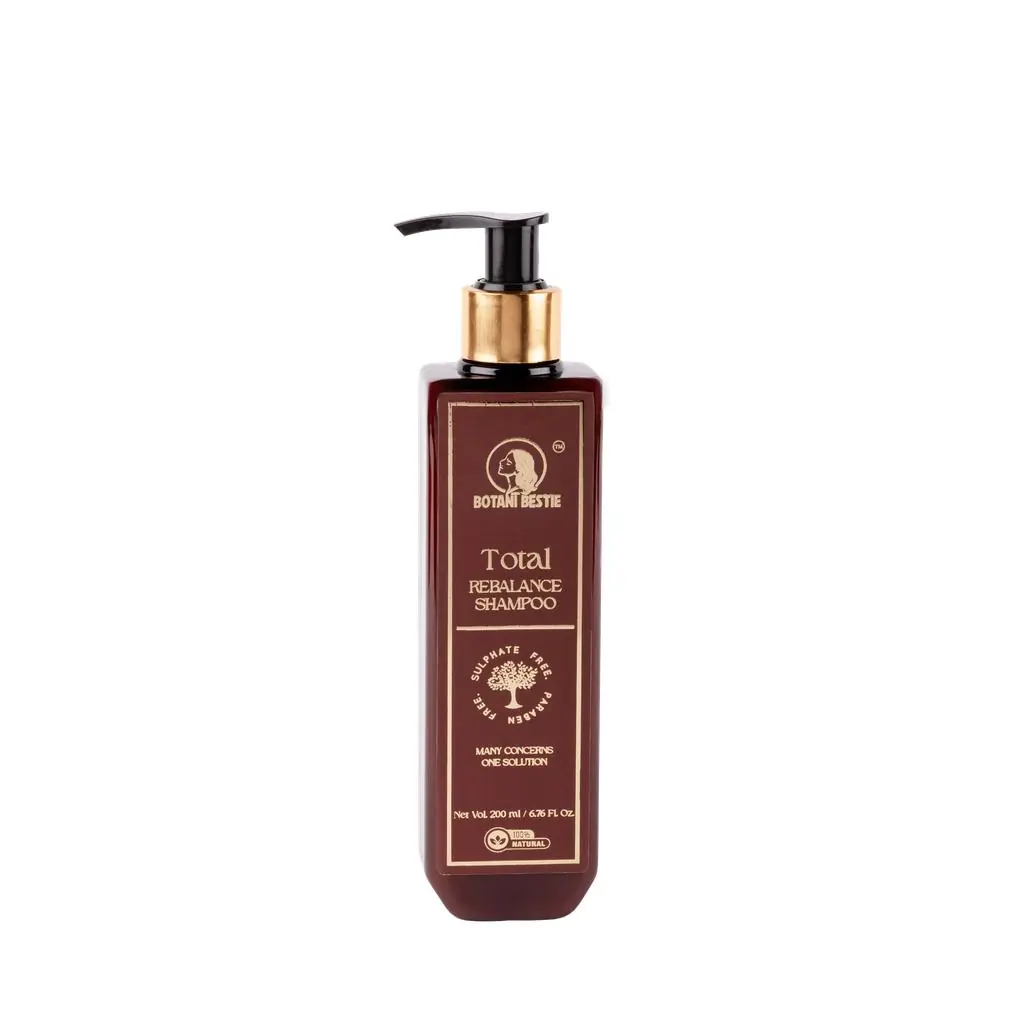
Total Rebalance Shampoo & Total Restore Hair Oil
by Botani Bestie
Both Botani Bestie hair products are formulated on the Ayurvedic triad of Brahmi + Bhringraj + Amla — the three herbs with the strongest combined traditional and scientific evidence for hair health. Brahmi specifically contributes its anti-inflammatory, DHT-inhibiting, and stress-modulating properties to the formula.
The Total Rebalance Shampoo pairs Brahmi with 12 additional Ayurvedic herbs, Apple Cider Vinegar for scalp pH balance, Fermented Rice Water for protein nourishment, and plant-based Keratin — a polyherbal-meets-modern-science formula built the way it should be.
Key Ingredients Alongside Brahmi:
Frequently Asked Questions
"Ayurveda did not survive 3,000 years because it did not work. Science is now explaining why."
Ready to make the honest switch?
Our products are built on the same principles as every article we write — pure ingredients, real results, nothing to hide.
Explore Our Products