Vitamin & Nutrient Deficiencies That Cause Hair Loss — Iron, Vitamin D, Zinc & B12: The Honest India Guide
The most common cause of diffuse hair fall in Indian women is not genetics, not stress, and not your shampoo — it is an undiagnosed deficiency in iron, Vitamin D, Zinc, or Vitamin B12. This guide covers the exact biological mechanisms, the correct tests, the levels that actually matter for hair (not just for 'normal range'), and what to do about each one.
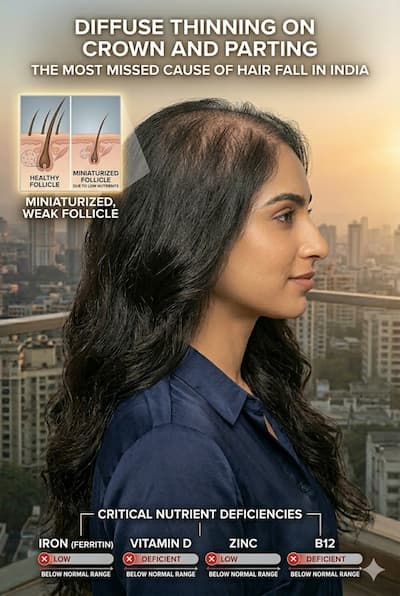
In the average dermatology clinic in India, the single most common diagnosis behind diffuse hair fall in women aged 18–45 is nutritional deficiency — specifically, low ferritin (stored iron), Vitamin D deficiency, zinc depletion, or Vitamin B12 deficiency. Often, more than one deficiency is present simultaneously.
Yet millions of people with these deficiencies are told their 'reports are normal,' because the standard reference ranges are set for general health — not for optimal hair follicle function. A ferritin of 15 ng/mL is technically above the 'anaemia threshold' but is far below the level at which hair follicles can sustain normal growth. The same gap exists for Vitamin D and B12.
This guide explains the mechanism behind each deficiency, the specific tests and optimal levels relevant to hair health (not just disease prevention), and the recovery timeline — so you can approach your own investigation with the right questions and the right tests.
⚡ Nutritional Deficiency Hair Loss — Quick Reference
| Nutrient | Test to Request | Standard 'Normal' | Hair-Optimal Level | Hair Loss Pattern |
|---|---|---|---|---|
| Iron (Ferritin) | Serum Ferritin + Serum Iron + TIBC | >12 ng/mL (women) | 70–80 ng/mL | Diffuse shedding; increased daily hair count; widening parting |
| Vitamin D | 25-OH Vitamin D (25-hydroxyvitamin D) | >20 ng/mL | 40–60 ng/mL | Diffuse thinning; alopecia areata patches |
| Zinc | Serum Zinc | 70–120 mcg/dL | Above 80 mcg/dL | Rapid diffuse shedding; brittle, slow-growing hair |
| Vitamin B12 | Serum B12 + MMA (methylmalonic acid) | >200 pg/mL | 400–600 pg/mL | Diffuse shedding; premature greying |
Why Hair Follicles Are Uniquely Vulnerable to Nutritional Deficiency
Hair follicles are not passive structures — they are metabolically among the most active tissues in the body. The hair matrix, at the base of each follicle, contains some of the fastest-dividing cells in human biology, with a cell cycle of approximately 24–72 hours during active growth. This relentless cell division demands a continuous and generous supply of micronutrients: iron for oxygen delivery and enzymatic activity, zinc for DNA synthesis and keratin production, B12 for cell division and methylation, Vitamin D for follicle cycling regulation.
Because the body treats hair growth as a low-priority metabolic process — nutrients are preferentially directed to vital organs — even a modest shortfall in any of these nutrients will manifest in the hair before it becomes apparent in a blood panel. This is why hair loss can be the first and only symptom of a deficiency that is still technically within 'normal' laboratory ranges.
The 'Normal Range' Problem
Standard laboratory reference ranges are designed to identify frank deficiency or disease — not to identify the level needed for optimal organ-specific function like hair growth. Ferritin above 12 ng/mL does not cause anaemia; but hair follicles need ferritin above 40–70 ng/mL to sustain normal growth. This gap between 'disease threshold' and 'optimal function threshold' is the reason that millions of people with clear nutritional causes of hair loss are told their results are normal. Ask your doctor specifically: "Are these levels optimal for hair follicle function?"
Iron Deficiency & Hair Loss — The Most Common Missed Cause
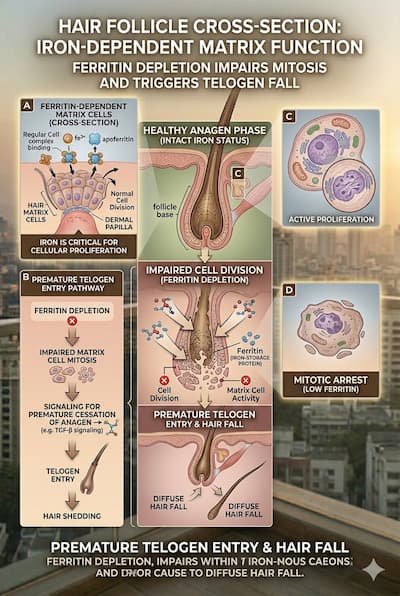
Iron deficiency is the most prevalent nutritional deficiency in India — estimated to affect over 50% of women of reproductive age — and it is also the most commonly missed cause of diffuse hair loss. The critical distinction that most people miss:
Hair loss does not require anaemia. Anaemia (low haemoglobin) is the late-stage consequence of iron depletion, occurring after the body has exhausted all stored iron. Hair follicles lose their iron supply much earlier — when stored iron (measured as serum ferritin) drops below approximately 40–70 ng/mL.
A 2006 study in the Journal of Investigative Dermatology by Trost et al. confirmed that ferritin levels below 40 ng/mL are significantly associated with telogen effluvium in premenopausal women. A subsequent 2010 clinical review in Dermatology recommended targeting ferritin above 70 ng/mL in women with active hair shedding.
The Mechanism: How Iron Deficiency Damages Hair
| Iron Function | What Happens When Iron Is Low | Hair Effect |
|---|---|---|
| Oxygen delivery (haemoglobin) | Reduced oxygen supply to dermal papilla cells at follicle base | Impaired energy production; follicle enters resting phase prematurely |
| Ribonucleotide reductase cofactor | DNA synthesis in hair matrix cells is impaired | Cell division slows; anagen phase shortens; hair thins |
| Ferritin in follicle | Ferritin is actually stored in dermal papilla cells and acts as a local iron reservoir for the follicle | Ferritin depletion triggers follicle-level iron starvation even before systemic anaemia |
| Mitochondrial function | Iron-sulfur cluster proteins in mitochondria impaired; ATP production falls | High-energy follicle cells disproportionately affected |
Iron Deficiency Hair Loss in India — Why It Is So Common
Several India-specific factors make iron deficiency hair loss particularly prevalent:
- Vegetarian and vegan diets: Haem iron (from animal sources) is 2–3x more bioavailable than non-haem iron (from plant sources like spinach, lentils, and rajma). Vegetarians must consume significantly more dietary iron to achieve the same absorption.
- Menstrual blood loss: Each menstrual cycle loses 30–80 mL of blood, equivalent to 15–40 mg of iron. Women with heavy periods (menorrhagia) can lose 200–400 mL per cycle — creating a chronic iron deficit that diet alone cannot correct.
- Tea and coffee consumption: Tannins in chai and coffee form insoluble complexes with non-haem iron in the gut, reducing absorption by up to 60%. Drinking chai with meals significantly impairs iron absorption from a vegetarian diet.
- H. pylori infection: Highly prevalent in India; impairs gastric acid secretion and ferric iron reduction — both necessary for non-haem iron absorption.
- Phytate in staple foods: Whole wheat roti, dal, and rice contain phytic acid that binds non-haem iron and zinc, reducing absorption.
Iron Supplementation for Hair: What the Evidence Shows
A 2013 systematic review in the Journal of the American Academy of Dermatology found that oral iron supplementation improved hair shedding in iron-deficient women, with the benefit correlating with the degree of ferritin correction. The recommended form is ferrous sulphate or ferrous bisglycinate (the latter has higher bioavailability and fewer gastrointestinal side effects).
Key clinical points:
- Take iron on an empty stomach or with Vitamin C (ascorbic acid) — Vitamin C enhances non-haem iron absorption by converting ferric iron to the more absorbable ferrous form.
- Avoid taking iron with tea, coffee, calcium supplements, or antacids — all reduce absorption significantly.
- Re-test ferritin after 3 months of supplementation — not haemoglobin — to confirm stores are rising toward the 70 ng/mL target.
- Dietary iron alone rarely corrects severe deficiency; supplementation is usually required.
Vitamin D Deficiency & Hair Loss — The Sunshine Paradox in India
India is one of the world's sunniest countries — yet paradoxically, Vitamin D deficiency affects an estimated 70–90% of the Indian population. The reasons include sun avoidance (especially among urban women), extensive skin coverage by clothing, melanin in darker skin tones requiring 3–6x longer UV exposure to synthesise equivalent Vitamin D compared to lighter skin, and a diet that is largely Vitamin D-poor (the richest food sources — fatty fish, egg yolks, and liver — are consumed in limited quantities by much of the vegetarian population).
How Vitamin D Regulates the Hair Cycle
Vitamin D does not merely support general health — it has specific, documented roles in the hair follicle:
Vitamin D Receptor (VDR) in the Follicle
VDRs are expressed in keratinocytes of the outer root sheath and in dermal papilla cells. VDR signalling is required for the hair follicle to progress from catagen (regression) back into anagen (growth). VDR-knockout mice — mice engineered without functional Vitamin D receptors — develop near-complete alopecia, even when their calcium levels are maintained normally. This confirms that VDR signalling in the follicle is independent of Vitamin D's classical role in calcium metabolism.
Clinical Evidence for Vitamin D and Hair Loss
A 2013 study in Skin Pharmacology and Physiology found serum 25-OH Vitamin D significantly lower in women with telogen effluvium (mean 18.2 ng/mL) versus controls (mean 29.3 ng/mL). A 2016 systematic review in the Indian Journal of Dermatology found Vitamin D deficiency consistently associated with alopecia areata (with the lowest levels in patients with extensive disease) and with female pattern hair loss. Supplementation studies show improvement in hair shedding and quality at 3–6 months when levels are corrected to above 40 ng/mL.
- Test with 25-OH Vitamin D (25-hydroxyvitamin D), not 1,25-OH₂ Vitamin D (the active form, which can be normal even when stores are depleted).
- Target 40–60 ng/mL for hair health. Above 100 ng/mL can cause toxicity.
- Typical supplementation for deficiency (<20 ng/mL): 60,000 IU once weekly for 8–12 weeks (prescribed), then 1,000–2,000 IU daily maintenance.
- Vitamin D3 (cholecalciferol) is more effective than Vitamin D2 (ergocalciferol) at raising 25-OH Vitamin D levels.
- Always retest after 3 months of supplementation. Vitamin D is fat-soluble and can accumulate — over-supplementation without testing is genuinely risky.
Zinc Deficiency & Hair Loss — The DHT Connection
Zinc is involved in more than 300 enzymatic reactions in the human body — and several of these are directly critical to hair follicle function. Zinc deficiency produces some of the fastest and most dramatic hair changes of any nutritional deficiency: acute, diffuse shedding can begin within weeks of significant depletion, and the hair that remains may be brittle, dull, and slow-growing.
Zinc's 3 Key Roles in Hair Follicle Biology
| Role | Mechanism | Hair Impact |
|---|---|---|
| DNA & RNA polymerase cofactor | Zinc is essential for the enzymatic activity of DNA and RNA polymerases — the core machinery of cell replication. Hair matrix cells, with their extremely high division rate, require abundant zinc for each cell cycle. | Zinc depletion impairs matrix cell proliferation → shorter anagen → diffuse shedding |
| 5α-Reductase inhibition | Zinc inhibits 5α-reductase — the enzyme that converts testosterone into dihydrotestosterone (DHT), the androgen responsible for miniaturising hair follicles in pattern hair loss. Multiple in vitro studies confirm zinc's dose-dependent 5α-reductase inhibitory activity. | Zinc deficiency → reduced 5α-reductase inhibition → elevated local DHT → accelerated follicle miniaturisation in genetically susceptible individuals |
| Keratin & collagen synthesis | Zinc activates the enzymes responsible for cross-linking keratin polypeptides into the structural protein that forms the hair shaft. It also activates collagenase enzymes in the dermal papilla that are required for follicle remodelling during cycling. | Zinc deficiency → structurally weak hair shaft → brittleness, breakage, and slow growth |
Zinc Deficiency in India — Why It Is Underappreciated
India has a high prevalence of zinc deficiency — estimated at 25–30% of the general population — for reasons that closely parallel iron deficiency: a predominantly vegetarian diet (plant sources provide zinc alongside phytates that block its absorption), staple foods high in phytic acid (whole wheat, legumes, seeds), and widespread intestinal parasitic infections that reduce zinc absorption from the gut.
A 2016 clinical study in Annals of Dermatology compared serum zinc levels between patients with telogen effluvium, alopecia areata, and controls — finding significantly lower zinc in both hair loss groups. Supplementation with 50 mg zinc sulphate daily for 12 weeks produced significant improvement in hair shedding in the deficient group.
Vitamin B12 Deficiency & Hair Loss — India's Hidden Epidemic
Vitamin B12 deficiency is estimated to affect 47–73% of vegetarians and near-universal proportions of vegans in India who do not supplement. It is also common in older adults regardless of diet (due to age-related gastric atrophy and reduced intrinsic factor secretion), in metformin users (the most commonly prescribed diabetes medication in India — metformin impairs B12 absorption from the gut), and in people with H. pylori infection.
How B12 Deficiency Damages Hair
B12 participates in two critical biochemical pathways relevant to hair:
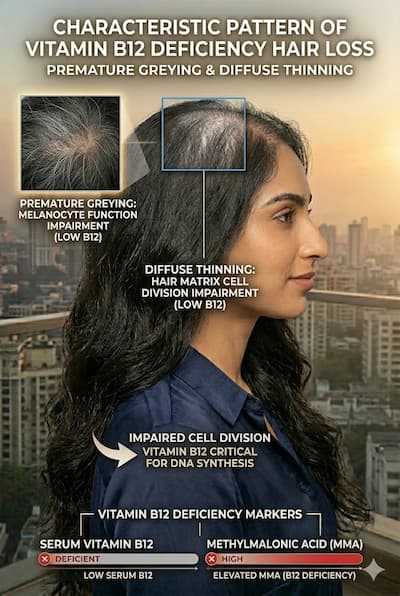
1. DNA methylation and cell division: B12 (as methylcobalamin) is a cofactor for methionine synthase, the enzyme that regenerates methionine from homocysteine. This reaction is essential for S-adenosylmethionine (SAM) synthesis — the universal methyl donor for DNA methylation. Without adequate B12, DNA methylation patterns are disrupted, and the high cell-division demand of hair matrix cells cannot be met. The result: premature anagen termination, increased telogen entry, and diffuse hair shedding.
2. Melanocyte function: B12 is required for melanin synthesis in the melanocytes of the hair bulb. B12 deficiency is a well-recognised cause of premature greying — often appearing before frank anaemia or neurological symptoms. In Indian clinical practice, a young adult with rapid-onset diffuse grey hair alongside hair thinning should have B12 deficiency high on the differential diagnosis list.
B12 Testing — The Serum Level Limitation
Standard serum B12 has significant limitations as a diagnostic test. A serum B12 of 200–400 pg/mL may be reported as 'normal' while tissue-level B12 function is impaired. Methylmalonic acid (MMA) and holotranscobalamin II (active B12) are more sensitive markers of functional B12 status. In clinical practice:
- Serum B12 below 200 pg/mL: definite deficiency — requires supplementation.
- Serum B12 200–400 pg/mL: 'grey zone' — if hair loss is present, consider MMA testing to confirm functional status.
- Target above 400–600 pg/mL for optimal hair follicle function (especially in vegetarians and those on metformin).
- Supplementation form: Methylcobalamin is preferred over cyanocobalamin for neurological protection and is the form most commonly used in India. Sublingual or intramuscular routes are preferred in people with absorption issues (gastric conditions, metformin use, H. pylori).
Multiple Deficiencies at Once — The Most Common Scenario in India
In clinical practice, isolated single-nutrient deficiency causing hair loss is actually less common than multiple co-existing deficiencies. The same dietary patterns (high-phytate vegetarian diet, low animal protein, high tea consumption), the same GI infections (H. pylori, intestinal parasites), and the same physiological stressors (heavy menstrual bleeding, pregnancy, stress) that cause iron deficiency also impair zinc and B12 absorption and often coexist with Vitamin D deficiency.
A practical approach: rather than testing one nutrient at a time, request a comprehensive panel:
- Serum Ferritin (iron storage — the most important single test)
- Serum Iron + TIBC (to assess iron status fully)
- CBC (Complete Blood Count) — to rule out anaemia
- 25-OH Vitamin D (not 1,25-OH₂D)
- Serum Zinc
- Serum Vitamin B12
- TSH — thyroid-stimulating hormone (thyroid dysfunction is the next most common cause of diffuse hair loss after nutritional deficiency)
- Blood glucose + HbA1c (if on metformin)
💡 Diagnosed with a deficiency but not sure which hair products are appropriate for your recovery phase? Our dermatologist can review your reports and build a targeted protocol.
Book Free Hair Consultation →The Recovery Timeline — What to Expect After Correcting Deficiency
Understanding the biological timeline prevents premature discouragement:
As nutrient levels begin rising and dormant follicles are stimulated back into anagen, the new anagen hair pushes out the existing telogen (resting) hair from the follicle. This produces a temporary increase in shedding — often alarming to patients who expect immediate improvement. This is a positive sign, not a worsening. The same phenomenon occurs at the start of effective minoxidil use ("minoxidil shedding") and is a sign that follicles are reactivating. Continue the supplementation protocol; shedding typically peaks at 4–6 weeks and then declines steadily.
If nutrient levels have been corrected to optimal, daily shedding typically returns to normal (below 100 hairs/day) by months 3–4. Fine, short new hairs become visible along the hairline and at the parting. These are fragile — avoid harsh styling, heat, and mechanical stress during this phase. Re-test your nutrient levels at 3 months to confirm levels are in the target range; adjust supplementation dose if needed.
New hair grows at approximately 1 cm per month. At 6 months from the start of recovery, new hair is approximately 6 cm long — noticeable but still establishing. The most dramatic visible improvement in density typically occurs between months 6 and 12. Patience during this phase is critical; nutritional recovery hair loss is fully reversible, but the timeline is determined by biology, not by products. Hair that was miniaturised by combined deficiency and androgen sensitivity may not fully recover to pre-loss density — but the shedding will stabilise and new growth will be healthier and thicker.
Topical Support During Nutritional Recovery — What Actually Helps
While correcting the deficiency is the primary intervention, topical hair care can meaningfully support the recovery phase — reducing the additional follicle stress from scalp inflammation, oxidative damage, and harsh ingredients, while delivering actives that complement the internal nutrient correction.

Total Restore Hair Oil
Scalp Nourishment — 2–3x weekly
Bhringraj (documented 5α-reductase inhibition and follicle stimulation), Amla (high-dose antioxidant — reduces oxidative stress at the follicle during nutrient-deficiency recovery), and Brahmi alongside Redensyl and Anagain. During nutritional deficiency recovery, the follicle environment is under oxidative stress; the antioxidant-rich Ayurvedic base reduces this burden while biotech actives support the re-entry of dormant follicles into anagen.
Shop Total Restore Hair Oil →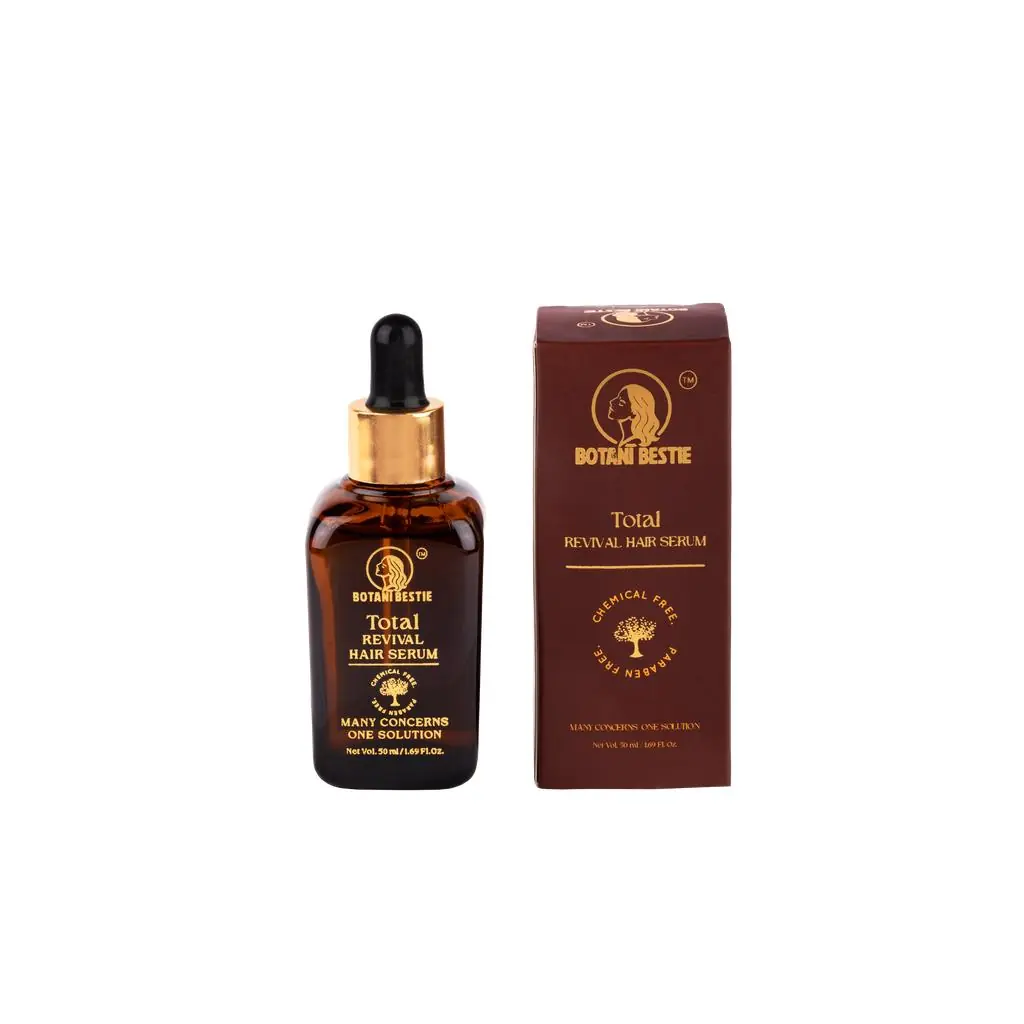
Total Revival Hair Serum
Daily Scalp Serum — AM or PM
Redensyl (the only natural compound with a published clinical trial against minoxidil for anagen stimulation), Procapil (anchors the follicle in the scalp matrix), and Anagain (extends anagen duration) in a daily serum designed to support follicle reactivation during recovery from telogen effluvium. As nutritional levels correct and dormant follicles receive the signal to re-enter anagen, scalp-applied actives provide the local growth-factor environment to support this transition.
Shop Total Revival Hair Serum →Nutritional Hair Loss? Get Your Reports Reviewed
Our in-house dermatologist reviews your blood reports, identifies your specific deficiency pattern, and builds a supplementation and topical protocol for your recovery. Most people are surprised to find they have more than one deficiency contributing to their hair fall. No purchase required.
Book Free Consultation → WhatsApp UsFrequently Asked Questions
The Bottom Line: Test First, Supplement Smart, Wait 12 Months
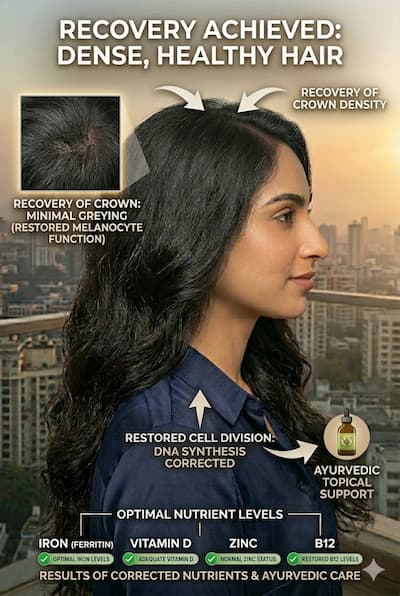
Nutritional deficiency hair loss is one of the most treatable causes of hair fall — but it requires the right tests, the right target levels, and realistic expectations about the timeline. A normal CBC does not rule out iron deficiency hair loss; a normal serum B12 does not rule out functional B12 deficiency; high UV exposure in India does not prevent Vitamin D deficiency.
The most common clinical pattern in Indian women with diffuse hair fall: ferritin below 40 ng/mL, Vitamin D below 20 ng/mL, and B12 below 300 pg/mL — often all three simultaneously. Correcting all deficiencies to optimal levels (not just 'normal' levels), combined with topical follicle support, produces full hair density recovery in the majority of cases.
The timeline is 12–18 months for full recovery. Shedding normalises by month 3–4. Visible density by month 6. The biology cannot be rushed — but it can be optimally supported.
Shop Total Restore Hair Oil → Free Hair Consultation"Most hair loss in India isn't genetic — it's a blood test you haven't done yet."
Ready to make the honest switch?
Our products are built on the same principles as every article we write — pure ingredients, real results, nothing to hide.
Explore Our Products