Hair Cycling: The Weekly Rotation Routine That Stops Build-Up, Protects Your Scalp, and Maximises Hair Growth
Most people apply the same products the same way every day and wonder why their hair stops responding. Hair cycling fixes this — by giving every step in your routine its own dedicated window, followed by time for your scalp to recover. Here is the complete India-adapted guide to building your cycle, with the science behind why it works and how to modify it for your specific hair and scalp type.
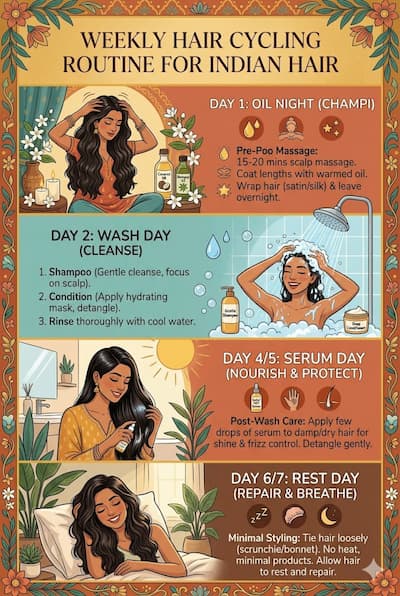
Skin cycling went viral on social media in 2023 — the idea that rotating actives on a schedule (retinol night, exfoliant night, recovery nights) produces better results than layering every active every day. The concept caught on because it is correct. The same logic applies directly to hair care, and the Indian hair care context makes it especially relevant.
In India, the most common hair care habits work against each other when done simultaneously: daily oiling on a scalp that gets re-oiled before the previous application is washed out. Shampooing every day with a sulphate-heavy formula that strips sebum and disrupts the acid mantle. Applying leave-in serums on top of oil residue from yesterday. Skipping wash days entirely for a week, then doing an aggressive cleanse. These are not individual mistakes — they are systemic mistakes that come from having no structured routine.
Hair cycling imposes the structure. Each step gets its own day, in the right order, with recovery time built in. The oil works better because it is properly washed out. The shampoo works better because it is not fighting accumulated product. The serum works better because it is applied to a clean, balanced scalp without a barrier of build-up between it and the follicle. And the rest day works because the scalp needs time without any product to regulate itself.
This is not a complicated routine. It is actually simpler than what most people are already doing — because it replaces daily product decisions with a repeating weekly pattern that you follow without thinking.
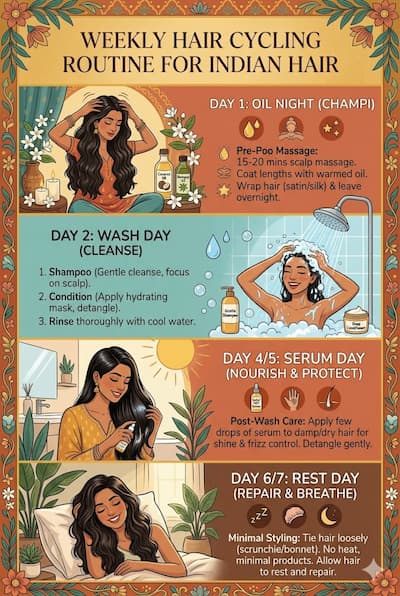
⚡ The Standard 4-Day Hair Cycling Schedule — Quick Reference
| Day | Step | What You Do | Why This Day |
|---|---|---|---|
| Day 1 | Oil Night | Apply herbal hair oil in sections with scalp massage. Leave 30–60 minutes (or overnight on lengths only). Do not wash out tonight — wash out tomorrow. | Oil penetrates the shaft and delivers bioactives to the scalp in preparation for the cleansing tomorrow. Massage activates follicle microcirculation. |
| Day 2 | Wash Day | Shampoo with a sulphate-free, pH-balanced formula. Condition mid-lengths and ends. Rinse thoroughly. Air dry or low-heat dry. | Removes the oil treatment, build-up from the previous cycle, and scalp cell debris. Restores the scalp's acid mantle. Prepares a clean surface for the serum tomorrow. |
| Day 3 | Serum Day | Apply leave-in scalp serum with growth actives (Redensyl, Procapil, Anagain) directly to the scalp in sections. Do not rinse out. | The scalp is clean from yesterday's wash — active ingredients reach the follicle without a build-up barrier. This is the highest-efficacy window for leave-in treatments. |
| Day 4 | Rest Day | No scalp products. Style as usual, apply lightweight oil to dry ends only if needed for split end management. Let the scalp breathe. | The scalp's sebum production self-regulates. The microbiome rebalances between active treatment events. Gives the scalp the recovery window it needs between cycles. |
Repeat the cycle from Day 1. Most people run two full 4-day cycles per week. Adjust cycle length based on your scalp type — see the adaptation table further below.
Why Hair Cycling Outperforms Daily Product Use — The Science
The case for hair cycling is not based on trend — it is based on how scalp biology actually works. Daily product use disrupts three systems that require periodic recovery to function optimally: the scalp microbiome, the follicle absorption cycle, and the scalp's sebum self-regulation. Understanding each one explains why cycling consistently produces better results than doing the same steps every day.
Every product applied to the scalp — oil, serum, dry shampoo, styling product — leaves a residue. This residue layers with the scalp's natural sebum, sweat, dead skin cells, and environmental pollutants (particularly high in Indian cities). Over days without a proper wash event, this accumulation creates a film over the scalp surface and follicle openings that: physically restricts the emergence of new hair growth from the follicle, creates an occlusive environment that raises scalp temperature and disrupts the microenvironment follicles grow in, and provides a substrate for Malassezia yeast and bacteria to proliferate.
In a daily-use routine without dedicated wash days, build-up accumulates faster than casual rinsing removes it. In a hair cycling routine, the wash day is a dedicated high-efficacy cleanse event that removes the entire oil treatment from Day 1 and any residue from the previous cycle — resetting the scalp surface completely before the next cycle begins.
Practical implication: The wash day in hair cycling is not optional and not replaceable with a quick rinse. It is the system reset that makes every other day in the cycle work. A sulphate-free, pH-balanced shampoo applied to a dry (pre-wet) oiled scalp is the most effective removal method — applying shampoo before water allows the surfactants to directly emulsify the oil rather than having to work through a diluted, water-coated surface.
The scalp hosts approximately 1.5 million microorganisms per square centimetre — a complex community of bacteria and fungi (primarily Malassezia species) that exists in balance when the scalp environment is stable. This balance is disrupted by repeated product application: oils change the fatty acid availability on the scalp surface, shampoos alter scalp pH, and leave-in treatments change the moisture and chemical composition of the scalp environment. Daily disruption prevents the microbiome from stabilising.
Research on skin microbiome dynamics (the scalp is skin and the same principles apply) consistently shows that the microbiome requires 24–72 hours of an undisturbed environment to re-establish population balance after a cleansing or treatment event. Continuous daily product application prevents this recovery entirely. The rest day in hair cycling — where nothing is applied — is the microbiome's recovery window. This is mechanistically similar to why dermatologists include recovery nights in skin cycling protocols.
Practical implication: The rest day is not a passive "do nothing" step. It is an active scalp regulation event. Scalp sebum production, microbiome rebalancing, and follicle-pore normalisation all happen most efficiently during periods without product interference. Skipping the rest day in favour of adding an extra oil or serum application breaks the cycle's core benefit. See our detailed guide on restoring your scalp microbiome for the full biological picture.
Leave-in scalp serums with clinical actives — Redensyl, Procapil, Anagain, copper peptides — rely on transdermal absorption through the scalp skin to reach the peri-follicular tissue where they have their effect. This absorption is directly impaired by surface barriers: a scalp coated in oil residue, build-up, or pollution particulates presents a hydrophobic barrier that significantly reduces the penetration of water-soluble active compounds.
Studies on topical drug delivery through the scalp (the relevant literature base for how hair growth topicals work) consistently show that absorption is maximised immediately post-wash, when the scalp surface is clean, the pores are open, and the skin barrier has been slightly loosened by the warm water of the wash. This is the biological reason the serum day falls immediately after the wash day in the cycling protocol — not as an arbitrary schedule, but because it is the specific moment when the active ingredients can achieve their maximum penetration and efficacy.
Practical implication: Applying your hair serum on Day 3 (post-wash scalp) versus applying it on Day 1 (pre-oil scalp) or Day 4 (rest day build-up) could represent a meaningful difference in actual active ingredient delivery. Timing serums to the post-wash window is one of the simplest efficacy improvements you can make without changing any product.
Sebaceous glands in the scalp regulate their output in response to the scalp surface environment — when the scalp surface is dry (from over-washing or harsh shampoo stripping), they upregulate production. When the surface is consistently coated in product, they adapt to the artificial lipid environment rather than producing their own. This produces the "rebound oiliness" pattern many people experience: washing every day because the scalp gets greasy within 24 hours, when in fact the daily washing is causing the glands to compensate by producing more oil.
Hair cycling breaks this feedback loop. The wash day cleanse is thorough but infrequent enough that the sebaceous glands are not perpetually in compensatory overdrive. The rest day allows the scalp to experience a normal surface environment and calibrate sebum output accordingly. Over 4–8 weeks of consistent cycling, most people find their scalp naturally becomes less oily between washes as the glands re-regulate — the "my hair gets greasy so fast" pattern improves on its own as a consequence of the routine structure.
Practical implication: If you currently shampoo every day because your scalp gets oily overnight, hair cycling will initially feel counterintuitive — you will feel the scalp getting oilier between cycles as you extend the time between washes. This normalises within 3–4 weeks as the sebaceous glands recalibrate. Dry shampoo can be used on rest days during this transition period to manage the adjustment without reverting to daily washing.
Hair Cycling Is Not New — It Is the Ayurvedic Approach, Formalised
The concept of rotating practices rather than applying everything daily is not a social media invention. It is a core principle of Ayurvedic hair and body care that has been practised in India for centuries — formalised in the Ayurvedic concept of Dinacharya (daily routine) and Ritucharya (seasonal routine).
The Traditional Ayurvedic Hair Week
Classical Ayurvedic texts prescribe a specific rhythm for scalp and hair care that maps directly onto the modern hair cycling structure:
- Abhyanga (oil application): Once or twice weekly, as a pre-wash treatment — not daily, not as a leave-on
- Shirodhara / Shikakai wash: The cleansing event that follows oil treatment, using herbal cleansers that maintain scalp pH
- Nasya / medicated herb application: Targeted herbal treatment applied to clean scalp after washing
- Rest and regulation: Days between treatments where the scalp is left to regulate, with minimal interference
This is the 4-step cycle. The modern version uses Redensyl serum instead of Nasya herbs, and sulphate-free shampoo instead of Shikakai paste — but the structure is identical.
Why This Matters for Indian Hair Specifically
Indian hair — typically thick, with high density and a round follicle cross-section — produces sebum at a rate well-suited to the traditional weekly oil-wash-rest cycle. The problems that most Indians experience with their hair are not inherent to Indian hair type — they are products of mismatched routines:
- Daily shampooing with SLS-based formulas designed for Western fine hair that over-strips Indian scalps
- Overnight oiling in urban India's warm, humid climate — a practice suited to dry, cool climates that feeds Malassezia in 35°C+ humidity
- Applying imported K-beauty or European product routines without accounting for India's hard water, pollution levels, and scalp sebum production differences
Hair cycling, adapted for Indian conditions, restores the rhythm that Indian hair is biologically suited to — which is also the rhythm Ayurvedic practice has described for centuries.
The 4-Day Cycle — Each Step Explained in Full
Each day in the cycle has a specific purpose, a correct method, and common mistakes that cancel its benefit. Here is how to do each step correctly.
Day 1 — Oil Night: Pre-Wash Herbal Treatment
What to do: Apply a herbal hair oil in 1cm sections across the entire scalp using fingertips — not by pouring from the top of the head. Massage gently in circular motions for 3–5 minutes. Cover mid-lengths with the remaining oil. Leave for a minimum of 30 minutes; if doing this the night before wash day, you can leave overnight — but confine the oil to the hair lengths (not the scalp) if leaving overnight in warm, humid conditions to avoid Malassezia risk.
Why this works: The herbal oil delivers fat-soluble bioactives (Bhringraj's ecliptine, Amla's gallic acid, Brahmi's bacoside A) transdermally through the scalp skin to the peri-follicular tissue during the leave-on period. Coconut oil in the base simultaneously penetrates the hair cortex and reduces the protein loss that will occur during tomorrow's wash. The scalp massage during application activates dermal papilla cells through mechanical stretch — a clinically validated mechanism for follicle stimulation (Koyama et al., 2016).
Do not: Apply oil on top of yesterday's serum residue or on an unwashed scalp that already has build-up — the oil will sit on top of the residue rather than reaching the scalp skin. If you have active dandruff, skip the scalp oil entirely and apply only to the lengths. See our complete scalp oiling guide for oil selection by concern.
Day 1 Checklist
- Scalp is clean (from previous cycle's wash day)
- Oil warmed slightly before application
- Applied in sections, not poured from top
- 5-minute scalp massage with fingerpads
- Leave minimum 30 min, max 60 min on scalp
- If overnight: confine to lengths only
- Do NOT wash out tonight — wash tomorrow
Day 2 — Wash Day: Sulphate-Free Deep Cleanse
What to do: Apply shampoo to the dry (or barely damp) scalp first — before fully wetting the hair. Working shampoo into oil on a dry scalp allows the surfactants to directly emulsify the oil, which is more effective than trying to lather through a water-diluted oil layer. Massage the scalp for 2–3 minutes, then wet with warm water and rinse thoroughly. A second shampoo pass may be needed for heavier oils (castor, large quantities of coconut). Apply conditioner to mid-lengths and ends only — never the scalp.
Why this is the pivot of the whole cycle: The wash day does not just remove the oil — it resets the scalp surface entirely. It removes the Day 1 oil, the scalp's natural sebum from the previous days, any pollution particulates or sweat, and the residue from the previous cycle's serum. This complete surface reset is what makes tomorrow's serum application maximally effective. A wash day done correctly sets up every other day in the cycle to work as intended.
Do not: Use a sulphate-heavy shampoo — the point of the pre-wash oil treatment was to protect the shaft from protein loss during washing; a harsh sulphate shampoo defeats this by aggressively stripping the cuticle. Do not skip conditioner on damaged or dry lengths — wash day is also the mechanical stress event for the hair shaft, and conditioning post-wash manages cuticle roughness.
Day 2 Checklist
- Apply shampoo to dry scalp first (before wetting)
- Massage 2–3 min before adding water
- Rinse thoroughly with lukewarm (not hot) water
- Second shampoo pass if oil residue remains
- Condition mid-lengths and ends only
- Rinse conditioner completely
- Air dry or low-heat — avoid aggressive towel rubbing
Day 3 — Serum Day: Leave-In Active Treatment
What to do: On the morning after wash day (or the evening, if your scalp is fully dry), apply your leave-in scalp serum directly to the scalp in sections — the same parting-and-applying method used for the oil on Day 1. Apply only to the scalp, not the lengths (leave-in serums have no benefit on the hair shaft — their actives work on living follicle tissue). Do not rinse. Style as normal.
Why this is the highest-efficacy day in the cycle: The scalp is in its cleanest, most receptive state — freshly washed, with the acid mantle restored, follicle openings clear, and the surface free of any barrier between the serum and the scalp skin. Water-soluble actives like Redensyl (DHQG + EGCG) and Procapil (biotinyl-GHK) rely on aqueous penetration through the scalp epidermis to reach the outer root sheath and peri-follicular dermis. Applying these to a clean, post-wash scalp rather than on top of oil residue or build-up meaningfully improves how much active compound actually reaches the follicle. This is the day to use your most potent, most expensive scalp treatment.
Do not: Apply the serum immediately after washing while the hair is still dripping wet — excess water dilutes the serum and reduces scalp contact. Wait until the scalp is dry or towel-dry, then apply. Do not apply oil on the same day as the serum — the two steps are on different days precisely because oil on the scalp surface reduces serum absorption.
Day 3 Checklist
- Scalp is dry or towel-dry (not dripping)
- Apply serum to scalp only — not lengths
- Section-by-section application for even coverage
- Gentle fingertip massage to distribute
- Do NOT rinse out
- Do NOT apply oil on top today
- Style as normal after application
Day 4 — Rest Day: Scalp Recovery and Sebum Regulation
What to do: Apply no products to the scalp. If the hair lengths are dry or have split end concerns, a small amount of lightweight oil applied only to the ends (not the scalp) is acceptable. Style as you normally would — braiding, tying, or wearing loose. If the scalp feels greasy (especially in the first 2–4 weeks as it adjusts), use a small amount of dry shampoo on the roots only.
Why the rest day is not optional: Every treatment event — oil application, shampooing, serum application — disrupts the scalp microenvironment to some degree. Even a well-formulated sulphate-free shampoo changes the scalp surface temporarily. The rest day is when the scalp's sebaceous glands recalibrate output, the microbiome rebalances after the previous days' treatments, and the scalp skin barrier repairs any minor disruption from the wash. Eliminating the rest day to "do more" for your hair consistently produces worse outcomes than respecting the recovery window — the same reason skin cycling includes recovery nights where only barrier-supporting products are used.
During the adaptation period (first 3–4 weeks): Many people find the scalp feels greasier than usual on rest days when transitioning from daily washing to a cycling routine. This is sebaceous gland recalibration — the glands were in compensatory overdrive from daily stripping, and they need time to reduce output. Dry shampoo manages this cosmetically during the transition. The scalp typically self-regulates within 3–5 weeks of consistent cycling.
Day 4 Checklist
- No scalp products today
- Light oil on ends only (optional)
- Dry shampoo on roots if needed
- Style as normal
- Let the scalp breathe and regulate
- Tomorrow: start the cycle again from Day 1
How to Adapt the Cycle for Your Hair Type and Scalp Condition
The 4-day cycle is the standard framework. Scalp type, hair condition, and seasonal factors all require adjustment. Here is how to modify the cycle for common Indian hair profiles.
| Scalp / Hair Profile | Cycle Length | Oil Night Adjustment | Serum Day Adjustment | Rest Days |
|---|---|---|---|---|
| Normal scalp, moderate hair fall The standard profile |
4 days (standard) | Herbal oil on scalp + lengths, 30–60 min pre-wash | Leave-in growth serum on scalp post-wash | 1 rest day per cycle |
| Oily scalp Greasy within 1–2 days of washing |
3 days (compress) | Skip scalp oil; apply only to lengths. Use lightweight oil (Argan, Jojoba). | Lightweight serum — avoid heavy formulations. Zinc PCA serums benefit oily scalp. | Minimal — oily scalps benefit from more frequent wash events; extend to 2 rest days only if scalp is stable |
| Dry scalp, low sebum Tight, itchy, flaky (non-fungal) |
5–6 days (extend) | Oil scalp + lengths, warm towel wrap, 45–60 min. May repeat oil night twice before wash day. | Hydrating serum with hyaluronic acid or glycerin in addition to growth actives | 2 rest days — dry scalps benefit from longer recovery between treatment events |
| Active dandruff / seborrheic dermatitis Visible flaking, scalp itch |
Pause hair cycling — treat first | Skip oil entirely until dandruff is controlled with antifungal shampoo. Resume only after 4 weeks clear. | Use antifungal shampoo as primary treatment; serum day resumes only after scalp is clear | Rest days still apply during transition |
| Significant hair fall (telogen effluvium, AGA) Visible thinning, shed > 100 hairs/day |
4 days (standard, but prioritise serum) | Use Bhringraj or Rosemary-based oil specifically. 5-min scalp massage mandatory. | This is the most critical day — use the highest-quality growth serum you can. Maximum absorption window. | 1 rest day; can extend to 2 if scalp is balanced |
| Chemically processed / heat-damaged hair Colour-treated, bleached, straightened |
4 days (standard) | Emphasise coconut oil on lengths (protein loss protection) over scalp oil application | Add a protein treatment or keratin treatment on wash day monthly; serum on scalp as normal Day 3 | 1 rest day; apply lightweight oil to ends on rest day for split end management |
| Summer / high humidity (India, May–Sep) Increased scalp sweat and sebum |
3–4 days (compress slightly) | Reduce oil quantity; skip overnight scalp oiling entirely in peak summer. 30 min maximum. | Lightweight serum formulations. Avoid heavy oils post-wash in high humidity. | May need to add a mid-cycle rinse (water only, no shampoo) on rest days during peak summer |
| Winter / dry season (India, Nov–Feb) Reduced scalp sebum, dry ends |
5–6 days (extend) | More oil, longer leave-on time, warm towel wrap. Sesame oil is particularly appropriate in Ayurvedic winter care. | Add a moisturising component to serum day (aloe vera scalp spray or glycerin-based mist) | 2 rest days during winter when scalp is naturally drier and less productive |
Common Hair Cycling Mistakes That Undo the Results
Mistake 1 — Applying Serum and Oil on the Same Day
The core structural rule of hair cycling is that oil and serum have dedicated separate days — oil on Day 1, serum on Day 3, with a wash between them. Applying both on the same day means applying a water-soluble serum on top of an oily scalp (or vice versa), which significantly reduces the serum's transdermal absorption. This is the most common error in home-constructed hair cycling routines, often driven by the impulse to "do more" on a given day. More is not more in a cycling routine — it defeats the core mechanism.
Mistake 2 — Skipping the Rest Day
The rest day is not optional filler in the cycle. It is the microbiome recovery and sebum regulation event that makes the entire structure function. Eliminating the rest day to add an extra treatment session produces worse outcomes over time — the scalp never has a window to self-regulate, the sebaceous glands remain in compensatory production mode, and the microbiome never fully rebalances between treatment events. If you feel compelled to do something on the rest day, confine it to applying a very small amount of lightweight oil to dry ends only — never the scalp.
Mistake 3 — Starting Hair Cycling with Active Dandruff
Hair cycling's oil night requires a scalp that is free of active Malassezia overgrowth. If you start the cycle with active dandruff or seborrheic dermatitis, the oil night feeds the Malassezia and worsens the condition regardless of the cycling structure. The correct sequence: treat dandruff with an antifungal shampoo (zinc pyrithione 1–2% or ketoconazole 2%) for 4–8 weeks until the scalp is completely clear, then begin the hair cycling routine. See our guide on dandruff vs seborrheic dermatitis for the treatment protocol.
The pre-wash oil on Day 1 protects the hair shaft from protein loss during washing — but only if the shampoo on Day 2 does not aggressively strip through the protective oil and continue stripping the shaft and scalp after the oil is removed. A sulphate-heavy shampoo (SLS, SLES, ammonium lauryl sulphate) does exactly this: it removes the oil efficiently and then keeps stripping. This raises the hair shaft's pH above its natural 4.5–5.5 acid mantle, roughens the cuticle, and stimulates the sebaceous glands to overproduce — triggering the rebound oiliness that makes the rest day feel uncomfortable.
Sulphate-free, pH-balanced shampoos are not a luxury in a hair cycling routine — they are the mechanism that preserves the protective benefit of Day 1's oil treatment through to the end of the wash. The two steps only work together correctly when the shampoo is formulated to work with the pre-wash oil rather than aggressively undo it.
Hair cycling has an adaptation period. In the first 2–4 weeks, most people transitioning from daily washing to a cycling routine will notice the scalp feels greasier between washes, and hair may look less "fresh" on rest days than it did when it was being washed daily. This is the sebaceous gland recalibration period — the glands are adjusting from daily-strip-compensate cycles to a more stable production rhythm.
Do not abandon the cycle during this period. Use dry shampoo on rest days to manage cosmetically, stay consistent with the structure, and allow 3–6 weeks for the scalp to self-regulate. The improvements — less greasiness between washes, more resilient hair, better serum efficacy, improved scalp comfort — become apparent after the adaptation period has completed. Evaluating a cycling routine in week one is evaluating the adaptation process, not the routine itself.
Day 1 is when the herbal actives in the oil reach the scalp skin. If the oil is primarily mineral oil (liquid paraffin) — which is the base of many large commercial Indian hair oils regardless of the herbs printed on the label — the bioactive delivery mechanism of Day 1 does not exist. Mineral oil coats the scalp surface without penetrating, delivers no fat-soluble plant compounds, and does not protect the hair cortex the way coconut oil's lauric acid does. The scalp massage is still beneficial, but the oil treatment specifically requires genuine herbal infusion in a natural fatty acid base (sesame, coconut, or almond) to deliver its documented effects.
Checking whether a hair oil is mineral oil-based is straightforward: if the first ingredient listed is "paraffinum liquidum" or "mineral oil" or "liquid paraffin," it is primarily mineral oil. The herbs mentioned in the marketing are present in marginal concentrations. This is the single biggest quality distinction that determines whether the oil night in your cycle actually delivers its intended effect.
Hair Cycling and Hard Water
More than 70% of Indian cities have hard water (high calcium and magnesium mineral content). Hard water interferes with both the wash day and the serum day in a hair cycling routine: it prevents shampoo from lathering effectively (requiring more product and more mechanical scrubbing), it leaves a mineral film on the scalp surface and hair shaft after washing, and this film acts as a barrier that reduces serum absorption on Day 3 — exactly what the cycle is designed to prevent.
If you are in a hard water area, use a chelating or clarifying shampoo once per month (replacing the standard wash day shampoo) to remove mineral deposits. An apple cider vinegar rinse (1 tablespoon in 250ml water, poured over scalp after shampooing and rinsed off) also chelates calcium deposits and restores the scalp's acid mantle. Both approaches complement the cycling routine without disrupting its structure. See our detailed guide on hard water and hair fall for the full picture.
Not sure which scalp condition you have or how to adapt the cycle for your specific hair profile? Our dermatologist can assess your scalp and give you a precise cycling protocol.
Book Free Scalp Consultation →The Three Products That Form a Complete Hair Cycling System
Hair cycling works best when each step uses a product specifically designed for that step's function. The three Botani Bestie hair products map directly onto the three active days of the cycle — with each one formulated for the exact job its day requires.
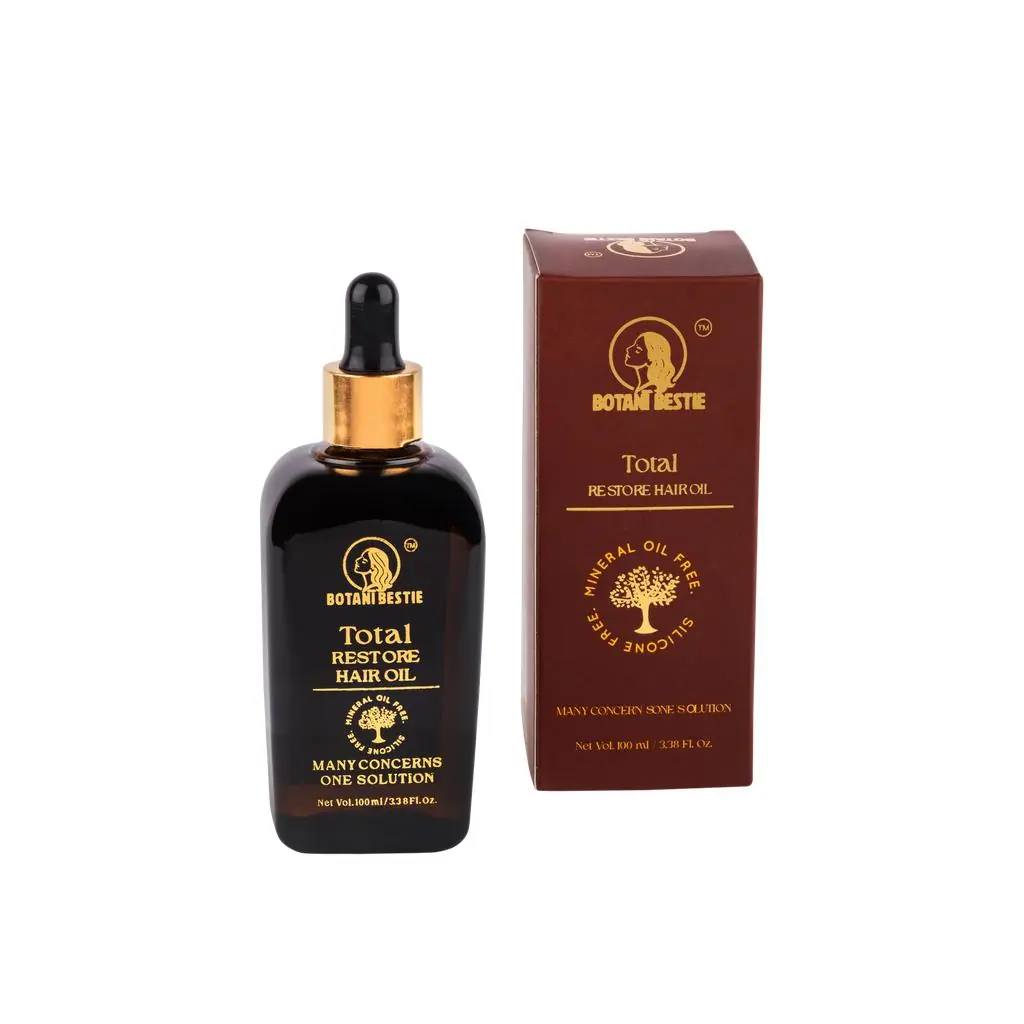
Total Restore Hair Oil
Pre-Wash Treatment · Sesame-Coconut Base · Bhringraj · Amla · Brahmi · Jatamansi
Built on a genuine sesame-coconut base — not mineral oil. Bhringraj extract (ecliptine + wedelolactone) for anagen phase support and anti-inflammatory scalp environment. Amla for follicle oxidative stress reduction and collagen support in the scalp dermis. Brahmi for scalp cortisol modulation and stress-driven shedding reduction. Jatamansi for anti-inflammatory scalp maintenance. Coconut oil in the base for lauric acid shaft penetration and protein loss reduction during Day 2's wash. Designed specifically for the pre-wash application method that hair cycling requires. Apply on Day 1, wash out on Day 2 — this is exactly how this oil is meant to be used.
Shop Total Restore Hair Oil →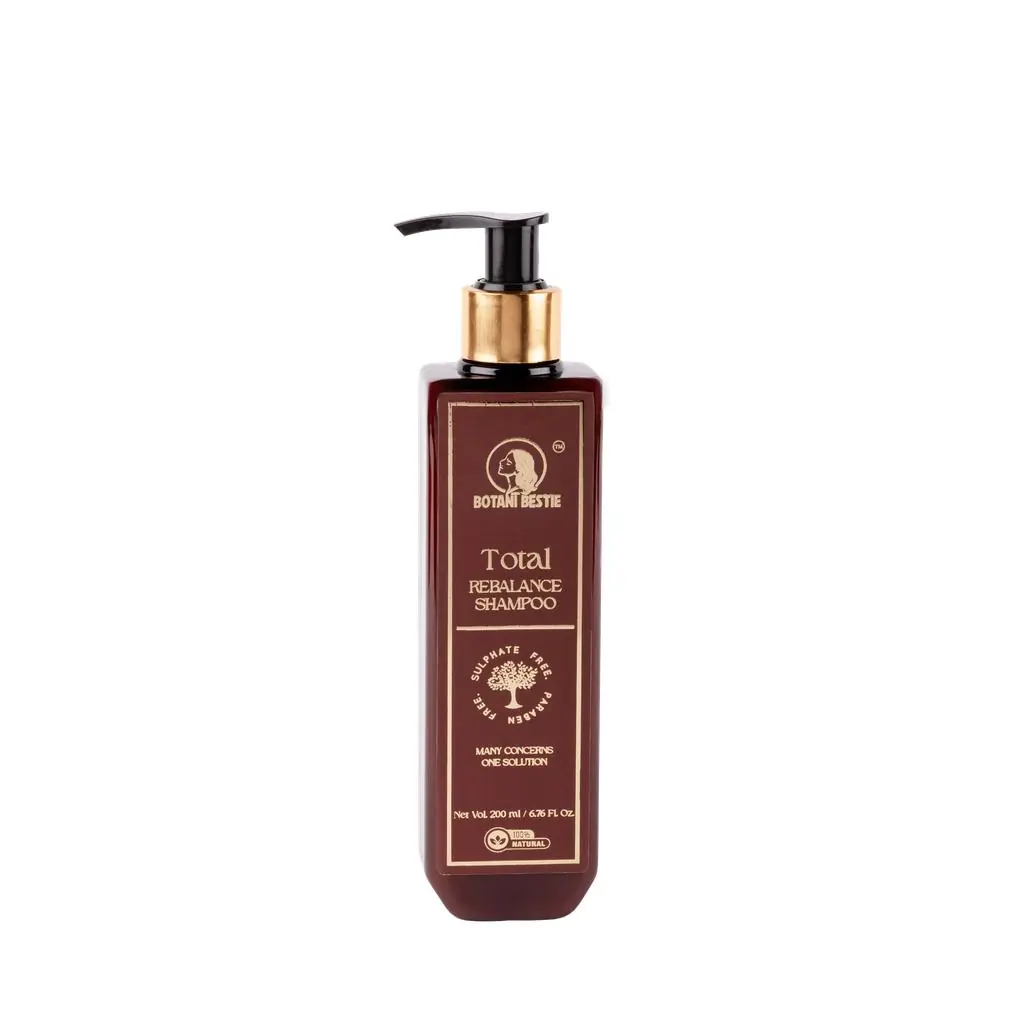
Total Rebalance Shampoo
Sulphate-Free · pH 4.5–5.5 · Bhringraj · EGCG Green Tea · Fermented Rice Water · ACV
The wash day in hair cycling requires a shampoo that removes the pre-wash oil completely without stripping the scalp's acid mantle or roughening the cuticle — because tomorrow's serum day depends on a clean, balanced scalp surface. Total Rebalance is sulphate-free and pH-balanced at 4.5–5.5, which matches the hair shaft's natural acid mantle rather than disrupting it. Apple Cider Vinegar provides natural chelation that removes mineral deposit build-up (critical for hard water areas) and restores scalp pH. Fermented Rice Water inositol begins the cuticle-smoothing step during the wash itself. EGCG from green tea provides antioxidant protection at the scalp surface through the wash event. Bhringraj continues follicle support even through the cleansing step. The shampoo that makes the rest of the cycle work as intended.
Shop Total Rebalance Shampoo →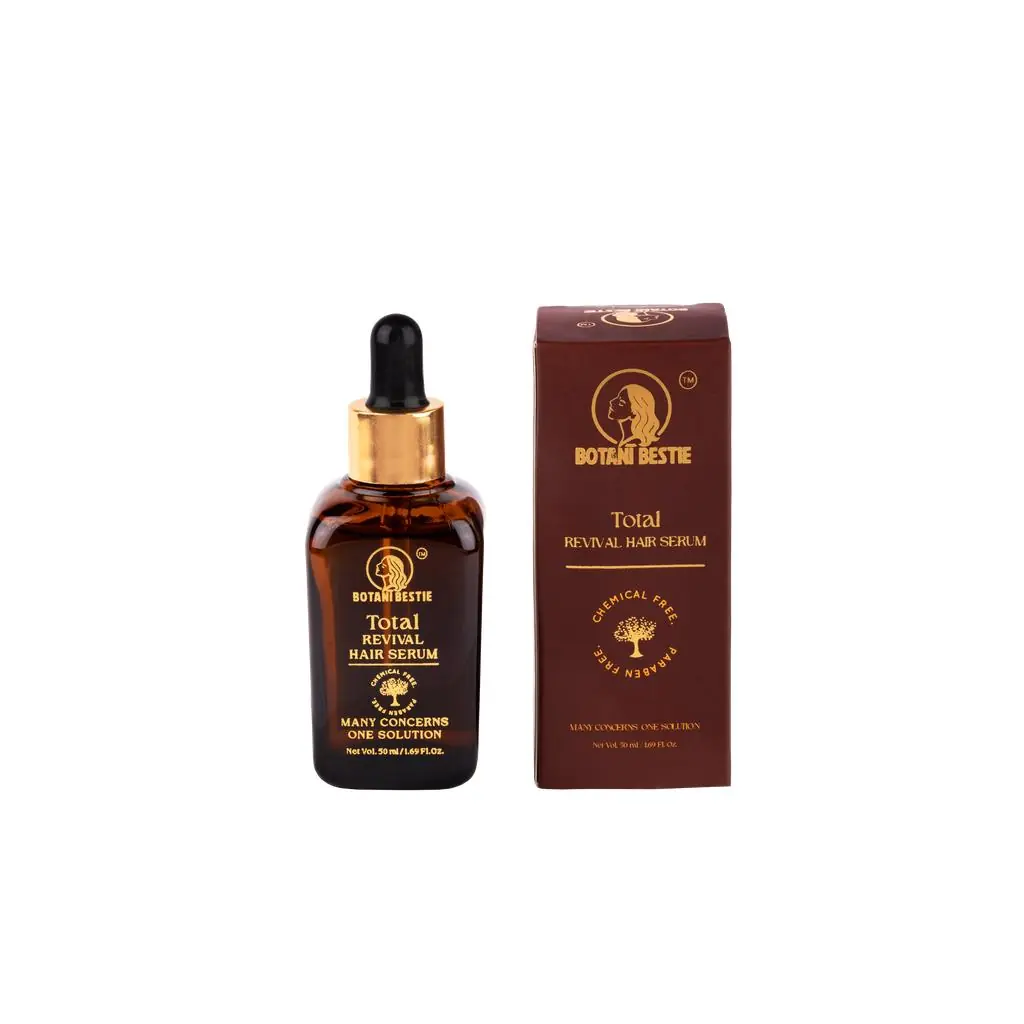
Total Revival Hair Serum
Leave-In Scalp Serum · Redensyl · Procapil · Anagain · Copper Peptides (GHK-Cu) · Saw Palmetto
Day 3 is the highest-efficacy absorption window in the entire cycle — the scalp is clean, the acid mantle is restored, and the follicle openings are clear. This is the day to use the serum with the clinical actives that actually address hair fall and follicle activation. Redensyl (DHQG + EGCG) targets hair follicle stem cells in the outer root sheath — the pathway that determines whether a dormant follicle re-enters anagen growth phase. Anagain (organic pea sprout extract) mimics dermal papilla growth signalling to extend anagen duration. Procapil (biotinyl-GHK + apigenin) improves scalp microcirculation and reduces follicle miniaturisation driven by DHT. GHK-Cu copper peptides stimulate follicle collagen regeneration and promote anagen re-entry. Saw Palmetto provides natural DHT inhibition at the follicle level without the systemic side effects of pharmaceutical 5α-reductase inhibitors. Applied to a clean scalp on Day 3, these actives work at maximum efficacy. Applied on top of oil residue or build-up, they barely work at all.
Shop Total Revival Hair Serum →Not Sure How to Adapt the Cycle for Your Scalp?
The right cycle length, oil choice, and serum protocol depends on whether you have dry scalp, oily scalp, active dandruff, pattern hair loss, telogen effluvium, or post-partum shedding. A dermatologist scalp assessment identifies your exact scalp type and gives you a cycling protocol matched to your biology — no guesswork, no generic routine. Our consultations are free and deliver a specific, actionable protocol within one session.
Book Free Consultation → WhatsApp UsFrequently Asked Questions

The Bottom Line — Structure Beats Products
The most common reason hair care products fail to deliver their advertised results is not that the products are ineffective. It is that they are applied in the wrong order, to the wrong scalp surface, at the wrong time — and then stacked on top of each other without recovery periods. A leave-in serum applied on top of oil residue, build-up, and yesterday's product layer does not reach the follicle. An oil applied to a scalp that has not been properly cleansed since the last cycle does not deliver its bioactives to the scalp skin. A scalp that is treated with products daily without rest days never rebalances its microbiome or sebum production.
Hair cycling solves all three problems at once — with the same products you likely already own, just used in the right sequence and timing. The 4-day structure is not complicated. It is the same rhythm that Ayurvedic practice has prescribed for centuries and that scalp biology supports: protect, cleanse, treat, rest. Repeat.
Start the cycle at the next oil night. Give it 6 weeks before evaluating. The scalp adaptation period in the first few weeks is not the routine failing — it is the routine working.
Shop Total Restore Hair Oil → Shop Total Revival Serum →"It is not which product you use. It is whether you give each product its moment to work."
Ready to make the honest switch?
Our products are built on the same principles as every article we write — pure ingredients, real results, nothing to hide.
Explore Our Products