Alopecia Areata — What It Is, Root Causes, and Ayurvedic Treatment Options
Alopecia areata is not stress-related diffuse hair fall. It is an autoimmune condition — the immune system attacks hair follicles directly. Understanding this distinction determines whether the treatment approach you choose has any chance of working at all.
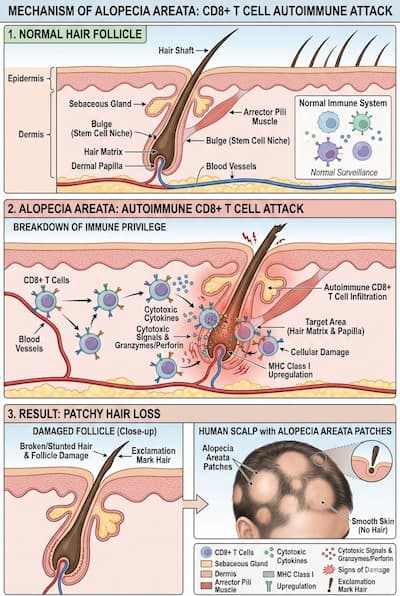
Alopecia areata affects approximately 2% of the global population — and an estimated 30–40 million Indians, making it one of the most common autoimmune conditions. Yet it is frequently misdiagnosed as stress hair fall or fungal infection, and treated with the wrong approach for years.
The characteristic presentation is unmistakable once you know what to look for: smooth, round patches of complete hair loss on an otherwise normal scalp. Unlike androgenetic alopecia (which thins gradually) or telogen effluvium (which sheds diffusely), alopecia areata creates sudden, discrete bald spots that can appear overnight.
The good news: the follicles are not destroyed. The hair loss is caused by immune-mediated suppression, not permanent follicle death — which is why spontaneous regrowth is possible and why the right supportive treatment can accelerate recovery.
The Autoimmune Mechanism: What Is Actually Happening
The Immune Privilege Breakdown — Step by Step
In normal physiology, hair follicles are protected by a phenomenon called immune privilege. The follicle suppresses local immune activity through several mechanisms — including production of TGF-β1, ACTH, and MIF — which prevent immune cells from recognising follicle proteins as foreign antigens. This immune privilege is why follicles can survive in the body without being attacked.
In alopecia areata, this privilege breaks down:
- Collapse of immune privilege: Follicle cells begin expressing MHC class I molecules (which they normally suppress). This makes them "visible" to CD8+ cytotoxic T cells circulating in the bloodstream.
- CD8+ T cell infiltration: Cytotoxic T cells recognise follicle-specific proteins as foreign antigens and accumulate around the follicle bulb — forming the characteristic "swarm of bees" infiltrate seen in histology of active alopecia areata patches.
- Inflammatory attack and anagen arrest: The T cells release inflammatory cytokines (IFN-γ, IL-2, TNF-α) that directly inhibit follicle proliferation and force the follicle out of anagen (growth phase) into a prolonged dystrophic catagen — the hair falls out but the follicle is not killed.
- Follicle enters dormancy: The follicle survives in a suppressed state below the scalp surface. This is why the skin within a patch looks completely normal — the follicle is present but dormant. This is also why regrowth is possible when the immune attack subsides.
Types of Alopecia Areata: From Mild to Severe
Patchy AA
One or more coin-shaped patches. Most common form — 70–80% of cases. Highest rate of spontaneous remission (50% within 12 months).
MildOphiasis
Band-shaped loss around the perimeter of the scalp (temporal and occipital). More resistant to treatment than patchy AA.
ModerateAlopecia Totalis
Complete loss of all scalp hair. Lower spontaneous remission rate. Requires dermatological evaluation and medical intervention.
SevereAlopecia Universalis
Complete loss of all body hair — scalp, eyebrows, eyelashes, beard, body. Rarest and most severe. Requires specialist immunological treatment.
Most SevereHow to Recognise Alopecia Areata vs Other Hair Loss
| Feature | Alopecia Areata | Telogen Effluvium | Androgenetic Alopecia | Tinea Capitis (Fungal) |
|---|---|---|---|---|
| Pattern | Discrete round/oval patches | Diffuse thinning overall | Crown/hairline thinning | Patchy + broken hairs |
| Scalp appearance | Normal skin in patch | Normal skin overall | Normal to slightly oily | Scaling, redness, itching |
| Onset speed | Sudden (days to weeks) | Gradual over 2–4 months | Gradual over years | Weeks to months |
| Exclamation mark hairs | Yes — at patch margin | No | No | No (broken hairs different) |
| Pull test | Positive at active margins | Positive diffusely | Positive at crown | Positive in affected areas |
| Can affect beard/eyebrows | Yes | Rarely | No | No |
| Treatment approach | Immune modulation + follicle support | Remove trigger + nutrition | DHT blocking | Antifungal medication |
Common Triggers for Alopecia Areata in India
Genetic Predisposition (Primary Factor)
Specific HLA (human leukocyte antigen) gene variants — particularly HLA-DRB1 and HLA-DQB1 — are the strongest risk factors. People with a family history of alopecia areata have a 5–7x higher risk. Other autoimmune conditions (thyroid disease, Type 1 diabetes, rheumatoid arthritis, vitiligo) in the patient or family increase risk — these conditions share overlapping genetic predispositions.
Acute Physical Stress / Infection (Common Trigger)
Viral infections — particularly SARS-CoV-2, influenza, herpes zoster, and EBV — are among the most commonly reported triggers for first-episode alopecia areata onset in genetically predisposed individuals. COVID-19 in particular has been associated with new-onset alopecia areata, possibly through molecular mimicry (viral proteins resembling follicle antigens). High fever from any cause can also trigger it.
Chronic Psychological Stress
Elevated cortisol and neuropeptide P (substance P) alter immune regulation at the scalp level, potentially breaking immune privilege in susceptible individuals. Examination stress, bereavement, and marital stress are commonly reported triggers. Important caveat: stress alone does not cause alopecia areata in people without genetic susceptibility — it is a trigger, not a cause.
Nutritional Deficiencies
Vitamin D deficiency in particular is associated with immune dysregulation and is documented as more common in alopecia areata patients than the general population (a 2020 meta-analysis confirmed significantly lower serum Vitamin D in AA patients). Zinc deficiency has also been associated with severity. These are not causes but factors that may worsen severity and slow remission.
The Ayurvedic Perspective: Indralupta (इन्द्रलुप्त)
Alopecia areata is described in classical Ayurvedic texts as Indralupta — a condition of sudden hair loss from a localized area, attributed to a combined vitiation of all three doshas (Vata, Pitta, and Kapha), with Pitta's fire element and Rakta (blood tissue) playing the central role. The follicle is considered "strangled" by the vitiated doshas rather than destroyed — consistent with the modern understanding that the follicle remains alive but dormant.
Ayurvedic treatment principles align with supporting the conditions for follicle re-activation: reducing inflammation (Pitta), strengthening the nervous system under stress (Vata), and restoring local circulation (Kapha).
Ayurvedic Herbs With Relevant Evidence for Alopecia Areata Support
Bhringraj's primary documented mechanism — Wnt/β-catenin pathway activation — is directly relevant to alopecia areata. In AA, follicles are arrested in a quiescent state. Wnt/β-catenin signalling is the key pathway that drives follicle stem cells from quiescence into anagen. Bhringraj's wedelolactone compound activates this pathway, potentially helping resting AA follicles re-enter the growth phase.
Additionally, Bhringraj has documented 5α-reductase inhibition and anti-inflammatory properties — reducing local scalp inflammation that may perpetuate the immune attack. Applied topically in oil form with scalp massage (2–3x/week) over a minimum of 12–16 weeks is the evidence-based approach.
Brahmi reduces cortisol and neurogenic inflammation — both of which can perpetuate the immune dysregulation underlying AA. Substance P (released during stress) is documented to break follicular immune privilege; Brahmi's adaptogenic properties may help reduce this neurogenic inflammatory trigger.
As a topical scalp ingredient, Brahmi's bacosides have anti-inflammatory activity at the follicle level. As an oral supplement (Bacopa monnieri extract, 300–450mg/day), it has multiple RCTs confirming cortisol reduction and improved stress resilience — supporting the systemic conditions for immune regulation.
The autoimmune attack in alopecia areata generates significant oxidative stress in follicle tissue. Jatamansi contains nardin and jatamansone — compounds with documented antioxidant and anti-inflammatory properties. In Ayurvedic practice, Jatamansi is specifically indicated for hair loss triggered by illness or systemic stress — the exact clinical profile of alopecia areata.
Topically in oil formulations, Jatamansi may protect remaining follicle cells from oxidative damage during the active inflammatory phase and support follicle re-activation during remission.
Amla is the richest natural source of Vitamin C in India — essential for collagen synthesis in the follicle's connective tissue sheath (the structure that holds the follicle in place). The immune attack in alopecia areata damages this connective tissue. Vitamin C also reduces the oxidative stress from the inflammatory cascade and supports the body's general immune regulation.
Amla is also documented to improve the anagen-to-telogen ratio in women with hair loss — supporting the transition of quiescent follicles back into growth phase. Topically and as a dietary supplement (Indian gooseberry, Amla powder), it is one of the most relevant nutritional supports for AA.
Realistic Expectations: What You Should Know Before Starting
What Ayurvedic Treatment Can Do
- Reduce scalp inflammation to create better conditions for follicle re-activation
- Activate Wnt signalling to support quiescent follicles entering anagen
- Reduce cortisol and neurogenic stress that can trigger or perpetuate episodes
- Correct nutritional deficiencies (Vitamin D, zinc, Vitamin C) that worsen severity
- Support general immune regulation through adaptogenic herbs
- Improve scalp microcirculation for follicle nutrient delivery
What Ayurvedic Treatment Cannot Do
- Cure the autoimmune cause or prevent future episodes
- Match the speed of corticosteroid injection (which suppresses immune attack directly)
- Treat alopecia totalis or universalis without dermatological support
- Guarantee regrowth — spontaneous remission rate is 50% in patchy AA regardless of treatment
- Reverse scarring alopecia (a different condition where follicles are destroyed, not suppressed)
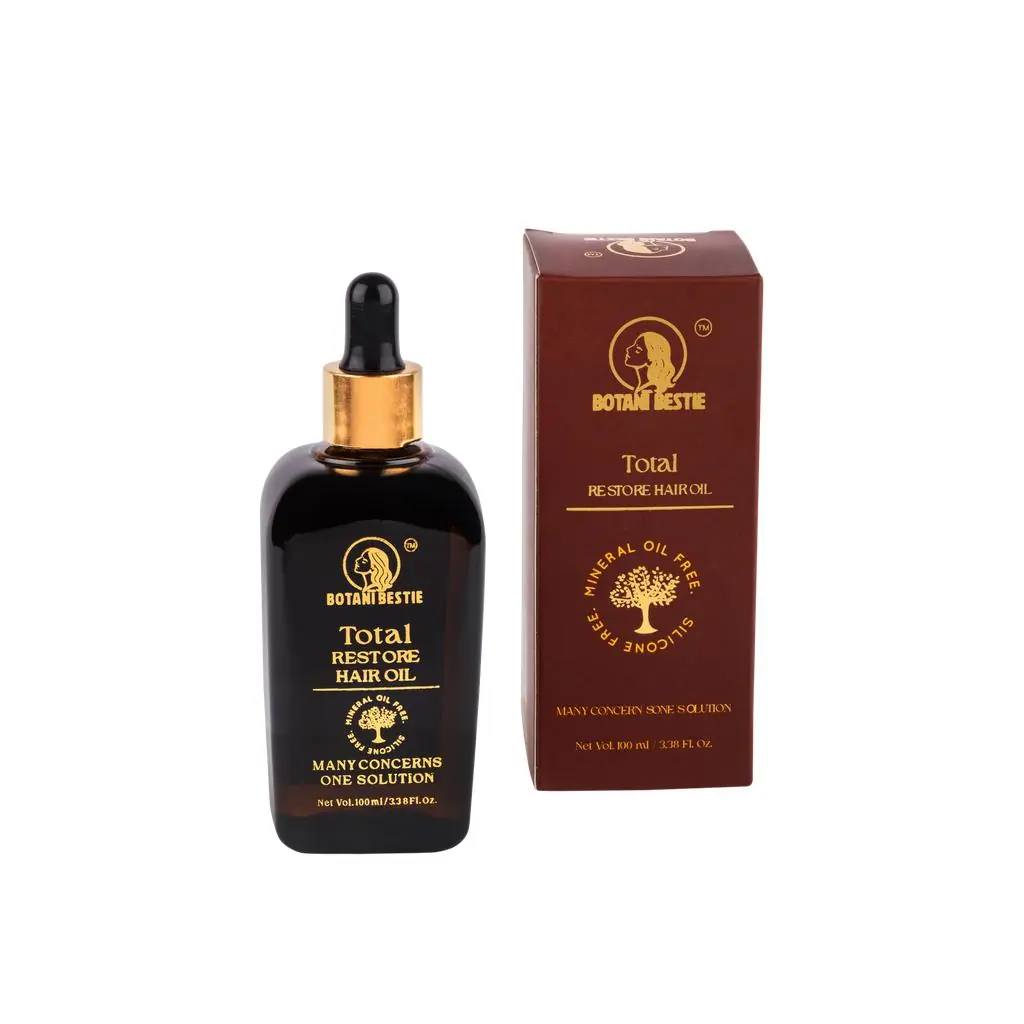
Total Restore Hair Oil
Ayurvedic scalp support — for follicle conditions in AA
Contains the four most relevant Ayurvedic herbs for alopecia areata support: Bhringraj (Wnt pathway activation — supports quiescent follicles re-entering anagen), Brahmi (cortisol reduction + scalp anti-inflammatory), Jatamansi (oxidative stress protection for follicle tissue during immune attack), and Amla (Vitamin C + collagen support). Used with scalp massage 2–3x per week as part of a comprehensive approach alongside dermatological care.
Shop Hair Oil → Free Hair ConsultationFrequently Asked Questions
"In alopecia areata, the follicle is asleep — not dead. The goal of every intervention is to create the right conditions for it to wake up."
Ready to make the honest switch?
Our products are built on the same principles as every article we write — pure ingredients, real results, nothing to hide.
Explore Our Products