Hair Breakage vs Hair Fall — How to Tell the Difference and Fix the Right Problem (2025)
Hair breakage and hair fall look identical in the drain — but they are two completely different biological problems requiring two completely different solutions. Using a hair growth serum for shaft breakage achieves nothing. Deep conditioning root loss changes nothing. The first and most important step in treating any hair problem is correctly diagnosing which one you actually have.
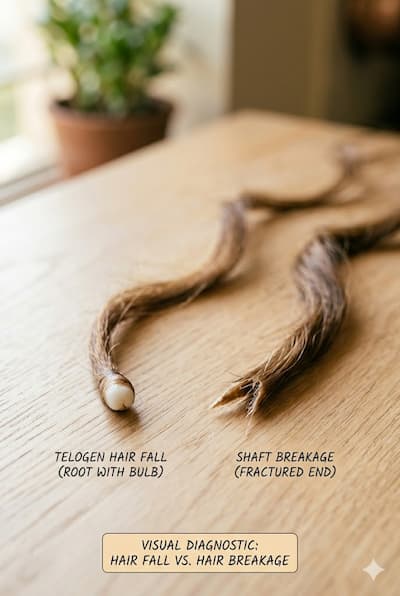
The confusion is understandable. Both problems result in hair in the drain, on the pillow, and in the brush. Both can produce what feels like alarming volume loss. Both cause distress. But the biology behind each is completely different — and the mistake of treating one as the other is extremely common in India, where most people self-treat without a diagnosis.
Hair fall (root shedding) is a problem of the follicle — the living structure beneath the scalp. The hair releases from the root. The follicle may be dormant, miniaturised, inflamed, or cycling prematurely. No product applied to the hair shaft addresses this. The cause is systemic or scalp-level: hormones, nutrition, stress, scalp health.
Hair breakage is a problem of the hair shaft — a dead structure of compacted keratin protein. The shaft snaps. The follicle is completely healthy and producing new hair normally. No hair growth treatment addresses this. The cause is mechanical, chemical, or thermal damage to the shaft itself.
This guide gives you the tools to diagnose which problem — or which combination — you have, and the specific interventions that work for each.
⚡ Hair Breakage vs Hair Fall — Quick Diagnostic Reference
| Feature | Hair Fall (Root Shedding) | Hair Breakage (Shaft Damage) |
|---|---|---|
| End of shed strand | Small white or translucent bulb at one end | Tapered, pointed, or ragged — no bulb |
| Strand length | Full-length strands (matches your hair length) | Shorter than your hair — could be any length |
| Where you notice it | Part widening, hairline recession, overall thinning | Short hairs around face frame, flyaways, frizz, split ends |
| Hair texture | Remaining hair feels and looks normal in texture | Hair feels rough, dry, brittle; snaps during combing |
| Root cause | Hormones (DHT, thyroid), nutrition (iron, Vitamin D), stress, scalp conditions | Chemical damage, heat damage, mechanical stress, protein-moisture imbalance |
| What fixes it | Address root cause; scalp actives (Redensyl, Bhringraj); treat underlying condition | Protein treatments, moisture balance, reduce heat/chemicals, protective styling |
| What doesn't fix it | Deep conditioning, protein masks, shaft treatments | Hair growth serums, scalp massages, DHT blockers |
The Bulb Test — The Single Most Reliable Way to Tell the Difference
Pick up one of the hairs from your brush, drain, or pillow and examine the thinner end closely. This one inspection tells you more about your hair problem than most people discover in months of trial-and-error treatment.
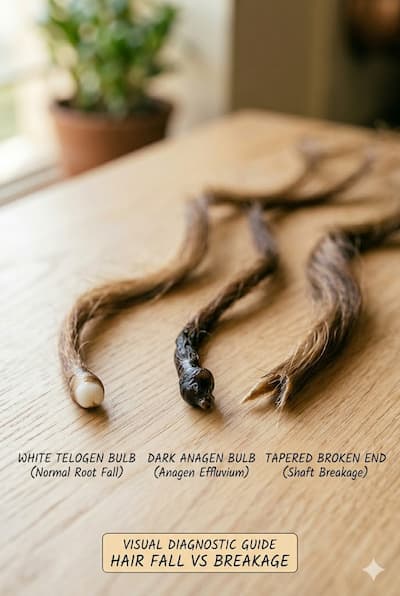
What the End of Your Shed Hair Tells You
White or translucent bulb — Normal telogen root shedding
A small, pale, club-shaped swelling at one end is the telogen hair root — the hair has completed its growth cycle and released naturally from the follicle. Finding some of these every day is completely normal (50–100/day). Finding 200+ consistently indicates elevated root shedding — investigate for telogen effluvium triggers: stress, nutritional deficiency, hormonal change, illness.
Tapered or ragged end, no bulb — Shaft breakage
No bulb. The strand is shorter than your hair length. The end is pointed, frayed, or irregular. This hair did not release from the follicle — it snapped. The follicle is still attached and active. This is a shaft problem, not a follicle problem.
Dark bulb at root — Anagen effluvium (seek medical attention)
A dark, pigmented bulb indicates the hair was pulled from an active anagen follicle — pulled out during growth rather than completing its cycle. This is anagen effluvium, associated with chemotherapy, autoimmune conditions, or severe traction alopecia. If you consistently find dark-bulbed hairs in large numbers, consult a dermatologist promptly.
Most People Have Both — In Different Proportions
It is rare to have purely breakage or purely root fall. Most people with significant hair concerns have both — some degree of shedding (which is always happening) plus some degree of shaft damage. The diagnostic question is: which is dominant? Check 10–15 shed hairs from different areas of the brush or drain. If 80%+ have white bulbs, root shedding is dominant. If 80%+ are broken ends, breakage is dominant. If it is close to 50/50, you are dealing with a mixed problem and need a two-pronged approach.
A practical tip: collect shed hairs over 3–5 days before drawing conclusions. A single day's drain contents can be skewed by vigorous washing or detangling.
Understanding Hair Fall — Root-Level Loss and Its Causes
Hair fall (technically: effluvium or alopecia, depending on the mechanism) is a problem of the follicle — the living biological structure anchored in the dermis. When a hair falls from the root, the follicle either sheds it naturally at the end of a completed telogen phase (normal cycling) or is pushed into early shedding by an internal or external disruption.
What it is: A sudden, diffuse increase in root shedding — typically 200–400+ hairs per day — triggered when a significant physical or psychological stressor pushes an abnormally large proportion of follicles simultaneously into the telogen resting phase. The shedding begins 2–3 months after the triggering event (the duration of the telogen phase), which is why the cause is often not recognised.
Common triggers in India: Childbirth (postpartum hair fall is one of the most common forms), significant illness or surgery, crash dieting or very low calorie intake, iron deficiency with ferritin below 70 ng/mL, Vitamin D deficiency, prolonged severe psychological stress, thyroid dysfunction, dramatic hormonal changes.
How to recognise it: Sudden onset, diffuse (all-over, not patterned), full-length hairs with white bulbs in the drain. Usually self-resolving within 3–6 months once the trigger is removed — but chronic telogen effluvium (persistent for 6+ months) requires investigation of an ongoing trigger.
What fixes it: Identify and remove the trigger. Correct nutritional deficiencies. No topical product can override a systemic trigger — but scalp actives (Bhringraj, Redensyl) can support follicle health during recovery.
What it is: Progressive miniaturisation of DHT-sensitive follicles in genetically predetermined scalp zones. In men, this produces the receding hairline and crown thinning of the Norwood scale. In women (FPHL), the Ludwig pattern — progressive part widening with hairline preservation.
How to recognise it: Gradual (not sudden) progression over years. Patterned — affects specific scalp zones while sparing others (often the back and sides). Short, fine, miniaturised hairs at the temples and crown. Part widening that gradually increases over months to years.
What fixes it: DHT-blocking scalp actives (saw palmetto, pumpkin seed oil, Bhringraj — all shown to inhibit 5α-reductase), Redensyl and Anagain (biotech actives that reactivate dormant follicles), Minoxidil (vasodilator — increases blood flow to follicle). Genuinely effective treatment is long-term — requires consistent application of the right actives. See our detailed guides on male pattern hair loss and female pattern hair loss.
What does not fix it: Protein treatments, deep conditioning, or any shaft-level product. The follicle is present but miniaturised — not the shaft.
What it is: Hair loss caused by chronic mechanical tension on the follicle root — from tight braids, high ponytails, tight buns, hair extensions, or consistently wearing hair pulled tightly. The repeated tension damages the follicle over time, causing progressive loss specifically along the hair line and at the points of greatest tension.
How to recognise it: Loss pattern matches where tension is applied — typically the frontal hairline (from tight ponytails), around the hairline (from braids), or at temples. Short, broken hairs at the hairline that are too short to be broken shaft hairs — they are miniaturised follicles. Follicular inflammation (red bumps, itching) at tension points in early stages.
Critical note: Traction alopecia is reversible if caught early and tension is removed promptly. With prolonged traction over years, the follicles can scar permanently and become irreversible. Changing to looser styles early is the only effective treatment. This is a commonly missed diagnosis in India among women who wear tight braids and buns daily from childhood.
What it is: Scalp inflammation from Malassezia yeast overgrowth (dandruff, seborrheic dermatitis), psoriasis, or other scalp conditions creates a hostile environment for follicle health. The chronic inflammation around follicle openings shortens anagen duration and increases shedding rates — producing a combined scalp condition + hair fall pattern.
How to recognise it: Hair fall accompanied by visible scalp symptoms — flaking, itching, redness, greasiness, or visible scale around the hairline. The fall is worse during active flare periods and improves when the scalp condition is controlled.
What fixes it: Treating the scalp condition directly — zinc pyrithione or ketoconazole shampoos for dandruff/seborrheic dermatitis; medical treatment for psoriasis. Once scalp inflammation is controlled, hair fall typically reduces. Deep conditioning or hair growth products do not treat scalp inflammation.
Understanding Hair Breakage — Shaft Damage and Its Causes
Hair breakage is a problem of the hair shaft — a dead structure of compacted keratin protein and lipid layers. Once formed, the shaft cannot repair itself. Damage to it is permanent unless the damaged portion is trimmed away. Understanding what causes breakage is the only way to stop it — and what causes it determines what will fix it.
Chemical Damage — The Most Severe Breakage Cause
What causes it: Hair bleaching, permanent hair colour, chemical relaxers, and keratin straightening treatments. All of these disrupt the disulphide bonds in the hair cortex — the cross-links between keratin chains that give hair its tensile strength and elasticity. Once disulphide bonds are broken, the cortex weakens structurally. Repeat chemical processing breaks progressively more bonds, producing hair that snaps at minimal tension.
How to recognise it: Breakage concentrated at the most recently processed sections. Extreme dryness and lack of elasticity — processed hair stretched between fingers snaps rather than stretching and springing back. Severe split ends through the length.
What helps: Bond-building treatments (olaplex chemistry — BIOX, SHEA MOISTURE bond repair) partially restore disulphide bond integrity. Deep protein conditioning rebuilds surface cortex. Most critically: stopping further chemical processing and trimming the damaged length.
Heat Damage — Cumulative Protein Denaturation
What causes it: Straighteners, curling irons, and blow dryers used at high temperatures. Above approximately 230°C (446°F), keratin proteins begin to denature — their molecular structure permanently changes, reducing the shaft's strength and moisture-holding capacity. Without heat protection, even lower temperatures (180–200°C) cause cumulative damage with repeated use.
How to recognise it: Breakage distributed along the length of the hair, not just at one section. Hair loses its natural texture — coloured curl pattern flattens, natural wave disappears. A "stretchy/mushy when wet" texture indicates protein denaturation. The hair feels rough, dull, and breaks readily when combed wet.
What helps: Protein treatments to temporarily strengthen denatured sections. Silicone-based heat protectant before any heat styling (reduces thermal transfer to the cortex). Reducing heat tool temperature to below 200°C. Air-drying instead of blow-drying wherever possible.
Mechanical Damage — Friction, Tension, and Rough Handling
What causes it: Tight elastics and hair ties create a point of chronic tension where the shaft snaps — visible as a consistent breakage point at the exact location of the hair tie. Cotton pillowcases create friction as you move during sleep, roughing up the cuticle and causing breakage at the most fragile sections. Aggressive detangling (particularly on wet hair, which has 30% less tensile strength than dry hair), rubbing hair dry with a rough towel, and fine-tooth combing without detangling spray all generate mechanical breakage.
What helps: Silk or satin pillowcases (dramatically reduce friction breakage overnight). Scrunchies or spiral hair ties instead of standard elastics. Wide-tooth comb for wet detangling, always starting from the ends and working up. Microfibre towel or cotton T-shirt for blotting — not rubbing.
Protein-Moisture Imbalance — The Hidden Breakage Driver
What causes it: Healthy hair requires a balance between protein (which provides structural strength) and moisture (which provides flexibility and elasticity). Both extremes cause breakage: too much protein without adequate moisture makes hair rigid and brittle — it snaps under normal tension. Too much moisture without adequate protein makes hair overly elastic and "mushy" — it stretches beyond its natural limit and breaks.
How to identify which imbalance you have:
- Protein-deficient: Hair feels limp, stretchy when wet, has no bounce or body, breaks by stretching and tearing rather than snapping cleanly.
- Moisture-deficient: Hair feels rough, straw-like, brittle; snaps cleanly without stretching; high frizz; absorbs water quickly but dries fast.
High Hair Porosity — Structural Cuticle Damage Causing Chronic Dehydration
Hair porosity — determined by the condition of the hair cuticle — significantly affects breakage tendency. High porosity hair (damaged or naturally raised cuticle) absorbs moisture rapidly but loses it equally rapidly, producing chronic dehydration and breakage. Chemical and heat damage both increase porosity by disrupting the flat, overlapping cuticle scales that normally seal moisture into the cortex.
The porosity guide covers how to test your hair's porosity and the specific products and techniques that seal high-porosity cuticles for better moisture retention — addressing one of the most common root causes of chronic breakage in Indian hair that has been chemically processed or heat-styled.
What helps: Acidic rinses (diluted ACV) that flatten the cuticle temporarily; leave-in conditioners with film-forming humectants; sealing the moisture with an oil after deep conditioning (LOC method: Leave-in → Oil → Cream); avoiding alkaline products (high-pH shampoos) that further raise the cuticle.
The 5-Point Diagnosis — Which Problem Do You Have?
Fixing Hair Breakage — A Systematic Approach
Treating breakage effectively requires two parallel actions: stopping the ongoing damage and rebuilding the shaft's protein-moisture balance. Doing one without the other produces limited results.
Step 1 — Stop the Damage Source First
- Heat: Reduce straightener/curler temperature to below 200°C. Use heat protectant every time. Embrace air-dry routines where possible — one heat-free week lets you accurately assess the real texture and health of your hair.
- Chemicals: Pause overlapping chemical treatments. If you colour, do not also relax or keratin-treat the same sections. Each chemical process removes another layer of structural integrity.
- Mechanical: Switch to a silk/satin pillowcase immediately (one of the highest-impact, lowest-effort changes for breakage). Replace sharp rubber hair ties with fabric scrunchies. Detangle only when wet with a wide-tooth comb, from ends to roots.
- Tight styles: Give pulled-back styles at least 2 rest days per week. Never sleep in a tight ponytail or bun.
Step 2 — Rebuild Protein-Moisture Balance
- Protein treatment (monthly): A protein mask or treatment containing hydrolysed keratin, hydrolysed wheat protein, or hydrolysed silk protein temporarily fills gaps in the hair cortex and cuticle, strengthening the shaft. Do not over-use protein — weekly protein treatments cause protein overload (brittle, snapping hair). Monthly is appropriate for most.
- Deep moisture conditioning (weekly): A deep conditioner with humectants (glycerin, aloe vera, hyaluronic acid) and emollients restores the water content the damaged cuticle cannot retain. Leave on for 20–30 minutes under a shower cap for better penetration.
- Trim the damage: No treatment regenerates severely split or broken ends. Trimming 2–3cm every 8–10 weeks removes the most damaged sections and allows healthy growth from the root to dominate over time.
- Sulphate-free shampoo: Sulphates strip the natural lipid layer of the hair shaft — already compromised in damaged hair. Switching to a sulphate-free, pH-balanced cleanser reduces further cuticle disruption at every wash.
Fixing Root-Level Hair Fall — Address the Cause First
| Type of Root Fall | First Action | Topical Support | Timeline |
|---|---|---|---|
| Telogen Effluvium (stress, illness, nutrition) |
Identify and remove trigger. Blood test: serum ferritin, 25(OH)D, thyroid. Correct deficiencies. | Bhringraj oil (anti-inflammatory follicle support), Redensyl serum (follicle stem cell activation) | Shedding reduces in 2–3 months after trigger removed; density recovers in 6–12 months |
| Androgenetic Alopecia (DHT-driven pattern loss) |
Start DHT-blocking topicals early — miniaturisation progresses continuously if untreated | Saw palmetto / pumpkin seed oil (5α-R inhibition), Redensyl, Anagain, Procapil serums. Consider Minoxidil with dermatologist. | Slowing of progression within 3–6 months; partial reversal in 6–12 months with consistent use |
| PCOS-driven fall | Treat underlying PCOS (diet, exercise, insulin regulation, medical management where needed) | Anti-androgenic scalp actives (same as AGA). Also address insulin resistance-driven inflammation. | Hair improvement follows hormonal improvement — typically 6–9 months |
| Traction Alopecia | Immediately remove source of tension — change to looser styles. Early reversal is possible; prolonged traction scars permanently. | Bhringraj and Amla oil on the affected hairline areas. Scalp massage to restore circulation. | Early-stage: recovery in 3–6 months after tension removed. Late-stage (scarring): permanent |
| Scalp condition-driven (dandruff, seb derm) |
Treat scalp condition with targeted antifungal shampoo (zinc pyrithione, ketoconazole) | Neem-enriched oil for anti-Malassezia scalp support between washes | Hair fall reduces as scalp inflammation resolves — typically 6–12 weeks |
💡 Not sure which type of hair fall or breakage you have? Our dermatologist can diagnose the specific pattern and build a targeted protocol.
Book Free Hair Consultation →Products Matched to Your Problem — Not Generic "Hair Fall" Solutions
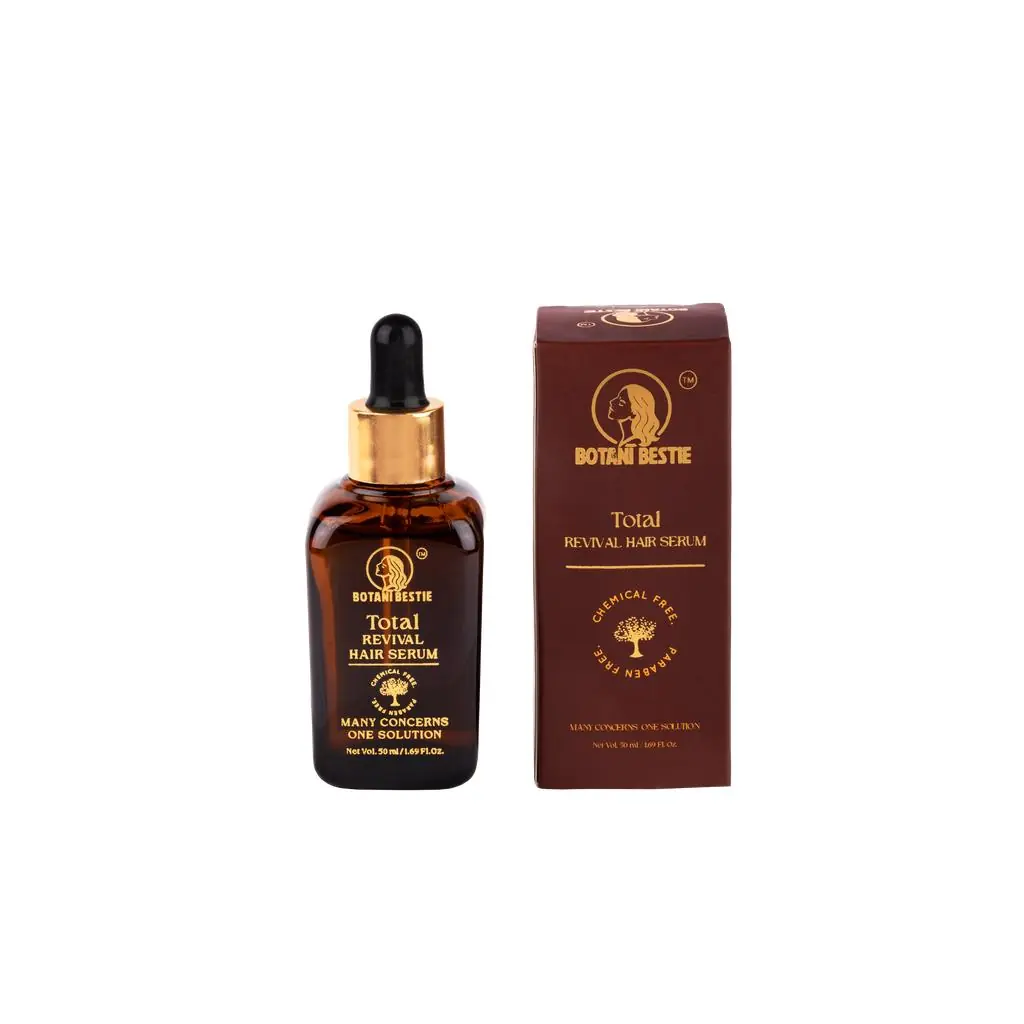
Total Revival Hair Serum — For Root-Level Hair Fall
Leave-In Scalp Serum · For Telogen Effluvium, AGA, Pattern Loss
Targets the follicle — not the shaft. Redensyl (DHQG + EGCG) activates hair follicle stem cells in the outer root sheath, directly promoting anagen re-entry in dormant follicles. Anagain (organic pea sprout extract) mimics dermal papilla signalling to extend anagen duration — the opposite of what DHT and stress do. Procapil (biotinyl-GHK + apigenin) improves scalp microcirculation and reduces follicle miniaturisation. Applied to the scalp as a leave-in serum. This is for root fall — not for shaft breakage.
Shop Total Revival Hair Serum →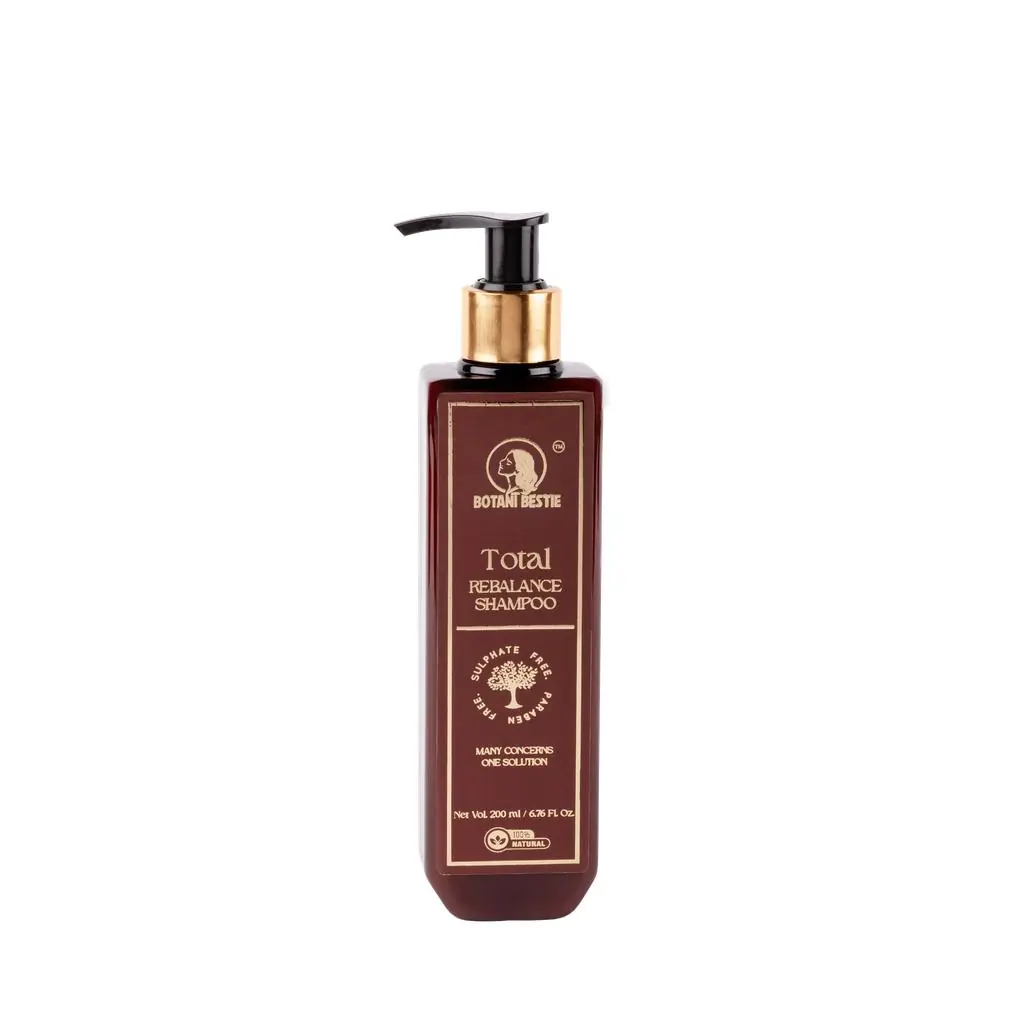
Total Rebalance Shampoo — For Both Problems
Sulphate-Free · pH Balanced · Every 2–3 Days
The one product that addresses both sides of the equation: sulphate-free formula prevents further cuticle disruption in breakage-prone hair (sulphates roughen the already-damaged cuticle at every wash); pH 4.5–5.5 preserves the acid mantle that protects both the shaft and the follicle opening. Green Tea EGCG delivers AhR-blocking antioxidant protection to the scalp (relevant for pollution-exposed follicles). Bhringraj extract supports follicle cycling and reduces scalp inflammation driving root fall. Rice water inositol provides the first layer of cuticle smoothing. The correct foundation for either breakage or fall treatment — every wash matters.
Shop Total Rebalance Shampoo →Still Not Sure Which Problem You Have? Get a Diagnosis
Hair breakage and root fall often co-exist, and the dominant problem is not always obvious from self-examination. A dermatologist consultation — including a trichoscopy (scalp microscopy) assessment if needed — identifies the exact pattern, the likely cause, and the specific treatment sequence. Most people with chronic hair concerns have been treating the wrong problem for months. Our dermatologist gives you the correct diagnosis and a protocol matched to what you actually have. No purchase required.
Book Free Consultation → WhatsApp UsFrequently Asked Questions

The Bottom Line — Diagnosis First, Treatment Second
The most common reason hair treatments fail is not that they are ineffective. It is that they are applied to the wrong problem. A growth serum applied to breaking hair does nothing. A protein mask applied to a stressed, shedding follicle does nothing. The hair care industry profits from selling general "hair fall" products to people who have not been told — and have no way of knowing — that they have two entirely different biological problems that require entirely different solutions.
The bulb check takes 30 seconds. The pattern check takes another minute. Combined with the elasticity test, these three steps give you a working diagnosis that no general "hair fall" product can substitute for.
Correct the diagnosis. Match the treatment. Give the biology the time it requires. Hair recovery — whether from broken shafts rebuilding through healthy growth, or from dormant follicles returning to anagen — is slow. But it is measurable, and it is predictable when the right intervention is applied to the right problem.
Shop Total Revival Serum → Free Hair Consultation"The right treatment for the wrong problem is the wrong treatment. Diagnose first."
Ready to make the honest switch?
Our products are built on the same principles as every article we write — pure ingredients, real results, nothing to hide.
Explore Our Products