Hair Porosity Guide: How to Test Yours and Choose the Right Products
Most hair care advice assumes all hair behaves the same way. It does not. Hair porosity — your hair's ability to absorb and hold moisture — is the single most important variable that determines which products actually work for you and which ones are a waste of money.
You've tried every oil, every shampoo, every "deep conditioning" mask you could find — and your hair still feels dry, limp, or refuses to absorb anything. The reason is almost never the product. It is that the product is designed for a different porosity type than yours.
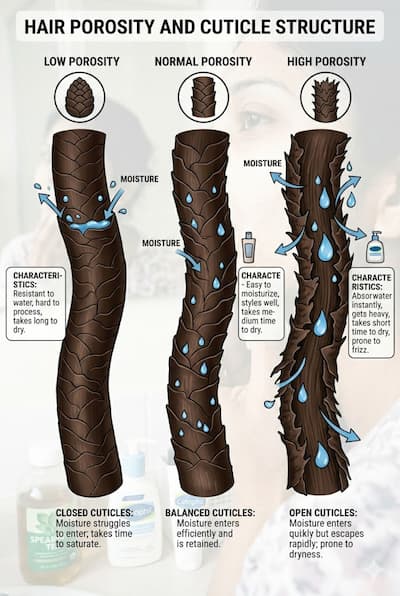
Hair porosity is determined by your cuticle — the outermost layer of overlapping protein scales that wrap around each strand. When those scales lie flat and tight, moisture struggles to get in (low porosity). When they are lifted or damaged, moisture floods in but escapes just as fast (high porosity). When they work as intended, you have normal porosity.
This guide gives you two reliable home tests to find your porosity type, explains the science behind each, and maps specific Ayurvedic ingredients and product choices to each type — so you stop guessing.
The Three Porosity Types at a Glance
Cuticles lie flat and tightly overlapping. Moisture struggles to enter. Products sit on top. Hair takes long to dry and rarely feels genuinely moisturised.
Cuticles are slightly raised, allowing controlled moisture exchange. Hair absorbs products well, retains moisture, and responds positively to most treatments.
Cuticles are lifted, chipped, or have gaps. Moisture enters easily but evaporates just as fast. Hair feels dry quickly, is prone to frizz, and tangles easily.
What Exactly is Hair Porosity?
Each strand of your hair is built in three layers. The innermost medulla is the soft core. The cortex is the thick middle layer that gives hair its strength, elasticity, and colour. The cuticle is the outermost armour — a series of overlapping, scale-like protein plates (like roof tiles or fish scales) that protect the cortex and regulate what goes in and out.
Porosity describes the state of those cuticle scales. When scales lie flat and compact, the cuticle is a tight barrier — this is low porosity. When scales are partially raised, the cuticle is slightly permeable — this is normal porosity. When scales are heavily lifted, chipped, or have visible gaps from damage, moisture moves in and out with minimal resistance — this is high porosity.
A heavy Bhringraj oil that works beautifully for high porosity hair (sealing open cuticles and locking in moisture) will sit uselessly on top of low porosity hair, creating grease without any benefit. The ingredient can be excellent — but wrong for the porosity. Porosity is not a flaw. It is a specification you need to know before selecting products.
How to Test Your Hair Porosity at Home
Two tests together give you the most reliable reading. Neither requires special equipment — just clean hair and a glass of water.
Test 1 — The Float Test
This is the most widely used test and works reliably when done correctly.
| Step | What to Do |
|---|---|
| 1. Collect a strand | Take 2–3 shed strands from your comb or brush — not freshly cut. Shed strands have cleaner cuticle structure for testing. |
| 2. Clean the strand | If you have product in your hair, rinse the strands briefly under water and let them air dry before testing. Product residue will skew the result. |
| 3. Drop into water | Fill a glass with room-temperature water. Gently place the strands on the surface. Do not push them down. |
| 4. Wait and observe | Watch what happens over 2–4 minutes without disturbing the glass. |
Cuticles are tightly sealed and repelling water. This indicates low porosity. The strand cannot absorb water so it has nothing to weigh it down.
The cuticle is allowing some water entry at a controlled rate. This indicates normal porosity. The strand absorbs gradually and finds equilibrium.
Cuticles are open and water is flooding in rapidly. This indicates high porosity. The strand becomes saturated quickly and sinks.
Test 2 — The Slip & Squeak Test
This is a tactile test that confirms what the float test showed. Take a single strand between your thumb and index finger and slide your fingers slowly from root to tip.
| What You Feel | What It Means | Porosity |
|---|---|---|
| Strand feels smooth, almost slippery. Fingers glide with no resistance or bumps. | Cuticles are flat and tightly packed — no surface texture means no raised scales. | Low Porosity |
| Slight resistance, mildly textured feel. Not rough, not completely smooth. | Cuticles are slightly raised in a healthy, functional way — small surface texture is normal. | Normal Porosity |
| Rough or bumpy texture. You may feel small raised sections or the strand feels coarse and uneven. | Cuticles are heavily lifted, chipped, or damaged — the bumps are the raised or broken scale edges. | High Porosity |
Use both together. If both tests give the same result, you can be confident in your porosity type. If they conflict — for example, the float test says low but the slip test feels rough — you may have mixed porosity: lower porosity near the root (newer growth) and higher porosity towards the tips (older, more damaged sections). This is common and just means you need to treat the mid-lengths and ends differently.
Low Porosity Hair: The Complete Care Guide
Signs You Have Low Porosity Hair
- Hair takes a very long time to fully wet in the shower
- Products (serums, oils, leave-ins) sit on top of hair and feel greasy rather than absorbing
- Hair takes a long time to air dry
- Protein treatments make hair feel stiff and brittle
- Product buildup accumulates quickly even with light use
- Hair feels healthy but does not respond to moisturising treatments
The Science of Low Porosity
Low porosity hair is not damaged — it is just tightly structured. The cuticle scales overlap so closely that water molecules and product ingredients have very little surface area to penetrate. This is actually good news: your hair is protected and retains its natural moisture well once you get it inside.
The challenge is the entry barrier. To moisturise low porosity hair effectively, you need to either open the cuticle temporarily (using gentle heat or steam) or use ingredients with molecular weights small enough to slip through the tight cuticle structure.
Best Ayurvedic Ingredients for Low Porosity Hair
| Ingredient | Why It Works for Low Porosity | How to Use |
|---|---|---|
| Fermented Rice Water | Low molecular weight inositol can slip through tight cuticles. Slightly acidic — keeps cuticles smooth. Strengthens without protein overload. | Use as a post-wash rinse or look for it in your shampoo's first 5 ingredients |
| Rosemary Oil | Penetrating, lightweight, and non-film-forming. Improves follicle circulation without sitting on sealed cuticles. | A few drops in a lightweight carrier oil; apply to scalp, not lengths |
| Argan Oil | One of the lightest natural oils. High oleic acid content allows it to penetrate even tight cuticles. Does not create buildup. | 2–3 drops on damp hair after washing; avoid applying to dry hair in large amounts |
| Brahmi (Bacopa monnieri) | Lightweight extract; improves scalp microcirculation; does not add coating to already-sealed strands. | Best delivered via a lightweight shampoo or scalp serum, not a heavy oil blend |
| Jojoba Oil (Simmondsia chinensis) | Technically a wax ester, not an oil — closest thing to your scalp's own sebum. Never feels heavy on low porosity hair. | Ideal base for scalp treatments; apply to scalp only |
What Low Porosity Hair Should Avoid
- Heavy oils: castor, coconut in large amounts, mineral oil
- Protein-heavy treatments — your cuticle doesn't need filling
- Silicones — add to an already-blocked entry point
- Thick butters (shea, mango) — sit on top and create buildup
- Cold water rinses — keep cuticles even more tightly closed
- Apply products on damp (not dry) hair to trap existing water
- Use a warm towel or steam cap before deep conditioning
- Clarify monthly with an ACV rinse to remove buildup
- Use lightweight, water-based leave-in formulas
- Humectant-rich products (glycerin) work well — they attract water
Normal Porosity Hair: The Complete Care Guide
Signs You Have Normal Porosity Hair
- Hair wets easily and takes a moderate amount of time to air dry
- Products absorb within a few minutes without feeling greasy or sitting on top
- Hair holds styles and curls well without being overly stiff
- Responds predictably to conditioning treatments
- Not prone to extreme dryness or extreme oiliness
The Science of Normal Porosity
Normal porosity hair has cuticle scales that are slightly raised from their base position — enough to allow moisture and product ingredients to pass through at a healthy rate, but not so open that moisture escapes immediately. This is the optimal functional state for the cuticle.
The priority for normal porosity is maintenance — keeping the cuticle in this healthy state by avoiding damage, using gentle cleansers, and building up your hair's moisture-protein balance over time. The biggest risk is degrading toward high porosity through heat damage, harsh products, or hard water.
Ayurvedic Ingredients That Maintain Normal Porosity
| Ingredient | Role for Normal Porosity |
|---|---|
| Bhringraj (Eclipta prostrata) | Anti-inflammatory at the follicle level; supports anagen phase (active growth); prevents the DHT-related damage that starts degrading porosity |
| Amla (Phyllanthus emblica) | Low pH naturally closes cuticle slightly; high Vitamin C acts as an antioxidant against oxidative cuticle damage; DHT blocking action preserves follicle output quality |
| Shikakai (Acacia concinna) | Gentle natural cleanser that maintains scalp pH between 4.5–5.5 — the mildly acidic range that keeps cuticles lying flat |
| Coconut Oil (pre-wash) | Applied before washing, coconut oil's lauric acid penetrates the cortex to reduce protein loss during the wash cycle — protecting from within |
| Hydrolyzed Keratin | Replenishes structural protein bonds; seals small cuticle micro-gaps before they develop into high porosity damage |
Total Rebalance Shampoo
by Botani Bestie
Fermented Rice Water, Coconut Milk, and Bhringraj in the first 5 ingredients. Sulfate-free and silicone-free — so it cleans without lifting the cuticle further. Gentle enough for high porosity hair, effective enough to cut through low porosity buildup.
Works with your cuticle, not against it.
No harsh detergents. No buildup.
Free shipping · 30-Day Money-Back Guarantee
High Porosity Hair: The Complete Care Guide
Signs You Have High Porosity Hair
- Hair wets almost instantly in the shower
- Hair absorbs products quickly but still feels dry within an hour
- Extreme frizz, especially in humid weather
- Hair feels rough, tangles easily, and breaks more than it should
- Colour fades very quickly after dyeing
- Hair air-dries faster than expected despite feeling dry immediately
What Causes High Porosity
High porosity can be genetic (common in naturally coily and tightly textured hair types) or acquired through damage. The most common acquired causes in Indian hair:
- Chemical treatments — bleaching, relaxing, perming, keratin treatments all use alkaline chemicals that forcibly lift and sometimes break cuticle scales
- Hard water buildup — the calcium and magnesium deposits in hard water (prevalent in most Indian metros) slowly etch the cuticle surface over months and years
- Repeated heat styling — each pass of a flat iron or blow dryer at high heat chips the protein structure of the cuticle
- Harsh sulfate shampoos — long-term use of SLS/SLES weakens the cuticle bonds through repeated pH disruption
- UV damage — unprotected sun exposure oxidises the cuticle proteins, causing progressive lifting
Best Ayurvedic Ingredients for High Porosity Hair
| Ingredient | Why It Works for High Porosity | How to Use |
|---|---|---|
| Bhringraj Oil | Heavy enough to sit in cuticle gaps as a sealant; anti-inflammatory at the follicle; reduces the breakage that high porosity causes at the cuticle level | Pre-wash oil treatment: apply to lengths, leave 30–60 mins under a warm towel, then wash |
| Amla Oil / Extract | Very low pH — helps temporarily flatten lifted cuticles; rich in tannins that bind to the cuticle surface and smooth it; reduces brittleness | Post-wash rinse or in a conditioning formula; excellent for closing cuticles after washing |
| Coconut Oil | High lauric acid content allows it to penetrate the cortex (not just coat the cuticle) and reduce protein loss during washing — addresses the root cause of moisture loss | Apply to slightly damp lengths 30 min before shampooing; do not apply to scalp |
| Apple Cider Vinegar (ACV) | Low pH rinse that physically closes lifted cuticles; chelates hard water mineral deposits that roughen the cuticle; antifungal | 1 tbsp in 250ml water as a post-wash final rinse; rinse out after 1–2 mins |
| Hydrolyzed Keratin / Silk Protein | Fill physical gaps in the cuticle layer; bind to exposed cortex proteins; temporarily smooth and strengthen the hair surface | Look for these in leave-in conditioners or hair serums applied post-wash |
| Neem (Azadirachta indica) | High porosity hair is prone to scalp infections as the raised cuticles also compromise the scalp's barrier; neem's antifungal action keeps the scalp healthy | In shampoo or as a scalp oil; particularly useful if high porosity is accompanied by dandruff |
- Sulfate shampoos — each wash lifts the cuticle further
- Heat styling without protection — causes more cuticle chipping
- Silicones — temporarily smooth but block protein treatments from working
- Very hot showers — hot water lifts cuticles further
- Protein overload — too much keratin treatment makes hair stiff and snap
- Always finish with a cold or cool water rinse to close cuticles
- Layer moisture: water-based product first, then seal with oil
- Use a microfiber towel — regular towels abrade raised cuticles
- Regular ACV rinse to close cuticles and chelate hard water
- Protein + moisture balance: alternate protein and moisture treatments
Total Restore Hair Oil
by Botani Bestie
Bhringraj, Amla, and Brahmi in a lightweight sesame base — without mineral oil or silicones that would block penetration. Use as a pre-wash treatment on high porosity hair to seal and strengthen before the wash cycle strips moisture.
Seals open cuticles.
Locks moisture in. Prevents protein loss.
Free shipping · 30-Day Money-Back Guarantee
Quick Reference: Porosity vs Products
| Factor | Low Porosity | Normal Porosity | High Porosity |
|---|---|---|---|
| Best oil type | Lightweight: Argan, Jojoba | Most oils work: Argan, Bhringraj, Coconut (pre-wash) | Heavy sealants: Bhringraj, Amla, Coconut |
| Oil timing | Apply to damp hair; use heat to open cuticle | Pre-wash or post-wash, both work | Pre-wash treatment for best penetration |
| Protein treatments | Avoid or use minimally — risk protein overload | Monthly protein treatment for maintenance | Every 2–4 weeks to fill cuticle gaps |
| Water temperature | Warm water opens cuticle for better absorption | Lukewarm; finish with cool rinse | Lukewarm; always finish with cold rinse |
| Shampoo frequency | Less frequent — prone to buildup; clarify monthly | Normal frequency (2–3× per week) | As needed; gentle, sulfate-free always |
| ACV rinse | Monthly to remove buildup | Every 2–4 weeks for maintenance | Weekly — closes cuticles and chelates hard water |
| Risk to avoid | Product buildup, protein overload | Preventing damage that shifts to high porosity | Further cuticle damage from heat and sulfates |
Frequently Asked Questions
Not Sure Where to Start?
Take the Free 5-Min Hair & Skin Test
Tell us about your hair type, porosity, concerns, and current products. We will identify your exact triggers and recommend the right clean formula — personalised to your specific hair profile.
Start Free Hair Test"There is no bad porosity type — only products chosen for the wrong one. Know your hair's language, then give it what it is actually asking for."
Ready to make the honest switch?
Our products are built on the same principles as every article we write — pure ingredients, real results, nothing to hide.
Explore Our Products