Summer Skin Care Routine for Indian Skin — Heat, Humidity, UV, and What Actually Works
Indian summers are not "slightly warm" — they are UV Index 10+, 40°C air temperature, 70–90% relative humidity, and fine particulate pollution in most cities. This combination creates specific skin problems that a Western skin care routine, or a generic "summer routine," is not designed to handle. This guide is built for Indian summer specifically.

The Indian summer skin care problem is not one problem — it is four problems happening simultaneously:
- UV overload: UV Index 10+ across most of India from March to September. At UVI 10, SPF 15 is inadequate. Unprotected skin starts experiencing melanin-triggering UV dose within 6–8 minutes of exposure.
- Sebum overproduction: Heat increases sebaceous gland activity. At 40°C, sebum production rates can be 2–3× higher than at 25°C. For people who are already oily-skinned, summer tips them into breakout territory.
- Barrier disruption from cleansing: Increased sweating triggers more frequent face washing. Each wash with an alkaline cleanser disrupts the skin barrier slightly — in winter, the barrier recovers between washes. In summer, repeated over-cleansing creates a damaged barrier that lets in more UV, pollution, and bacteria.
- Dark spot acceleration: Any existing acne spot, minor inflammation, or previous PIH is worsened by summer UV — the UV triggers additional melanin deposition on already-inflamed skin, deepening and spreading hyperpigmentation.
These four problems require specific solutions — not just a "lighter version of your winter routine."
The Indian Summer Skin Care Routine — Step by Step
Morning Routine — The Protective Stack
Remove night-accumulated sweat and sebum without stripping the barrier. Use cool or lukewarm water — hot water raises sebum production. A low-pH, sulfate-free cleanser is optimal. If you have acne-prone skin in summer, look for Neem, ACV, or low-dose Salicylic acid in the formula. Avoid SLS — the "squeaky clean" sensation it creates is barrier damage, which causes more oiliness and sensitivity within hours.
Apply 2–3 drops of a stable Vitamin C formulation to clean, dry skin before sunscreen. Vitamin C neutralises UV-generated free radicals and inhibits tyrosinase (the melanin production enzyme) — directly preventing new dark spots and slowing existing ones. Apply while skin is dry — Vitamin C is less stable at high pH (water on the face raises pH slightly).
Apply a gel-based moisturiser with Hyaluronic acid, Aloe vera, or Niacinamide. The goal is hydration without lipid occlusion. Niacinamide is particularly valuable in summer — it reduces sebum production (sebocyte activity), reduces pore appearance, and inhibits melanin transfer to surface cells. Do not skip moisturiser thinking oily skin does not need it — the skin interprets dehydration as a signal to produce more sebum.
The single most important step in Indian summer skin care. At UVI 10+, SPF 30 provides adequate protection if applied correctly (2mg/cm² = approximately ½ teaspoon for face + neck). Reapply every 2 hours in direct sun. For Indian skin tones, look for sunscreens that are formulated without the white cast issue — chemical sunscreens (avobenzone, octinoxate) or modern hybrid formulas. A PA+++ or higher UVA protection rating is essential — UVA drives dark spots and skin aging even on overcast days.
Evening Routine — The Repair Stack
First cleanse with a lightweight oil or micellar water to remove sunscreen and makeup residue — sunscreen in particular is designed to be water-resistant and requires a lipid-based first cleanse. Second cleanse with your low-pH cleanser to clean the skin surface. If not wearing sunscreen, a single pH-balanced cleanser is sufficient.
Evening is the time for actives that are either UV-sensitive (Retinol, AHAs) or benefit from overnight contact time. For summer dark spots: Niacinamide 10% (inhibits melanin transfer) or Alpha Arbutin. For uneven texture and mild exfoliation: Lactic acid or Mandelic acid 5–10% (gentler than Glycolic for Indian skin, less likely to cause PIH). For anti-aging and cell turnover: Retinol (start at 0.025%, build slowly).
Night is when skin barrier repair primarily occurs. A lightweight cream (not as heavy as winter) with Ceramides, Squalane, or Centella Asiatica provides barrier support without the occlusion that causes milia or clogged pores in summer. If your skin is very oily, a thin gel moisturiser with Centella or Aloe vera is sufficient overnight.
Apply benzoyl peroxide, Salicylic acid, or Neem-based spot treatment only to active breakouts — not as an all-over treatment. All-over active treatment in summer increases photosensitivity and barrier disruption. Targeted spot treatment addresses the acne without compromising the barrier of uninflamed skin.
Summer Routine Adjustments by Skin Type
| Skin Type | Summer-Specific Changes | What to Avoid |
|---|---|---|
| Oily / Acne-prone | Gel moisturiser only; Niacinamide AM + PM; BHA (Salicylic acid 0.5–2%) cleanser; mattifying mineral sunscreen; blotting papers for midday; clay mask 1× per week | Heavy creams, face oils, pore-clogging sunscreens, SPF foundations as primary UV protection, Coconut oil anywhere on face |
| Combination | Light gel moisturiser; Niacinamide; lightweight chemical sunscreen; focus active treatments on T-zone; hydrating sheet mask 1× per week for dry zones | Applying heavy products to the T-zone; over-exfoliating (worsens dryness in U-zone) |
| Dry / Sensitive | Hydrating cleanser with Ceramides; Hyaluronic acid serum (on damp skin); gentle physical sunscreen (zinc oxide/titanium dioxide — less irritating than chemical filters); barrier cream PM; avoid all active treatments in summer | AHAs, retinol, high-dose Vitamin C (irritating), alcohol-based toners, mattifying products (drying) |
| Dark spots / Hyperpigmentation-prone | SPF 50+ mandatory; Vitamin C AM; Niacinamide + Alpha Arbutin PM; avoid picking blemishes (every picked spot becomes a dark spot in summer UV); wear physical UV barriers (hats, scarves) in peak hours | AHAs without SPF (photosensitising), strong retinol in summer, any product that increases photosensitivity without adequate SPF cover |
The Summer Dark Spot Problem — Why Indian Skin Is More Vulnerable
Indian skin (Fitzpatrick types III–V) has naturally higher melanin density than lighter skin types — which means more UV protection but also a significantly higher tendency to produce excess melanin in response to any inflammation or UV trigger. This is called post-inflammatory hyperpigmentation (PIH).
Why Indian Summer Worsens Dark Spots
- UV Index 10+: Even 20 minutes of unprotected exposure at UVI 10 triggers measurable melanin increase in Fitzpatrick III–V skin types.
- Heat-induced vasodilation: Hot skin is inflamed skin — dilated vessels, slightly elevated pro-inflammatory cytokines, and an environment where melanocytes are more reactive to any trigger.
- Sweat + pollution cocktail: PM2.5 and ozone in urban Indian air generate free radicals on the skin surface — triggering melanin production as a UV-like oxidative stress response.
- Existing PIH deepened: Any old acne scar, dark spot, or mild hyperpigmentation is directly worsened by UV — summer is when old dark spots get darker and new ones form faster.
The Anti-Dark-Spot Summer Protocol
- SPF 50+ daily — no exceptions: This alone prevents the majority of new dark spot formation and stops existing ones from deepening.
- Vitamin C every morning: Neutralises UV-generated free radicals before they trigger melanin production; directly inhibits tyrosinase.
- Niacinamide AM + PM: Inhibits melanosome transfer from melanocytes to keratinocytes — reduces dark spot appearance regardless of cause.
- No picking: Every broken pimple that gets UV exposure in summer becomes a dark spot. Hands-off policy, always.
- Antioxidant diet: Amla, berries, green tea, tomatoes — dietary antioxidants provide systemic protection that topicals cannot fully replace.
The Right Face Wash for Indian Summer
The face wash is the most frequently used product in any summer routine — and the most frequently wrong. Using an SLS-based, alkaline, fragrance-heavy face wash twice daily in summer is the fastest way to damage your skin barrier, increase UV sensitivity, worsen breakouts, and make dark spots more persistent. pH-balanced, gentle, and active-containing is the specification for Indian summer cleansing.
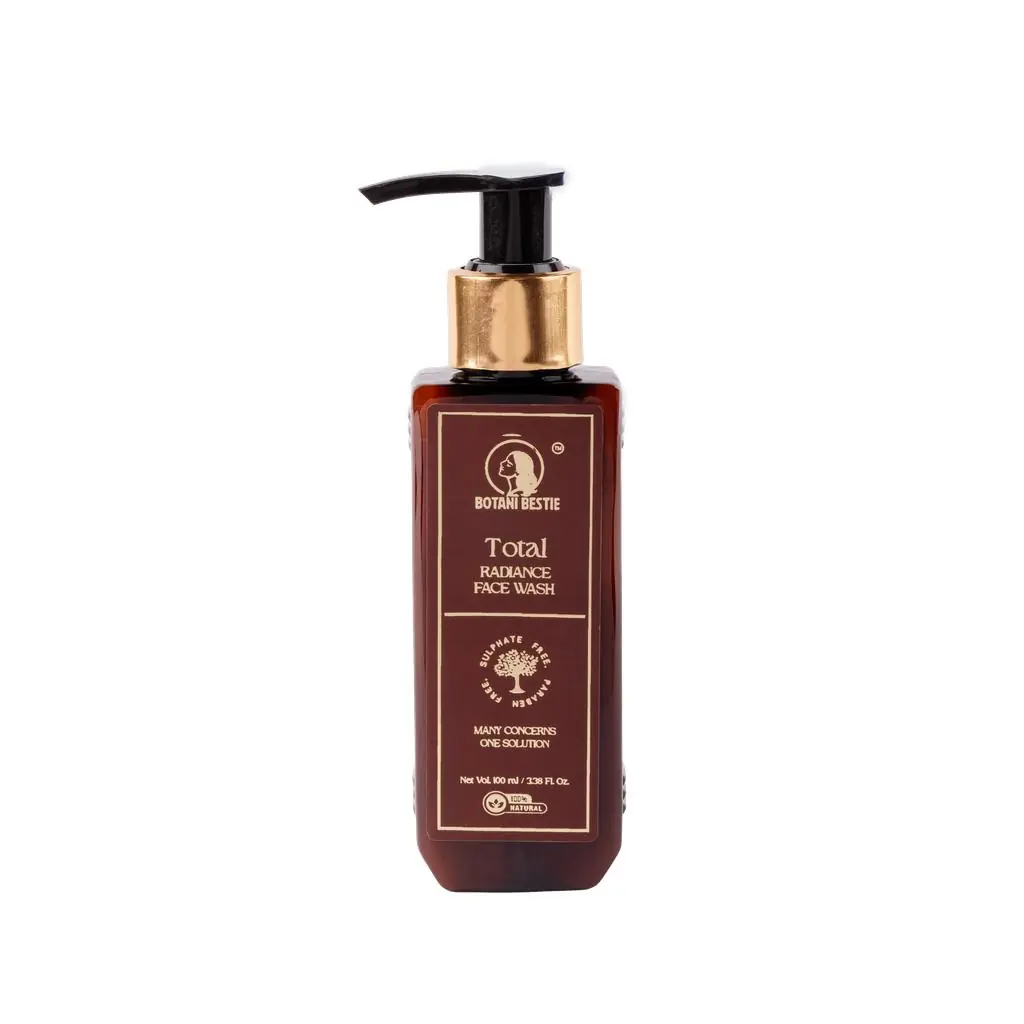
Total Radiance Face Wash
by Botani Bestie — Brightening Ayurvedic Face Cleanser
Formulated specifically for Indian skin conditions — combining gentle cleansing with active ingredients for dark spots, acne, and pH preservation. Key actives include Niacinamide (sebum control + melanin inhibition), Apple Cider Vinegar (pH normalisation), Turmeric (anti-inflammatory), Licorice (tyrosinase inhibition), Neem (antibacterial + antifungal), and Aloe vera (barrier soothing).
- Sulfate-free — no SLS or SLES that disrupts barrier and worsens summer oiliness
- pH-balanced to 4.5–5.5 — preserves acid mantle integrity
- Niacinamide + Licorice — active dark spot treatment in the cleanser step itself
- No synthetic fragrance — safe for inflamed summer skin
What to Remove from Your Routine in Indian Summer
Heavy Facial Oils and Rich Creams
Rosehip oil, marula oil, rich shea butter creams — excellent in winter, occlusive nightmares in Indian summer. They trap heat, increase comedone formation, and leave a visible oily finish in humidity. Switch to gel-based or water-based equivalents. If you need a facial oil, apply a small amount to dry areas (not the T-zone) overnight only — not as part of a daytime routine.
Alcohol-Based Toners and Astringents
Alcohol-based toners remove excess oil temporarily — and cause the skin to over-produce sebum within 2–3 hours as a compensatory response. They also disrupt the skin barrier, increasing UV photosensitivity. Replace with ACV-based or Witch Hazel (alcohol-free) toners, or skip the toner step entirely in summer and rely on your cleanser + moisturiser to balance the skin.
High-Strength AHAs Without Adequate SPF
Glycolic acid and Lactic acid are excellent exfoliants — but they increase photosensitivity for 48–72 hours after use. Using a 10%+ AHA on a Tuesday evening and walking into peak Indian sun without SPF 50+ on Wednesday is a recipe for severe PIH. If using AHAs in summer, reduce to once per week, use lower concentrations (5–8%), and never skip SPF the following morning.
Skipping SPF on "Cloudy" Days
UVA rays (the dark spot and aging rays) pass through clouds virtually unimpeded — UV Index on an overcast Indian summer day is typically 6–8, still high enough to cause measurable melanin increase in Fitzpatrick III–V skin. The visual signal of bright sunshine is your brain's UV sensor, not your skin's. Your skin does not distinguish between sunny and cloudy days — apply SPF regardless.
Frequently Asked Questions
The Honest Summer Skin Care Summary
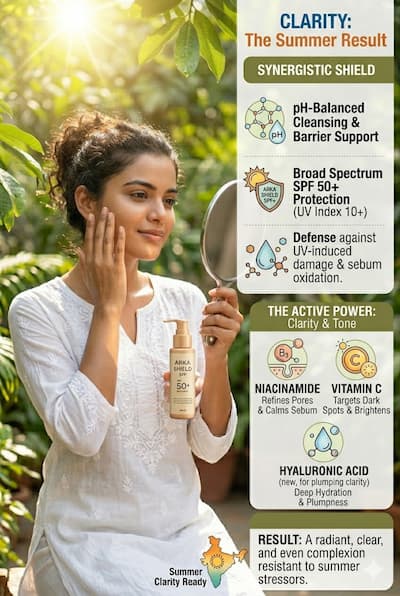
Indian summer is tough on skin — but it is predictable. The same four problems (UV, sebum, barrier disruption, dark spot acceleration) recur every year for every person with Indian skin. The solution is not a 15-step routine — it is four consistent steps done correctly every day.
Cleanse gently (pH-balanced, no SLS). Protect (SPF 50+, Vitamin C). Hydrate without occlusion (lightweight gel moisturiser). Treat at night (Niacinamide, gentle exfoliant). That is summer skin care for Indian skin. Everything else is optional optimisation on top of that foundation.
The dark spot prevention during summer is the compounding return investment — consistent SPF and Niacinamide for one summer prevents more dark spots than two years of whitening treatments after the fact.
Shop Total Radiance Face Wash → Free Skin Consultation"The best time to start wearing SPF was ten years ago. The second best time is this morning."
Ready to make the honest switch?
Our products are built on the same principles as every article we write — pure ingredients, real results, nothing to hide.
Explore Our Products