Rosemary for Hair and Skin — The Complete Science-Backed Guide (2025)
Rosemary is the only natural herb clinically compared head-to-head with Minoxidil in a randomised trial. In 2025, a landmark JCI Insight study discovered exactly how its carnosic acid heals skin at the molecular level. India's most underrated botanical just got its most comprehensive scientific validation yet.
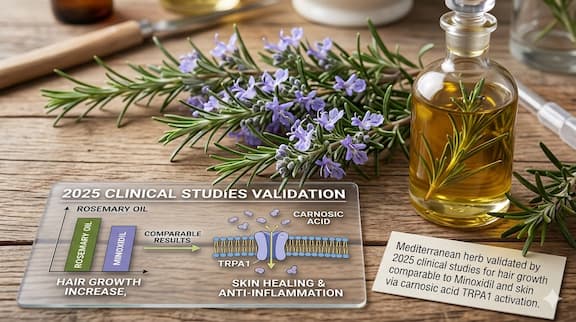
For most of its 4,000-year medicinal history, rosemary's reputation rested on traditional use and anecdotal observation. Known as Rosmarinus officinalis — "dew of the sea" in Latin — it was used by ancient Greek scholars to strengthen memory, by Roman physicians for skin conditions, and by Ayurvedic practitioners as a component of hair and scalp formulations.
In 2015, something unusual happened: rosemary became the first natural herb to be tested in a rigorous, randomised head-to-head comparison with Minoxidil — the FDA-approved pharmaceutical gold standard for hair loss. The results made headlines. In 2025, two landmark studies — one in JCI Insight and one in the Journal of Clinical and Aesthetic Dermatology — provided the most detailed molecular explanations yet for how rosemary's key compounds heal skin and support follicle health.
This guide covers both dimensions: what rosemary does for your hair (the growth mechanisms, the Minoxidil comparison, the honest limitations), and what it does for your skin (the carnosic acid wound-healing breakthrough, the anti-ageing data, the anti-inflammatory mechanism). It is present in Botani Bestie's Hair Oil, Shampoo, and Face Wash precisely because the science supports its inclusion in all three.
💡 What Are You Looking to Treat? Jump to Your Section.
Rosemary's benefits span both hair and skin — and the active compounds responsible differ. Choose your primary concern to go directly to the most relevant science:
👉 Or read the complete guide below for the full picture — both hair and skin benefits are interconnected through rosemary's compound profile.
What is Rosemary — The Bioactive Compounds Behind the Benefits
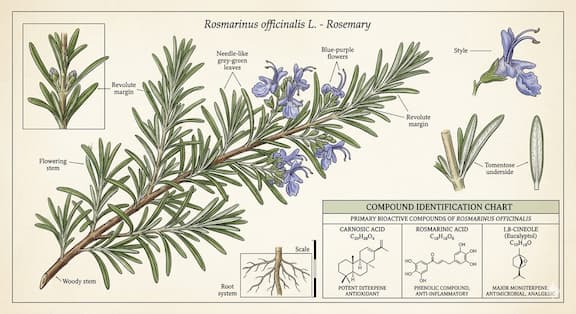
Rosemary (Rosmarinus officinalis L., now also classified as Salvia rosmarinus Spenn.) is a woody perennial herb of the Lamiaceae family, native to the Mediterranean basin. It grows abundantly across India's drier regions and is widely cultivated in Karnataka, Tamil Nadu, and Himachal Pradesh.
Phytochemical analysis identifies it as one of the richest natural sources of specific antioxidant and anti-inflammatory compounds — making it pharmacologically distinct from most herbs that offer broad, non-specific activity. For hair and skin specifically, its most important compounds are:
| Compound | Class | Primary action for hair & skin |
|---|---|---|
| Carnosic Acid | Phenolic diterpene | Antioxidant (ROS scavenging); wound healing via TRPA1 activation (2025 JCI Insight); anti-inflammatory via NF-κB and Nrf2; collagen promotion |
| Carnosol | Phenolic diterpene | Antioxidant + anti-inflammatory (NF-κB, COX-2 suppression); synergises with carnosic acid |
| Rosmarinic Acid (RA) | Phenolic acid | Anti-glycation (53% AGE reversal, 2025 JCAD RCT); anti-inflammatory; anti-pigmentation; antioxidant; analgesic |
| Ursolic Acid | Triterpene | 5α-reductase inhibition (DHT blocking); anti-inflammatory; collagen synthesis stimulation |
| 1,8-Cineol (Eucalyptol) | Monoterpene | Scalp vasodilation (increases blood flow to follicles); antimicrobial against Malassezia and Staphylococcus; penetration enhancer |
| α-Pinene / Camphor | Monoterpenes | Antimicrobial; anti-inflammatory; scalp circulation stimulation; camphor promotes collagen in dermal fibroblasts |
| Caffeic Acid / Chlorogenic Acid | Phenolic acids | Antioxidant; anti-inflammatory; synergistic with rosmarinic acid for AGE prevention |
🌿 Part 1: Rosemary for Hair — The Complete Evidence
How Rosemary Promotes Hair Growth — 4 Mechanisms
Best for: General hair thinning, follicles weakened by poor scalp circulation
Rosemary's primary mechanism for hair growth is vasodilation — it enhances blood flow to the scalp's capillary network that supplies each follicle with oxygen and nutrients. The primary compound responsible is 1,8-cineol (eucalyptol), a monoterpene that directly stimulates microcapillary perfusion in the scalp dermis. This is the same mechanism through which Minoxidil promotes hair growth (as a potassium channel opener causing arteriolar vasodilation) — which is precisely why rosemary was chosen for the Minoxidil comparison trial.
A 2024 PMC overview of natural alternatives for androgenetic alopecia confirmed that rosemary oil promotes scalp microcirculation similar to Minoxidil. The Panahi et al. (2015) RCT — which used rosemary essential oil applied directly to the scalp twice daily for 6 months in 100 patients with androgenetic alopecia — found comparable improvement in hair density to Minoxidil 2%, with the added benefit of significantly lower scalp itching in the rosemary group.
The 2025 Bayesian network meta-analysis (PMC, 15 trials, 9 active comparators) independently confirmed: rosemary topical produced significantly greater hair density improvement than control (MD = 10.63 hairs/cm², 95% CI: 0.82 to 20.89 hairs/cm², p<0.05) — establishing it as one of the only natural topical treatments with statistically significant controlled trial evidence for hair density improvement.
Best for: Androgenetic alopecia (pattern thinning), PCOS-related hair fall
Ursolic acid — a triterpene found in rosemary leaves — has demonstrated 5α-reductase (5αR) inhibiting activity. 5αR is the enzyme that converts testosterone into DHT (dihydrotestosterone), the primary driver of androgenetic alopecia. Inhibiting 5αR reduces DHT production at the follicle level, slowing the miniaturisation process that causes pattern hair loss. This is the same mechanism as finasteride — the most effective pharmaceutical treatment for male pattern baldness.
This 5αR inhibition gives rosemary a dual-mechanism advantage in androgenetic alopecia: the vasodilation from 1,8-cineol increases follicle blood supply (like Minoxidil), while ursolic acid's 5αR inhibition addresses the androgen-driven miniaturisation (like finasteride) — in a single ingredient. No pharmaceutical treatment currently addresses both pathways simultaneously at the OTC level.
A 2024 ethnopharmacological mini-review noted that rosemary oil promotes scalp microcirculation similar to Minoxidil while also potentially inhibiting 5α-reductase activity — summarising the dual mechanism that makes rosemary pharmacologically more comprehensive than either Minoxidil or finasteride alone.
Best for: Dandruff-driven hair fall, itchy scalp, Malassezia overgrowth
Rosemary's monoterpenes — particularly 1,8-cineol and α-pinene — demonstrate direct antimicrobial activity against the microorganisms most relevant to scalp health. Studies confirm that 1,8-cineol and α-pinene are key compounds for antimicrobial activity especially against Pseudomonas aeruginosa and Staphylococcus aureus. Staphylococcus aureus is a scalp coloniser that worsens dandruff inflammation and contributes directly to follicle-level hair fall. See our complete dandruff and hair fall guide →
For Malassezia specifically — the primary cause of dandruff — a 2024 Scientific Reports study (Hashem et al.) confirmed the combined anti-dandruff and anti-hair-loss efficacy of rosemary and neem together. The antimicrobial monoterpenes create an inhospitable scalp environment for Malassezia overgrowth, while rosemary's anti-inflammatory mechanisms calm the inflammatory cascade that dandruff triggers — addressing both the cause and the consequence of dandruff-driven hair fall simultaneously.
The scalp barrier-repairing properties of carnosic acid (confirmed in the 2025 JCI Insight study) also contribute to dandruff management — a stronger scalp barrier reduces the permeability that allows Malassezia deeper follicle access.
Best for: UV-driven hair thinning, premature greying, pollution-damaged hair
Carnosic acid and carnosol are among the most potent natural antioxidants identified in any plant — they scavenge reactive oxygen species (ROS) directly and indirectly through upregulation of antioxidant defences via the Nrf2 pathway. For hair follicles — particularly the melanocytes responsible for hair pigment — this antioxidant protection is critical in India's high-UV, high-pollution environment.
ROS damage follicle structures progressively: degrading the dermal papilla cells that regulate growth, depleting follicle melanocytes (causing premature greying), and weakening the follicle microenvironment that supports healthy hair cycles. Rosemary's carnosic acid and carnosol neutralise this ROS damage at the follicle level — the same biological basis for its traditional use in premature greying prevention documented across Mediterranean and Ayurvedic herbal practice.
The 2023 Antioxidants (MDPI) comprehensive review confirmed rosemary's potent antioxidant role in cutaneous diseases and its anti-photoaging potential — directly relevant for Indian hair care in a country where UV index averages 8–11 year-round.
The Clinical Evidence for Rosemary and Hair — What Studies Show
| Study | Design | Key Finding | Strength |
|---|---|---|---|
| Panahi et al., 2015 SKINmed — Rosemary oil vs Minoxidil 2% RCT |
Randomised comparative trial, 100 AGA patients, 6 months, twice-daily application | Rosemary essential oil showed comparable hair density improvement to Minoxidil 2% at 6 months; significantly less scalp itching in rosemary group | High — human RCT vs pharmaceutical |
| Patel et al., 2025 — Indian RCT Cureus — Rosmagain™ double-blind 3-arm RCT, CTRI registered |
Double-blind, randomised, 3-arm, placebo-controlled, 90 days; rosemary-lavender vs rosemary-castor vs coconut oil (control); ICMR GCP guidelines; phototrichography measurement | Rosemary-lavender: 57.73% hair growth rate improvement; rosemary-castor: 47.59%. Hair thickness increased by nearly 70%; density improved by approximately 32%. Both significantly better than coconut oil control. | High — 2025 Indian RCT, double-blind, phototrichography |
| 2025 Bayesian Network Meta-Analysis PMC — 15 trials, 9 active comparators for male AGA |
Systematic review + Bayesian NMA; rosemary topical included as one of 9 OTC comparators | Rosemary significantly more effective than control (MD = 10.63 hairs/cm², p<0.05); Minoxidil 5% most effective overall (SUCRA = 99.8%); rosemary outperformed saw palmetto topical | High — 2025 systematic review + NMA |
| Hay et al., 1998 Archives of Dermatology — essential oil blend RCT |
Double-blind RCT, thyme + rosemary + lavender + cedarwood in carrier oils vs carrier alone | 44% of treatment group showed improvement in alopecia areata vs 15% in control group — 19 of the 43 patients (44%) in the treatment group showed improvement | Moderate — human RCT, combination formula |
| Hashem et al., 2024 Scientific Reports — rosemary + neem anti-dandruff efficacy |
Combined efficacy study | Confirmed combined anti-dandruff and anti-hair-loss efficacy of rosemary and neem; antimicrobial action against Malassezia validated | Moderate — combined herbal study |
| ScienceDirect, 2025 Minoxidil + Rosemary oil nanoemulsion — synergistic effect study |
In vitro + formulation study | Minoxidil + rosemary oil nanoemulsion combination demonstrated synergistic hair growth promotion effects in cell studies; confirms complementary mechanisms | Moderate — in vitro, combination |
Myth vs. Truth — Rosemary for Hair
| Myth | Scientific Truth |
|---|---|
| Rosemary oil is as effective as Minoxidil 5% | The Panahi RCT compared it to Minoxidil 2% — not 5%. The 2025 NMA found Minoxidil 5% significantly more effective than rosemary topical. Rosemary is comparable to Minoxidil 2%, not 5%. |
| You can just rub rosemary leaves directly on your scalp | The clinically studied delivery format is rosemary essential oil or standardised rosemary extract in a carrier oil or formulated shampoo — not raw leaves. The bioactive compounds require proper extraction to be bioavailable at concentrations that produce measurable effects. |
| Rosemary only works for androgenetic alopecia | The Hay et al. RCT showed benefit for alopecia areata. Rosemary's antifungal mechanism is directly relevant for dandruff-driven hair fall. Its antioxidant action is relevant for UV and pollution-driven thinning. Its applications span multiple hair fall types. |
| Rosemary oil can be applied undiluted to the scalp | Rosemary essential oil is potent and should always be diluted in a carrier oil (typically 2–3 drops per tablespoon of carrier) before scalp application. Undiluted essential oil can cause sensitisation, irritation, and chemical burns in some individuals. |
| Shampoo with rosemary doesn't work because it rinses off | The scalp contact time during shampooing — 2–5 minutes of active massage — is sufficient for rosemary's oil-soluble bioactives (carnosic acid, ursolic acid, 1,8-cineol) to penetrate into the scalp. Consistent twice-daily or every-wash delivery accumulates to clinically meaningful exposure over weeks and months. |
💡 Want rosemary + Bhringraj + Amla + ACV + 10 more actives in one sulfate-free formula — delivering anti-dandruff, anti-hair-fall, and follicle-stimulating benefits with every wash?
See Total Rebalance Shampoo →🌸 Part 2: Rosemary for Skin — The 2025 Science
How Rosemary Benefits Skin — 4 Evidence-Backed Mechanisms
Best for: Post-acne marks, skin barrier repair, PIH reduction, anti-scarring
A landmark October 2025 study published in JCI Insight (Rapp et al., University of Pennsylvania + University of Utah) provided the first molecular explanation for rosemary extract's widely observed wound-healing properties. Using adult wound healing mouse models, the researchers demonstrated that an ethanol-based rosemary extract accelerates the speed of wound healing and mitigates fibrosis.
The mechanism identified was novel and unexpected: carnosic acid activates TRPA1 (transient receptor potential ankyrin 1) nociceptors on cutaneous sensory neurons — triggering a tissue regeneration response that enhances keratinocyte migration to the wound site and reduces the fibrotic (scarring) tissue formation that characterises normal mammalian wound healing. Mice lacking TRPA1 in sensory neurons did not exhibit these pro-regenerative responses, confirming it as the critical mediator. Crucially, carnosic acid is substantially less caustic than other TRPA1 agonists (like AITC, the gold-standard TRPA1 activator) and does not activate TLR7 or cause tissue-damaging properties.
For Indian skin — where post-acne PIH marks, friction hyperpigmentation, and sun damage create persistent skin barrier compromise — this wound-healing and barrier-repair mechanism is directly clinically relevant. A stronger, faster-repairing skin barrier reduces the permeability to UV and pollution that drives further pigmentation and sensitivity.
Best for: Skin dullness, roughness, uneven texture, anti-ageing
Advanced glycation end products (AGEs) form when sugar molecules bind to collagen, elastin, and other skin proteins — creating cross-links that stiffen and yellow the protein matrix, contributing to skin dullness, roughness, enlarged pores, and the loss of elasticity associated with ageing. UV exposure, high-sugar diets, and urban pollution all accelerate AGE formation in Indian skin.
Rosmarinic acid (RA) — the primary phenolic compound in rosemary leaves — demonstrated the greatest ability to reverse AGE crosslink proteins in controlled comparison studies: 53% AGE crosslink reversal, p<0.0001, outperforming established anti-glycation agents including aminoguanidine and Alagebrium (ALT-711, 46%). A 2025 JCAD double-blind, randomised, placebo-controlled trial (52 subjects per arm, 40–65-year-old women with moderate-to-severe skin dullness and roughness) confirmed that a rosemary extract supplement containing RA significantly improved all assessed skin quality parameters over 12 weeks — including skin dullness, roughness/texture, erythema, pore size, and uneven pigmentation. Rosemary extract and its natural cofactors demonstrated two times more deglycation ability than pure RA alone, confirming the whole-extract advantage over isolated compounds.
Best for: Acne, post-acne redness, oily skin, sebum-driven breakouts
Carnosic acid and carnosol modulate multiple inflammatory signalling pathways simultaneously — an unusually broad anti-inflammatory profile documented in a major 2023 Biomedicines review: NF-κB, MAPK, Nrf2, SIRT1, STAT3, and NLRP3 inflammasome pathways are all modulated. The downstream effect is suppression of pro-inflammatory cytokines (TNF-α, IL-1β, IL-6), adhesion molecules, and prostaglandins — the same inflammatory cascade that turns a blocked pore into an inflamed papule or pustule in acne-prone skin.
Specifically relevant for Indian skin: IL-1β and TNF-α are the primary drivers of post-inflammatory hyperpigmentation (PIH) — by reducing these cytokines, rosemary simultaneously calms active breakouts and reduces the inflammatory trigger for the dark marks that follow them. Studies confirm inhibition of iNOS and COX-2 — two key enzymes for mediating inflammatory processes — by rosemary's methanol extract and purified carnosic acid and carnosol fractions.
The antimicrobial properties — 1,8-cineol and α-pinene against Staphylococcus aureus — are directly relevant for acne management, as Staphylococcus aureus and Cutibacterium acnes are the primary bacterial drivers of inflammatory acne lesions. See our complete acne guide →
Best for: UV pigmentation, sun damage, anti-photoageing in India's high-UV environment
Rosemary's polyphenols — particularly carnosic acid, carnosol, and rosmarinic acid — activate the antioxidant response element/Nrf2 (ARE/Nrf2) transcription system, the cell's primary antioxidant defence mechanism, in response to UVB exposure. This activation upregulates the cell's own antioxidant enzymes, neutralising the UV-generated ROS that cause DNA damage, collagen degradation (via MMP-9 upregulation), and melanin overproduction (UV-triggered hyperpigmentation).
A 2023 Antioxidants review confirmed that rosemary's carnosic acid and carnosol inhibit the UV-induced increase in active metalloproteinase-9 (MMP-9) — the enzyme that breaks down collagen and contributes to photoageing wrinkles and skin sagging. Camphor (a monoterpene in rosemary essential oil) has been specifically verified for its collagen-promoting property in human primary dermal fibroblasts in both a dose- and time-dependent manner, and in UV-exposed mouse skin.
In India's UV environment — where UV index of 8–11 drives daily photoageing, hyperpigmentation, and collagen degradation — rosemary's multi-compound UV protection mechanism (ROS scavenging + Nrf2 activation + MMP-9 inhibition + collagen promotion) makes it one of the most comprehensive natural photoprotective ingredients available.
Clinical Evidence for Rosemary on Skin
| Study | Design | Key Finding | Strength |
|---|---|---|---|
| Rapp et al., JCI Insight, 2025 University of Pennsylvania + University of Utah |
Mechanistic mouse model (adult wound healing) + TRPA1 knockout confirmation | Carnosic acid activates TRPA1 on cutaneous sensory neurons → accelerates wound healing speed, mitigates fibrosis; TRPA1 confirmed as critical mediator; carnosic acid non-caustic unlike other TRPA1 agonists | High — 2025 JCI Insight mechanistic |
| Guitto et al., JCAD, 2025 J Clin Aesthet Dermatol — double-blind RCT, 104 subjects |
Double-blind, randomised, placebo-controlled, 12 weeks, 52 subjects per arm | Rosemary extract supplement: rosmarinic acid achieved 53% AGE crosslink reversal (p<0.0001); whole extract showed 2x more deglycation than pure RA; significant improvement in skin dullness, roughness, pore size, pigmentation at 12 weeks | High — 2025 double-blind RCT |
| Li Pomi et al., Antioxidants, 2023 MDPI comprehensive review |
Systematic review — in vitro + in vivo + human studies | Confirmed antioxidant, anti-inflammatory, antimicrobial, wound-healing, and anti-photoageing activity; MMP-9 inhibition (collagen protection); filaggrin loss prevention (barrier function); anti-wrinkle action of rosmarinic acid confirmed | High — comprehensive systematic review |
| Nobile et al. (cited in Li Pomi 2023) Multi-centre DB RCT, 100 women, Milan urban pollution study |
Randomised, double-blind, placebo-controlled; 4 phenol-rich plants including rosemary | Long-term supplementation improved skin elasticity, reinforced skin barrier function, reduced wrinkle depth and black spots in both Caucasian and Asian women in high-pollution environment | High — DB RCT, Asian women included |
| Habtemariam, 2023 — Carnosic Acid Anti-Inflammatory Biomedicines — comprehensive mechanism review |
Literature review of carnosic acid + carnosol mechanisms | Carnosic acid and carnosol modulate NF-κB, MAPK, Nrf2, SIRT1, STAT3, NLRP3; reduce TNF-α, IL-1β, IL-6, COX-2, iNOS; confirmed anti-inflammatory clinical relevance for skin conditions | Moderate — comprehensive mechanistic review |
💡 Want rosemary + niacinamide + salicylic acid + sandalwood in one pH-balanced formula that addresses acne, dark spots, and oily skin simultaneously?
See Total Radiance Face Wash →📅 What to Expect — A Realistic Timeline for Hair and Skin
| Week 1–2 | Scalp feels less itchy; dandruff reduced |
| Week 4–6 | Shedding noticeably reduced; scalp healthier |
| Week 8–12 | Hair feels stronger; visible density improvement beginning |
| Month 4–6 | Hair thickness and density measurably improved (aligned with Panahi RCT 6-month data; 2025 Indian RCT 90-day data) |
| Week 1–2 | Skin feels calmer; acne redness reduced; barrier feels stronger |
| Week 4 | AGE-related dullness and roughness beginning to improve (2025 JCAD data) |
| Week 8 | Skin tone more even; post-acne redness lighter; texture noticeably smoother |
| Week 12 | Significant improvement in dullness, pore appearance, and uneven pigmentation (2025 JCAD 12-week RCT data) |
Rosemary Across All Four Botani Bestie Products — Why It Belongs in Every Step
Rosemary's unique compound profile — delivering microcirculation enhancement (hair), antifungal scalp action (hair), carnosic acid skin healing (skin), rosmarinic acid anti-glycation (skin), and broad anti-inflammatory coverage (both) — makes it the rare ingredient that justifies inclusion across a complete hair and skin care range. Here is how it contributes specifically to each Botani Bestie product:
Rosemary in carrier oil — the delivery format used in the Panahi RCT and 2025 Indian RCT. Extended scalp contact time maximises 1,8-cineol vasodilation, ursolic acid 5αR inhibition, and carnosic acid antioxidant protection at the follicle level.
Shop Hair Oil →Rosemary delivers consistent every-wash antifungal and anti-inflammatory scalp action — complementing ACV's pH restoration and Bhringraj's Wnt/β-catenin follicle stimulation to address dandruff-driven and inflammatory hair fall simultaneously.
Shop Shampoo →Rosemary alongside Redensyl, Procapil, and Copper Peptides — its antioxidant protection for the follicle microenvironment complements the growth-stimulating actives, creating a more receptive follicle environment for the serum's hair growth signals.
Shop Hair Serum →Rosemary alongside Niacinamide, Salicylic Acid, Sandalwood, and Aloe Vera — carnosic acid's anti-inflammatory and barrier-repair action (TRPA1 mechanism) and rosmarinic acid's antioxidant protection directly complement the brightening and acne-clearing actives.
Shop Face Wash →Join the growing community of customers across India choosing clean, science-backed Ayurvedic formulations.
🎁 Not Sure Which Rosemary Product is Right for Your Concern?
Get a free personalised consultation with our in-house dermatologist — no purchase required. Tell us your hair or skin concern and receive a targeted routine recommendation built specifically for you.
Book Free Consultation → WhatsApp UsFrequently Asked Questions
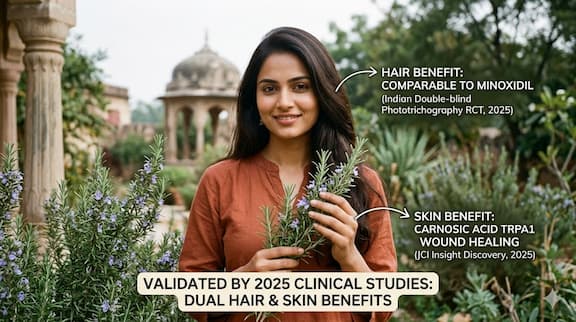
The Verdict: Rosemary is the Most Clinically Validated Natural Botanical for Both Hair and Skin
No other single botanical has been directly compared to Minoxidil in a head-to-head human RCT, validated in a 2025 Indian double-blind phototrichography trial, had its skin wound-healing mechanism identified at the molecular level (TRPA1) in a 2025 JCI Insight study, and confirmed for anti-ageing efficacy in a 2025 double-blind RCT — all within the same 12-month period.
Rosemary is not a miracle herb. It is not a replacement for Minoxidil 5% in moderate-to-severe androgenetic alopecia. But for the hair fall patterns most common in India — dandruff-driven, stress-related, early-stage androgenetic, and oxidative-damage-driven — and for the skin concerns most prevalent in Indian urban environments — acne, PIH, UV ageing, and pollution damage — it is one of the most scientifically credible, broadly effective, and well-tolerated natural actives available.
The science is there. The evidence is growing. And it is in your Hair Oil, Shampoo, Serum, and Face Wash — working every single day.
Shop Hair Oil → Shop Face Wash →"The dew of the sea has been healing for 4,000 years. Science has finally mapped exactly how."
Ready to make the honest switch?
Our products are built on the same principles as every article we write — pure ingredients, real results, nothing to hide.
Explore Our Products