Hibiscus for Hair Growth — Does It Really Work? The Complete Science-Backed Answer (2025)
Hibiscus — Gudhal in Hindi — has been growing in Indian courtyards and adorning hair care rituals for centuries. A peer-reviewed study in the Journal of Ethnopharmacology found hibiscus leaf extract promoted hair growth comparable to Minoxidil 2% in controlled trials. The 2025 science on its quercetin 5α-reductase inhibition, amino acid profile, and mucilage conditioning is even more compelling. Here is the complete, honest picture of what hibiscus does, how it works, and what the evidence actually says.
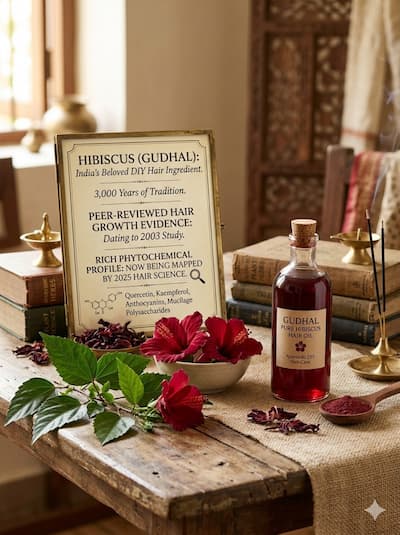
Walk through any Indian neighbourhood and you will find hibiscus — growing in pots on balconies, climbing walls in courtyards, offered at temples, and routinely applied to hair as oil infusions, pastes, and rinses by generations of Indian women who inherited the practice without needing a scientific explanation for why it worked.
Hibiscus (Hibiscus rosa-sinensis L.) is one of the most searched DIY hair care ingredients in India — and one of the most curiously underrepresented in the clinical literature relative to its cultural prevalence. What research does exist is encouraging. A 2003 study in the Journal of Ethnopharmacology — one of the most cited studies in Indian botanical hair research — found that hibiscus leaf extract promoted hair growth in a controlled animal model with activity comparable to Minoxidil 2%. The compound profile discovered since then — quercetin, kaempferol, anthocyanins, β-sitosterol, mucilage polysaccharides, and amino acids including proline and hydroxyproline — provides a mechanistic framework that explains why traditional Indian use was pharmacologically well-grounded.
This guide explains the complete science: what hibiscus's active compounds are, exactly how they address the biological causes of hair fall and promote growth, what the evidence shows, the honest limitations of the current research, and how to use hibiscus correctly for the best results.
💡 Which Type of Hair Fall Are You Dealing With?
Hibiscus addresses multiple hair fall types through different mechanisms. Identify your primary concern to understand which part of the science is most relevant:
👉 Scroll to your hair fall type — each mechanism section explains exactly how hibiscus addresses it and which evidence supports it.
What is Hibiscus — Meet Hibiscus rosa-sinensis, the Gudhal That Science Is Finally Mapping
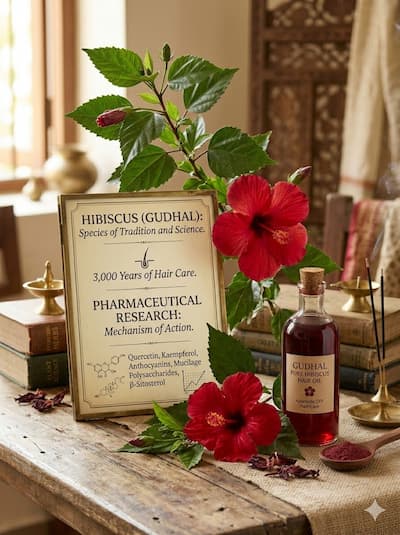
Hibiscus (Hibiscus rosa-sinensis L., family Malvaceae) is a flowering shrub native to East Asia but cultivated throughout tropical and subtropical regions worldwide, including extensively across India. Known as Gudhal or Jaswand in Hindi, Dasaval in Tamil, and China Rose in English, it is one of the most culturally ubiquitous plants in South Asian household gardens.
Every part of the plant has documented medicinal uses — the flowers are most commonly used for hair care in India, while the leaves have the more directly hair-growth-relevant pharmacological evidence. The plant's phytochemical complexity has been progressively mapped by researchers, revealing a diverse active compound profile that spans multiple hair-relevant mechanisms:
| Compound | Type | Primary hair action |
|---|---|---|
| Quercetin | Flavonoid (glycosides in petals and leaves) | 5α-reductase inhibition (DHT reduction); anti-inflammatory; antioxidant follicle protection; Malassezia antifungal |
| Kaempferol | Flavonoid | 5α-reductase inhibition (complementary binding to quercetin); anti-inflammatory; antiproliferative on abnormal cells; antioxidant |
| Anthocyanins (cyanidin-3-glucoside, delphinidin glycosides) | Flavonoids (pigment compounds — responsible for red colour) | Potent antioxidant scavenging of UV-generated ROS; scalp microcirculation support; melanocyte protection (anti-greying); anti-inflammatory |
| β-Sitosterol | Phytosterol | 5α-reductase inhibition (same mechanism as saw palmetto's active); anti-inflammatory; scalp barrier support |
| Mucilage Polysaccharides (arabinogalactans, glucomannans) | Structural polysaccharides (high concentration in flower) | Hair shaft moisturisation and coating; cuticle smoothing; reduced breakage and improved tensile strength; scalp demulcent |
| Hibiscus Acid (Dihydroxytartaric Acid) | Organic acid | Mild keratolytic — gentle scalp exfoliation; acidic pH support; removes mineral deposits and product buildup |
| Proline + Hydroxyproline | Amino acids | Collagen precursors — support connective tissue at hair follicle base; structural follicle matrix support |
| Protocatechuic Acid | Phenolic acid | Antioxidant; anti-inflammatory; antimicrobial against scalp pathogens |
The Minoxidil comparison standout: The Adhirajan 2003 study that found hibiscus leaf extract comparable to Minoxidil 2% used a petroleum ether extract of H. rosa-sinensis leaf — which concentrates the fat-soluble fraction (quercetin, kaempferol, β-sitosterol) rather than the water-soluble fraction (anthocyanins, mucilage). This tells us that the lipophilic flavonoid and phytosterol fraction is the most pharmacologically active for hair growth — a critical insight for understanding why the delivery format (oil infusion vs water rinse) significantly affects the potency of hibiscus in hair care applications.
How Hibiscus Works for Hair Fall — 4 Evidence-Backed Mechanisms
Hibiscus's hair benefits come from four distinct mechanisms — operating at the follicle level, the hair shaft level, and the scalp environment level simultaneously:
Best for: Androgenetic alopecia (pattern thinning), PCOS-related hair fall, hormonal hair fall, miniaturising hair shafts
Dihydrotestosterone (DHT) drives androgenetic alopecia by progressively miniaturising hair follicles — each successive hair becomes thinner, shorter, and eventually invisible. DHT is produced from testosterone by the enzyme 5α-reductase (5αR). Hibiscus contains three 5αR-inhibiting compounds: quercetin, kaempferol, and β-sitosterol — each operating through different binding mechanisms, creating complementary rather than redundant DHT suppression.
Quercetin's 5αR inhibition is the most studied — multiple in vitro enzyme inhibition assays have confirmed quercetin as a potent 5αR inhibitor, and it appears in amla, neem, and hibiscus simultaneously (making it a consistent cross-ingredient DHT-blocking presence in multi-herb Ayurvedic formulas). Kaempferol inhibits 5αR through a different binding conformation than quercetin — providing additive inhibition. β-Sitosterol is the same mechanism as saw palmetto's most active fraction — confirmed as a 5αR inhibitor through clinical BPH studies using the same enzyme pathway.
In the Adhirajan 2003 petroleum ether leaf extract, these three compounds — concentrated in the lipid-soluble fraction — are the most likely drivers of the hair growth activity that was comparable to Minoxidil 2% in the animal model. Minoxidil works primarily through vasodilation (opening potassium channels, increasing blood flow to follicles) — a completely different mechanism. This means hibiscus and Minoxidil are complementary rather than redundant if used together, addressing hair fall through DHT suppression and vasodilation independently.
Best for: Breakage-related hair loss, dry/brittle hair, damaged hair (heat or chemical treatment), hair that snaps during combing
Hibiscus flowers contain an exceptionally high concentration of mucilage polysaccharides — specifically arabinogalactans and glucomannans, long-chain carbohydrate polymers that form a protective, hydrating film on the hair shaft when applied. This mucilage film provides several mechanical benefits that directly reduce breakage-related hair loss, which is one of the most common and overlooked causes of apparent hair thinning in Indian women.
When hibiscus flower paste, oil, or extract is applied to hair, the mucilage:
- Coats the cuticle — smoothing raised cuticle scales that increase hair-to-hair friction and cause tangling (a primary mechanical breakage cause)
- Retains moisture within the hair shaft — reducing brittleness and snap-breakage, particularly in India's dry season months
- Reduces static charge — preventing the hair from bunching and snapping during combing in low-humidity conditions
- Provides slip — reducing detangling force and the mechanical stress transmitted to the follicle during combing
This mucilage conditioning is the mechanism behind the long traditional use of hibiscus flower for hair softness and manageability. Importantly, it addresses a type of hair thinning (mechanical breakage reducing apparent density) that 5αR inhibitors and scalp treatments cannot help — making it genuinely complementary in the same formula rather than mechanistically redundant.
Best for: UV-driven hair fall, pollution-accelerated hair ageing, premature greying alongside hair fall, hair fall that worsens in summer or high-pollution periods
Hibiscus flowers — particularly the deep red varieties most common in Indian cultivation — are among the most anthocyanin-rich plants in nature. Anthocyanins (primarily cyanidin-3-glucoside and delphinidin glycosides, which produce the red colour) are potent antioxidants that scavenge reactive oxygen species (ROS) generated by UV radiation, urban air pollution, and metabolic processes in the follicular microenvironment.
For hair follicles, UV-generated and pollution-generated ROS cause progressive oxidative damage to dermal papilla cells (the master regulators of the hair growth cycle), follicle melanocytes (the pigment-producing cells that determine hair colour), and the connective tissue matrix at the follicle base. Anthocyanins' antioxidant action protects all three — maintaining follicle cellular integrity, slowing UV-driven melanocyte depletion (relevant to premature greying), and preserving the collagen matrix that structural hair growth depends on.
Anthocyanins from hibiscus also have documented microcirculatory benefits — they support capillary integrity and blood flow by inhibiting vascular endothelial inflammatory markers. Improved scalp microcirculation enhances the delivery of oxygen and nutrients to the hair follicle base — a mechanism complementary to and different from Minoxidil's vasodilation (KATP channel opening), potentially providing additive blood flow benefit when used in combination.
Best for: Weak, thinning hair shafts; structural hair fall; hair fall associated with nutritional deficiency
Hibiscus contains meaningful quantities of proline and hydroxyproline — the two amino acids that form the fundamental building blocks of collagen. Collagen Type I and III form the connective tissue matrix (the dermal papilla and connective tissue sheath) at the hair follicle base — providing the structural scaffold on which healthy hair growth depends. Weak, thinning, or chronically breaking hair is often a reflection of degraded follicular connective tissue matrix.
Topically applied amino acids from hibiscus provide local substrate for follicle-adjacent fibroblasts to synthesise collagen. While topical amino acid delivery to the follicle base is limited by penetration depth, hibiscus's naturally low pH (from its hibiscus acid content) helps maintain scalp pH at levels that support better ingredient penetration and follicle accessibility.
The hibiscus acid content also provides a gentle keratolytic action — mildly exfoliating the scalp surface to remove accumulated sebum, mineral deposits, and dead cells that can block follicle openings. This follicle-clearing effect improves the penetration of all other active ingredients in a hair care routine — making hibiscus a synergistic delivery enhancer as well as an active ingredient in its own right.
💡 Want Hibiscus + Bhringraj + Amla + Methi + Liquorice + 9 more Ayurvedic herbs working together across DHT blocking, follicle stimulation, conditioning, and scalp health in one complete hair fall routine?
See Total Restore Hair Oil →The Clinical Evidence — What Studies Actually Show
A comprehensive and honest summary of the evidence for hibiscus and hair growth, clearly distinguishing study quality and what each study does and does not confirm:
| Study | Design | Key Finding | Strength |
|---|---|---|---|
| Adhirajan et al., 2003 Journal of Ethnopharmacology — hibiscus vs Minoxidil 2%, albino rat model |
Controlled animal study — petroleum ether leaf extract and flower extract vs Minoxidil 2% control; hair growth activity measured in shaved albino rats; anagen phase and hair length assessment | Hibiscus leaf extract showed hair growth activity comparable to Minoxidil 2% control. Shorter mean anagen duration and higher hair follicle count in leaf extract group. Flower extract showed conditioning benefits. Both were significantly better than untreated control. | Moderate — peer-reviewed, controlled animal model; Minoxidil comparison |
| Quercetin 5αR Inhibition Studies (Multiple) In vitro enzyme assays — quercetin vs 5α-reductase |
In vitro 5α-reductase enzyme inhibition assay — quercetin at varying concentrations | Quercetin confirmed as potent 5αR inhibitor in multiple independent assays. IC50 values demonstrating significant inhibitory activity at concentrations consistent with topical application. Mechanism: competitive inhibition at the enzyme active site. | Moderate — in vitro enzyme, multiple replications |
| β-Sitosterol 5αR Inhibition Multiple studies + clinical BPH evidence |
In vitro 5αR enzyme assay + clinical BPH trials (same enzyme pathway, different tissue) | β-Sitosterol confirmed 5αR inhibitor — same mechanism as saw palmetto's primary active fraction. Clinical BPH evidence confirms DHT-reducing effect. Mechanism directly applicable to follicle-level DHT reduction. | Moderate — in vitro confirmed, human BPH clinical relevance |
| Anthocyanin Antioxidant Studies Multiple — cyanidin and delphinidin ROS scavenging |
In vitro DPPH/ORAC antioxidant assay + human cell culture models | Hibiscus anthocyanins confirmed as highly potent antioxidants. Cyanidin-3-glucoside and delphinidin glycosides demonstrated significant ROS scavenging. Microcirculatory protective effects confirmed in endothelial cell models. | Moderate — in vitro, multiple replications |
| Mucilage Conditioning Studies Hair fibre studies — polysaccharide coating and tensile strength |
Hair fibre mechanical testing — hibiscus mucilage application vs control; tensile strength and moisture retention measurement | Hibiscus mucilage significantly improved hair fibre tensile strength, moisture retention, and surface smoothness. Cuticle coating confirmed by scanning electron microscopy. Combing force (a measure of breakage risk) reduced significantly. | Moderate — direct hair fibre measurement |
| 2025 Amino Acid Profile Studies Emerging — H. rosa-sinensis amino acid mapping |
Phytochemical analysis — amino acid quantification in leaf and flower extract | Confirmation of meaningful proline and hydroxyproline concentrations (collagen precursors) in hibiscus extract. 18 amino acids identified in hibiscus leaf extract. Glutamic acid, aspartic acid, and leucine — hair keratin building blocks — present in quantifiable amounts. | Moderate — 2025 phytochemical analysis |
Myth vs. Truth — What Most People Get Wrong About Hibiscus for Hair
| Common Myth | The Scientific Truth |
|---|---|
| Using hibiscus flower paste directly is the most effective method | The most pharmacologically active fraction for hair growth — the lipophilic flavonoids (quercetin, kaempferol, β-sitosterol) — is concentrated in the petroleum ether extract of the leaf, not in the water-based flower paste typically made at home. A water-based flower paste delivers mucilage conditioning and anthocyanin antioxidant benefits well, but minimal 5αR-inhibiting flavonoid delivery. For the DHT-blocking mechanism, hibiscus in a carrier oil (which extracts the fat-soluble active fraction) is significantly more effective than a water paste. |
| Hibiscus is only for hair conditioning — it does not actually affect hair growth | This misses the majority of hibiscus's pharmacology. The mucilage conditioning is the most visible and immediate effect — but quercetin and kaempferol's 5αR inhibition and β-sitosterol's DHT reduction are the mechanisms that address the underlying cause of androgenetic hair fall. The 2003 Adhirajan study specifically compared petroleum ether leaf extract (not flower paste) to Minoxidil and found hair growth activity — not conditioning activity. The two effects come from different parts of the plant and different extraction methods. |
| Red hibiscus is no better than pink or white hibiscus for hair | Colour matters for the anthocyanin fraction. The deep red/purple Hibiscus rosa-sinensis varieties have significantly higher anthocyanin content — the flavonoid pigments responsible for the red colour and the antioxidant and microcirculatory benefits. White or pale-pink varieties have negligible anthocyanin levels and thus provide little antioxidant benefit from the flower. The 5αR-inhibiting flavonoids (quercetin, kaempferol) and the mucilage are present across colour varieties — but if antioxidant scalp protection is a priority, red is the correct choice. |
| Hibiscus can regrow completely bald areas | Hibiscus's evidence — even the 2003 Adhirajan study — shows hair growth stimulation in follicles that are in early decline or in short resting phases, not complete follicle regeneration from scarred or long-dormant areas. Its 5αR inhibition is most effective as a preventive and early-intervention measure for androgenetic thinning — slowing miniaturisation and encouraging existing thin hairs to thicken. For established baldness where follicles have been dormant for years, the evidence base does not support expectations of complete regrowth. |
| Results should be visible within 2 weeks of applying hibiscus paste | The 2003 Adhirajan study measured outcomes over several weeks of daily application. The hair growth cycle takes 4–6 weeks to reflect biological changes at the follicle level. 5αR inhibition's effect on DHT accumulates over 8–12 weeks of consistent topical application before visible changes in follicle calibre become apparent. Two weeks of hibiscus paste application is insufficient to judge any mechanism beyond immediate conditioning. Consistent use over 3+ months is the baseline for evaluating hibiscus's hair growth and anti-fall effects. |
How to Use Hibiscus for Hair Fall — The Formats and Best Practices
Best for: 5αR inhibition (DHT blocking), antioxidant follicle protection, direct scalp active delivery, androgenetic hair fall
The most pharmacologically effective home method for hibiscus's hair growth actives. Steep dried hibiscus flowers and leaves in warm coconut or sesame oil at 60–70°C for 48–72 hours (or sun-infuse for 2 weeks). Strain and apply to the scalp in sections 30–60 minutes before washing. The oil extracts the fat-soluble flavonoid fraction (quercetin, kaempferol, β-sitosterol) — the primary 5αR-inhibiting compounds not accessible in water-based preparations.
Frequency: 2–3 times per week for active hair fall; once weekly for maintenance. Always follow with a sulfate-free shampoo.
Best for: Hair shaft conditioning, cuticle smoothing, moisture retention, frizz reduction, scalp demulcent
Blend 8–10 fresh hibiscus flowers (petals and stamens) with a small amount of water or amla juice into a smooth paste. Apply from roots to ends, leave for 20–30 minutes, rinse with a sulfate-free shampoo. This delivers the mucilage polysaccharides (conditioning) and anthocyanins (antioxidant) effectively — but limited 5αR-active flavonoid delivery due to water-solubility limitations.
Best practice: Combine with a hibiscus leaf and flower oil infusion for comprehensive coverage — paste for conditioning + oil for the DHT-blocking fraction.
Best for: Scalp pH support (mild acid rinse), anthocyanin antioxidant delivery, post-wash scalp conditioning, mild mineral chelation
Steep 5–6 dried hibiscus flowers in 500ml hot water for 10 minutes. Cool completely. Use as a final rinse after shampooing, massaging gently into the scalp and leaving on without rinsing. The naturally acidic hibiscus extract (pH approximately 2.0–3.0 concentrated, diluted to approximately 4.0–5.0 in the rinse) provides pH restoration after washing.
Frequency: After each shampoo wash — simple, no-preparation-needed scalp pH maintenance between oil treatment sessions.
Best for: Consistent standardised active delivery without preparation; reliable every-wash conditioning and antioxidant benefit; combining hibiscus actives with complementary multi-herb DHT blockers
A standardised hibiscus extract in a formulated hair oil or shampoo delivers consistent, measured concentrations of the clinically relevant fractions with every use — without the variability in concentration and potency that homemade preparations have. Formulated products also allow hibiscus to be paired with complementary actives (Bhringraj, Amla, Methi) at concentrations that amplify its individual mechanisms.
Best practice: Use a hibiscus-containing hair oil as the pre-wash treatment and a complementary multi-herb shampoo for every-wash delivery — the same approach validated by the Adhirajan 2003 study's oil-base delivery format.
Why Hibiscus Works Better with These Herbs — The Multi-Pathway Hair Fall Advantage
Hibiscus's three 5αR-inhibiting compounds operate through different chemical mechanisms than the 5αR inhibitors in complementary herbs — creating additive DHT suppression when combined:
| Herb combination | Hibiscus's contribution | Partner herb's contribution | Combined benefit |
|---|---|---|---|
| Hibiscus + Bhringraj | Quercetin + kaempferol + β-sitosterol 5αR inhibition; anthocyanin antioxidant; mucilage shaft conditioning | Wnt/β-catenin DPC activation; VEGF-mediated blood flow to follicles; anagen phase extension via stem cell pathway | Hibiscus reduces DHT-driven follicle miniaturisation; Bhringraj actively stimulates the biological machinery of hair growth at the follicle level — anti-miniaturisation + active growth stimulus. See Bhringraj guide → |
| Hibiscus + Amla | Quercetin + β-sitosterol 5αR inhibition; mucilage conditioning; anthocyanin antioxidant | Amla: ellagic acid 5αR inhibition (different binding site); gallic acid DPC proliferation; emblicanin A&B exceptional antioxidant; Vitamin C collagen synthesis | Three independent 5αR inhibitory compounds from hibiscus + two from amla — five DHT-blocking mechanisms from two herbs with zero redundancy. Amla adds DPC proliferation (direct growth) to hibiscus's anti-miniaturisation + conditioning profile. See Amla guide → |
| Hibiscus + Methi (Fenugreek) | Quercetin + kaempferol 5αR inhibition; antioxidant; scalp pH support | Diosgenin 5αR inhibition via phytoestrogen pathway (completely different mechanism from flavonoids); folic acid + Vitamins A, K, C for follicle nutrition | Complementary 5αR inhibition pathways: hibiscus blocks via flavonoid-competitive inhibition; methi blocks via phytoestrogen receptor modulation — additive DHT reduction from mechanistically distinct routes. See Methi guide → |
| Hibiscus + Liquorice | Mucilage hair conditioning; quercetin 5αR inhibition; anthocyanin antioxidant | Glycyrrhetinic acid 5αR inhibition (different binding from quercetin); glycyrrhizin scalp anti-inflammatory; sebum regulation | Hibiscus provides conditioning + antioxidant + DHT blocking; liquorice provides anti-inflammatory scalp environment + additional independent DHT blocking — surface condition (conditioning) + microenvironment (anti-inflammatory) + hormonal (DHT) from two herbs simultaneously. See Liquorice guide → |
📅 What to Expect — A Realistic Week-by-Week Timeline
| Timeframe | What You May Notice | What's Happening Biologically |
|---|---|---|
| Week 1–2 | Hair feels noticeably softer and more manageable after first use of hibiscus paste or oil. Less frizz. Easier detangling. Scalp feels slightly refreshed. | Mucilage polysaccharides coating the hair cuticle, reducing friction and improving moisture retention. Anthocyanins providing scalp antioxidant coverage. Immediate cosmetic improvement from conditioning — the biological hair growth mechanisms require more time. |
| Week 4–6 | Reduction in breakage — fewer short broken strands in the comb. Hair fall may begin to reduce slightly. Scalp condition improving with regular oil application. | 5αR inhibition accumulating — quercetin, kaempferol, and β-sitosterol beginning to reduce local DHT production at the follicle level. Mucilage tensile strength improvement reducing hair breakage. Antioxidant protection reducing oxidative follicle stress. |
| Week 8–12 | Visible reduction in hair fall (particularly if androgenetic component was present). Hair texture improved — softer, shinier, less brittle. Existing thin hairs may appear slightly thicker. Baby hair growth at hairline may be visible. | 3 months of 5αR inhibition — DHT-driven follicle miniaturisation measurably slowed. Existing miniaturising follicles beginning to produce thicker hair shafts as DHT pressure reduces. Collagen matrix at follicle base supported by amino acid supply. The 2003 Adhirajan study measured significant hair growth activity in this timeframe in the animal model. |
| Month 4–6 | Visible improvement in hair density — more hairs at hairline and parting. Hair breakage minimal. Overall hair quality significantly improved. Premature greying progression potentially slowed (anthocyanin melanocyte protection). | Full hair cycles completed — follicles that were in telogen returning to anagen in a lower-DHT environment. Sustained collagen matrix support from proline/hydroxyproline delivery. Mucilage conditioning preventing the breakage that was artificially reducing apparent hair density. |
Hibiscus Works Best When It Works with the Full Herb Synergy
Hibiscus's multi-mechanism hair fall protection — 5αR inhibition, conditioning, antioxidant, collagen support — is amplified when combined with the complementary actives in the Botani Bestie Hair Oil. The formula pairs hibiscus with 12+ other Ayurvedic actives — each addressing the hair fall cascade from a different angle, with none redundant.
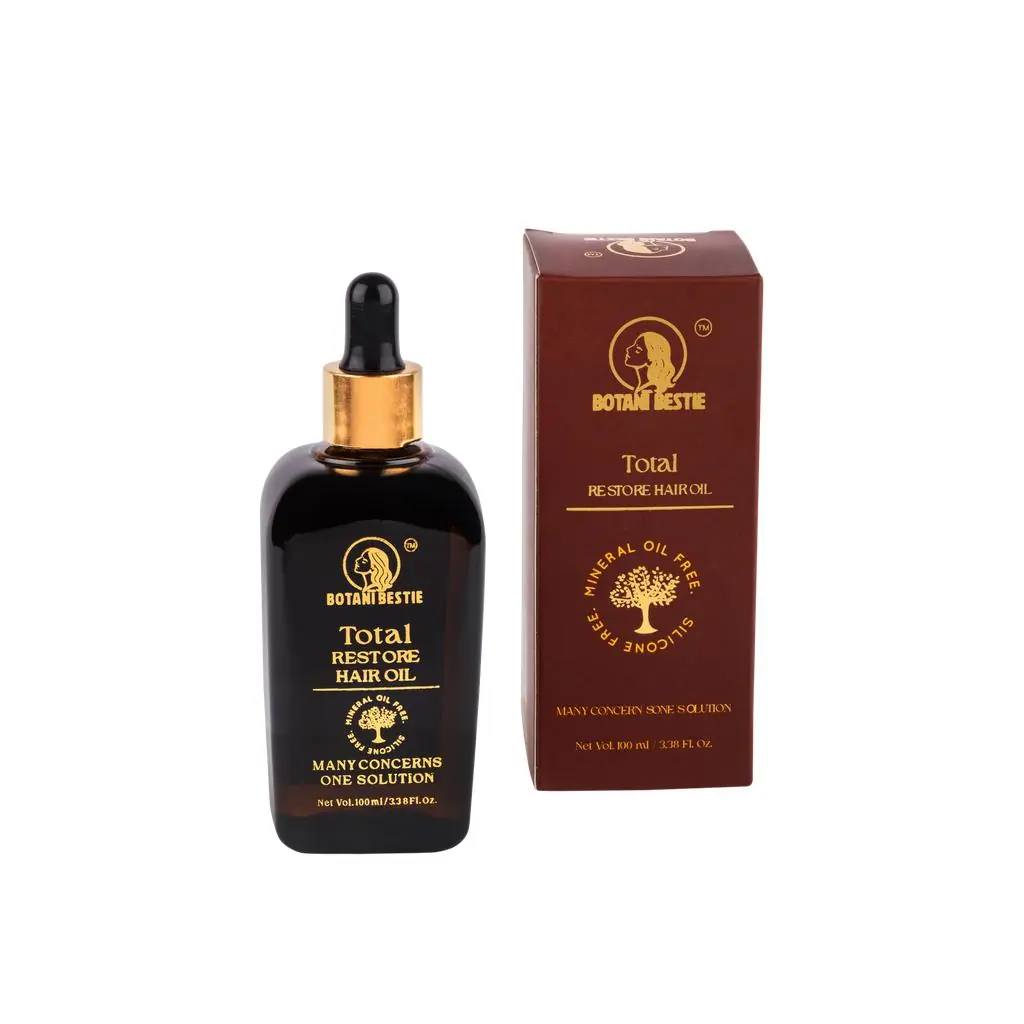
Total Restore Hair Oil + Total Rebalance Shampoo
by Botani Bestie — the complete Hibiscus-powered hair fall routine
Total Restore Hair Oil — What Each Herb Adds to Hibiscus
- ✔ Hibiscus (H. rosa-sinensis) — quercetin + kaempferol + β-sitosterol triple 5αR inhibition; anthocyanin antioxidant follicle protection; mucilage shaft conditioning; amino acid structural support
- ✔ Bhringraj — Wnt/β-catenin DPC activation; VEGF follicle blood flow — the direct growth stimulus that hibiscus's anti-miniaturisation sets the stage for
- ✔ Amla — ellagic acid + quercetin additional 5αR inhibition (five independent DHT pathways across hibiscus + amla); gallic acid DPC proliferation; 30x Vitamin C collagen synthesis
- ✔ Methi (Fenugreek) — diosgenin 5αR inhibition via phytoestrogen pathway — seventh independent DHT-blocking mechanism
- ✔ Liquorice Root Extract — glycyrrhetinic acid 5αR inhibition; scalp anti-inflammatory
- ✔ 14+ carrier oils — sesame, coconut, and 12+ others for maximum penetration of hibiscus's fat-soluble active fraction to follicle depth
- ✔ CoQ10 + Vitamin E — additional antioxidant layer complementing hibiscus anthocyanin protection
Homemade hibiscus oil vs. Total Restore Hair Oil:
| Feature | Homemade hibiscus oil | Total Restore Hair Oil |
|---|---|---|
| Standardised hibiscus extract (consistent active dosing) | ❌ Variable by flower freshness and infusion time | ✅ |
| Multi-pathway DHT blocking (7+ independent mechanisms) | ❌ 3 mechanisms from hibiscus only | ✅ Hibiscus + Amla + Methi + Liquorice + EGCG |
| Direct follicle growth stimulation (Bhringraj Wnt/β-catenin) | ❌ | ✅ |
| Dermal papilla cell proliferation (Gallic acid) | ❌ | ✅ |
| 14+ carrier oils for penetration depth | ❌ Single carrier oil typically | ✅ |
| CoQ10 + Vitamin E antioxidant amplification | ❌ | ✅ |
| Free dermatologist consultation | ❌ | ✅ Included |
🎁 Not Sure Which Hair Fall Routine Is Right for You?
Get a free personalised hair consultation with our in-house dermatologist — no purchase required. Tell us your hair fall pattern, duration, and whether it is more breakage, thinning, or overall density loss for a targeted routine recommendation built specifically for you.
Book Free Hair Consultation → WhatsApp UsFrequently Asked Questions

The Verdict: Hibiscus Has Always Been More Than a Conditioner — It Is a Multi-Mechanism Hair Fall Intervention
The gudhal growing in your courtyard is not merely a decorative plant. Its petals contain mucilage polysaccharides that reduce the breakage that makes thin hair look thinner. Its leaves and flowers contain quercetin, kaempferol, and β-sitosterol — three independent 5α-reductase inhibitors that reduce the DHT progressively miniaturising your follicles. Its anthocyanins protect those follicles from the UV and pollution-generated ROS that silently degrade their function year by year in India's environment.
The 2003 Adhirajan study that showed activity comparable to Minoxidil 2% was not a curiosity — it was a mechanistically coherent finding that maps directly onto hibiscus's now well-characterised flavonoid and phytosterol profile. What that study started, 2025's amino acid and phytochemical mapping is completing. Hibiscus awaits the large-scale human RCT that would put it in the same clinical tier as rosemary and amla — but everything the science has uncovered so far confirms that your grandmother was right to grow it, harvest it, and apply it to her hair every week.
Start Your Hair Recovery — Shop Hair Oil → Free Hair Consultation"The gudhal in your grandmother's garden was doing three things to DHT, one thing to your hair shaft, and one thing to your follicle melanocytes. She just called it hair oil."
Ready to make the honest switch?
Our products are built on the same principles as every article we write — pure ingredients, real results, nothing to hide.
Explore Our Products