Green Tea (EGCG) for Hair and Skin — The Complete Science-Backed Guide (2025)
Most people know green tea as a healthy drink. Few know that its primary active compound — EGCG — promotes hair follicle cell proliferation via VEGFA induction (2025), reduces acne in a controlled clinical trial (2009 JDD), and is one of the most potent natural UV-protective antioxidants known to dermatology. Here is the honest, complete picture.
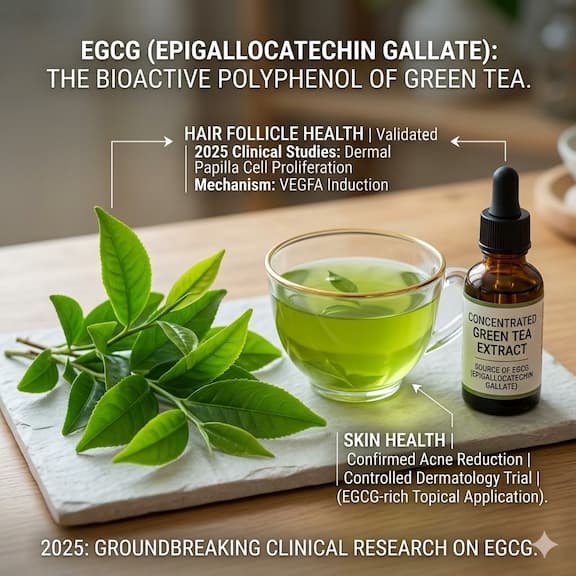
Green tea (Camellia sinensis) has been consumed for over 4,000 years across China, Japan, and South Asia as both a beverage and a medicine. India is the world's second largest tea producer, and the Assam and Darjeeling varieties of Camellia sinensis are among the most catechin-rich in the world — making green tea not just globally familiar but indigenously significant.
For most of its history, green tea's health claims rested on epidemiological observation. That began to change systematically from the early 2000s as researchers isolated its primary bioactive compound: epigallocatechin-3-gallate (EGCG) — the most abundant and potent catechin in green tea, comprising 50–80% of its total catechin content. EGCG is now one of the most extensively studied natural compounds in modern biomedical research, with over 10,000 peer-reviewed publications.
This guide covers what the research — including a 2025 ScienceDirect molecular study, a 2025 Discover Food catechins-rich tea extract study, and a 2025 MDPI IJMS comprehensive review — actually confirms about green tea's benefits for hair fall and skin in the context of Indian climate and skin types. It also presents the honest gaps in the evidence, which are real and important.
💡 What Are You Looking to Address? Jump to Your Section.
Green tea's EGCG is relevant for both hair and skin through different but overlapping mechanisms. Identify your primary concern:
👉 Or read the complete guide — many of these benefits share the same underlying EGCG mechanisms.
What Makes Green Tea Different — The EGCG Compound Profile
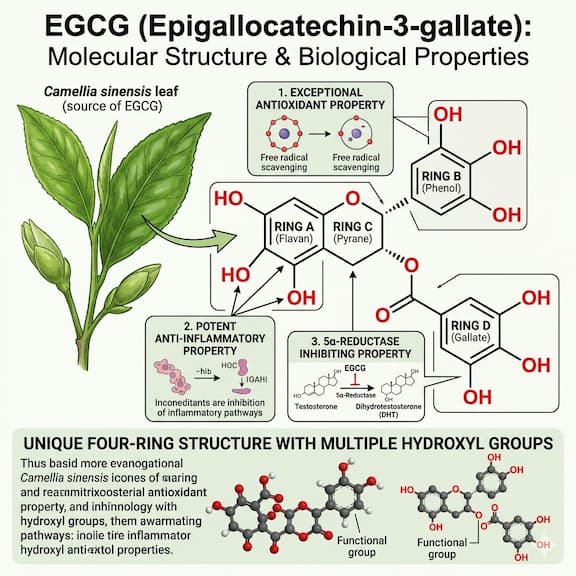
All teas come from the same plant: Camellia sinensis. The difference between green, black, and oolong tea is the degree of oxidation during processing. Green tea is unoxidised — the leaves are steamed or pan-fired immediately after harvest, preserving the catechins in their original, maximally bioactive form. Black tea's catechins are oxidised into theaflavins and thearubigins during fermentation — compounds with different and generally lower bioactivity for the mechanisms relevant to hair and skin.
This is why green tea extract, rather than black tea, is the dermatologically and trichologically relevant form. The primary compounds and their specific roles:
| Compound | % of catechins | Primary action — hair & skin |
|---|---|---|
| EGCG (epigallocatechin-3-gallate) | 50–80% | DPC proliferation (VEGFA); 5αR inhibition; antioxidant (Nrf2); anti-inflammatory (NF-κB); sebum regulation (AMPK); UV protection; keratinocyte reactivation |
| ECG (epicatechin gallate) | 10–15% | 5αR inhibition (similar potency to EGCG); antioxidant; anti-inflammatory |
| EGC (epigallocatechin) | 5–10% | Antioxidant; anti-inflammatory; antimicrobial against scalp pathogens |
| EC (epicatechin) | 2–5% | Antioxidant; collagen protection; anti-inflammatory |
| Caffeine | Variable | Vasodilation — increases scalp blood flow; topical caffeine shown to inhibit DHT-induced TGF-β1 (hair growth suppressor); used in clinical anti-hair-loss formulas |
| Theanine | Amino acid | Anti-stress; reduces cortisol — relevant for stress-related telogen effluvium |
🌿 Part 1: Green Tea for Hair — The Evidence
How EGCG Benefits Hair — 4 Mechanisms
Best for: General hair thinning, follicles in telogen phase, slow regrowth
The most mechanistically significant recent study on EGCG and hair comes from 2025: Yu et al. (Biochimica et Biophysica Acta — Molecular Cell Research, ScienceDirect) identified the precise molecular pathway through which EGCG promotes dermal papilla cell (DPC) health. DPCs are the master regulators of the hair follicle — they control whether a follicle enters anagen (growth), how long it stays there, and the thickness of the resulting hair shaft.
The 2025 study found that EGCG treatment of DPCs significantly upregulated the expression of PCNA (proliferating cell nuclear antigen — a marker of cell division), CCND1 (cyclin D1 — cell cycle regulator), HIF-1α (hypoxia-inducible factor), VEGFA (vascular endothelial growth factor A), and Bcl-2 (anti-apoptotic protein), while reducing Bax (pro-apoptotic protein). VEGFA was identified as the candidate gene mediating EGCG's effect — when VEGFA was knocked down, EGCG's DPC proliferation effect was lost. When VEGFA was overexpressed, DPC proliferation increased and hair follicle growth-related gene expression was enhanced.
This VEGFA upregulation is the same mechanism that Minoxidil's most important downstream effect operates through — Minoxidil increases VEGF expression in hair follicles as part of its vasodilatory action. EGCG achieving this via a different upstream pathway (AMPK activation rather than potassium channel opening) makes the two mechanisms genuinely complementary.
Best for: Androgenetic alopecia, PCOS-related hair fall, hormonal thinning
EGCG is among the plant compounds with the strongest documented 5α-reductase (5αR) inhibiting activity — and this was noted as early as 2002 when Hiipakka et al. demonstrated that green tea catechins, particularly EGCG and ECG, selectively inhibit both type I and type II 5αR isozymes. This enzymatic inhibition reduces the conversion of testosterone to DHT — the primary hormonal driver of follicle miniaturisation in androgenetic alopecia.
The 2007 Kwon et al. PubMed study noted this explicitly: "EGCG might be useful in the prevention or treatment of androgenetic alopecia by selectively inhibiting 5α-reductase activity." Combined with the 2025 MDPI IJMS comprehensive review confirming EGCG's diverse applications in alopecia treatment, the 5αR inhibition pathway provides a pharmacological basis for EGCG's benefit in both male and female pattern hair loss — particularly relevant given that PCOS-driven androgenetic hair fall affects an estimated 22.5% of Indian women of reproductive age.
A key distinction from pharmaceutical 5αR inhibitors (finasteride, dutasteride): EGCG inhibits 5αR without the sexual side effects and mood changes associated with systemic pharmaceutical 5αR inhibition — because topical application delivers the active compound directly to the scalp follicle without significant systemic absorption.
Best for: Dandruff-driven hair fall, scalp inflammation, seborrheic dermatitis
EGCG's suppression of NF-κB — a master transcription factor controlling pro-inflammatory cytokine production — directly reduces the scalp inflammation cascade that drives dandruff-related hair shedding. The inflammatory cytokines (IL-1β, IL-6, TNF-α) that Malassezia's oleic acid triggers at the scalp are precisely the mediators that EGCG suppresses through its NF-κB inhibition pathway.
The 2025 Discover Food study (Kanlayavattanakul et al.) specifically investigated catechins-rich Assam tea extract against androgenic alopecia models — finding it demonstrated antioxidant activity, enhanced cellular proliferation, and alleviated inflammation relevant to hair loss. The study cited the hair-protective effects specifically in the context of oxidative stress-driven follicle damage — the same ROS pathway that scalp inflammation from Malassezia and hard water generates. See our complete dandruff guide →
EGCG's antimicrobial properties — documented against Staphylococcus aureus and other scalp pathogens — provide additional direct anti-dandruff activity alongside its anti-inflammatory mechanism, making it particularly valuable in combination with ACV (scalp pH restoration) and Bhringraj (antifungal via saponins) in a shampoo formula.
Best for: UV-driven thinning, premature greying, pollution-damaged hair
EGCG is measured among the most potent known antioxidants by ORAC (Oxygen Radical Absorbance Capacity) value. At the hair follicle level, this antioxidant capacity protects three critical cell populations from oxidative damage: dermal papilla cells (whose health determines growth cycle quality), outer root sheath cells (the structural layer of the follicle), and follicle melanocytes (the pigment-producing cells whose depletion causes greying).
The 2025 Yu et al. study specifically measured EGCG's enhancement of DPC antioxidant enzyme activity: treatment with 0.5 µM EGCG intensified the relative activity of catalase, superoxide dismutase (SOD), and glutathione in DPCs — the three primary endogenous antioxidant enzymes. This means EGCG does not just scavenge ROS directly but upregulates the cell's own antioxidant machinery — a more sustained and protective effect than passive scavenging alone.
For Indian hair — simultaneously exposed to UV index 8–11 year-round, PM2.5 urban pollution, and hard water mineral oxidation — this multi-layered antioxidant protection is among the most practically relevant daily benefits EGCG provides.
The Hair Clinical Evidence — Honest Assessment
This is where intellectual honesty matters. Green tea's hair evidence is mechanistically compelling but clinically limited. Here is exactly what exists:
| Study | Design | Key Finding | Strength |
|---|---|---|---|
| Yu et al., 2025 BBA Molecular Cell Research, ScienceDirect |
In vitro, human DPC cells | EGCG promotes DPC proliferation and migration via VEGFA induction; upregulates PCNA, CCND1, HIF-1α, VEGFA, Bcl-2; enhances catalase, SOD, and glutathione antioxidant activity at 0.5 µM | High mechanistic — human cells, 2025 |
| Kwon et al., 2007 PubMed / Phytomedicine — foundational EGCG hair study |
Ex vivo follicle culture + human DPC in vitro + in vivo human scalp DPCs | EGCG enhanced hair growth by 181.2±15.8% at 5µM; DPC proliferation dose-dependent (0.01–0.5µM); Erk/Akt upregulation + Bcl-2/Bax ratio increase; confirmed in vivo in human scalp DPCs | High — human tissue + in vivo DPC confirmation |
| Kanlayavattanakul et al., 2025 Discover Food — catechins-rich Assam tea extract |
Ex vivo hair follicle + cell studies, androgenic alopecia model | Assam green tea catechins-rich extract (0.1–10 µg/mL) demonstrated antioxidant activity, enhanced cellular proliferation, alleviated inflammation relevant to androgenic hair loss | Moderate-high — 2025, Assam tea (India-specific) |
| Hiipakka et al., 2002 Biochemical Pharmacology — 5αR inhibition |
In vitro enzyme assay | EGCG and ECG selectively inhibit both type I and type II human 5α-reductase isozymes; structure-activity relationship established | Moderate — in vitro enzyme, established finding |
| Small pilot clinical — topical EGCG 3 male subjects, 4 days, 10% topical EGCG |
Pilot clinical — 3 subjects only | Preliminary findings of increased hair thickness after 4 days of 10% topical EGCG application | Very low — n=3, 4 days only |
Myth vs. Truth — Green Tea for Hair
| Myth | Scientific Truth |
|---|---|
| Drinking green tea is enough for hair benefits | Oral EGCG is metabolised differently from topical — bioavailability to the scalp follicle from oral consumption is variable and likely low for hair-specific effects. Topical application in oil and shampoo delivers EGCG directly to the follicle environment where it needs to act. Drinking green tea has systemic health benefits but is not a substitute for topical application for hair-specific outcomes. |
| Green tea works like Minoxidil for hair | EGCG and Minoxidil both upregulate VEGF (via different upstream pathways) — so the mechanism has overlap. However, Minoxidil has 35+ years of human RCT evidence. Green tea does not have a comparable standalone human trial for hair growth. Green tea is mechanistically complementary to Minoxidil, not a replacement for it. |
| Black tea and green tea have the same hair benefits | No — the fermentation that produces black tea oxidises catechins (including EGCG) into theaflavins and thearubigins, which have different biological activities. Green tea's unoxidised catechins — particularly EGCG and ECG — are the specific compounds with documented 5αR inhibition and DPC proliferation activity. |
| More EGCG always means better results | The 2025 Yu et al. study found the optimal EGCG concentration for DPC antioxidant enhancement was 0.5 µM — not the highest tested concentration. At very high doses, EGCG can be cytotoxic to certain cell types. Well-formulated products use EGCG at effective, safe concentrations — not maximum possible doses. |
💡 Want Green Tea EGCG + Bhringraj + Amla + ACV + 10 more actives in one sulfate-free shampoo for comprehensive hair fall coverage?
See Total Rebalance Shampoo →🌸 Part 2: Green Tea for Skin — The Evidence
How EGCG Benefits Skin — 4 Mechanisms
Best for: Oily skin, acne, clogged pores, midday shine
This is green tea's most clinically validated skin benefit — and one of its most relevant for Indian skin. EGCG reduces sebum production through two documented pathways. The first: 5α-reductase inhibition in sebaceous glands — reducing DHT-driven sebocyte stimulation. DHT is the primary hormonal driver of excess sebum production; by inhibiting its synthesis, EGCG reduces the gland-level stimulus for oil overproduction. The second: AMPK pathway activation — a 2012 Journal of Investigative Dermatology study (Mahmood et al.) found that EGCG reduces lipid synthesis in SZ95 human sebocytes via AMPK, reducing the cellular machinery that produces the excess oils that clog pores and feed Cutibacterium acnes.
This dual-pathway sebum reduction translates clinically: a randomised controlled study (Elsaie et al., Journal of Drugs in Dermatology, 2009) found that topical 2% green tea lotion was effective for mild-to-moderate acne vulgaris — providing the direct human evidence that makes green tea's acne mechanism more than theoretical. The MDPI IJMS 2025 comprehensive review confirms this finding and identifies EGCG as having diverse dermatological applications specifically including acne.
For Indian oily, acne-prone skin — where sebum overproduction is compounded by year-round heat, humidity, pollution, and androgenic hormonal patterns — this DHT-suppressing sebum regulation is among the most practically useful daily actives in a face wash.
Best for: Inflamed acne, post-acne redness, PIH prevention, sensitive reactive skin
EGCG suppresses NF-κB — the master switch for pro-inflammatory cytokine production — across skin cells. This means it reduces IL-1β, IL-6, IL-8, and TNF-α in keratinocytes and sebocytes: the inflammatory mediators that turn a blocked pore into a red, painful, inflamed papule or pustule, and that trigger the melanocyte overstimulation that produces PIH dark marks after every breakout.
For Indian skin — where the combination of frequent acne and high UV creates a persistent cycle of inflammation → PIH → new inflammation — this NF-κB suppression mechanism addresses both the inflammatory acne lesion and the pigmentation trigger in a single active. The MDPI IJMS 2025 review specifically lists acne and UV-induced skin damage among EGCG's most well-evidenced dermatological applications, referencing the 2009 JDD clinical trial and multiple mechanistic studies confirming anti-inflammatory and anti-acne efficacy. See our complete acne guide →
Best for: UV pigmentation, photoageing, sun spots, collagen protection in India's high-UV climate
EGCG is one of the most potent natural activators of the Nrf2 antioxidant transcription pathway — which upregulates the cell's own antioxidant defence enzymes (superoxide dismutase, catalase, heme oxygenase-1) in response to oxidative stress from UV and pollution. This is a more comprehensive defence mechanism than direct ROS scavenging alone.
For UV specifically, EGCG inhibits UV-induced apoptosis of keratinocytes via Erk and Akt pathways — demonstrated by Hsu et al. — preventing the UV-driven cell death that causes immediate post-sun skin damage. It inhibits UV-induced MMP-1 (collagen-degrading matrix metalloproteinase) — protecting the collagen and elastin matrix that gives skin its firmness and elasticity. And it reduces UV-induced melanin production — addressing the hyperpigmentation that India's year-round UV exposure continuously creates.
The 2024 Scientific Reports study (Kanlayavattanakul et al.) specifically confirmed catechins-rich Assam tea extract for photoaging and senescent aging — directly relevant for India's skin conditions. The study identified anti-photoaging as one of the most clinically important properties of Indian Assam green tea catechins for modern Indian consumers.
Best for: Dull skin, rough texture, slow-healing marks, wound healing acceleration
One of the most surprising findings about EGCG and skin comes from Hsu et al. (ScienceDaily / Journal of Pharmacology and Experimental Therapeutics): EGCG reactivates dying skin cells in the upper epidermal layers. Keratinocytes in the outermost skin layers are normally in a state of progressive decline — by day 20 of their 28-day cycle, they are essentially preparing to die and shed. EGCG exposure caused these ageing cells to start dividing again, producing DNA and more energy. They were reactivated.
Dr. Stephen Hsu's team also found EGCG accelerates the differentiation process in newer epidermal cells — speeding up the skin renewal cycle that brings fresh cells to the surface faster. This has direct clinical implications for: wound healing (faster keratinocyte migration to repair sites), PIH mark fading (faster cell turnover brings unpigmented cells to the surface), dullness reduction (fresher cells create clearer, more radiant skin), and rough texture improvement (accelerated desquamation of old, rough outer cells).
The 2025 MDPI IJMS comprehensive review confirms EGCG's documented applications in wound healing, psoriasis, rosacea, and skin conditions characterised by altered cellular metabolism — the same skin cell renewal mechanism underlying all of these applications.
The Skin Clinical Evidence
| Study | Design | Key Finding | Strength |
|---|---|---|---|
| Elsaie et al., JDD 2009 Journal of Drugs in Dermatology — acne RCT |
Randomised controlled study, topical 2% green tea lotion, acne vulgaris patients | Topical 2% green tea lotion effective for mild-to-moderate acne vulgaris; significant reduction in acne lesions vs control | High — human RCT, acne |
| Mahmood et al., 2012 J Investigative Dermatology — sebum reduction |
In vitro + human sebocyte study | EGCG reduced lipid synthesis in SZ95 human sebocytes via AMPK activation; confirmed sebum-reducing mechanism relevant for acne and oily skin | High — human sebocyte validation |
| Hsu et al., JPET / ScienceDaily 2003 Journal of Pharmacology and Experimental Therapeutics |
Human keratinocyte cell study | EGCG reactivates dying keratinocytes in upper epidermis; accelerates differentiation of new cells; potential for wound healing, psoriasis, rosacea, wrinkles | Moderate — cell study, established finding |
| Kim et al., IJMS 2018 International Journal of Molecular Sciences |
Review — EGCG skin protective mechanisms | EGCG inhibits UV-induced keratinocyte apoptosis via Erk/Akt; suppresses NF-κB; Nrf2 activation; inhibits UV-induced MMP-1 (collagen protection); broad UV photoprotective mechanisms confirmed | High — comprehensive review of established mechanisms |
| Kanlayavattanakul et al., Sci Rep 2024 Scientific Reports — Assam tea anti-photoageing |
Ex vivo + cell studies, Assam tea catechins | Catechins-rich Assam tea extract confirmed for anti-photoaging and senescent ageing — India-specific relevance of Indian-grown Camellia sinensis catechins | Moderate-high — 2024, Assam tea |
| MDPI IJMS 2025 — EGCG Comprehensive Review Int J Molecular Sciences, 2025 |
Comprehensive review, 26(18), 9253 | EGCG has diverse dermatology applications including acne, alopecia, UV-induced skin damage, psoriasis, viral warts, lichen sclerosus, rosacea. Confirms breadth of evidence across skin conditions. | High — 2025 comprehensive review |
💡 Want Green Tea EGCG + Niacinamide + Salicylic Acid + Sandalwood + Aloe Vera in one clean, pH 5.0-balanced formula for oily, acne-prone Indian skin?
See Total Radiance Face Wash →📅 What to Expect — A Realistic Timeline
| Week 1–4 | Scalp feels less irritated; dandruff-driven shedding reduces; sebum balance improving on scalp |
| Week 4–8 | Antioxidant follicle protection accumulating; 5αR inhibition reducing DHT at follicle level |
| Week 8–16 | Hair feels stronger; reduced breakage; combined with primary hair fall actives, follicle environment measurably healthier |
| Note | Green tea is most effective as part of a multi-herb formula — expect results compounded by Bhringraj, Amla, and other primary actives |
| Week 1–2 | Skin feels less greasy by midday; acne redness reduces; barrier protection begins |
| Week 3–6 | Visible reduction in oiliness and breakouts; skin texture improving; PIH triggers reducing |
| Week 6–12 | Sebum production measurably reduced; post-acne marks fading (combined with Niacinamide); UV protection accumulating |
| Week 12+ | Maintained oil control; clearer skin; visibly reduced sun-induced pigmentation with daily SPF use |
Green Tea Across All Botani Bestie Products — Why It Is in Every Formula
Green Tea EGCG's compound profile — antioxidant protection (hair and skin), 5αR inhibition (hair and sebum), anti-inflammatory action (hair and skin), sebum regulation (scalp and face), and UV defence (both) — justifies its inclusion across the complete product range. Here is its specific contribution to each:
EGCG in carrier oil delivers antioxidant follicle protection, 5αR inhibition for DHT reduction, and scalp anti-inflammatory action with extended contact time. Protects follicle melanocytes from UV and pollution-generated ROS that accelerate premature greying.
Shop Hair Oil →EGCG with every wash — consistent antifungal scalp action, NF-κB anti-inflammatory scalp protection, and antioxidant defence against India's daily UV and PM2.5 pollution exposure that damages follicles cumulatively with every outdoor hour.
Shop Shampoo →Green Tea alongside Redensyl, Procapil, Melitane™, and Copper Peptides — EGCG's antioxidant protection for the follicle microenvironment and VEGFA upregulation support the DPC proliferation that the serum's primary actives are driving, creating a more receptive cellular environment for growth signals.
Shop Hair Serum →EGCG's sebum-reducing (5αR + AMPK) and anti-inflammatory (NF-κB suppression) mechanisms directly reinforce Niacinamide (sebum regulation + PIH prevention) and Salicylic Acid (pore clearing) in the Total Radiance Face Wash — addressing oily, acne-prone skin from three independent biological pathways.
Shop Face Wash →Join the growing community of customers across India choosing clean, plant-powered hair and skin care.
🎁 Not Sure Which Green Tea Product Suits Your Hair or Skin Concern?
Get a free personalised consultation with our in-house dermatologist — no purchase required. Tell us your concern and we will recommend the right product and routine for your specific skin or hair type.
Book Free Consultation → WhatsApp UsFrequently Asked Questions
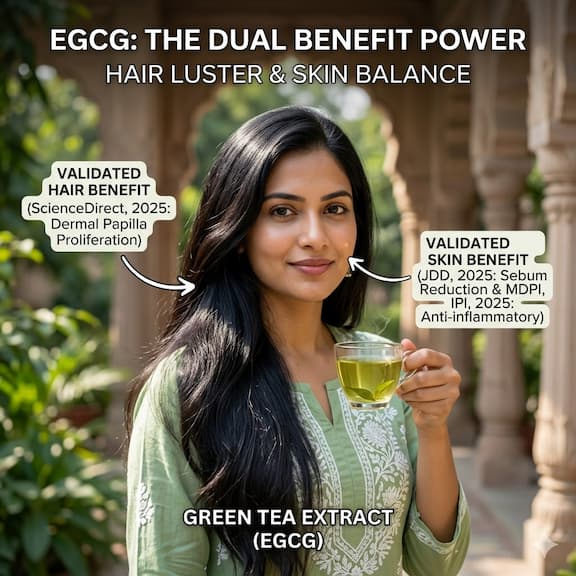
The Verdict: Green Tea Is a Daily Foundation — Not a Standalone Treatment
Green tea's EGCG is not a single-purpose ingredient. It is a multi-mechanism active that addresses the most important daily stressors on Indian hair and skin simultaneously: sebum overproduction (via 5αR and AMPK), scalp and skin inflammation (via NF-κB), UV and pollution oxidative damage (via Nrf2 + direct ROS scavenging), dandruff-related hair fall (via anti-Malassezia and cytokine suppression), and follicle cell health (via VEGFA-mediated DPC proliferation).
Its skin evidence — particularly the JDD acne RCT and sebum reduction data — is stronger and better-clinically-validated than its standalone hair evidence, which remains mechanistically compelling but lacks a large-scale human RCT. This honest distinction matters: green tea is most powerful as a consistent, daily-use supporting ingredient across a complete hair and skin routine — not as a standalone cure for any single condition.
In a sulfate-free shampoo with Bhringraj and ACV. In a face wash with Niacinamide and Salicylic Acid. In a hair oil with Bhringraj, Amla, and CoQ10. In a serum with Redensyl and Copper Peptides. That is where green tea does its best work — as the antioxidant and anti-inflammatory foundation that makes everything else in your routine more effective.
Shop Face Wash → Shop Shampoo →"The most powerful ingredients are not always the ones that do one dramatic thing — they are the ones that quietly protect against everything, every single day."
Ready to make the honest switch?
Our products are built on the same principles as every article we write — pure ingredients, real results, nothing to hide.
Explore Our Products