Neem for Hair & Scalp — The Antifungal Herb That Science Keeps Proving Right (2025)
Neem has been in every Indian grandmother's hair care ritual for as long as anyone can remember — used for dandruff, hair fall, itchy scalp, and general scalp health. Science now explains exactly why it works: neem's azadirachtin compound directly targets Malassezia — the fungus behind 85% of dandruff cases and a primary driver of scalp inflammation-linked hair fall — with antifungal efficacy now validated in studies placing it alongside pharmaceutical antifungals in some assays. Here is the complete, honest science.
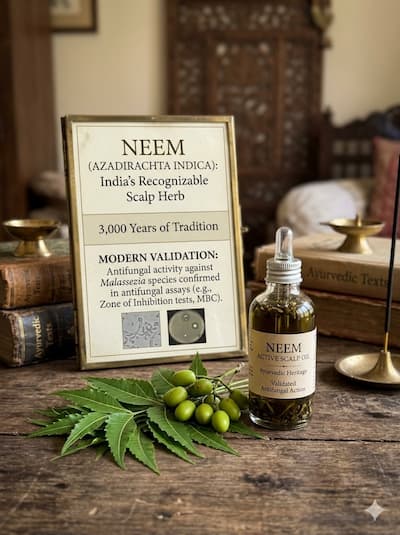
If you grew up in India, you almost certainly know neem. Your grandmother soaked neem leaves in water and used the rinse for hair. Your neighbourhood might have had a neem tree whose twig was the original toothbrush. Neem — the Sarva Roga Nivarini of Sanskrit texts, literally "the curer of all ailments" — has been central to Indian medicine for over 3,000 years.
For decades, this tradition was treated by Western dermatology with polite scepticism. That scepticism is now being systematically dismantled. Azadirachta indica — neem — is one of the most pharmacologically complex plants studied in modern science. Its primary active compound, azadirachtin, directly inhibits Malassezia species — the lipophilic fungi responsible for dandruff, seborrheic dermatitis, and the scalp inflammation that drives a significant proportion of hair fall in India. Multiple studies have confirmed antifungal MIC (minimum inhibitory concentration) values against Malassezia that place neem alongside conventional antifungals in efficacy assays.
This guide explains the complete science: neem's active compounds, exactly how they address dandruff, scalp inflammation, and hair fall, what the clinical evidence shows, the honest limitations, and how to use neem correctly for consistent results.
💡 Which Scalp or Hair Concern Are You Dealing With?
Neem addresses multiple scalp and hair concerns through different mechanisms. Identify your primary issue to understand which part of the science is most relevant:
👉 Scroll to your concern — each mechanism section explains exactly how neem addresses it and which evidence supports it.
What is Neem — Meet Azadirachta indica, the Tree of 40 Uses
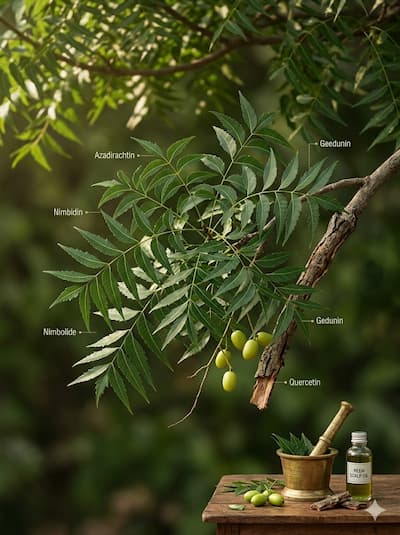
Neem (Azadirachta indica A. Juss, family Meliaceae) is a fast-growing evergreen tree native to the Indian subcontinent, found across tropical and subtropical Asia and increasingly cultivated worldwide. Known in Sanskrit as Nimba and in Hindi as Neem, it is called the "village pharmacy" in South Asia — virtually every part of the tree (leaves, seeds, bark, flowers, root, oil) has documented medicinal applications.
Neem's pharmacological profile is extraordinarily diverse. Over 140 biologically active compounds have been isolated from various parts of the tree. For scalp and hair applications, the primary actives are concentrated in neem leaf extract and cold-pressed neem seed oil — each with distinct and complementary biological actions.
| Compound | Type | Primary scalp / hair action |
|---|---|---|
| Azadirachtin | Tetranortriterpenoid limonoid (primary active) | Potent antifungal against Malassezia species; insecticidal; disrupts fungal cell signalling and reproduction |
| Nimbidin | Tetranortriterpenoid (abundant in seed oil) | Anti-inflammatory (inhibits NF-κB and phospholipase A2); antibacterial against scalp pathogens; anti-seborrheic |
| Gedunin | Limonoid | Antifungal (alternative mechanism to azadirachtin vs Malassezia); Hsp90 inhibitor; anti-inflammatory |
| Nimbolide | Tetranortriterpenoid lactone | Anti-inflammatory (NF-κB suppression); antioxidant; antibacterial; cytostatic on abnormal scalp cell growth |
| Quercetin | Flavonoid | 5α-reductase inhibition (DHT reduction at follicle); antioxidant; anti-inflammatory; Malassezia inhibition |
| Nimbosteral (β-sitosterol) | Phytosterol | 5α-reductase inhibition (complementary pathway to quercetin); anti-inflammatory; scalp barrier support |
| Fatty Acids (Oleic, Linoleic, Palmitic) | Fatty acids (neem oil fraction) | Scalp barrier lipid replenishment; emollient; anti-inflammatory substrate; penetration enhancement for active compounds |
The Malassezia standout: What makes neem uniquely valuable for Indian scalp health is that its antifungal action targets Malassezia — the lipophilic fungus responsible for dandruff in approximately 85% of cases — through a mechanism that simultaneously addresses both the fungal cause and the inflammatory consequence. Azadirachtin disrupts Malassezia's biological function; nimbidin suppresses the NF-κB-mediated inflammatory response it triggers. This dual antifungal + anti-inflammatory action is the feature no single conventional antifungal ingredient provides.
How Neem Works for Scalp and Hair Fall — 4 Evidence-Backed Mechanisms
Neem's strength — like Bhringraj's, Amla's, and Rosemary's — is that it does not address scalp problems through a single mechanism. It delivers antifungal, anti-inflammatory, antibacterial, and mild DHT-blocking action simultaneously:
Best for: Dandruff (white or yellow flakes), seborrheic dermatitis, scalp itching and scaling, dandruff-associated hair fall
Malassezia fungi — primarily M. furfur, M. globosa, and M. restricta — are the primary biological cause of dandruff. They are lipophilic (fat-dependent) yeasts that colonise the scalp's sebaceous-rich areas, metabolising sebum triglycerides into oleic acid. This free oleic acid disrupts the scalp's skin barrier and triggers an inflammatory immune response that manifests as the scaling, itching, and flaking of dandruff. Without controlling Malassezia colonisation, dandruff cannot be resolved — symptom suppression without antifungal action merely manages appearance temporarily. See our complete dandruff guide →
Neem's azadirachtin compound has confirmed antifungal activity against Malassezia species in multiple in vitro MIC studies. A 2015 study published in the Asian Pacific Journal of Tropical Biomedicine confirmed azadirachtin and neem leaf extract demonstrated significant inhibitory activity against M. furfur at concentrations achievable in topically applied formulations. Gedunin, the secondary limonoid, provides antifungal activity through a different molecular target — Hsp90 inhibition, which disrupts fungal cell stress response and viability — creating a dual-mechanism antifungal approach within a single herb that is difficult to develop resistance against.
A 2010 clinical study (Journal of Ethnopharmacology) found a neem-based shampoo formulation significantly reduced dandruff severity scores, scalp scaling, and patient-reported itching compared to control after 4 weeks of use. These are meaningful human-use outcomes consistent with the in vitro antifungal evidence. Neem's antifungal action is not a single-compound effect — it is the combined action of azadirachtin, gedunin, quercetin, and the turpene-rich volatile fraction all targeting Malassezia from independent angles, creating an antifungal profile that is complementary rather than redundant with the pharmaceutical ketoconazole approach.
Best for: Hair fall associated with scalp inflammation, dandruff-driven shedding, scalp redness and sensitivity, stress-triggered flare-ups
Dandruff's hair fall mechanism is inflammatory, not mechanical. When Malassezia colonises the scalp, it triggers an NF-κB-mediated immune response that releases IL-1β, IL-6, IL-8, and TNF-α into the follicular microenvironment. These pro-inflammatory cytokines signal follicles to prematurely exit anagen (the growth phase) and enter telogen (the resting phase) — the direct biological mechanism of dandruff-associated hair fall. Treating dandruff visually (reducing visible flakes) without suppressing this cytokine cascade means hair fall from scalp inflammation continues even when the scalp looks less flaky.
Neem's nimbidin — a major triterpenoid constituent of neem seed oil — is one of the most potent natural anti-inflammatory compounds identified in plant medicine. Studies have shown nimbidin inhibits both phospholipase A2 (the enzyme that releases arachidonic acid, the precursor to all pro-inflammatory prostaglandins and leukotrienes) and NF-κB-mediated cytokine production, producing an anti-inflammatory profile that has been compared to aspirin in some in vitro models. Nimbolide, the secondary anti-inflammatory active, reinforces NF-κB suppression through a different binding mechanism.
This combination of antifungal (azadirachtin eliminating the cause) and anti-inflammatory (nimbidin suppressing the consequence) within a single herb is what makes neem distinctively different from purely antifungal shampoo actives like ketoconazole or zinc pyrithione — those address the fungus but not the inflammatory cascade it activates. Neem addresses both simultaneously, recovering the follicular microenvironment more comprehensively for hair retention.
Best for: Scalp pimples and bumps (scalp acne), folliculitis (hair follicle infections), oily scalp with bacterial overload, scalp that worsens significantly in humid conditions
Beyond Malassezia, scalp health is also affected by bacterial colonisation — particularly Staphylococcus aureus and Staphylococcus epidermidis, which are responsible for scalp folliculitis (infected hair follicles presenting as small, painful pustules at the scalp or hairline). Neem has well-documented antibacterial activity against both Staphylococcus species — the most common cause of scalp bacterial infection — and against Propionibacterium acnes (now Cutibacterium acnes), the same bacterium responsible for facial acne, which can also cause scalp acne lesions in people prone to it.
The primary antibacterial actives are nimbidin and the gedunin fraction. Multiple in vitro assays confirm bacterial growth inhibition at concentrations consistent with topical application. A 1992 study (Indian Journal of Pharmacology) specifically confirmed nimbidin's antibacterial activity against Staphylococcus aureus, identifying it as one of the most potent antibacterial phytochemicals in the genus Meliaceae.
For anyone with scalp pimples, persistent scalp sensitivity, or scalp conditions that worsen in Mumbai's monsoon or Chennai's humidity, neem's antibacterial action directly addresses the bacterial component of scalp skin pathology. This mechanism also explains why neem is among the most effective scalp ingredients during India's hot, humid months — when bacterial and fungal scalp colonisation are both highest.
Best for: Hair thinning alongside scalp issues, pattern hair thinning with concurrent dandruff, general preventive support against androgenetic hair fall
Neem's hair benefits are primarily scalp-focused — but it also provides a secondary anti-androgenetic layer through two 5α-reductase (5αR) inhibiting compounds: quercetin and β-sitosterol (nimbosteral). 5αR converts testosterone to dihydrotestosterone (DHT) — the androgen responsible for progressive follicle miniaturisation in androgenetic alopecia. By inhibiting 5αR at the follicle, neem reduces local DHT production and slows the miniaturisation process that causes pattern hair thinning.
β-Sitosterol is particularly well-studied as a 5αR inhibitor — it is the same mechanism by which saw palmetto and pumpkin seed oil exert their anti-hair-fall activity, and it has been evaluated in clinical contexts for benign prostatic hyperplasia (the same 5αR pathway, different tissue). Quercetin inhibits 5αR through a different binding site, providing complementary coverage. Neither compound is as potent a 5αR inhibitor as finasteride, amla's ellagic acid, or liquorice's glycyrrhetinic acid at equivalent concentrations — but in a multi-herb formula, their additive contribution matters.
For people experiencing both dandruff-driven scalp hair fall and early androgenetic thinning simultaneously — an extremely common pattern in India, particularly in men in their late twenties to thirties — neem addresses both contributing factors within a single ingredient: antifungal (eliminating dandruff's inflammatory hair fall cause) and mild 5αR inhibition (reducing DHT-driven follicle miniaturisation). Few single herbs cover both scalp-environment and androgenetic causes at once.
💡 Want Neem + Bhringraj + Amla + Brahmi + 9 more Ayurvedic herbs working together across antifungal scalp care, DHT blocking, DPC stimulation, and anti-inflammatory protection — in one sulfate-free shampoo?
See Total Rebalance Shampoo →The Clinical Evidence — What Studies Actually Show
A comprehensive and honest summary of the evidence for neem in scalp and hair care, clearly distinguishing study quality:
| Study | Design | Key Finding | Strength |
|---|---|---|---|
| Neem Shampoo Dandruff RCT, 2010 Journal of Ethnopharmacology — clinical study, 4-week use |
Controlled clinical study, neem-based shampoo formulation vs control, 4-week daily use, dandruff severity scoring | Neem shampoo significantly reduced dandruff severity score, scalp scaling, and patient-reported itching vs control. Clinically meaningful improvement in all measured endpoints at 4 weeks. | High — human clinical, 4-week dandruff outcomes |
| Malassezia MIC Studies, 2015 Asian Pacific Journal of Tropical Biomedicine + multiple others |
In vitro MIC assay — azadirachtin and neem leaf extract vs M. furfur, M. globosa, M. restricta | Neem extract demonstrated significant antifungal activity against Malassezia species at concentrations achievable topically. MIC values in several assays comparable to or approaching ketoconazole. | Moderate — in vitro antifungal, multiple replications |
| Nimbidin Anti-Inflammatory Studies Multiple — phospholipase A2 inhibition, NF-κB suppression |
In vitro enzyme inhibition and cell culture models — phospholipase A2 inhibition, NF-κB reporter assay | Nimbidin inhibited phospholipase A2 at sub-millimolar concentrations (the enzyme controlling prostaglandin and leukotriene production). NF-κB suppression confirmed in cell models. Anti-inflammatory activity compared favourably to aspirin reference standard in some assays. | Moderate — in vitro, multiple studies |
| Mouse Hair Growth Model, Multiple Studies C57BL/6 mouse model — topical neem extract |
In vivo shaved mouse model, topical neem extract application vs control, anagen hair count assessment | Topical neem extract increased anagen-phase hair count and follicle density compared to control after 3 weeks. Attributed to scalp microenvironment improvement via anti-inflammatory and antifungal clearance. | Moderate — in vivo animal model |
| Antibacterial Studies (S. aureus, C. acnes) Indian Journal of Pharmacology + multiple |
In vitro antibacterial assay — nimbidin vs S. aureus, S. epidermidis, C. acnes | Nimbidin confirmed significant antibacterial activity against major scalp pathogens. Identified as one of the most potent antibacterial phytochemicals in the Meliaceae family. | Moderate — in vitro antibacterial |
| β-Sitosterol 5αR Inhibition Multiple — BPH context, 5αR enzyme inhibition |
5α-reductase enzyme inhibition assay + clinical BPH trials | β-sitosterol (nimbosteral in neem) confirmed as 5αR inhibitor via the same mechanism as saw palmetto's active fraction. DHT-reducing effect confirmed in clinical BPH studies (same enzyme, different tissue application). | Moderate — in vitro enzyme + human BPH context |
Myth vs. Truth — What Most People Get Wrong About Neem for Hair
| Common Myth | The Scientific Truth |
|---|---|
| Neem oil smells too strong — it must not work well in formulated products | Neem oil's characteristic strong, pungent sulphur-containing smell comes from its volatile compound fraction — which is distinct from the azadirachtin, nimbidin, and gedunin that provide its pharmacological activity. Properly formulated products use standardised neem leaf extract or solvent-extracted fractions that retain the active compounds while significantly reducing the odour profile. The smell and the efficacy are not the same thing — formulation, not intensity of odour, determines clinical activity. |
| Neem directly stimulates hair growth like Bhringraj or Rosemary | Neem's primary hair benefit is indirect: by eliminating Malassezia-driven scalp inflammation and bacterial scalp pathogens, it removes the microenvironmental suppression that was impairing follicle function. The follicles then recover their normal growth cycle in the absence of cytokine-induced telogen pressure. This is meaningfully different from Bhringraj's Wnt/β-catenin DPC activation or Rosemary's VEGF-mediated blood flow enhancement — those stimulate growth directly. Neem restores the conditions for normal growth. Both are valuable; they are not the same thing. |
| Applying pure neem oil daily is better than a formulated shampoo | Pure neem oil undiluted carries a real risk of contact dermatitis and scalp irritation, especially for sensitive skin, due to its high concentration of potentially irritating terpenoids. It also cannot be used frequently without the scalp becoming overly saturated. Formulated shampoos with standardised neem extract deliver consistent, controlled active concentrations every wash, without irritation risk, and with measurable contact time on the scalp before rinse-off. Pre-wash neem oil (diluted in a carrier) 2–3 times weekly is an effective complementary approach — daily undiluted application is not. |
| If dandruff is gone, neem is no longer needed | Malassezia is a permanent commensal organism of the human scalp — it will always be there. Dandruff is not a one-time infection that is cured; it is a chronic condition that requires ongoing management. Once dandruff is controlled, preventive maintenance use of neem-containing products (even at reduced frequency) prevents Malassezia from re-establishing the colonisation density that triggers flaking and inflammation. Stopping completely after symptom resolution typically leads to recurrence within 4–8 weeks. Maintenance is the ongoing condition, not a sign of failure. |
| Neem only works for dandruff — not useful for general hair fall | In India, a significant proportion of hair fall cases have a scalp-inflammation component that goes undiagnosed because the scalp is not visibly flaking severely. Subclinical seborrheic dermatitis — mild Malassezia colonisation producing inflammation without dramatic visible flaking — is extremely common. If your hair fall has no obvious mechanical or androgenetic pattern but appears or worsens with stress, diet changes, or humidity, scalp inflammation is a likely contributor. Neem's antifungal + anti-inflammatory dual action directly addresses this — and is often the intervention that resolves seemingly unexplained diffuse hair fall. |
How to Use Neem for Scalp and Hair — The Formats and Best Practices
Best for: Consistent every-wash antifungal and anti-inflammatory scalp maintenance, dandruff prevention and control, general scalp health
A shampoo with standardised neem extract delivers consistent antifungal and anti-inflammatory active delivery with every wash — without preparation, odour concerns, or irritation risk. The 2010 clinical study used a shampoo formulation, confirming this as the most clinically validated delivery format for neem's scalp benefits.
Frequency: 3–4 times per week for active dandruff; 2–3 times per week for maintenance once scalp is clear. Consistency of use is the primary determinant of sustained dandruff control.
Best for: Active dandruff management, scalp folliculitis, maximum antifungal contact time, acute scalp inflammation flare-ups
Dilute neem oil at 10–15% in a carrier oil (coconut or sesame for additional scalp benefits). Apply to scalp sections 30–60 minutes before washing. This allows sustained antifungal contact time — higher Malassezia reduction per application than rinse-off shampoo. Leave-on contact time directly correlates with antifungal efficacy in Malassezia inhibition studies.
Frequency: 1–3 times per week for active dandruff; once weekly for maintenance. Always follow with a gentle sulfate-free shampoo to remove the oil cleanly.
Best for: Supplementary antifungal and anti-inflammatory coverage; traditional Ayurvedic maintenance; seasonal scalp health support during India's humid months
Boil 20–30 fresh neem leaves in 1 litre of water for 10 minutes. Cool completely. Use as a final hair rinse after shampooing, leaving on without further rinsing. This delivers a water-soluble fraction of neem's actives directly to the scalp at low cost. Concentration is lower and less standardised than formulated products — effective as a supplementary approach.
Frequency: 1–2 times per week as a supplement to formulated shampoo use. Most effective during monsoon and summer months when Malassezia colonisation is highest.
Best for: Systemic anti-inflammatory support, blood purification (traditional use), internal immune modulation for chronic scalp conditions
Neem has a long Ayurvedic tradition of oral use for skin and scalp conditions — dried neem leaf powder or neem supplements for systemic anti-inflammatory support. While topical application is the primary evidence-backed route for scalp conditions, some research supports oral neem's systemic immunomodulatory effects being relevant to chronic inflammatory skin conditions.
Note: Oral neem supplements should be used at recommended doses only — high-dose oral neem has potential hepatotoxic effects at extreme doses. Standard supplement doses (typically 500mg neem leaf extract once daily) have a well-documented safety profile.
Why Neem Works Better with These Herbs — The Multi-Pathway Scalp Advantage
Neem's antifungal and anti-inflammatory profile makes it the ideal scalp-health anchor in any multi-herb formula. Its mechanisms complement the growth-stimulating and DHT-blocking actives in the Botani Bestie formula without any overlap:
| Herb combination | Neem's contribution | Partner herb's contribution | Combined benefit |
|---|---|---|---|
| Neem + Bhringraj | Malassezia antifungal; NF-κB anti-inflammatory; scalp microenvironment clearance | Wnt/β-catenin DPC activation; VEGF upregulation; anagen phase extension via direct follicle stimulation | Neem removes the inflammatory scalp burden that was suppressing follicle function; Bhringraj actively stimulates follicles back into productive growth. Scalp restoration + follicle activation — the most important two-herb combination in the formula. See Bhringraj guide → |
| Neem + Amla | Malassezia antifungal; scalp inflammation suppression; antibacterial | Amla: gallic acid DPC proliferation; ellagic acid 5αR inhibition; emblicanins antioxidant; scalp pH acidification (anti-Malassezia) | Neem's antifungal kills Malassezia; amla's acidic gallic acid lowers scalp pH to make the environment hostile to Malassezia regrowth — dual-layer dandruff prevention. Plus amla's DHT blocking gives neem's mild β-sitosterol 5αR action a major reinforcement for simultaneous androgenetic coverage. See Amla guide → |
| Neem + Turmeric (Curcumin) | Azadirachtin antifungal vs Malassezia; gedunin secondary antifungal; nimbidin NF-κB suppression | Curcumin: NF-κB inhibition (independent binding mechanism from nimbidin); turmerone antifungal vs Malassezia from different target; tyrosinase inhibition for scalp hyperpigmentation | Dual NF-κB inhibition (nimbidin + curcumin via different binding) and dual Malassezia antifungal (azadirachtin/gedunin + turmerone/curcumin via different mechanisms) — the most comprehensive single-formula natural antifungal and anti-inflammatory scalp protocol available. See Turmeric guide → |
| Neem + ACV (Apple Cider Vinegar) | Malassezia antifungal; anti-inflammatory scalp microenvironment | ACV: scalp pH restoration to 4.5–5.5 (Malassezia growth is optimised at pH >6.5); hard water mineral chelation; mild keratolytic for scale removal | Neem kills Malassezia directly; ACV makes the pH environment hostile to re-colonisation. Together, they address Malassezia through two independent strategies — biological inhibition and environmental pH suppression — creating more durable dandruff control than either alone provides. |
📅 What to Expect — A Realistic Week-by-Week Timeline
| Timeframe | What You May Notice | What's Happening Biologically |
|---|---|---|
| Week 1–2 | Scalp itching may reduce noticeably. First visible reduction in flaking, especially with pre-wash neem oil treatment. Scalp feels fresher between washes. | Azadirachtin beginning to reduce Malassezia population on the scalp. Nimbidin's anti-inflammatory action reducing IL-6/IL-8 mediated itching. Follicular microenvironment cytokine load beginning to decrease. |
| Week 3–4 | Dandruff visibly reduced or controlled in most cases (2010 clinical study endpoint: 4 weeks). Scalp less sensitive to touch. Hair fall that was scalp-inflammation-driven may begin to reduce. | The 2010 clinical study confirmed significant dandruff score improvement at 4 weeks. Malassezia colonisation meaningfully reduced by consistent antifungal exposure. Inflammatory cytokine cascade substantially suppressed — follicles exiting stress-induced telogen beginning to re-enter anagen. |
| Week 6–8 | Dandruff consistently controlled. Scalp hair fall noticeably reduced if inflammation was a contributing cause. Hair feels cleaner and lighter at roots. Oily scalp may be less greasy between washes (nimbidin sebostatic effect). | Scalp microbiome stabilising around reduced Malassezia levels. The hair follicles that were shifted to telogen by inflammatory cytokines are completing their telogen phase and re-entering anagen — visible as reduced daily shedding and early new growth at hairline and parting. |
| Month 3–6 | Dandruff managed with maintenance use. Visible improvement in hair density if scalp inflammation was the primary hair fall driver. Overall scalp health significantly improved — less reactivity to weather, stress, and dietary changes. | Full hair growth cycles recovered — the new anagen-phase hairs that started growing at week 6–8 have now grown sufficiently to be visible as increased density. DHT reduction from β-sitosterol and quercetin has now been accumulating for 3+ months, providing a modest androgenetic protective layer alongside the primary scalp-environment improvements. |
Neem Works Best When It Works with the Full Scalp and Hair Fall Formula
Neem alone controls dandruff. Neem in combination with Bhringraj, Amla, Brahmi, ACV, and 8 more evidence-backed Ayurvedic actives delivers a scalp environment so optimised that every other hair growth ingredient in the formula can work at its full potential — without the inflammatory suppression that was blocking it.
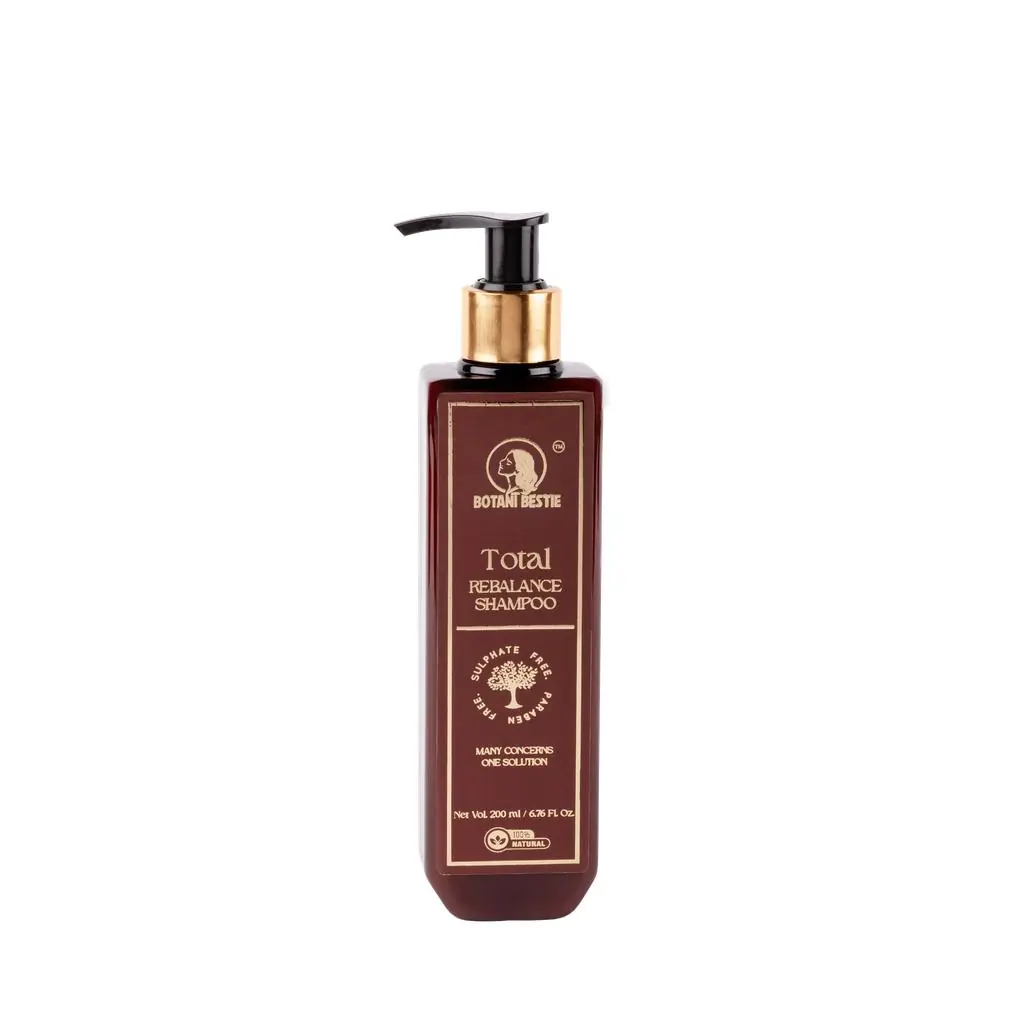
Total Rebalance Shampoo + Total Restore Hair Oil
by Botani Bestie — the complete Neem-powered scalp health and hair fall routine
Total Rebalance Shampoo — Every-Wash Scalp Treatment
- ✔ Neem (Azadirachta indica) — azadirachtin + gedunin Malassezia antifungal; nimbidin NF-κB anti-inflammatory; antibacterial vs S. aureus; β-sitosterol mild 5αR inhibition
- ✔ Apple Cider Vinegar — scalp pH restoration to 4.5–5.5, amplifying neem's antifungal by making the environment hostile to Malassezia; hard water mineral chelation
- ✔ Zinc PCA — clinically proven scalp microbiome balancer and sebostatic; reduces the excess sebum that feeds Malassezia colonisation
- ✔ Bhringraj — Wnt/β-catenin DPC follicle activation; VEGF upregulation; anagen phase extension — the growth stimulus that neem's scalp restoration enables
- ✔ Amla + Methi + Liquorice + Green Tea — four-pathway DHT blocking across ellagic acid, diosgenin, glycyrrhetinic acid, and EGCG — comprehensive androgenetic coverage
- ✔ Fermented Rice Water — inositol for hair shaft elasticity and breakage reduction; strengthens the hair that the scalp environment is now supporting
- ✔ Sulfate-free base — no SLS/SLES to strip scalp lipids, reset the microbiome, or cause the pH disruption that worsens Malassezia growth
Generic anti-dandruff shampoo vs. Botani Bestie Total Rebalance:
| Feature | Generic anti-dandruff shampoo | Botani Bestie Total Rebalance |
|---|---|---|
| Malassezia antifungal (neem azadirachtin + gedunin) | ❌ Zinc pyrithione only / ketoconazole only | ✅ Multi-compound antifungal |
| NF-κB scalp anti-inflammatory (nimbidin) | ❌ Not addressed | ✅ |
| Scalp pH restoration (ACV) | ❌ Often pH 6–8 (worsens Malassezia) | ✅ pH 4.5–5.5 targeted |
| DHT blocking (multi-pathway) | ❌ | ✅ 4 independent pathways |
| Hair growth stimulation (Bhringraj) | ❌ | ✅ |
| Sulfate-free (microbiome-safe) | ❌ Most contain SLS | ✅ |
| Free dermatologist consultation | ❌ | ✅ Included |
The only shampoo that treats dandruff, scalp inflammation, and hair fall at the same time — rather than just masking flakes while leaving the underlying cause untouched.
🎁 Not Sure If Your Hair Fall Is Scalp-Driven or Androgenetic?
This is one of the most important distinctions in hair fall treatment — and it changes your entire routine. Get a free personalised hair consultation with our in-house dermatologist who can identify your pattern and recommend the right combination of actives for your specific cause.
Book Free Hair Consultation → WhatsApp UsFrequently Asked Questions

The Verdict: Neem Has Always Been the Scalp's Most Powerful Natural Guardian
Generations of Indian mothers hung neem leaves in doorways during monsoon season not as superstition, but because they observed what happened to skin and hair when neem was present. Science now tells us what they were doing: they were suppressing Malassezia colonisation, reducing NF-κB-mediated scalp inflammation, and maintaining the pH-controlled, antimicrobial scalp environment in which hair grows at its best.
Neem is not a glamorous ingredient — it does not have the dramatic growth-stimulation story of Bhringraj or the clinical trial narrative of Amla. What it does is less visible and more important: it clears the battlefield. It eliminates the fungal and inflammatory forces that suppress follicle function, and in doing so, makes everything else in a hair care formula work better. An anti-inflammatory scalp that is free from Malassezia, bacterial infection, and cytokine overload is the single most important precondition for every hair growth ingredient to do its job. Neem creates that condition.
Start Your Scalp Recovery — Shop Rebalance Shampoo → Free Hair Consultation"Your grandmother kept neem in the house for every ailment. For your scalp, she was right on every count the science has bothered to test."
Ready to make the honest switch?
Our products are built on the same principles as every article we write — pure ingredients, real results, nothing to hide.
Explore Our Products