Amla for Hair Growth — Does It Really Work? The Complete Science-Backed Answer (2025)
India's most beloved hair ingredient — used by grandmothers, praised by Ayurveda, and now confirmed by a 2024 triple-blind randomised controlled trial. Amla significantly increases the anagen-to-telogen hair ratio in women with androgenetic alopecia. Here is the complete, honest picture of exactly why it works.
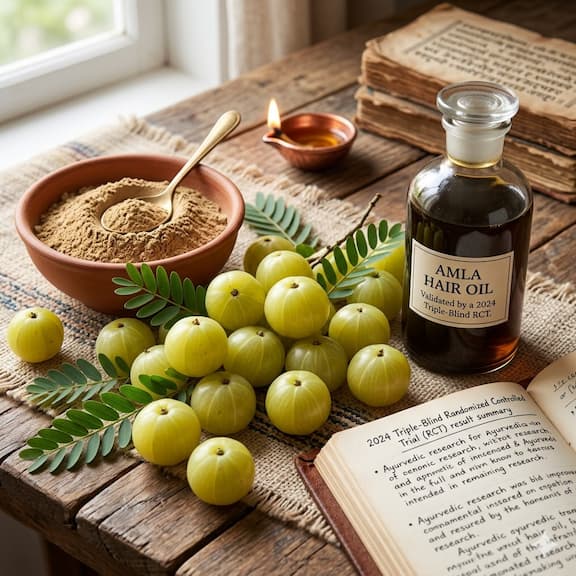
Ask anyone's mother, grandmother, or great-grandmother in India what they use for hair fall and the answer is almost invariably the same: Amla. The small, tart gooseberry has been central to Indian hair care for so long — referenced in the Charaka Samhita, the Sushruta Samhita, and classical Ayurvedic texts as a primary hair tonic — that most people have stopped questioning whether it works and simply accepted it as fact.
Here is what is remarkable: the science is proving those generations right. Amla (Phyllanthus emblica L., also known as Emblica officinalis) is one of the most extensively studied medicinal plants in the world, with a research profile spanning antioxidant, anti-inflammatory, DHT-blocking, and follicle-stimulating mechanisms. In 2024, it became the subject of the first triple-blind, randomised, placebo-controlled clinical trial for female androgenetic alopecia — and the results were significant.
This guide explains the complete science: what amla's active compounds are, exactly how they address the biological causes of hair fall, what the clinical trials show, the honest limitations of the current evidence, and how to use amla correctly for the best results.
💡 Which Type of Hair Fall Are You Dealing With?
Amla addresses multiple hair fall types through different mechanisms. Identify your pattern to understand which part of the science is most relevant:
👉 Scroll to your hair fall type — each mechanism section explains exactly how amla addresses it and which clinical evidence supports it.
What is Amla — Meet Phyllanthus emblica, the World's Richest Vitamin C Fruit
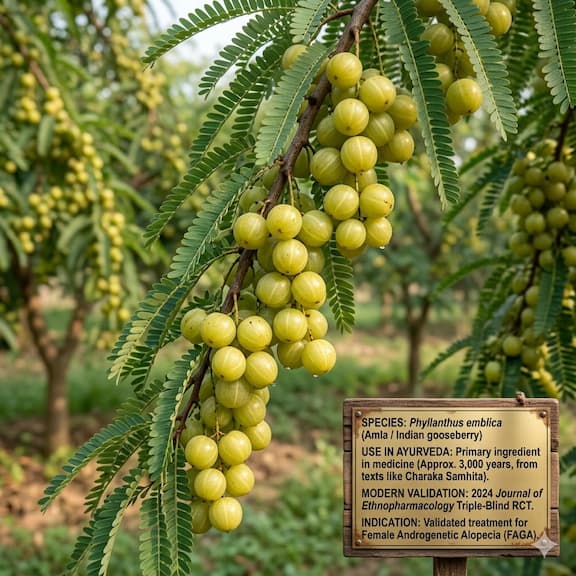
Amla (Phyllanthus emblica L., family Phyllanthaceae) is a deciduous tree native to tropical and southern Asia, growing 8–18 metres tall with small, light-green feathery leaves and clusters of pale yellow-green fruits with characteristic vertical ridges. It is one of the most pharmacologically investigated plants in the world — amla is one of the most extensively studied plants with reports suggesting it contains tannins, alkaloids, flavonoid glycosides, phenolic glycosides, terpenoids, and minerals.
| Compound | Type | Primary hair action |
|---|---|---|
| Gallic Acid | Phenolic acid (primary active) | DPC proliferation; anti-inflammatory; antioxidant; antimicrobial against Malassezia; scalp pH support |
| Emblicanin A & B | Tannins (hydrolysable) | Exceptionally potent antioxidant activity; UV protection for follicle melanocytes; anti-ageing |
| Ellagic Acid | Tannin-derived polyphenol | 5α-reductase inhibition; anti-inflammatory; DNA protection in follicle cells |
| Vitamin C (Ascorbic Acid) | Vitamin | 30x more than oranges; collagen synthesis at follicle; iron absorption enhancement; antioxidant |
| Quercetin | Flavonoid | 5α-reductase inhibition; anti-inflammatory; antioxidant; DHT suppression |
| Punigluconin / Pedunculagin | Ellagitannins | Antioxidant; anti-inflammatory; scalp barrier support |
| β-Glucogallin | Ester of gallic acid | DPC protection (used in standardised Saberry® extract); hair density in clinical studies |
The Vitamin C standout: Amla contains approximately 30 times more Vitamin C than oranges by weight. This is not trivial — ascorbic acid is essential for collagen synthesis at the hair follicle base, accelerates iron absorption (iron deficiency is one of the most common causes of hair fall in Indian women), and is one of the most potent natural antioxidants against UV-generated ROS that damage follicle cells progressively in India's high-UV environment.
How Amla Works for Hair Fall — 4 Evidence-Backed Mechanisms
Amla's strength is the same as Bhringraj's and rosemary's: it does not address hair fall through a single pathway but through four interconnected biological mechanisms simultaneously:
Best for: Androgenetic alopecia (pattern thinning), PCOS-related hair fall, hormonal hair loss in women
Dihydrotestosterone (DHT) drives androgenetic alopecia by progressively miniaturising hair follicles — making each successive hair thinner, shorter, and eventually invisible. DHT is produced from testosterone by 5α-reductase (5αR) enzymes. Finasteride and dutasteride work by inhibiting 5αR — but carry significant hormonal side effects.
Phyllanthus emblica is a potent inhibitor of 5α-reductase — confirmed in a 2012 Journal of Ethnopharmacology study (Kumar et al.) that measured 5αR inhibitory activity of Thai plants used traditionally for hair treatment, finding P. emblica among the most potent. The primary compounds responsible are ellagic acid and quercetin — both documented 5αR inhibitors that work through different binding mechanisms than finasteride, allowing them to be combined without redundancy.
This 5αR inhibition from amla works through a different chemical pathway than the 5αR inhibition documented for liquorice (glycyrrhetinic acid), rosemary (ursolic acid), and green tea (EGCG) — meaning that in a multi-herb formula containing all four, DHT suppression is addressed from four independent biochemical angles simultaneously, providing more comprehensive androgenetic protection than any single ingredient can deliver.
Best for: General hair thinning, follicles in telogen phase, anagen phase extension
Amla fruit extract has been shown to directly promote proliferation in dermal papilla cells (DPCs) of human hair follicles. DPCs are the master regulators of the hair cycle — they determine when a follicle enters anagen, how long it remains in the growth phase, and how thick the resulting hair fibre becomes. Any ingredient that stimulates DPC proliferation is directly and favourably influencing the biological machinery of hair growth.
In vivo studies demonstrated hair growth-enhancing activities of amla because it contains compounds that effectively increase the size of hair follicles and prolong the anagen phase. The primary active driving this DPC proliferation is gallic acid — the major component identified in amla's aqueous extract by ultra-performance liquid chromatography. Gallic acid activates gene expression involved in hair growth promotion in human keratinocytes — confirmed in Phyllanthus emblica extract transfersome studies using PE aqueous extract.
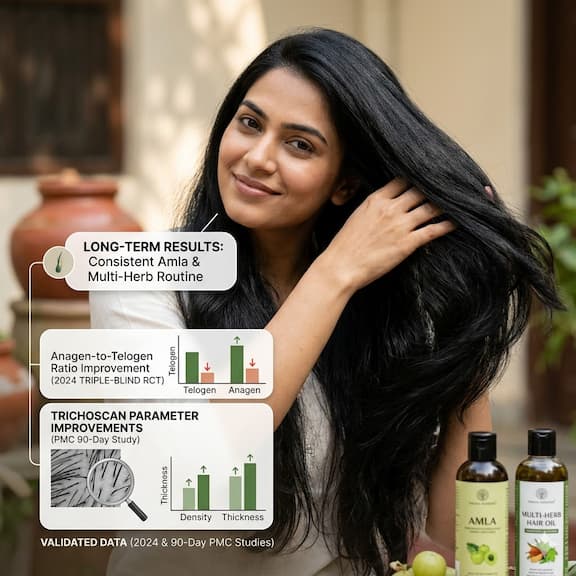
The 2024 triple-blind RCT's TrichoScan finding of a significant increase in anagen-to-telogen ratio (p=0.002) in the amla group is the clinical reflection of this DPC stimulation and anagen phase extension mechanism in human hair follicles — making it one of the most directly clinically confirmed effects of any botanical on the hair growth cycle.
Best for: Weak, breaking hair; thinning hair shaft; hair that snaps during combing
Amla's extraordinary Vitamin C content — the highest of any natural food source — has a direct structural role in hair health that goes beyond antioxidant protection. Vitamin C (ascorbic acid) is an essential cofactor for collagen synthesis — it activates prolyl hydroxylase and lysyl hydroxylase, the enzymes that create the stable triple-helix structure of collagen. Collagen Type I and III form the connective tissue matrix at the hair follicle base (the dermal papilla and connective tissue sheath), providing the structural scaffolding on which healthy hair growth depends.
When Vitamin C is deficient — a surprisingly common deficiency in urban India where processed food consumption is high — collagen synthesis at the follicle is impaired, producing weaker, thinner hair fibres with reduced tensile strength. Amla-derived Vitamin C restores this collagen synthesis capacity, directly strengthening the physical structure of the growing hair shaft.
Additionally, Vitamin C significantly enhances non-haem iron absorption from plant-based foods — a critical benefit for Indian women, who have the world's highest prevalence of iron deficiency anaemia (approximately 53% of non-pregnant women of reproductive age). Iron deficiency is one of the most common and underdiagnosed causes of diffuse hair fall in Indian women — amla's Vitamin C acts as a natural co-supplement to any iron-containing diet, improving the absorption of the very mineral that follicles need for healthy haemoglobin-dependent oxygen delivery.
Best for: Premature greying, UV and pollution-driven hair fall, oxidative follicle damage
Amla's tannins — particularly emblicanin A and B, pedunculagin, and punigluconin — are among the most potent natural antioxidants identified in any food or plant. A standardised extract of Phyllanthus emblica (Saberry®), used in clinical formulations, is standardised specifically for β-glucogallin and low molecular weight hydrolysable tannins precisely because of their exceptional, concentration-measurable antioxidant activity.
For hair follicles — particularly the melanocytes responsible for pigment production — this antioxidant action provides two critical benefits. First, it protects dermal papilla cells from the oxidative DNA damage caused by UV radiation, pollution-generated ROS, and metabolic byproducts that accumulate in the follicle microenvironment and progressively suppress hair growth quality. Second, it protects follicle melanocytes from the ROS depletion that is the primary driver of premature greying — the same biological basis for amla's 3,000-year traditional use in India specifically for preventing grey hair.
The 2013 Journal of Functional Foods study (Fujii et al.) specifically confirmed: UVB-induced photoaging effects on the skin and scalp were measurably mitigated by amla extract — the antioxidant and collagen-protecting compounds in amla counteracted UV-driven structural deterioration. In India's year-round UV environment, this is one of amla's most practically important daily contributions.
Best for: Dandruff-driven hair fall, oily scalp, scalp inflammation
Amla's naturally acidic pH (approximately 2.8–3.5 in its fresh juice form) is one of its most underappreciated hair benefits. The scalp's optimal pH is 4.5–5.5. Most Indian water supplies (hard water, pH 7–8.5) and most commercial shampoos (SLS-based, pH 6–8) push the scalp above this range — creating the alkaline environment in which Malassezia fungus (the primary cause of dandruff) colonises most aggressively. See our dandruff guide →
Amla's acidic tannins and gallic acid gently lower the scalp's pH toward its ideal range during application — the same mechanism by which Apple Cider Vinegar works in the Total Rebalance Shampoo. Combined with its documented antimicrobial activity (gallic acid's antibacterial properties against scalp pathogens) and its anti-inflammatory action (ellagic acid suppresses the same NF-κB cytokine cascade that dandruff-driven Malassezia triggers), amla addresses dandruff-related hair fall from three complementary angles simultaneously.
This scalp-balancing mechanism is why amla-containing shampoos have been used in India for generations to control dandruff — a traditional use now backed by the pharmacological evidence for its active compounds' antimicrobial, anti-inflammatory, and pH-adjusting properties.
💡 Want Amla + Bhringraj + Liquorice + Green Tea + 9 more Ayurvedic herbs working together across DHT blocking, DPC proliferation, scalp pH, and antioxidant protection?
See Total Restore Hair Oil →The Clinical Evidence — What Studies Actually Show
Here is a comprehensive and honest summary of the evidence for amla and hair growth, clearly distinguishing study quality:
| Study | Design | Key Finding | Strength |
|---|---|---|---|
| Akhbari et al., 2024 J Ethnopharmacol — triple-blind RCT, FAGA, 60 women, 12 weeks |
Triple-blind, randomised, placebo-controlled; oral amla syrup 10cc 3x/day; TrichoScan assessment | Significant increase in anagen-to-telogen ratio in amla group vs placebo (p=0.002); physician satisfaction significantly higher (p<0.001); patient satisfaction significantly higher (p<0.001). No serious side effects. | High — 2024 triple-blind human RCT |
| PMC TrichoScan Study (Hair Serum) PMC — amla (Saberry®) in hair serum, 42 subjects, 90 days |
Open-label clinical, 42 subjects (male + female), TrichoScan® assessment, daily application | Significant improvement in hair growth rate (p<0.0001), hair density (p<0.0001), vellus hair density (p<0.0001), and terminal hair density (p<0.0001) at 90 days. "Amla extract stimulates hair growth and makes hair softer and shinier." | High — human TrichoScan, 90 days |
| 2025 Naunyn-Schmiedeberg's Systematic Review 16 RCTs evaluated; June 2025 |
Systematic review of 16 herbal RCTs for hair loss | Amla (oral trial) identified among most clinically evidenced herbs. Confirmed anagen-to-telogen ratio improvement (p=0.002). Listed alongside rosemary as one of the best-supported herbal treatments for hair fall. | High — 2025 systematic review |
| DPC Proliferation Studies Multiple — Emblica fruit extract, human DPCs |
In vitro, human dermal papilla cells | Emblica fruit extract promotes proliferation in dermal papilla cells of human hair follicles; enlarges follicle size and prolongs anagen phase in in vivo models | Moderate — in vitro + in vivo confirmation |
| Kumar et al., 2012 J Ethnopharmacology — 5αR inhibition study |
In vitro 5αR enzyme assay + in vivo C57BL/6 mice | Phyllanthus emblica among the most potent 5α-reductase inhibitors measured; promotes hair growth in mouse model at concentrations consistent with topical application | Moderate — in vitro + animal, 5αR confirmed |
| DA-5512 Multi-herb Clinical Trial PMC — includes Emblica officinalis in 6-herb formula |
Preclinical + clinical evaluation, multi-herb including amla | DA-5512 formula (including Emblica officinalis) effectively stimulated hair growth and promoted hair health. Amla's 5αR inhibition confirmed as the active mechanism. | Moderate — multi-herb formula, amla component |
Myth vs. Truth — What Most People Get Wrong About Amla for Hair
| Common Myth | The Scientific Truth |
|---|---|
| Applying amla juice directly is the most effective method | Raw amla juice is acidic and contains the active compounds, but in inconsistent and uncontrolled concentrations that vary widely between fruits and seasons. Standardised amla extract (like Saberry® standardised for β-glucogallin and emblicanins) in a formulated product delivers measured, consistent amounts of the clinically active fractions with every use. |
| Amla works for hair only because of Vitamin C | Vitamin C is one of amla's many actives — but ellagic acid (5αR inhibition), emblicanins A and B (exceptional antioxidant activity), gallic acid (DPC proliferation, antimicrobial), and quercetin (DHT blocking via a different pathway) all contribute meaningfully. Amla's hair benefits are the product of its full phytochemical complexity — not a single compound. |
| Amla can regrow completely lost hair (bald patches) | Amla's 2024 RCT showed improvement in anagen-to-telogen ratio — meaning it shifts more follicles into the growth phase. This is most effective for early-to-moderate hair fall and follicle thinning. For follicles that have been dormant for many years (in established bald areas), clinical evidence for amla-driven complete regrowth is limited. Earlier-stage hair fall responds significantly better. |
| Eating amla is enough for hair benefits | Both oral and topical routes are supported by evidence. The 2024 RCT used oral syrup — showing systemic benefits including hormonal balance support (5αR inhibition via circulation) and Vitamin C-mediated collagen synthesis. Topical application in oil and shampoo delivers actives directly to the scalp follicle environment. For maximum coverage, the combination of topical + dietary amla is ideal. |
| Results should appear within 2–4 weeks | The 2024 RCT measured outcomes at 12 weeks; the TrichoScan PMC study ran for 90 days. The hair growth cycle takes 4–6 weeks to respond to any biological change at the follicle level. Visible improvements in density typically require 3–6 months. Expecting results within 2–4 weeks and stopping because nothing has happened is the most common reason amla fails for people who should be benefiting from it. |
How to Use Amla for Hair Fall — The Formats and Best Practices
Best for: Scalp penetration, DHT blocking at follicle level, antioxidant protection, premature greying
Apply amla-containing hair oil to the scalp in sections 30–60 minutes before washing. Massage gently for 5 minutes to improve penetration. This is the traditional Indian method and the format closest to the in vivo and topical application models studied.
Frequency: 2–3 times per week for active hair fall; once a week for maintenance.
Best for: Consistent every-wash delivery, scalp pH support, anti-dandruff, daily antioxidant protection
A standardised amla extract in a sulfate-free shampoo delivers consistent, measurable active concentrations with every wash. The mildly acidic amla compounds support scalp pH while ACV in the same formula chelates hard water mineral deposits. No preparation required.
Frequency: 3–4 times per week — the every-wash consistency is what makes the cumulative benefit build over months.
Best for: Systemic benefits — collagen synthesis (Vitamin C), iron absorption enhancement, hormonal DHT blocking via circulation
The 2024 triple-blind RCT used oral amla syrup (10cc thrice daily for 12 weeks) and showed the most direct clinical hair fall evidence to date. Eating fresh amla, drinking amla juice (diluted), or taking standardised amla extract supplements delivers systemic benefits that topical application alone cannot replicate.
Best practice: Consume amla with iron-rich foods (dals, leafy greens) — the Vitamin C dramatically enhances iron absorption, addressing one of the most common causes of diffuse hair fall in Indian women.
Best for: Highest concentration of fresh gallic acid and Vitamin C; suitable when fresh amla is seasonally available
Traditional Ayurvedic use includes applying fresh amla juice or paste directly to the scalp. This delivers active compounds at their highest freshness — but concentration varies by fruit maturity, and undiluted fresh amla juice can temporarily stain grey hair green-tinged (harmlessly, due to tannin oxidation).
Best practice: Dilute fresh amla juice 1:1 with water before applying. Leave for 20–30 minutes, then shampoo out. Seasonal supplement to formulated products — not a replacement.
Why Amla Works Better with These Herbs — The Multi-Pathway DHT Blocking Advantage
One of amla's most important strategic advantages in a multi-herb formula is that its 5α-reductase inhibition operates through different chemical mechanisms than the other DHT-blocking herbs in Botani Bestie's formulas. This means combining them creates additive — and potentially synergistic — DHT suppression:
| Herb combination | Amla's contribution | Partner herb's contribution | Combined benefit |
|---|---|---|---|
| Amla + Bhringraj | Ellagic acid + quercetin 5αR inhibition; DPC proliferation via gallic acid | Wnt/β-catenin DPC activation; VEGF upregulation; antifungal | Amla extends follicle into anagen; Bhringraj pushes follicle into anagen via stem cell activation — two pathways to the same goal. See Bhringraj guide → |
| Amla + Methi (Fenugreek) | Ellagic acid 5αR inhibition; antioxidant protection | Diosgenin (phytoestrogen) 5αR inhibition via different binding site; folic acid for follicle nutrition | Dual 5αR suppression from two independent chemical mechanisms; folic acid fills the nutritional gap that amla's Vitamin C fills for collagen |
| Amla + Liquorice | Vitamin C collagen synthesis; tannin antioxidant; scalp pH support | Glycyrrhetinic acid 5αR inhibition; glycyrrhizin scalp anti-inflammatory | Amla provides structural support (collagen) + antioxidant protection; Liquorice provides anti-inflammatory scalp environment + DHT blocking — structural + environment synergy. See Liquorice guide → |
| Amla + Green Tea (EGCG) | 30x Vitamin C antioxidant; ellagic acid DHT blocking | EGCG VEGFA-mediated DPC proliferation; EGCG 5αR inhibition via AMPK | Three complementary antioxidant mechanisms (Vitamin C, emblicanins, EGCG) providing the most comprehensive follicle oxidative protection of any two-ingredient pairing. See Green Tea guide → |
📅 What to Expect — A Realistic Week-by-Week Timeline
| Timeframe | What You May Notice | What's Happening Biologically |
|---|---|---|
| Week 1–2 | Scalp feels slightly fresher; dandruff-related itching may reduce; hair feels marginally softer after washing. | Amla's antimicrobial gallic acid beginning to reduce scalp pathogen load. Acidic tannins gently lowering scalp pH toward ideal range. Antioxidant compounds protecting follicle cells from ongoing UV and pollution ROS damage. |
| Week 4–6 | Some reduction in daily shedding noticeable. Hair feels stronger at roots. Dandruff-driven fall (if present) measurably reduced. | 5αR inhibition from ellagic acid and quercetin beginning to reduce DHT production at follicle level. DPC proliferation signalling from gallic acid accumulating — anagen phase beginning to extend. |
| Week 8–12 | Visible reduction in hair shedding. Hair texture improved — softer, shinier, less breakage. Anagen-to-telogen ratio shifting (more growing hairs, fewer resting ones). | 2024 RCT measured significant anagen-to-telogen improvement at 12 weeks. PMC TrichoScan study showed significant hair growth rate and density improvements at 90 days. Collagen synthesis at follicle strengthened by consistent Vitamin C delivery. |
| Month 4–6 | Visible improvement in hair density. Baby hairs appearing at parting and hairline. Premature greying progression potentially slowed. Overall hair quality noticeably better. | Full hair cycles completed — follicles that were in telogen returning to anagen. Collagen matrix at follicle strengthened by months of Vitamin C delivery. DHT suppression maintained through ongoing 5αR inhibition. |
Amla Works Best When It Works with the Full Herb Synergy
The research is consistent: amla in combination with complementary hair fall herbs delivers results that amla alone, at the same total concentration, cannot match. The Botani Bestie Hair Oil and Rebalance Shampoo pair amla with 12+ other Ayurvedic actives — each addressing the hair fall cascade from a different angle, none redundant, all complementary.
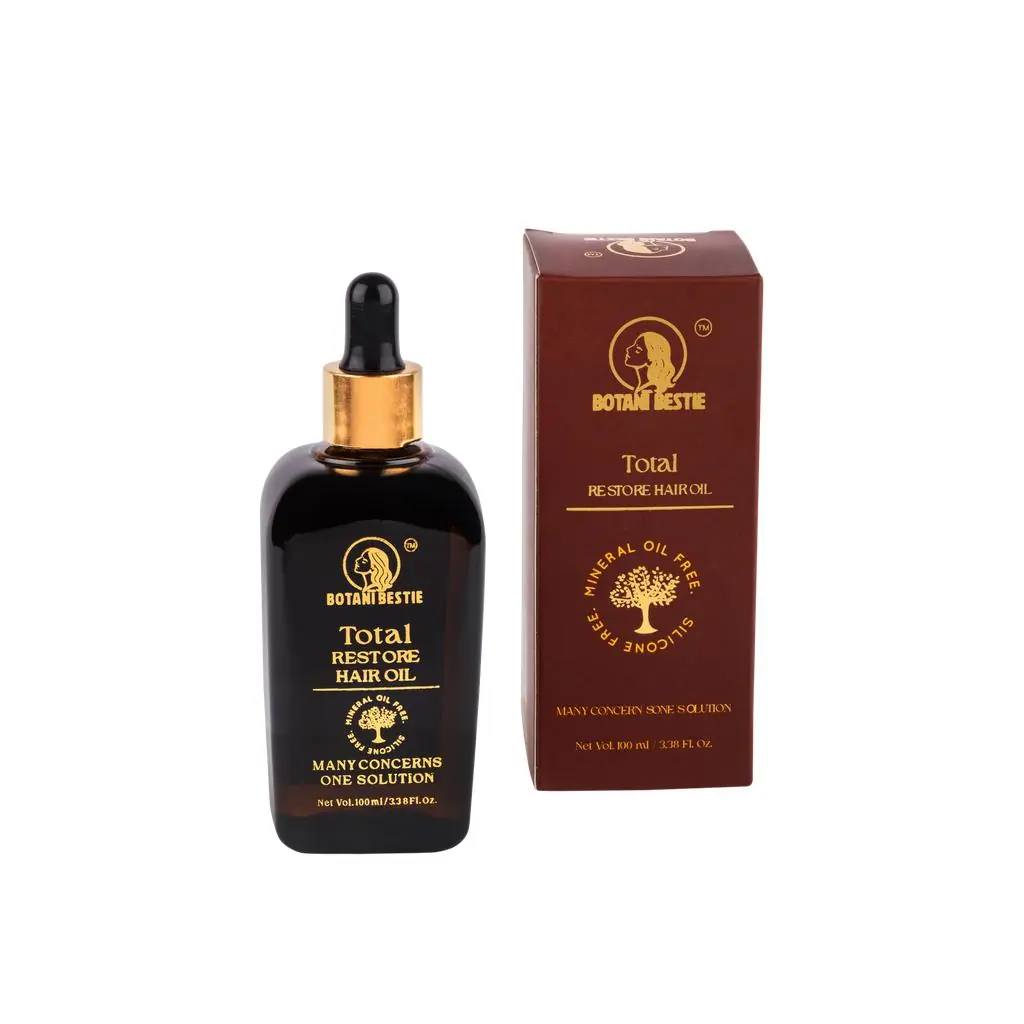
Total Restore Hair Oil + Total Rebalance Shampoo
by Botani Bestie — the complete Amla-powered hair fall routine
Total Restore Hair Oil — Pre-Wash Treatment
- ✔ Amla (Phyllanthus emblica) — standardised extract delivering ellagic acid (5αR inhibition), gallic acid (DPC proliferation), emblicanins A&B (antioxidant follicle protection), and Vitamin C (collagen synthesis)
- ✔ Bhringraj — Wnt/β-catenin follicle stimulation, VEGF upregulation, antifungal scalp clearing; the strongest single-herb hair growth evidence alongside rosemary
- ✔ Brahmi — adaptogenic stress reduction for cortisol-driven telogen effluvium; scalp anti-inflammatory
- ✔ Methi (Fenugreek) — dual DHT blocking via diosgenin; folic acid + Vitamins A, K, C for follicle nutrition
- ✔ Liquorice Root Extract — glycyrrhetinic acid 5αR inhibition; glycyrrhizin anti-inflammatory; sebum regulation
- ✔ 14+ carrier oils including sesame and coconut for maximum active penetration to follicle depth
- ✔ CoQ10 + Vitamin E — antioxidant protection complementing amla's emblicanin-based defence system
Total Rebalance Shampoo — Every-Wash Reinforcement
- ✔ Amla + Bhringraj + Brahmi + Methi + Liquorice + Green Tea + 7 more herbs — consistent standardised delivery with every wash
- ✔ Apple Cider Vinegar — scalp pH restoration to 4.5–5.5, amplifying amla's pH-supporting mechanism and chelating hard water mineral deposits
- ✔ Fermented Rice Water — inositol for hair shaft elasticity and breakage reduction
- ✔ Plant-Based Keratin + Soy & Silk Proteins — shaft repair alongside root-level follicle stimulation
Raw amla vs. formulated Botani Bestie routine:
| Feature | Raw amla / single herb | Botani Bestie routine |
|---|---|---|
| Standardised amla extract (consistent active dosing) | ❌ Variable by fruit | ✅ |
| Multi-pathway DHT blocking (4 independent pathways) | ❌ Single pathway only | ✅ Amla + Methi + Liquorice + EGCG |
| Wnt/β-catenin follicle stimulation (Bhringraj) | ❌ | ✅ |
| Scalp pH restoration (ACV) | ❌ | ✅ |
| Hard water mineral chelation | ❌ | ✅ |
| Sulfate-free base (no protein stripping) | ❌ Most shampoos SLS | ✅ |
| Free dermatologist consultation | ❌ | ✅ Included |
Join the growing community of customers across India experiencing the difference of a multi-herb formula built around clinical evidence, not just tradition.
🎁 Not Sure Which Hair Fall Routine is Right for You?
Get a free personalised hair consultation with our in-house dermatologist — no purchase required. Tell us your hair fall pattern, duration, and scalp condition for a targeted routine recommendation built specifically for you.
Book Free Hair Consultation → WhatsApp UsFrequently Asked Questions
The Verdict: Amla Has Earned Its Title as India's King of Hair Ingredients
For 3,000 years, every generation of Indian grandmothers knew something about amla that the scientific community is only now fully documenting. The 2024 triple-blind RCT, the 90-day TrichoScan clinical study, the documented 5α-reductase inhibition, the DPC proliferation studies, and the 2025 systematic review of 16 herbal RCTs all point in the same direction: amla is not tradition dressed up as science. It is science that has been practised as tradition for millennia.
Its greatest value is not as a single-ingredient treatment — it is as the nutritional, antioxidant, and DHT-blocking foundation of a multi-herb formula that addresses hair fall from every angle simultaneously. With Bhringraj stimulating follicle growth via Wnt/β-catenin, Liquorice calming the scalp inflammation that suppresses it, Methi blocking DHT via a complementary pathway, and Amla providing the Vitamin C, antioxidant protection, and ellagic acid 5αR inhibition that tie it all together — the formula is substantially more powerful than the sum of its parts.
Start Your Hair Recovery — Shop Hair Oil → Free Hair Consultation"Your grandmother knew. The clinical trial confirmed it. Now you have no reason not to use it."
Ready to make the honest switch?
Our products are built on the same principles as every article we write — pure ingredients, real results, nothing to hide.
Explore Our Products