Hair Fall in Men — Androgenetic Alopecia, DHT, and the Ayurvedic + Biotech Approach (2025)
Male pattern hair loss affects approximately 50% of Indian men by age 50 and up to 80% by age 70 — making it the most common hair condition in existence. The mechanism is well understood: DHT, the androgen receptor, and a follicle miniaturisation cascade that is gradual, predictable, and — in its early stages — interruptible. This guide covers the complete biology, the honest treatment evidence (including the side effects that manufacturers understate), and the Ayurvedic + biotech combination approach that is changing how men approach hair loss without prescription drugs.
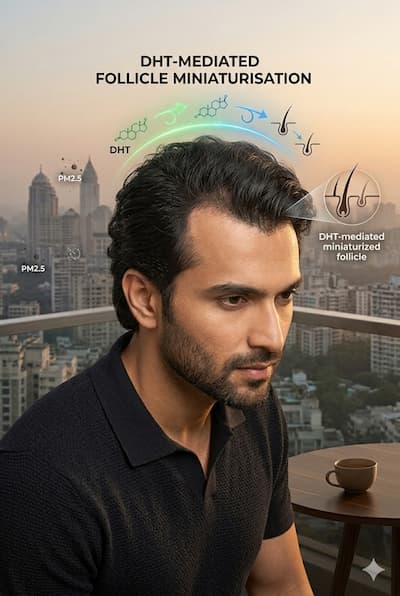
The most important thing to understand about male pattern hair loss is also the most often misrepresented: it is not a disease of the scalp. The scalp is normal. The follicles are normal. The DHT is normal. What is different — and what is entirely genetic — is the sensitivity of certain follicles' androgen receptors to DHT.
This distinction matters because it explains why no topical ingredient can 'cure' androgenetic alopecia (AGA), why the same DHT level that maintains a full beard causes crown thinning, and why treatments must address either the DHT signal or the follicle's response to it — not the scalp surface.
It also explains why early intervention is the defining variable in outcomes. A follicle that has been miniaturising for 2 years is far more recoverable than one that has been miniaturising for 10. The biology is clear: act early, use the right approach, and the trajectory can be meaningfully altered. Wait for visible baldness, and the window narrows dramatically.
⚡ Androgenetic Alopecia — Quick Reference
| Cause | DHT (dihydrotestosterone) acting on androgen-receptor-sensitive follicles in the crown and temples; follicles in the occipital region are DHT-resistant |
| Enzyme responsible | 5α-reductase type II (primary in scalp) — converts testosterone → DHT |
| Genetics | Polygenic; AR gene on X chromosome (from mother) is primary determinant; 20p11 locus on chromosome 20 also significant |
| Pattern | Bitemporal recession + crown thinning; classified by Norwood-Hamilton scale (I–VII) |
| Gold standard medical treatment | Finasteride 1 mg/day (oral, 5α-R II inhibitor) + Minoxidil 5% topical (vasodilator, K⁺ channel opener) |
| Natural 5α-R inhibitors | Saw palmetto (β-sitosterol), Bhringraj (ecliptasaponins), Methi (diosgenin), Green Tea EGCG, Pumpkin seed oil |
| Biotech topical actives | Redensyl (DHQG + EGCG), Procapil (biotinyl-GHK + apigenin + GABA), Anagain (pea sprout IGF-1 pathway) |
| Best stage to treat | Norwood I–III — early intervention produces the most meaningful response; Norwood V–VII has limited reversal potential |
The DHT Mechanism — How Androgenetic Alopecia Actually Works
Male pattern hair loss is not caused by too much DHT. Men with AGA have normal circulating DHT levels — identical to men who retain a full head of hair into their seventies. What is different is the sensitivity of specific follicles' androgen receptors to DHT's signal.
The Miniaturisation Cascade — Step by Step
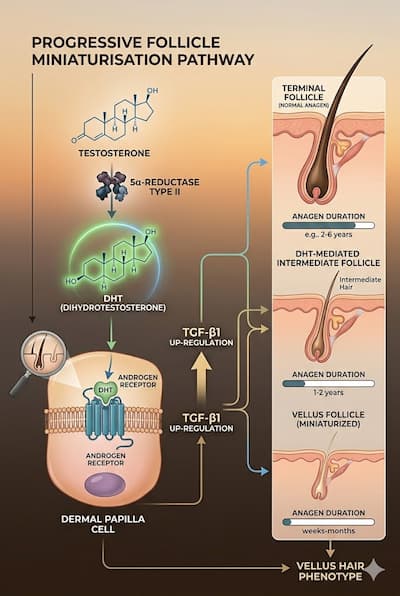
- 5α-Reductase converts testosterone to DHT: In the scalp's dermal papilla cells, the enzyme 5α-reductase type II (5α-R II) converts circulating testosterone into DHT — a more potent androgen with approximately 5x higher androgen receptor (AR) affinity. 5α-R II is expressed at particularly high levels in the scalp's front, top, and crown regions — explaining the topographic pattern of AGA.
- DHT binds the androgen receptor: In genetically susceptible follicles, the androgen receptor has an inherited hypersensitivity — it binds DHT more avidly and produces a more pronounced downstream response. The AR gene is located on the X chromosome, determining baseline AR sensitivity from birth.
- DHT–AR complex upregulates TGF-β1: Inside the dermal papilla nucleus, the DHT–AR complex upregulates transforming growth factor beta-1 (TGF-β1) — a potent inhibitor of follicle growth that suppresses keratinocyte proliferation in the hair matrix and accelerates catagen (regression) entry.
- Progressive shortening of anagen: Each successive hair cycle, TGF-β1 shortens the anagen duration. A follicle that originally had a 4–6 year anagen phase produces progressively shorter cycles — 3 years, then 2, then 1 year — producing shorter, finer hair with each cycle until the anagen phase is too short to produce a visible hair.
- Miniaturisation to vellus: The terminal follicle (producing pigmented, thick hair) gradually converts to an intermediate follicle, then a vellus follicle (producing the colourless, near-invisible 'peach fuzz'), and eventually becomes dormant. This process spans years to decades — which is exactly the window during which treatment can alter the trajectory.
Why the Crown and Temples — but Not the Sides and Back?
The follicles in the occipital region (back and sides of the scalp) express significantly lower levels of 5α-R II and have fewer androgen receptors than crown and temple follicles — meaning they produce less DHT locally and are less responsive to its signal. This is why occipital donor hair from men with even advanced AGA retains its DHT resistance when transplanted to the crown — it is follicle-intrinsic, not location-dependent. The same biology explains why hair transplantation works: transplanted occipital follicles continue to resist DHT in their new location.
The Norwood-Hamilton Scale — Staging Your Hair Loss
Understanding your current Norwood stage is essential for realistic treatment expectations. The scale runs from I (no significant recession) to VII (only a horseshoe of hair remaining at the sides and back):
| Stage | Pattern | Treatment Response | Recommended Approach |
|---|---|---|---|
| I | No significant recession; normal juvenile hairline | Prevention focus — follicles fully intact | DHT-blocking topicals, scalp health maintenance; no urgent medical treatment needed |
| II | Slight temple recession, hairline slightly elevated | Excellent — miniaturisation just beginning | Natural DHT blockers + biotech serum; strong response expected |
| III | Deep temple recession; crown may show earliest thinning | Very Good — significant reversal possible | Biotech serum + natural DHT blockers; consider finasteride/minoxidil discussion with dermatologist |
| IV | Significant crown thinning; temple areas meeting crown loss | Moderate — partial regrowth achievable | Medical treatment (finasteride + minoxidil) most effective; biotech topicals as adjunct |
| V | Crown and temple loss connecting; only a thin band separating | Limited — slowing progression primary goal | Medical treatment + topicals; hair transplant consultation reasonable at this stage |
| VI–VII | Extensive loss; horseshoe pattern remaining | Minimal reversal potential — many follicles permanently dormant | Hair transplant is the primary restorative option; medical/topical treatment preserves remaining hair |
The Honest Treatment Review — What Works, What Doesn't, and the Side Effects
How it works: Finasteride 1 mg/day selectively inhibits 5α-reductase type II — the isoform responsible for the majority of scalp DHT production. This reduces scalp DHT by approximately 60–70%, significantly reducing the miniaturisation signal to androgen-sensitive follicles. In clinical trials (the landmark 2-year PLESS trial and subsequent studies), finasteride produced visible hair count improvement in 65–80% of men, with stabilisation in nearly all others.
The honest side effect picture: The package insert lists sexual side effects (decreased libido, erectile dysfunction, reduced ejaculate volume) occurring in approximately 1.8–3.8% of users during treatment. What the prescribing information underemphasises: a subset of users (estimated at 1–2%) reports persistent sexual dysfunction after stopping finasteride — termed 'post-finasteride syndrome' — including persistent erectile dysfunction, loss of libido, depression, and cognitive symptoms that can last months to years post-cessation. This is the primary reason many men — especially younger men prioritising sexual function — seek non-prescription alternatives.
Practical point: Finasteride requires indefinite use; stopping results in return of DHT levels within 2–4 weeks and subsequent hair loss within 6–12 months. Dutasteride (which blocks both 5α-R I and II, reducing scalp DHT by ~90%) is more potent but has the same side effect profile and is used off-label for hair loss in India.
How it works: Minoxidil (topical 5% solution or foam, or oral 0.25–1.25 mg off-label) was originally an antihypertensive drug — its hair growth effect was discovered as an unexpected side effect. The mechanism: minoxidil sulphate (the active metabolite, requiring conversion by the scalp enzyme SULT1A1) opens potassium channels in dermal papilla cells, increasing scalp microcirculation, extending the anagen phase, and enlarging miniaturised follicles. Critically, minoxidil does not block DHT — it does not address the androgenetic cause, only the follicle's functional response to it.
The initial shedding trap: 40–60% of men experience a significant initial shedding increase in weeks 4–8 after starting minoxidil — because it forces resting telogen follicles into anagen, pushing out existing telogen hairs simultaneously. This causes many men to stop treatment precisely when it is beginning to work. Shedding resolves by months 2–3; the key message is to continue treatment through the shedding phase.
Limitations: Minoxidil requires indefinite use — stopping causes return of hair loss within 6–12 months. Contact dermatitis from propylene glycol in the solution is common (10–15%); the foam formulation reduces this. Oral minoxidil is increasingly used in India at low doses (0.25–0.5 mg/day), producing results comparable to topical but with potential systemic effects including hypertrichosis (body hair growth) and rarely cardiac effects at higher doses — requires medical supervision.
What it is: Redensyl is a patented complex of two molecules: DHQG (dihydroquercetin glucoside — a plant-derived polyphenol) and EGCG (epigallocatechin gallate from green tea), combined with glycine and zinc. It was developed as a direct alternative to minoxidil, with a completely different mechanism.
The mechanism: DHQG specifically activates hair follicle stem cells (ORS stem cells — outer root sheath stem cells, also called hair germ cells) by targeting the DP-1 protein expressed in these cells. Activated stem cells differentiate into new hair matrix cells, directly extending and strengthening the anagen phase. EGCG provides anti-DHT activity by inhibiting 5α-reductase and anti-inflammatory support to the follicle microenvironment. The combination addresses both the growth phase and the androgenetic signal.
Clinical evidence: A 2014 published clinical trial compared Redensyl (3%) applied to the scalp against a 3% minoxidil solution. At 84 days: Redensyl increased the anagen-to-telogen ratio by 214% vs. minoxidil's 214% — essentially equivalent efficacy, but without minoxidil's initial shedding, dependency requirement, or propylene glycol irritation. Redensyl does not require indefinite use to prevent rebound loss; it acts on the follicle's own biology rather than masking androgenetic vulnerability.
What it is: Procapil is a patented combination of three actives: biotinyl-GHK (biotin coupled to a collagen-stimulating tripeptide), apigenin (a flavonoid from chamomile), and oleanolic acid (from olive leaf). Each targets a different aspect of androgenetic follicle deterioration.
Three-way mechanism:
- Biotinyl-GHK: Stimulates the anchoring proteins in the dermal sheath that attach the follicle to the scalp matrix. In AGA, the follicle-scalp anchoring weakens progressively — contributing to the ease with which miniaturised hairs shed. Biotinyl-GHK counters this loss of anchoring.
- Apigenin: Improves scalp microcirculation by activating local nitric oxide synthase — increasing blood flow and nutrient delivery to the dermal papilla. Also documented as a mild 5α-reductase inhibitor through flavonoid-mediated enzyme binding.
- Oleanolic acid: Direct 5α-reductase inhibitor — reduces local DHT production at the follicle level without systemic hormone disruption, avoiding finasteride's systemic side effects.
Clinical evidence: Procapil clinical studies show a 121% increase in anagen hairs and a 46% reduction in hair loss at 4 months. The combination of local DHT inhibition (oleanolic acid + apigenin), improved scalp microcirculation (apigenin), and follicle anchoring (biotinyl-GHK) addresses three of the four key mechanisms of androgenetic alopecia simultaneously.
What it is: Anagain is a standardised extract of organic pea sprout (Pisum sativum var. Bikini) that acts through the IGF-1 (insulin-like growth factor 1) signalling pathway — one of the key anagen-promotion pathways in the dermal papilla that is suppressed by DHT in AGA. Anagain upregulates the expression of genes encoding IGF-1, FGF7 (fibroblast growth factor 7), and the hair keratin associated proteins (KAPs) that strengthen the hair shaft. Clinical data: a 2-month study showed a 78% improvement in the anagen-to-telogen ratio in men using Anagain-containing products. As a standalone active, Anagain is less potent than Redensyl or Procapil — but as a third active in combination, it adds the IGF-1 pathway that the other two do not specifically target, creating a synergistic multi-pathway approach.
Ayurvedic 5α-Reductase Inhibitors — The Natural DHT Blockers
Several Ayurvedic herbs contain compounds with documented 5α-reductase inhibitory activity — providing a natural DHT-blocking mechanism that complements the biotech actives' anagen-stimulation approach.
Saw Palmetto (Serenoa repens) — The Best-Evidenced Natural 5α-R Inhibitor
The fatty acid and phytosterol content of saw palmetto (principally β-sitosterol and lauric acid) inhibits both 5α-reductase type I and type II through non-competitive binding — a different binding mechanism from finasteride, making it complementary rather than redundant. A 2012 randomised trial in International Journal of Immunopathology and Pharmacology compared saw palmetto extract to finasteride in men with AGA: at 24 months, finasteride showed 68% improvement vs. saw palmetto's 38% — but saw palmetto produced no sexual side effects vs. finasteride's 1.8% rate. For men who cannot or will not take finasteride, saw palmetto is the strongest natural alternative and is available in oral supplemental form (320 mg/day standardised extract) or in topical formulations.
Bhringraj (Eclipta prostrata) — The Ayurvedic Standard
Bhringraj contains wedelolactone, ecliptasaponins, and polyacetylenes — compounds that demonstrate 5α-reductase inhibitory activity in in vitro studies. A 2009 study in Journal of Ethnopharmacology found Bhringraj extract promoted hair follicle growth in animal models comparable to 2% minoxidil. The proposed mechanism combines 5α-R inhibition with prostaglandin D2 suppression (PGD2 is the principal androgen-independent hair loss mediator discovered in 2012) and direct dermal papilla cell proliferation stimulation. Bhringraj oil applied 2–3x weekly provides both DHT reduction and follicle stimulation — making it the most appropriate Ayurvedic oil for AGA specifically.
Green Tea EGCG — The Dual-Action Active
EGCG (epigallocatechin gallate) inhibits 5α-reductase type I (the isoform that produces DHT in the sebaceous gland and skin) and independently promotes dermal papilla cell proliferation through the IGF-1 pathway. A 2007 study in Phytomedicine confirmed EGCG's 5α-R inhibitory activity at physiologically relevant concentrations. Because it targets the type I isoform rather than type II (finasteride's target), EGCG is a complementary DHT blocker — reducing scalp sebum DHT production that finasteride and saw palmetto do not optimally address. EGCG is present in both topical formulations and oral green tea supplementation (400–800 mg EGCG/day from green tea extract).
Methi / Fenugreek (Trigonella foenum-graecum) — Androgen Modulation
Methi seeds contain diosgenin — a steroidal saponin that modulates androgen receptor sensitivity through a mechanism independent of 5α-reductase inhibition. By competitively interacting with the androgen receptor, diosgenin reduces the downstream transcriptional response to DHT without reducing DHT levels. A 2016 randomised clinical study (International Journal of Medical Sciences) found fenugreek seed extract supplementation significantly reduced hair fall and increased hair growth in men over 6 months, compared to placebo. The additional benefit: fenugreek improves scalp microcirculation through its niacin content and has direct anti-inflammatory properties that reduce the scalp inflammatory infiltrate around miniaturising follicles.
The Ayurvedic + Biotech Combination — The Complete Protocol
The most effective non-prescription approach to androgenetic alopecia addresses all four key mechanisms simultaneously: DHT production reduction, androgen receptor modulation, follicle stem cell activation, and scalp microcirculation improvement. No single ingredient covers all four; the combination approach does.
| Mechanism | Target | Ingredient(s) | Application |
|---|---|---|---|
| 5α-Reductase inhibition | Reduce local DHT production in scalp follicles | Saw palmetto, Bhringraj, EGCG (green tea), oleanolic acid (Procapil), pumpkin seed oil | Oral + topical combined is more effective than either alone |
| Androgen receptor modulation | Reduce follicle sensitivity to DHT signal | Methi (diosgenin), zinc (5α-R co-inhibitor), nettle root extract | Primarily oral supplementation |
| Follicle stem cell activation | Re-enter miniaturised follicles into anagen from bulge ORS stem cells | Redensyl (DHQG + EGCG), Anagain (pea sprout IGF-1) | Daily scalp serum |
| Follicle anchoring + microcirculation | Prevent premature shedding of miniaturised hairs; improve nutrient delivery | Procapil (biotinyl-GHK + apigenin), Bhringraj oil, scalp massage | Daily serum + 2–3x weekly oil massage |
| Anti-inflammatory scalp environment | Reduce perifollicular inflammation that accelerates miniaturisation | EGCG, Bhringraj, neem, salicylic acid (in shampoo), jatamansi | Shampoo + oil |
💡 Not sure what stage your hair loss is at, or which approach is right for your pattern? Our dermatologist assesses your specific situation and recommends the most appropriate protocol.
Book Free Hair Consultation →The Botani Bestie Approach to Men's Hair Loss
Our hair loss products are formulated around the multi-mechanism combination approach — delivering Ayurvedic DHT-blocking actives alongside biotech follicle-stimulating compounds in formats appropriate for daily and weekly use.
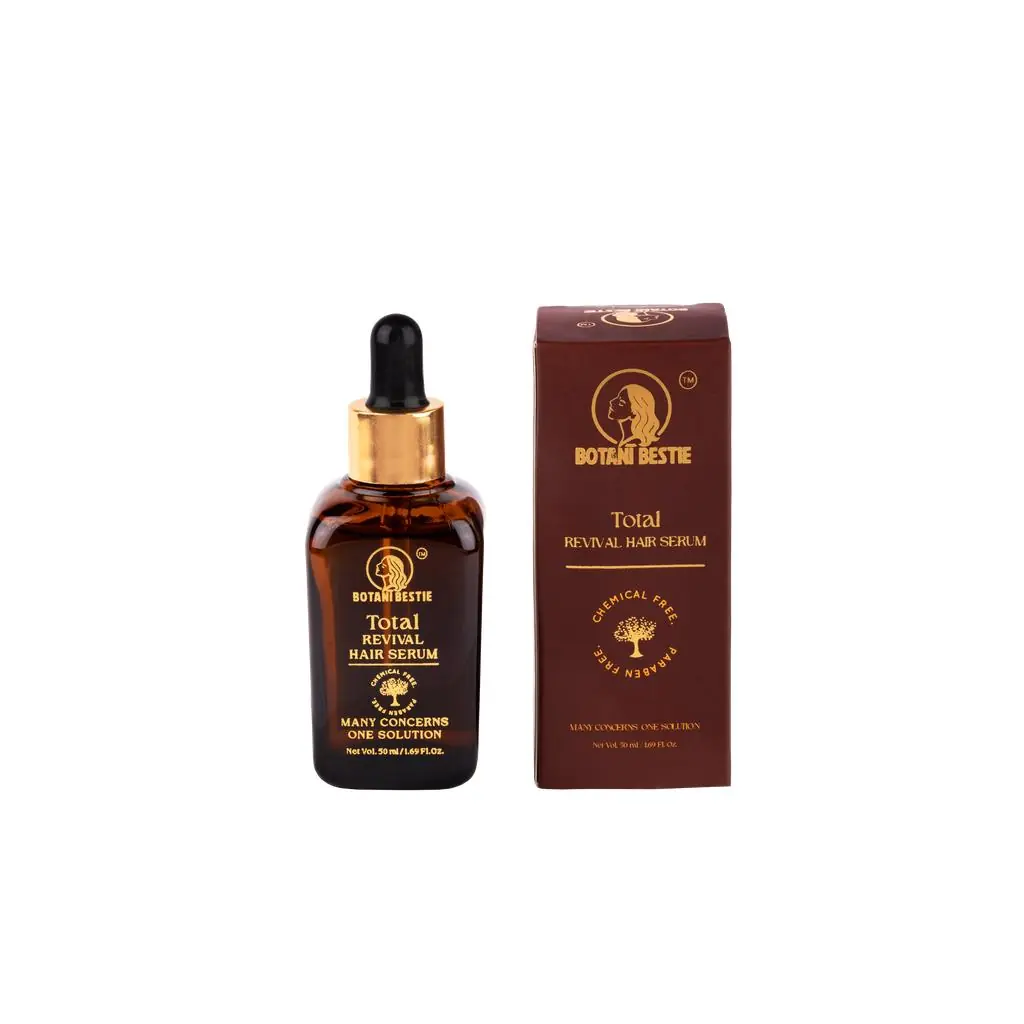
Total Revival Hair Serum
Daily Scalp Serum — AM or PM
The cornerstone of the biotech approach: Redensyl (DHQG + EGCG — follicle stem cell activation, documented clinical equivalence to minoxidil at 3% with no rebound dependency), Procapil (local DHT inhibition via oleanolic acid + scalp microcirculation via apigenin + follicle anchoring via biotinyl-GHK), and Anagain (IGF-1 pathway activation in dermal papilla). Apply daily to dry scalp using the dropper; focus on the crown and temples. The combination targets three mechanisms simultaneously — making it the most complete topical approach to AGA without requiring a prescription.
Shop Total Revival Hair Serum →
Total Restore Hair Oil
Scalp Oil — 2–3x weekly
Bhringraj oil (wedelolactone and ecliptasaponins — 5α-reductase inhibition + direct follicle growth stimulation), Amla (EGCG and emblicanins — additional 5α-R inhibition + the highest natural Vitamin C for antioxidant scalp protection), Brahmi, Jatamansi, and Green Tea in a base of Redensyl and Anagain. The Ayurvedic-biotech oil for AGA: the herb-rich base reduces DHT at the scalp level while biotech actives in the carrier provide complementary anagen stimulation. Massage into the scalp 2–3x per week and leave for minimum 30 minutes before washing. Scalp massage alone has documented DHT-reduction potential (increased scalp blood flow → reduced local androgen concentration).
Shop Total Restore Hair Oil →Hair Loss Progressing Despite Treatment? Get a Targeted Assessment
Our in-house dermatologist assesses your Norwood stage, family history, lifestyle factors, and any co-existing conditions (thyroid, nutritional deficiency) that may be accelerating your AGA. The prescription approach, the natural approach, or the combination — a personalised protocol is the most effective way forward. No purchase required.
Book Free Consultation → WhatsApp UsFrequently Asked Questions
The Bottom Line: Act Early, Target DHT, and Use the Right Combination
Androgenetic alopecia is the most common hair condition in the world — but it is also one of the most treatable when approached at the right stage with the right tools. The DHT mechanism is well understood; the treatments that interrupt it are well evidenced; and the window for meaningful reversal is wider than most men realise — if they act before significant miniaturisation has occurred.
The choice between the prescription approach (finasteride + minoxidil — most potent, requires indefinite use, carries side effect risk) and the Ayurvedic + biotech approach (saw palmetto + Bhringraj + Redensyl + Procapil — less potent but no systemic side effects, no dependency) is a personal decision that should be made with complete information. Both are legitimate; neither is without trade-offs.
What is not a legitimate choice: doing nothing while the follicles miniaturise past the point of return. The biology is clear — the follicle can recover from miniaturisation; it cannot recover from complete dormancy.
Shop Total Revival Hair Serum → Free Hair Consultation"DHT writes the story of hair loss. But you get to decide how early you change the chapter."
Ready to make the honest switch?
Our products are built on the same principles as every article we write — pure ingredients, real results, nothing to hide.
Explore Our Products