PCOS & Hair Fall — Why It Happens and How to Actually Stop It
PCOS affects 1 in 10 women of reproductive age in India — and for many, hair fall is the most visible and distressing symptom. The reason most treatments fail is that they treat the symptom while ignoring the hormonal mechanism driving it. This is the complete, honest guide to what is actually happening and what to do about it.
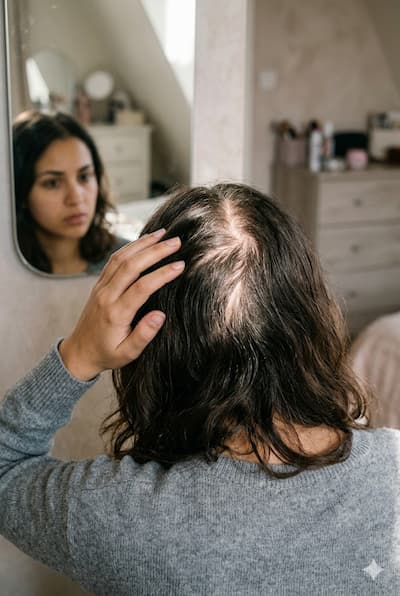
If you have PCOS and are experiencing hair fall, you have almost certainly been told to "manage your hormones" — a phrase that is simultaneously correct and almost entirely useless without specifics. What does managing hormones mean for your hair? Which hormones? Through what mechanism? And what actually helps at the follicle level?
PCOS-related hair fall is not the same as stress-related shedding, nutritional deficiency hair fall, or postpartum hair loss. It is androgenic alopecia — the same type of hair loss that causes male pattern baldness — occurring in women because of the androgen excess that PCOS produces. This distinction matters enormously, because the treatment approach is different from almost every other type of hair fall.
This guide explains the mechanism precisely, reviews the evidence for interventions — both pharmaceutical and Ayurvedic — and gives you a practical, realistic protocol based on what the science actually supports.
Is Your Hair Fall PCOS-Related? A Quick Pattern Check
PCOS hair fall has a specific presentation that distinguishes it from other types. Check how many of these apply to you:
If 3 or more of these apply and you have a PCOS diagnosis, the mechanism driving your hair fall is almost certainly androgenic. The sections below explain exactly how to address it.
The Mechanism: Why PCOS Causes Hair Fall (Explained Without Jargon)
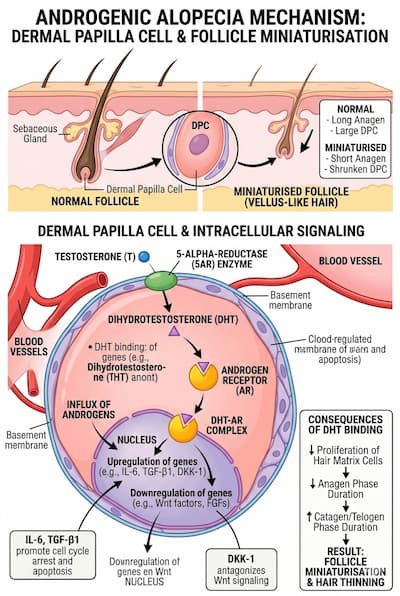
To understand PCOS hair fall, you need to understand three things working together: insulin resistance, androgen production, and DHT at the follicle.
Step 1 — Insulin resistance drives androgen excess. In women with PCOS, the ovaries and adrenal glands are hypersensitive to insulin. When insulin levels are high (which they are when insulin resistance is present), the ovaries produce excessive amounts of androgens — primarily testosterone. This is the upstream driver of nearly all downstream PCOS symptoms, including hair fall.
Step 2 — Testosterone converts to DHT. Testosterone is converted to dihydrotestosterone (DHT) by the enzyme 5-alpha-reductase (5-AR), which is present in skin and scalp tissue. DHT is approximately 3–5 times more potent than testosterone at the androgen receptor. Women with PCOS tend to have both elevated testosterone levels and, in many cases, higher 5-AR activity — meaning more DHT is produced at the scalp.
Step 3 — DHT miniaturises hair follicles. DHT binds to androgen receptors in the hair follicle's dermal papilla cells. This binding shortens the anagen (growth) phase and causes a process called miniaturisation: over successive growth cycles, the follicle shrinks, producing progressively thinner and shorter hair — until the follicle eventually becomes dormant and invisible.
This is identical to the mechanism of male pattern baldness — which is why women with PCOS lose hair in the same areas men do (crown, parting), but typically retain their frontal hairline (because the frontal hairline follicles have different androgen receptor sensitivity).
| PCOS prevalence | Affects approximately 1 in 10 women of reproductive age; one of the most common endocrine disorders globally |
| Hair fall prevalence in PCOS | Studies report 40–70% of women with PCOS experience some degree of androgenic alopecia |
| Hair fall type | Female androgenic alopecia (FPHL) — Ludwig pattern: diffuse thinning at crown, widening parting, retained frontal hairline |
| Primary hormonal driver | Elevated DHT (from 5-AR conversion of excess testosterone); sometimes elevated DHEAS from adrenal androgen excess |
| Compounding factors | Iron deficiency anaemia (very common in PCOS); Vitamin D deficiency; chronic stress (elevates cortisol → androgens); inflammation |
| Is it reversible? | Yes, if addressed before follicles become permanently dormant — typically within 2–5 years of onset. Early treatment produces the best results. |
Why Most Hair Fall Treatments Don't Work for PCOS
Most hair fall products — including many marketed to women specifically — are designed for diffuse telogen effluvium (stress-related or nutritional shedding). They work by nourishing the scalp, strengthening existing hair, and reducing breakage. For PCOS androgenic alopecia, these products address the wrong problem entirely.
❌ What Doesn't Address the Root Cause
- Biotin supplements — help with brittle nails and breakage, but have no documented effect on androgenic miniaturisation. If you are not biotin deficient, additional biotin does nothing for hair fall.
- Protein-boosting shampoos — strengthen the hair shaft, not the follicle. Useful for breakage, irrelevant for hormonal thinning.
- Generic anti-hair fall oils without DHT-blocking activity — provide scalp nourishment without addressing the androgen excess causing follicle miniaturisation.
- Treating only the scalp without addressing insulin resistance and systemic androgen levels — the hormonal driver continues, overriding any topical intervention.
✅ What Actually Works for PCOS Hair Fall
- Reducing insulin resistance — dietary changes (low-GI), exercise, inositol supplementation, and where prescribed, metformin. This reduces the upstream androgen production.
- 5-Alpha-reductase inhibition at the scalp — blocking the conversion of testosterone to DHT at the follicle level. This is where Ayurvedic herbs like Bhringraj and Amla are particularly powerful.
- Follicle growth stimulation — activating the Wnt/β-catenin and VEGF pathways to push miniaturised follicles back into the growth phase.
- Anti-inflammatory scalp care — inflammation accelerates follicle miniaturisation and must be actively suppressed.
- Correcting nutritional deficiencies — particularly iron (ferritin < 40 ng/mL worsens hair fall), Vitamin D, and zinc.
The Ayurvedic Approach to PCOS Hair Fall — 5 Herbs with Evidence
Ayurveda understood hormonal hair loss in women as a Pitta-dominant condition with aggravated Rakta (blood tissue) and elevated androgenic markers — centuries before the biochemistry of DHT was described. The herbs traditionally prescribed for this pattern happen to contain phytochemicals with documented 5-AR inhibiting, phytoestrogenic, and anti-androgenic activity.
Bhringraj is the most directly relevant Ayurvedic herb for PCOS hair fall because it works on both the hormonal and the follicle level simultaneously.
At the hormonal level: wedelolactone, Bhringraj's primary bioactive compound, has demonstrated 5-alpha-reductase inhibiting activity — reducing the conversion of testosterone to DHT at the scalp. A 2023 study found Eclipta alba extract to have comparable 5-AR inhibiting activity to finasteride in vitro. For PCOS patients who are already producing excess testosterone, blocking 5-AR at the scalp is one of the most targeted topical interventions available.
At the follicle level: wedelolactone activates the Wnt/β-catenin signalling pathway, increasing human dermal papilla cell proliferation by 45% in a 2025 molecular docking study. This directly counters the miniaturisation that DHT has caused — pushing follicles back toward active growth.
The combination — reducing DHT at the follicle while simultaneously stimulating growth signalling — is unique among single-herb interventions and directly addresses the two-pronged mechanism of PCOS hair fall.
Amla (Indian Gooseberry) is the richest known natural source of Vitamin C — approximately 20 times more Vitamin C per gram than oranges — but its hair benefits go far beyond a single nutrient.
Amla contains gallic acid, ellagic acid, and tannins that have demonstrated documented 5-alpha-reductase inhibiting activity in multiple studies. A 2012 study published in the Journal of Ethnopharmacology found that Phyllanthus emblica extract inhibited 5-AR with an IC50 value in the same range as established pharmaceutical 5-AR inhibitors. This makes Amla a second line of DHT-blocking defence alongside Bhringraj — particularly valuable when combined in a single product.
Additionally, Amla's powerful antioxidant profile protects follicle cells from the oxidative damage that PCOS-associated inflammation generates — slowing the pace of miniaturisation and supporting the follicle microenvironment.
Methi is one of the most underrated herbs for PCOS hair fall specifically. Its mechanism is distinct from and complementary to Bhringraj and Amla.
Fenugreek seeds contain diosgenin — a phytosterol and phytoestrogen precursor. Diosgenin and other steroidal saponins in Methi competitively bind to androgen receptors, reducing the amount of DHT that can attach to and damage follicle cells. This receptor-level competition is the same mechanism exploited by pharmaceutical anti-androgens like spironolactone — but with a dramatically safer side-effect profile.
Methi is also rich in folic acid, iron, Vitamins A, K, and C — nutrients that are frequently deficient in PCOS patients (particularly iron and folic acid) and that directly support hair follicle health and red blood cell production for follicle oxygenation.
Cortisol — the primary stress hormone — directly worsens PCOS by increasing adrenal androgen production (DHEAS) and worsening insulin resistance. For many women with PCOS, chronic stress is a significant amplifier of hair fall beyond what the ovarian androgen excess alone would produce.
Brahmi is a documented adaptogen — it reduces cortisol levels and modulates the HPA (hypothalamic-pituitary-adrenal) axis response to stress. Multiple clinical studies, including a 2012 double-blind RCT in the Journal of Ethnopharmacology, confirmed significant cortisol reduction in human subjects taking standardised Brahmi extract. For PCOS patients, this systemic adaptogenic effect reduces one of the key amplifiers of androgen excess.
Topically, Brahmi has anti-inflammatory properties that soothe scalp inflammation — the local follicular environment that DHT-mediated miniaturisation worsens and that anti-inflammatory herbs can partially counteract.
Neem is one of the most comprehensively studied Ayurvedic herbs. For PCOS hair fall, its relevance comes from two angles.
First, neem contains nimbolide and azadirachtin — compounds with documented anti-androgenic activity. Research published in the Journal of Medicinal Food found neem leaf extract to reduce testosterone levels in animal models, suggesting a systemic androgen-modulating effect. While human data is more limited, neem's anti-androgenic bioactive profile is scientifically recognised.
Second, PCOS patients frequently experience scalp sebum excess (driven by androgen-stimulated sebaceous glands) — which creates a hospitable environment for Malassezia fungus and seborrheic dermatitis. Neem's potent antifungal and antibacterial activity directly addresses this secondary complication, preventing the additional dandruff-driven follicular inflammation that PCOS patients are particularly prone to.
💡 All five of these herbs — Bhringraj, Amla, Methi, Brahmi, and Neem — are in the Botani Bestie Hair Routine.
See Total Rebalance Shampoo →The Diet-Hair Fall Connection in PCOS — What Actually Matters
Topical treatments address the follicle level. But if the hormonal upstream driver — insulin resistance and androgen excess — is not addressed systemically, topical interventions will slow but not stop PCOS hair fall. Diet is the most powerful lever for reducing insulin resistance, and therefore androgen levels, without pharmaceutical intervention.
| Dietary change | Mechanism for PCOS hair fall | Evidence |
|---|---|---|
| Low-GI diet (whole grains, legumes, non-starchy vegetables) | Reduces postprandial insulin spikes → reduces ovarian androgen stimulation → lowers testosterone and DHT | Strong — multiple RCTs in PCOS populations |
| Inositol (particularly myo-inositol + D-chiro-inositol, 40:1 ratio) | Insulin sensitiser — reduces insulin resistance and directly lowers LH-driven androgen production in the ovaries | Strong — multiple RCTs; endorsed by PCOS consensus guidelines |
| Iron repletion (if ferritin < 40 ng/mL) | Iron deficiency independently worsens telogen effluvium even when androgenic alopecia is the primary driver; correction improves regrowth speed | Moderate — well-established correlation, RCT data mixed |
| Vitamin D supplementation (if deficient) | Vitamin D receptors are present in hair follicles; deficiency is associated with both PCOS severity and alopecia areata and FPHL rates | Moderate — association strong; causality studies underway |
| Omega-3 fatty acids (flaxseed, walnuts, fatty fish) | Reduces systemic inflammation — which worsens both insulin resistance and follicular miniaturisation in PCOS; also mildly lowers androgen levels | Moderate — consistent across observational and small intervention studies |
| Reducing refined sugar and ultra-processed foods | Primary driver of insulin spikes; eliminating it is the single most impactful dietary change for PCOS androgen levels | Strong — foundational dietary principle in PCOS management |
Pharmaceutical Options — The Honest Picture
For completeness, here is an honest assessment of the pharmaceutical options commonly prescribed for PCOS-related hair fall. We are not advocating for or against these — but you deserve accurate information about what they do, how well they work, and what the trade-offs are.
| Treatment | Mechanism | Evidence for PCOS Hair Fall | Key Trade-offs |
|---|---|---|---|
| Spironolactone Anti-androgen |
Blocks androgen receptors systemically; reduces DHT binding at the follicle | Strong — multiple RCTs confirm hair density improvement in FPHL | Menstrual irregularity, potassium elevation, hypotension, teratogenic (must not be taken in pregnancy) — requires long-term use; hair fall returns on stopping |
| Minoxidil (topical) Vasodilator |
Increases blood flow to follicles; extends anagen phase; does NOT block DHT | Strong for FPHL generally; works alongside anti-androgen treatment | Facial hypertrichosis (unwanted facial hair), scalp dryness, rebound shedding on stopping — requires indefinite use |
| OCP (oral contraceptive pill) Hormonal |
Reduces LH → lowers ovarian androgen production; some pills contain anti-androgenic progestins | Moderate — regulates androgen levels but hair benefit is indirect and variable | Mood changes, libido effects, thrombosis risk, not suitable if pregnancy is planned; hair fall may return or worsen after stopping |
| Metformin Insulin sensitiser |
Reduces insulin resistance → lowers androgen production upstream; does not directly act on follicles | Moderate — reduces androgen levels; indirect hair fall benefit | GI side effects (nausea, diarrhoea); requires prescription; primarily a metabolic intervention |
The PCOS-Specific Hair Routine — What to Use and Why
Because PCOS hair fall is androgenic rather than diffuse, the routine needs to specifically address DHT at the scalp, stimulate miniaturised follicles back into growth, and manage scalp inflammation — all consistently, with every use. Here is what that looks like in practice:
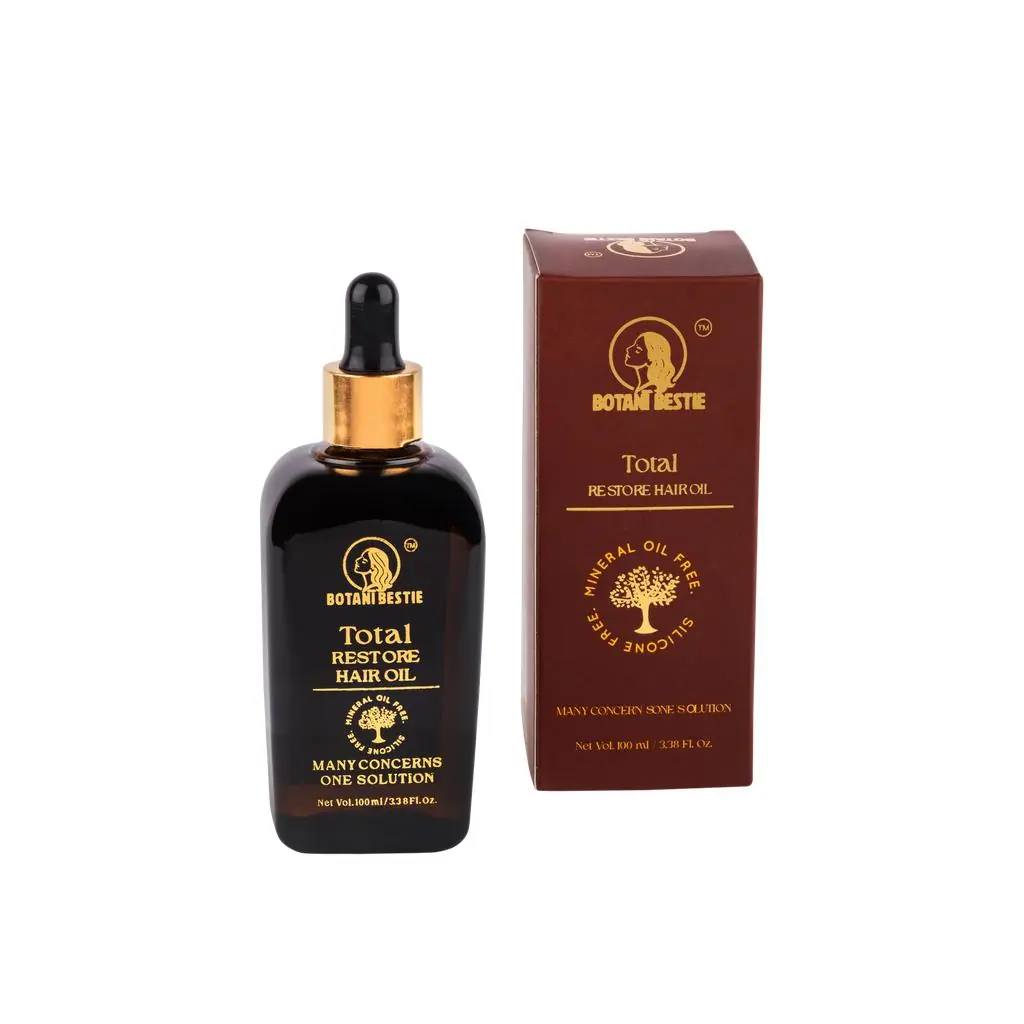
Step 1: Total Restore Hair Oil (Pre-Wash, 2–3× per Week)
DHT-blocking herbs at the follicle level — sustained contact treatment
The oil is applied directly to the scalp in sections, massaged for 5–10 minutes to stimulate microcirculation, and left for 30–60 minutes before washing out. This allows the active compounds in Bhringraj, Amla, Methi, and Brahmi maximum contact time with the scalp — the format where 5-AR inhibiting and Wnt/β-catenin activating compounds can penetrate to the follicle level most effectively.
- ✔ Bhringraj — 5-AR inhibition + Wnt/β-catenin follicle activation
- ✔ Amla — Second-pathway DHT blocking; antioxidant follicle protection
- ✔ Methi — Androgen receptor competition; iron and folic acid support
- ✔ Brahmi — Cortisol reduction (systemic); scalp anti-inflammation (local)
- ✔ Neem — Anti-androgenic + antifungal scalp environment control
- ✔ Coenzyme Q10 + Vitamin E — Antioxidant protection for follicle microenvironment
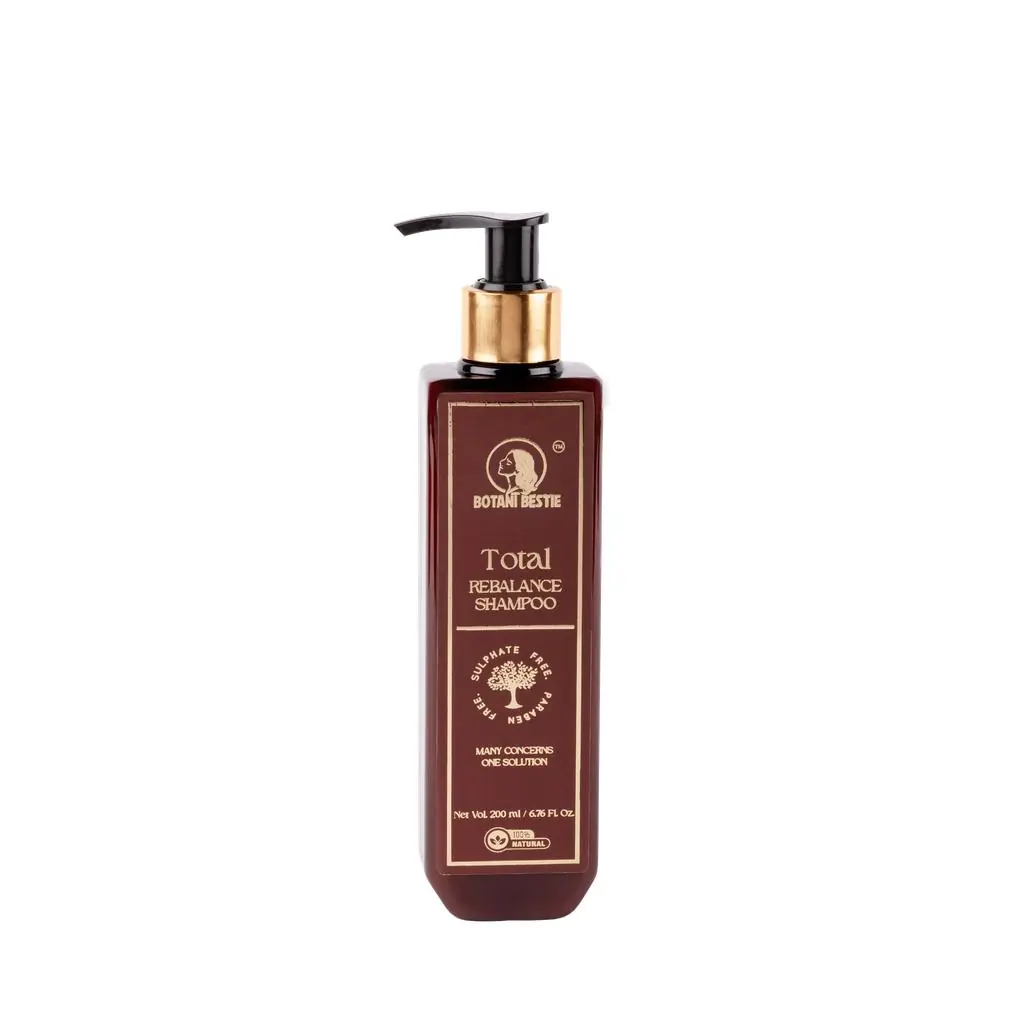
Step 2: Total Rebalance Shampoo (Every Wash)
Consistent every-wash DHT inhibition and follicle support
Consistency is the deciding factor in PCOS hair fall treatment — because the hormonal driver is chronic, topical treatment must be uninterrupted. The shampoo delivers Bhringraj, Amla, Methi, Brahmi, Neem, and 8+ more herbs with every single wash, without preparation time, ensuring the DHT-blocking and growth-stimulating regimen is never missed.
- ✔ Bhringraj, Amla, Methi, Brahmi, Neem + 8 more herbs — the full PCOS-relevant herb combination, standardised per wash
- ✔ Apple Cider Vinegar — restores scalp pH to 4.5–5.5; the acidic environment inhibits 5-AR activity and reduces Malassezia overgrowth (worsened by PCOS sebum excess)
- ✔ Fermented Rice Water — inositol delivery at the scalp level (inositol is the same compound proven in RCTs to reduce PCOS androgen levels systemically)
- ✔ Sulfate-free — prevents stripping the scalp barrier; PCOS patients are prone to a compromised scalp microbiome from sebum excess
- ✔ Plant-Based Keratin + Silk Proteins — strengthen miniaturised fine hairs, reducing breakage that mimics additional hair fall
📅 Realistic Timeline for PCOS Hair Fall Treatment
PCOS hair fall is slower to reverse than temporary shedding conditions — because it requires reversing follicle miniaturisation, not just stopping a shed. Set realistic expectations:
| Timeframe | What You May Notice | What's Happening |
|---|---|---|
| Weeks 1–4 | Scalp feels less oily between washes. Scalp inflammation and any associated dandruff begins to reduce. | Antifungal and anti-inflammatory herbs control the scalp sebum environment. 5-AR inhibition begins — but the DHT already bound to receptors takes time to clear. |
| Weeks 4–12 | Daily shedding count begins to reduce. Hair feels slightly stronger at the root. Parting may look marginally less wide. | 5-AR inhibition is reducing new DHT production at the follicle. Wnt/β-catenin signalling is pushing more follicles into anagen. Miniaturised follicles begin to recover slightly. |
| Months 3–6 | Noticeably less hair on the pillow, in the shower, and on the brush. Finer hairs begin to appear slightly thicker at the roots. | Multiple complete hair growth cycles have occurred under reduced-DHT conditions. Follicles that were in miniaturised catagen/telogen begin completing anagen phases at slightly longer lengths. |
| Months 6–12 | Visible improvement in hair density, especially at the crown and parting. Regrowth visible in previously thinning areas. | Sustained DHT reduction over multiple growth cycles allows follicles to gradually increase in size. Improvement is progressive — continued treatment maintains and deepens results. |
| Beyond 12 months | Stable, maintained improvement. Ongoing treatment required to prevent regression, since PCOS is a chronic condition. | PCOS does not resolve without systemic management (diet, exercise, medication if needed). Topical Ayurvedic maintenance is a long-term, sustainable approach to managing the scalp-level consequences of chronic androgen excess. |
Not Sure If Your Hair Fall Is PCOS-Related?
Get a free hair consultation with our in-house dermatologist. Tell us your hair fall pattern, PCOS status, blood test results if you have them, and how long you have been experiencing thinning — and receive a targeted routine recommendation built specifically for your hormonal profile.
Book Free Hair Consultation → WhatsApp UsFrequently Asked Questions
The Honest Bottom Line on PCOS Hair Fall
PCOS hair fall is not random, not your fault, and — crucially — not inevitable. It is the predictable scalp-level consequence of a specific hormonal mechanism: insulin resistance → androgen excess → DHT miniaturisation. When you address that mechanism directly — with a low-GI diet, targeted DHT-blocking herbs, and consistent follicle stimulation — the process can be slowed, stabilised, and in many cases reversed.
The mistake most women make is treating PCOS hair fall with generic hair fall products designed for a different mechanism. Bhringraj, Amla, Methi, Brahmi, and Neem — combined in a standardised, consistent format — address the actual mechanism at the scalp level. The science supports it. The clinical observations across thousands of years of Ayurvedic use confirm it.
Start early. Stay consistent. And address the root — both at the follicle and in the hormonal system driving it.
Shop Total Restore Hair Oil → Shop Total Rebalance Shampoo →"The right treatment for hormonal hair fall is not the one that addresses the hair — it is the one that addresses the hormone."
Ready to make the honest switch?
Our products are built on the same principles as every article we write — pure ingredients, real results, nothing to hide.
Explore Our Products