Scalp Massage for Hair Growth — The Published Research, Correct Technique, Best Oils, and How to Actually Do It (2025 India)
Scalp massage is not folk tradition — it has published clinical evidence for increasing hair strand thickness by 15% over 24 weeks through a specific mechanism: mechanical stretching of dermal papilla cells that activates hair growth genes and suppresses DHT-driven miniaturisation. This guide gives you the exact technique, frequency protocol, best oils for Indian scalp types, and the mistakes that cancel the benefit.
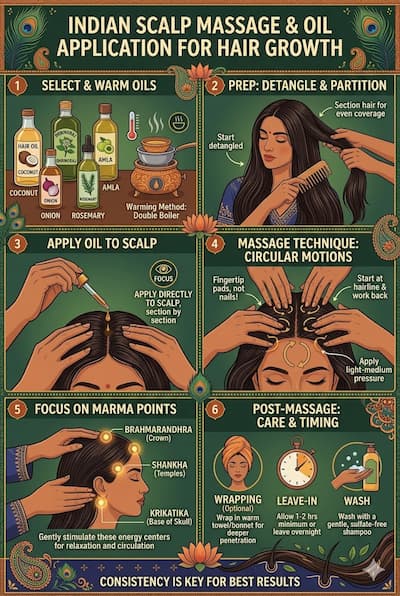
The Indian tradition of "champi" (head massage) has existed for at least 3,000 years. The Ayurvedic system prescribed scalp massage with herbed oils as a primary hair care intervention long before the mechanism was understood. What 21st-century hair research has added is a precise biological explanation for why it works — and therefore how to do it better.
The landmark study is a 2016 paper in Eplasty by Koyama et al. Nine male participants with thinning hair performed 4-minute standardised scalp massages daily using a custom silicone scalp massager for 24 weeks. Hair strand thickness measurement (using a phototrichogram) increased from an average of 65 microns to 75 microns — a 15% improvement — compared to no change in the control period. Gene expression analysis in scalp biopsies confirmed upregulation of genes associated with dermal papilla cell proliferation.
A follow-up self-report study (Koyama et al., 2019) surveyed 327 participants with alopecia who performed daily scalp massage. 68.9% reported stabilisation or improvement in hair loss, with a positive correlation between daily massage duration and outcome. Longer massage sessions (above 11 minutes) showed higher improvement rates than shorter sessions.
This is a real, free, evidence-based intervention. The question is not whether scalp massage works — it is whether you are doing it correctly, consistently, and combining it with the right oil to amplify the result.
Why Scalp Massage Grows Hair: The Biology
Mechanical Stretching of Dermal Papilla
Dermal papilla cells sit at the base of each follicle and are the master controllers of hair growth — they signal whether the follicle stays in anagen (growth) or shifts to telogen (rest). These cells have mechanosensitive ion channels (specifically Piezo1 channels) that respond to physical tension. When the scalp is physically stretched during massage, the dermis transmits this tension to the dermal papilla, activating the Piezo1 channels. The result: upregulation of genes associated with anagen maintenance (including IL-6, HGF, and VEGF), improved dermal papilla cell proliferation, and suppression of the miniaturisation process. This mechanical stimulus is distinct from chemical or hormonal signals — it is a direct physical activation of the cell's growth programme.
Blood Flow and Nutrient Delivery
Hair follicles are among the most metabolically active tissue units in the body during anagen — the dermal papilla has dense capillary networks that supply the oxygen, glucose, and amino acids for rapid cell division. Restricted scalp blood flow (from tension, stress, or chronic poor circulation) limits nutrient delivery to the follicle matrix and shortens anagen. Scalp massage directly increases local blood perfusion — measured using laser Doppler flowmetry in studies — improving the nutrient supply environment for follicle cells. In Indian urban adults with chronically elevated cortisol (stress-driven scalp tension), massage-induced blood flow improvement is particularly meaningful.
DHT and Sebum Management
The sebaceous glands that sit alongside each follicle produce DHT (from testosterone via 5-alpha reductase) and sebum locally. In people with androgenetic predisposition, excess DHT accumulation around the follicle accelerates miniaturisation. Scalp massage improves lymphatic drainage from the follicular microenvironment — helping to clear DHT and inflammatory byproducts from around the follicle. Massage also redistributes sebum across the scalp, preventing the buildup pattern where oil and DHT accumulate at the crown while the scalp periphery becomes dry — a common pattern in Indian adults with mixed oily-dry scalp.
Cortisol Reduction and Stress Relief
Massage therapy research confirms that scalp massage (and head massage generally) reduces cortisol levels and increases serotonin and dopamine — the neurochemical shift that reverses the HPA axis activation that drives stress-induced hair fall. For the large proportion of Indian hair fall cases driven by chronic stress and elevated cortisol, daily scalp massage addresses both the mechanical follicle stimulus and the hormonal suppressor of hair growth simultaneously. Ten to fifteen minutes of evening scalp massage before bed has a dual function: follicle stimulation and cortisol reduction that improves sleep quality — itself a key hair growth factor. Sleep and hair loss guide →
The Correct Scalp Massage Technique (Step by Step)
Standard 4-Minute Daily Scalp Massage (Dry or with Oil)
Hand Position
Place all ten fingertips on the scalp — not fingernails, not the pads. Fingers should be spread to cover as much scalp area as possible. Both hands on the scalp simultaneously, symmetrically positioned. For the "front quadrant," position fingers just behind the hairline. For "crown," fingers meet at the top centre. For "back/nape," fingertips curve to the occipital area.
The Motion
Small circular movements — the fingertips should move the scalp skin itself, not slide over the scalp. The skin should move with the fingers, creating the stretching and compression of the subcutaneous tissue where the follicles sit. This is the key distinction from incorrect technique: you want to move the scalp, not rub the surface. Pressure: medium-firm. Pain means too much pressure; the sensation should be firm and comfortable.
Coverage Pattern (4 Sections)
1. Front hairline to mid-crown (60 seconds). 2. Left and right temporal areas (30 seconds each side). 3. Crown to vertex (60 seconds). 4. Occipital (nape) area (60 seconds). Total: 4 minutes. For longer sessions, cycle through again. Do not focus only on areas of thinning — full scalp coverage ensures even vascular stimulation and prevents creating regions of comparative neglect.
Frequency
Daily is ideal — the Koyama 2016 study used daily massage and produced hair thickness improvement. Consistency is the most important variable. Even 4 minutes daily before bed (when it also supports cortisol reduction and sleep quality) produces measurable results over 20–24 weeks. Once or twice a week will produce slower results. Minimum: 5 days/week.
Best Oils for Scalp Massage for Hair Growth
| Oil | Key Active Compound | Hair Growth Mechanism | Best For |
|---|---|---|---|
| Bhringraj-infused sesame | Wedelolactone, ecliptasaponin | 5-alpha reductase inhibition + dermal papilla stimulation; anagen prolongation confirmed in published studies | Pattern thinning, receding hairline, slow growth |
| Coconut oil | Lauric acid | Penetrates hair shaft cortex (reduces hygral fatigue); anti-inflammatory at scalp; reduces Malassezia growth | Dry scalp, breakage-prone hair, dandruff-associated fall |
| Castor oil (diluted 1:3) | Ricinoleic acid | Prostaglandin E2 receptor agonist — directly stimulates anagen induction; castor oil is too thick to use undiluted for massage | Sparse areas, eyebrows, hairline thickening |
| Rosemary oil (1–2% in carrier) | Rosmarinic acid, 1,8-cineole | Comparable to minoxidil 2% in androgenetic alopecia (Skinmed 2023 publication); improves scalp blood flow; anti-inflammatory | Androgenetic alopecia, general hair fall |
| Brahmi-infused coconut | Bacosides A and B | Adaptogenic; reduces cortisol-driven follicle suppression; supports anagen extension; improves hair quality from follicle outward | Stress-driven hair fall, telogen effluvium |
| Jatamansi-infused oil | Jatamansone, nardosinone | Anxiolytic + adaptogenic — normalises HPA axis and cortisol rhythm; also has direct anagen-prolonging activity in studies | High-stress hair fall, disturbed sleep-related fall |
| Sesame oil (plain) | Sesamin, sesamolin | Medium-chain fatty acid that penetrates well; antioxidant protection; UV screening effect on scalp; traditional Ayurvedic base | General maintenance, base for herbal infusions |
Common Scalp Massage Mistakes (That Cancel the Benefit)
Mistake 1: Rubbing Instead of Stretching
The most common error. Rubbing the scalp surface creates friction and does not move the subcutaneous tissue where follicles sit. The mechanical stretching mechanism requires that your fingertips grip the scalp skin and move it with them in circles — the scalp moves, the fingers do not slide. If your fingertips are sliding across your hair, you are rubbing, not massaging. Stop, re-grip, and apply slightly more pressure so the fingertips feel resistance and the scalp moves with them.
Mistake 2: Only Massaging Where You're Thinning
Focusing exclusively on the thin areas (typically crown in pattern thinning) and neglecting the rest of the scalp misses the vascular and lymphatic benefits of full-scalp coverage. The follicles in areas that are not yet thinning need stimulation to maintain their health. And the lymphatic drainage effect (DHT clearance) requires movement across the whole scalp, not spot treatment of problem areas.
Mistake 3: Using Too Much Oil (Blocking Massage Mechanics)
Applying a large amount of oil before massage makes the scalp slippery — your fingers slide over the scalp surface rather than gripping and moving it. For oil massage to maintain the mechanical benefit, apply a small amount of oil (enough to lightly coat the fingertips) and ensure you still have enough grip to move the scalp with your fingers. Thick, heavy oil applications are better left as leave-on treatments after massage rather than applied before.
Mistake 4: Inconsistency (Once a Week Isn't Enough)
The Koyama study's results came from daily 4-minute massage for 24 consecutive weeks. The mechanical stimulation of dermal papilla cells appears to require repeated, regular signalling to produce sustained gene expression changes — not a single intense weekly session. Once-weekly massage provides some benefit but produces significantly slower and less pronounced results than daily practice. Treat it like exercise: 20 minutes three times a week beats 2 hours on Sunday and nothing else.
Mistake 5: Massaging Wet or Freshly Washed Hair
Wet hair is in its most fragile state — the hydrogen bonds that give hair its strength are disrupted by water, making the shaft prone to mechanical breakage. Massaging wet hair with any tension on the strands (especially for long hair) causes mechanical damage. Scalp massage should be done on dry hair (daily maintenance) or with light oil applied to dry hair before washing — not on freshly washed, dripping-wet hair. Wait until hair is completely dry for the daily dry massage.
Mistake 6: Expecting Results in 2–4 Weeks
Hair follicle biology operates on a 3–6 month timeline. The Koyama study measured hair thickness at week 24 — nearly 6 months. New anagen hairs initiated by massage stimulation take the full anagen phase to become visible at the scalp surface. People who start daily scalp massage and assess it after 4 weeks without seeing change are quitting right before the biology has had time to produce a visible result. Set a 6-month assessment timeline and maintain the practice consistently throughout.
Scalp Massage Protocol: Weekly Schedule
| Day | Practice | Duration | Notes |
|---|---|---|---|
| Daily (Mon–Fri) | Dry scalp massage (no oil) | 4–5 minutes | Before bed; full scalp coverage; circular motion moving scalp skin |
| Wash Day 1 (e.g., Wednesday) | Oil scalp massage → leave 30 min → shampoo | 10–15 minutes massage | Apply Total Restore Hair Oil; warm towel over head for 20 min post-massage |
| Wash Day 2 (e.g., Saturday) | Oil scalp massage → leave overnight → shampoo AM | 10–15 minutes massage | Overnight oil increases total contact time for herb penetration; sleep on silk pillowcase |
| Weekend (any day) | Extended dry massage at desk or watching TV | 10–20 minutes | Longer weekend session supplements the 4-minute daily routine; no oil needed |
Frequently Asked Questions
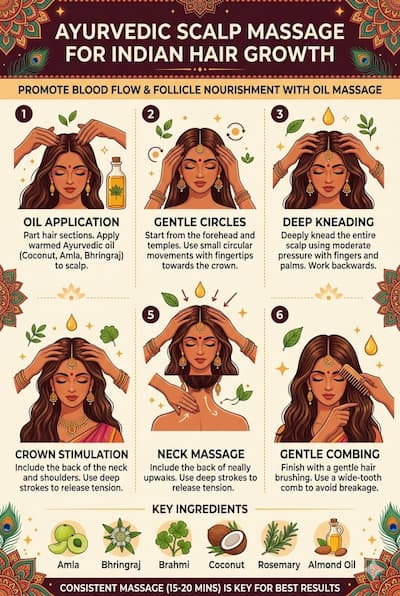
Complete the Protocol
Scalp massage is a mechanical tool. It works best when paired with an oil that delivers active Ayurvedic and biotech compounds to the follicle during the increased blood flow window that massage creates. Our Total Restore Hair Oil contains Bhringraj, Brahmi, Jatamansi, and Amla in a coconut + sesame base — formulated specifically for the scalp massage context, where the active herb compounds need to penetrate to the dermal papilla, not just coat the hair surface.
After washing out the oil, the Total Revival Hair Serum applied on damp hair continues the follicle stimulation with Redensyl + AnaGain Nu + Copper Peptides — maintaining the anagen signal between massage and wash-day sessions.
Shop Total Restore Hair Oil → Shop Total Revival Hair Serum →"The champi is not a luxury. It is a 4-minute daily investment in mechanical follicle stimulation that the research confirms actually works."
Ready to make the honest switch?
Our products are built on the same principles as every article we write — pure ingredients, real results, nothing to hide.
Explore Our Products