Postpartum Hair Fall & Telogen Effluvium — Why It Happens, When It Stops, and What Actually Helps
You grew a human. Your hormones did something extraordinary for 9 months. Now they are recalibrating — and your hair is paying for it. Postpartum hair fall is one of the most common and most distressing experiences new mothers face. This is the complete, science-backed, honest guide to what is happening in your body, exactly when it will stop, and what you can do to come through it faster.
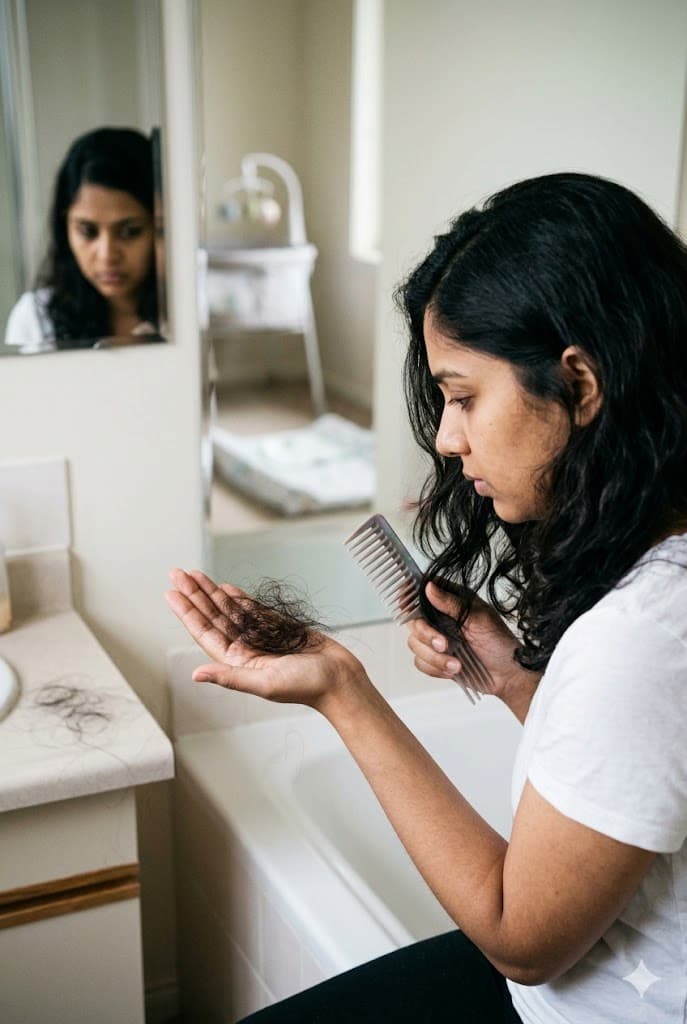
It usually begins around 3 months after delivery — handfuls of hair in the shower drain, clumps on the pillow, a visibly thinner ponytail. For women who experienced the lush, thick hair of pregnancy, the contrast is alarming. For women who were already managing hair fall before pregnancy, it can feel catastrophic.
The first thing to understand is this: postpartum hair fall is not your hair falling out. It is the hair from pregnancy finally falling. During pregnancy, unusually high oestrogen levels held hairs in the growth phase longer than normal. After delivery, oestrogen drops — and all those hairs enter the resting phase together, then shed together. The follicles are intact. The shed is temporary.
The second thing to understand is that while you cannot stop the shed entirely, you can meaningfully accelerate recovery — by correcting nutritional gaps that extend shedding, managing postnatal stress that compounds it, and using herbs that push recovering follicles back into the growth phase faster.
This guide gives you the precise science, an honest timeline, and a practical Ayurvedic protocol built on the biology of what is actually happening in your scalp.
Postpartum Hair Fall — Key Facts at a Glance
The Biology Explained — Why the Oestrogen Drop Causes Mass Hair Shedding
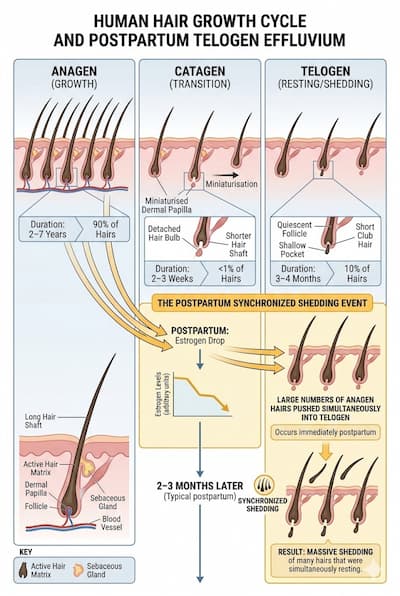
To understand what is happening, you need to understand the normal hair growth cycle — and what pregnancy does to it.
The normal hair cycle has three phases:
- Anagen (growth) — the active phase, lasting 2–7 years. Approximately 80–90% of hairs are in anagen at any time.
- Catagen (transition) — a 2–3 week period of follicle regression.
- Telogen (rest) — a 2–3 month resting phase, at the end of which the hair sheds and anagen restarts. About 10–15% of hairs are in telogen at any given time.
What pregnancy does: Oestrogen levels rise dramatically during pregnancy — up to 100× pre-pregnancy levels by the third trimester. High oestrogen is a potent anagen-prolonging signal. It keeps hairs in the growth phase well beyond their normal cycle length, dramatically reducing the proportion of hairs entering telogen. This is why most women have noticeably fuller, longer, and thicker hair during pregnancy.
What delivery does: Within 24–72 hours of delivery, oestrogen levels drop sharply — often to below pre-pregnancy levels (since placental oestrogen production ceases immediately). This sudden withdrawal of the anagen-prolonging signal causes a mass synchronised transition: thousands of hairs that were held in extended anagen shift into telogen simultaneously.
Why the delay: Telogen hairs do not shed immediately — they rest in the follicle for 2–3 months before the new anagen hair below them pushes them out. This is why the dramatic shedding does not begin until 2–4 months after delivery — the lag is the normal telogen duration between the hormonal trigger and the visible shed.
Postpartum telogen effluvium is temporary and self-resolving. The follicles are intact. Once the synchronised telogen cohort sheds, the follicles re-enter anagen and regrowth follows. PCOS-related androgenic alopecia, by contrast, is a progressive, chronic condition driven by DHT miniaturisation — the follicles shrink over time and do not recover without active DHT-blocking intervention. Some women have both: postpartum TE unmasking underlying androgenic alopecia that was suppressed by pregnancy oestrogen. If your hair does not recover by 9–12 months postpartum, androgenic alopecia or thyroid dysfunction should be investigated.
Telogen Effluvium — Beyond Postpartum: Other Triggers
Postpartum hair fall is the most common form of telogen effluvium, but the same mechanism — a physiological stressor shifting anagen hairs into telogen — can be triggered by several other events. Understanding your trigger matters because it determines the timeline and what compounding factors to address.
| Trigger | Mechanism | Expected Timeline | Key action |
|---|---|---|---|
| Postpartum (delivery) | Oestrogen drop → synchronised telogen entry | Begins 2–4 months post-delivery; resolves 6–15 months | Nutrition, stress management, follicle-stimulating herbs |
| Crash dieting / very low calorie intake | Caloric and protein restriction → follicles prioritised last in nutrient allocation | Begins 2–3 months after restrictive period; resolves on adequate nutrition | Restore adequate protein (1.0–1.5g/kg/day) and total caloric intake |
| Severe illness / surgery / hospitalisation | Systemic physiological stress → cortisol spike → anagen disruption | Begins 2–3 months after illness; resolves 3–9 months after recovery | Ensure nutritional recovery; manage inflammation; support regrowth with herbs |
| Severe psychological stress | Cortisol excess → premature catagen entry; also suppresses IGF-1 growth factor | Ongoing if stress persists; resolves 3–6 months after stress reduction | Address cortisol with adaptogens (Brahmi, Ashwagandha); stress management |
| Iron deficiency anaemia | Iron is essential for DNA synthesis in rapidly dividing follicle cells; deficiency directly impairs anagen | Resolves 3–6 months after ferritin correction (above 40 ng/mL) | Test serum ferritin (not just haemoglobin); correct deficiency; do not supplement without confirmation |
| Thyroid dysfunction (hypo- or hyperthyroid) |
Thyroid hormones regulate hair follicle cycling; both excess and deficiency cause TE | Resolves 3–6 months after TSH normalisation with treatment | Test TSH and free T4; postpartum thyroiditis affects 5–10% of women |
| Stopping the pill (oral contraceptive withdrawal) |
Same mechanism as postpartum — OCPs maintain oestrogen levels; cessation causes withdrawal TE | Begins 2–3 months after stopping; resolves 6–12 months | Same approach as postpartum TE; be aware if transitioning from OCP |
Why Some Women's Postpartum Hair Fall Is Worse — The Compounding Factors
The base postpartum oestrogen drop is the same for all women. But the severity and duration of hair fall varies considerably. These are the factors that turn a manageable shed into a prolonged, distressing one:
⚠ Iron Deficiency Postpartum
Childbirth — particularly complicated deliveries, C-sections, or significant blood loss — can deplete iron stores dramatically. Iron deficiency independently causes its own telogen effluvium on top of the oestrogen-drop TE. Many women are unaware their ferritin is critically low because haemoglobin (measured in a standard CBC) can appear normal even when tissue iron stores are depleted. Ferritin below 40 ng/mL significantly prolongs postpartum shedding.
What to do: Test serum ferritin at 6–8 weeks postpartum, not just haemoglobin. Correct deficiency before attributing prolonged shedding solely to TE.
⚠ Postnatal Cortisol Excess
New parenthood is physiologically stressful — sleep deprivation alone can elevate cortisol to levels that independently trigger telogen effluvium. Cortisol induces premature catagen entry in hair follicles and suppresses Insulin-like Growth Factor-1 (IGF-1), a key driver of anagen. For women who are sleep-deprived, breastfeeding, and managing the physical and psychological demands of new parenthood, cortisol-driven TE compounds the oestrogen-drop TE significantly.
What to do: Adaptogens that reduce cortisol — Brahmi (Bacopa monnieri) and Ashwagandha — have RCT-level evidence for cortisol reduction. Sleep when the baby sleeps is not a cliché; it is hair science.
⚠ Nutritional Gaps from Breastfeeding
Breastfeeding increases daily caloric requirements by approximately 500 kcal/day and significantly elevates demands for protein, calcium, iodine, and zinc. Many new mothers are in a nutritional deficit — particularly if they are eating less due to exhaustion, prioritising the baby over their own meals, or restricting food intake for postpartum weight loss. Inadequate protein intake directly impairs follicle synthesis (hair is 95% keratin protein). Zinc deficiency independently causes TE.
What to do: Continue prenatal vitamins through the breastfeeding period. Prioritise adequate protein (lentils, paneer, eggs, nuts). Do not restrict calories during breastfeeding.
⚠ Postpartum Thyroiditis
Postpartum thyroiditis — an autoimmune thyroid inflammation — affects approximately 5–10% of women within the first year after delivery. It typically presents as a phase of hyperthyroidism followed by hypothyroidism, and can cause persistent hair fall that outlasts normal postpartum TE. It is commonly mistaken for prolonged postpartum TE — and it is frequently missed because it is not routinely tested postpartum.
What to do: If shedding persists beyond 6 months or is accompanied by fatigue, weight changes, or palpitations, request TSH and free T4 testing. Postpartum thyroiditis is treatable once identified.
The Ayurvedic Approach to Postpartum Hair Recovery — What Works and Why
Ayurveda has a rich tradition of postpartum care — the Sutika Paricharya (postpartum regimen) in classical texts specifically addresses the depleted state of the new mother's body and the herbs and practices that support recovery. Many of these traditional recommendations map remarkably well onto the modern understanding of postpartum telogen effluvium.
For hair recovery specifically, the goal is to: (1) push recovering follicles back into anagen faster, (2) reduce cortisol and stress that are extending the shed, and (3) provide the scalp with the nutrients and blood supply to support rapid new hair growth.
For postpartum TE specifically, Bhringraj is valuable not for its 5-AR inhibiting activity (which is more relevant to androgenic alopecia) but for its Wnt/β-catenin activation and VEGF upregulation — the growth signalling pathways that push follicles from telogen into anagen.
A 2025 molecular docking study demonstrated a 45% increase in human dermal papilla cell proliferation and a 2.5-fold strengthening of β-catenin nuclear signalling from Eclipta alba extract. For postpartum follicles that have completed telogen and are primed to re-enter anagen, this growth signal activation can meaningfully accelerate the transition — shortening the time between the end of shedding and the beginning of visible regrowth.
Animal studies also showed hair growth initiation time reduced to half compared to controls when Bhringraj extract was applied — directly relevant to the anagen re-entry phase that postpartum recovering follicles are going through.
How to use postpartum: Apply Bhringraj oil as a pre-wash scalp massage 2–3× per week. The scalp massage itself — separate from the herb — stimulates dermal papilla cells mechanically. Combined with Bhringraj's wedelolactone content, it creates a potent anagen-promoting environment for recovering follicles.
Brahmi is the single most relevant herb for the cortisol-compounded postpartum shed. A 2012 double-blind, placebo-controlled RCT found that standardised Brahmi extract produced significant reduction in cortisol levels versus placebo in a stress-exposed population.
Cortisol acts on hair follicles through two mechanisms: it induces premature catagen (pushing more hairs into telogen, extending the postpartum shed) and suppresses IGF-1, the Insulin-like Growth Factor that drives anagen initiation. In a sleep-deprived new mother with elevated cortisol, both mechanisms are active — meaning a postpartum TE that might resolve in 4 months is instead extended to 6–9 months.
Brahmi applied to the scalp (topically in oil) also has local anti-inflammatory properties that soothe the follicle environment during the active shedding phase. The systemic cortisol-lowering benefit comes from oral Brahmi — in supplements or traditional herbal preparations (Brahmi ghee is a classical Ayurvedic postpartum formulation specifically for this purpose).
Amla has two distinct benefits in the postpartum context:
Topically: Amla's rich antioxidant profile (Vitamin C, tannins, ellagic acid) protects follicle cells from the oxidative stress generated by elevated cortisol and systemic inflammation during the postpartum period. Oxidative stress at the follicle level independently extends the telogen phase — Amla's antioxidants counteract this.
Systemically / nutritionally: Amla is the world's richest natural source of Vitamin C. Vitamin C is essential for iron absorption from dietary sources (non-haem iron from plant foods requires Vitamin C for conversion to the absorbable form). For postpartum women with iron deficiency — one of the key compounding factors for prolonged shedding — consuming Amla alongside iron-rich foods significantly improves the iron repletion rate. Amla is also commonly prescribed in Ayurvedic postpartum care for its rasayana (rejuvenating) properties, supporting tissue recovery after the demands of childbirth.
Methi is traditionally central to Indian postpartum care — consumed in laddoos, added to dal, and applied as a hair mask. Its postpartum relevance is multilayered:
Nutritionally: Methi is rich in iron, folic acid, Vitamin K, and B-complex vitamins — all critical for postpartum recovery and for supporting the rapid cell division in hair follicle matrix cells as they re-enter anagen. For exclusively breastfeeding mothers with elevated nutritional demands, methi provides a food-first source of these nutrients.
As a galactagogue: Methi is widely used to support milk supply in new mothers. Its diosgenin content (a phytoestrogen precursor) may also provide mild oestrogen-like activity at the scalp level — gently supporting the oestrogen-sensitive hair cycle mechanisms that the postpartum oestrogen drop disrupted.
Topically: Methi seed paste or methi-containing oil applied to the scalp nourishes follicles and has mild antifungal properties that prevent the seborrheic dermatitis flares that some women experience postpartum as scalp sebum regulation changes.
Ashwagandha is the most comprehensively studied adaptogen for cortisol reduction. A 2019 double-blind RCT published in Medicine found 240mg of standardised Ashwagandha extract reduced cortisol levels by 22.2% versus placebo over 60 days. Multiple other RCTs have confirmed significant cortisol and perceived stress reduction.
In the postpartum context, Ashwagandha (used internally in appropriate postpartum doses, and confirmed safe with breastfeeding by Ayurvedic tradition — though consult your physician) can meaningfully reduce the cortisol-driven component of extended telogen effluvium. Combined with Brahmi's cortisol-reducing effect, the adaptogenic approach to postpartum stress management has direct hair fall implications — not just wellbeing benefits.
Important note: While Ashwagandha has a long history of traditional use during the postpartum period in Ayurveda, consult your doctor before taking it if you are breastfeeding, as research on its safety specifically for lactating women is limited in the Western pharmacological literature.
💡 Bhringraj, Amla, Brahmi, and Methi — all combined in a single postpartum-safe routine.
See Total Restore Hair Oil →Myth vs. Truth — What Most New Mothers Are Told (and What Is Actually True)
| What you hear | What is actually true |
|---|---|
| "It will stop in a few months — nothing you can do" | Partially true and partially harmful advice. The base TE will self-resolve. But compounding factors (iron deficiency, thyroid dysfunction, cortisol, nutrition gaps) can significantly extend it — and these are highly addressable. "Nothing you can do" leaves women without the information they need to accelerate recovery. |
| "Take biotin — it's good for hair" | Biotin deficiency is rare and its supplementation does not address postpartum telogen effluvium. The mechanism of TE is hormonal and follicular, not biotin-related. High-dose biotin can interfere with thyroid tests — particularly relevant postpartum when thyroid screening is important. |
| "Your hair will never be the same after having a baby" | False for the vast majority of women. Postpartum TE is fully reversible — follicles are intact. Full recovery by 12–15 months is the norm. Permanent change is not expected from TE alone. |
| "Oiling your hair will make the shedding worse — don't use oil" | Incorrect. Oil applied to the scalp (not the hair) and washed out properly does not cause hair fall. It provides beneficial herbs contact time with recovering follicles. The shed during washing when oil is applied is hairs that were already in telogen — they would have shed regardless. |
| "Breastfeeding makes hair fall worse" | Partially. Prolactin (the breastfeeding hormone) does mildly extend the postpartum period during which oestrogen stays low. But the main extension of hair fall comes from nutritional gaps and sleep deprivation that breastfeeding can worsen — addressing those is actionable. |
| "Cut your hair short and it will grow back faster" | Cutting hair length has no effect on follicle behaviour or the rate of telogen-to-anagen transition. Shorter hair may appear fuller due to less visual weight, but it does not accelerate regrowth biology. |
The Postpartum Hair Routine — What to Use and How
A postpartum hair routine has two goals: reduce the compounding factors that are extending your shed, and support the fastest possible follicle return to anagen. The topical routine below is designed specifically for the postpartum scalp — recovering follicles in a hormonally recalibrating environment.
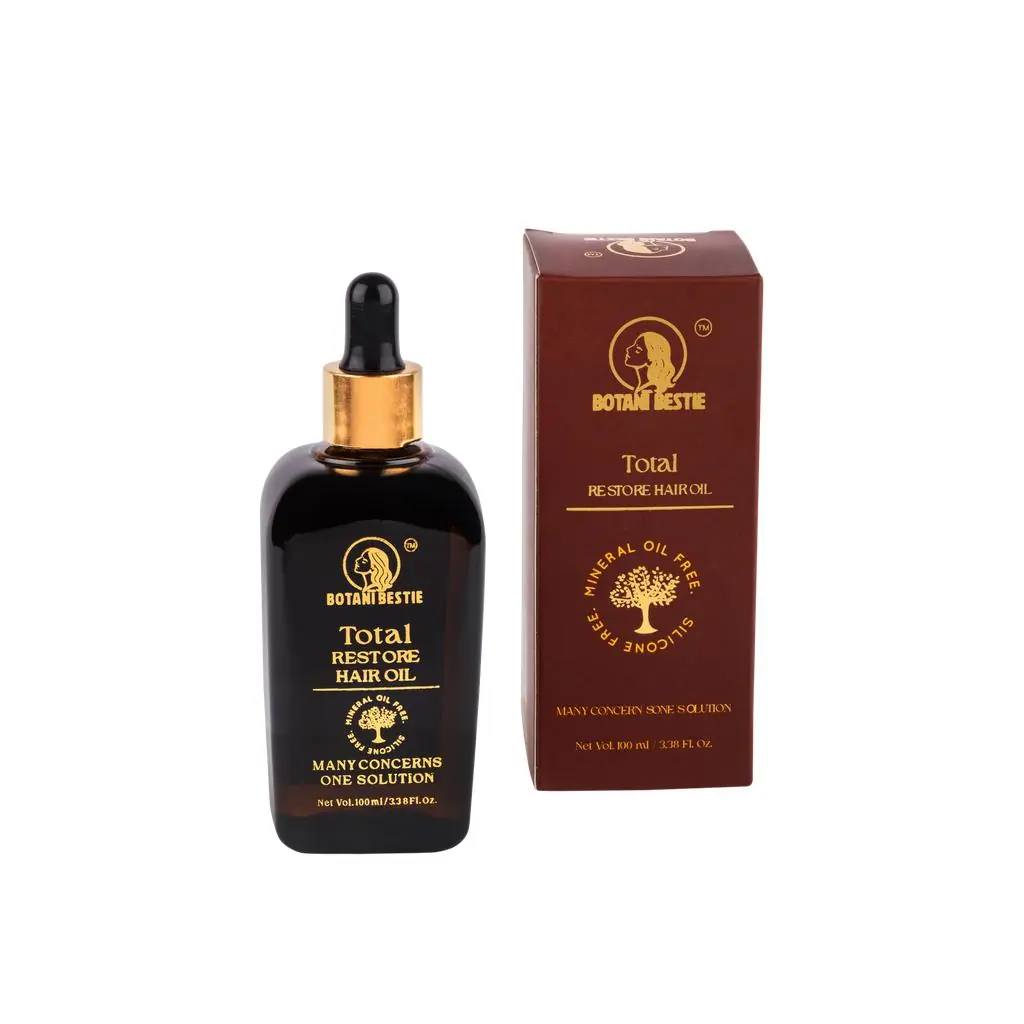
Step 1: Total Restore Hair Oil — Pre-Wash Scalp Treatment (2–3× per Week)
Anagen activation + cortisol-calming herbs + scalp microcirculation
Apply 1–2 tablespoons in sections to the scalp. Massage with fingertips in slow circular motions for 5–10 minutes — the mechanical stimulation of scalp massage increases blood flow to the papillae and has independent evidence for dermal papilla activation. Leave for 30–60 minutes, then wash out thoroughly. Avoid overnight application during active postpartum shedding — the scalp needs to breathe.
- ✔ Bhringraj — Wnt/β-catenin activation in recovering telogen follicles; VEGF upregulation for follicle blood supply
- ✔ Brahmi — Scalp anti-inflammation; complements systemic cortisol reduction
- ✔ Amla — Antioxidant follicle protection; Vitamin C for iron absorption
- ✔ Methi — Phytoestrogenic scalp support; nutritive contact with follicles
- ✔ Sesame & Coconut oil base — Traditional postpartum Ayurvedic carrier oils; sesame is warming (pacifies Vata aggravated postpartum), penetrates the scalp effectively
- ✔ Coenzyme Q10 + Vitamin E — Antioxidant protection at the follicle microenvironment level
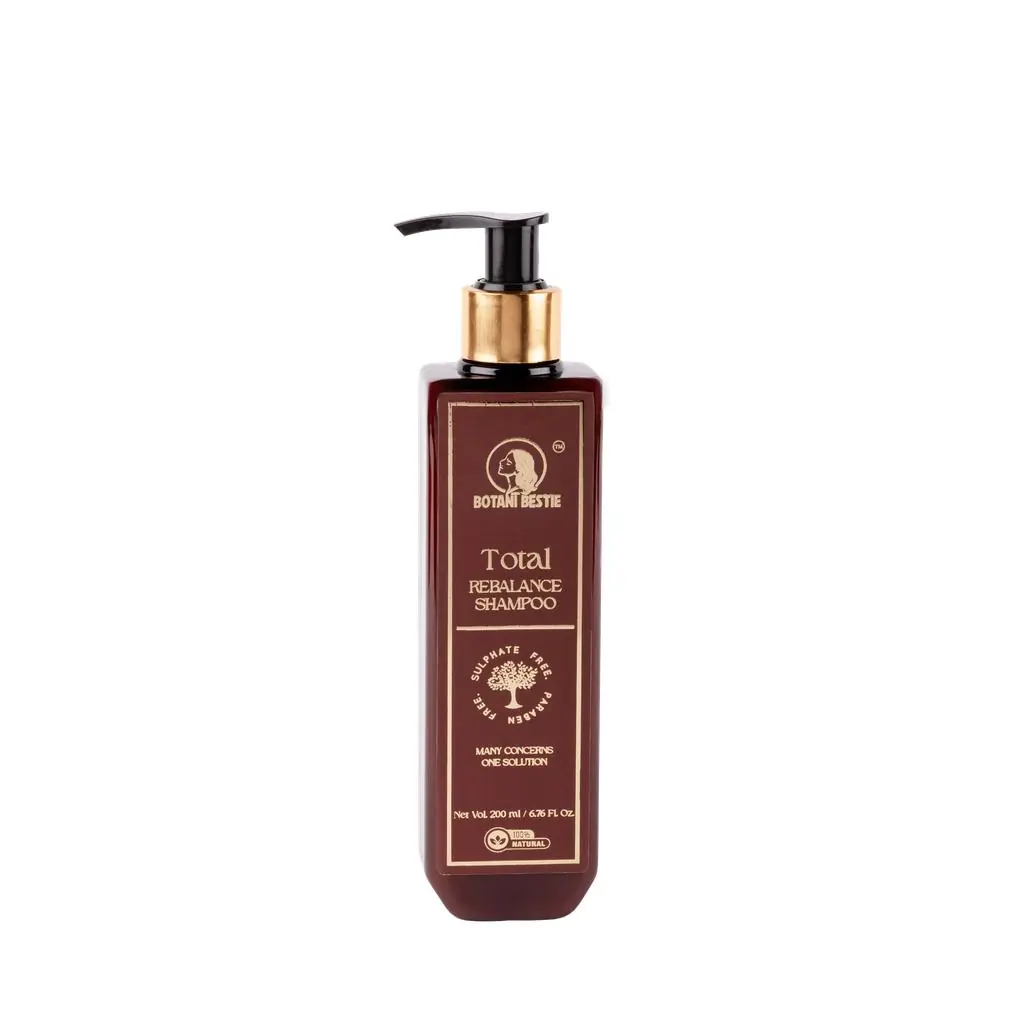
Step 2: Total Rebalance Shampoo — Every Wash
Consistent herb delivery + scalp pH balance + shaft strengthening for new regrowth
Sulfate-free formula is essential postpartum — the scalp's barrier function is still recalibrating after the hormonal changes of pregnancy. Sulfates strip the scalp aggressively and can worsen the seborrheic dermatitis some women experience postpartum. Apply to wet scalp, massage for 3–5 minutes in circular motions, rinse thoroughly.
- ✔ Bhringraj, Amla, Brahmi, Methi + 9 more herbs — consistent every-wash herb delivery without preparation
- ✔ Fermented Rice Water — inositol delivery at the scalp; inositol has independent evidence for reducing postpartum androgen-related effects; also deposits amino acids on the hair shaft, reducing breakage of fragile regrowth
- ✔ Apple Cider Vinegar — restores scalp pH to 4.5–5.5; the acidic pH closes the cuticle of new regrowth hairs (which emerge with a naturally rougher cuticle structure) and inhibits scalp fungal overgrowth
- ✔ Plant-Based Keratin + Silk Proteins — strengthen the fine, delicate regrowth hairs as they emerge, reducing breakage that can be mistaken for continued hair fall
- ✔ Sulfate-free, paraben-free, silicone-free — gentle enough for the sensitive postpartum scalp and confirmed safe for breastfeeding mothers
📅 The Honest Postpartum Hair Fall Timeline — Month by Month
What to realistically expect, and what to do at each stage:
| Months Postpartum | What You May Experience | What's Happening | What to Do |
|---|---|---|---|
| 0–2 months | Hair still feels normal or slightly thicker than pre-pregnancy. Little to no shedding yet. | The oestrogen-held hairs are in telogen — but the telogen phase takes 2–3 months before the hairs shed. No visible change yet. | Start your Ayurvedic routine now — before the shed. Get ferritin tested. Continue prenatal vitamins. |
| 2–4 months | Shedding begins and escalates — often dramatically. Significant hair on pillow, in the shower, in the brush. | The synchronised telogen cohort begins shedding. This is the peak phase of postpartum TE. The follicles are primed to re-enter anagen immediately after. | Do not panic — this is normal and temporary. Consistent Bhringraj oil + shampoo routine. Manage stress, eat adequately. Do not crash diet. |
| 4–6 months | Shedding begins to slow. Daily count starts to reduce. First signs of baby hairs at the hairline and parting. | The main telogen cohort has shed. Follicles begin re-entering anagen. Wnt/β-catenin activation from Bhringraj is supporting this transition. | Continue routine consistently. Baby hairs appearing is a positive sign. Be gentle — baby hairs are fragile and break easily. Avoid heat styling and tight hairstyles. |
| 6–9 months | Noticeably less daily shed. Regrowth visible — typically shorter hairs framing the face and along the parting. Hair beginning to feel fuller. | Active anagen is underway for the previously telogen hairs. The Bhringraj routine supports faster and thicker anagen emergence. Hair density begins to recover visibly. | Maintain the routine. If shedding has not meaningfully reduced by 6 months — investigate ferritin, thyroid, and Vitamin D. Do not attribute prolonged shedding to "still normal postpartum TE." |
| 9–15 months | Progressive recovery of hair density. Regrowth integrates with existing hair length. Hair approaches or reaches pre-pregnancy density. | Multiple complete anagen cycles have completed since the postpartum shed. Full recovery is the expected outcome for women without compounding factors. | Transition to a maintenance routine — weekly oil treatment, regular Bhringraj shampoo use. If density has not recovered by 12–15 months, consult a dermatologist to rule out underlying androgenic alopecia. |
Your Hair Fall Isn't Going Away on Its Own?
If your postpartum shed has passed its expected timeline, or if you are unsure whether what you are experiencing is TE or something more — speak to our in-house dermatologist. Free, personalised, no purchase required. Tell us your delivery timeline, current symptoms, and any blood test results you have, and get a targeted recommendation built for your situation.
Book Free Hair Consultation → WhatsApp UsFrequently Asked Questions
The Bottom Line: This Is Temporary — and You Can Come Through It Faster
Postpartum hair fall is not a problem with your body. It is your body completing a remarkable biological process — and then recalibrating from one of the most significant hormonal events in human physiology. The follicles are intact. The shed is temporary.
But "temporary" can last 12 months or longer when compounding factors are left unaddressed — iron deficiency, cortisol excess, nutritional gaps, undiagnosed thyroid dysfunction. Addressing those factors while supporting follicle recovery with herbs that are clinically shown to activate anagen growth signalling — Bhringraj, Brahmi, Amla, Methi — gives your body what it needs to complete the recovery cycle faster.
You cannot stop the shed. You can shorten it. And you can come through it with better, healthier hair than you had before — if you support your body through the process rather than waiting for it to resolve on its own.
Shop Total Restore Hair Oil → Shop Total Rebalance Shampoo →"You cannot stop the tide — but you can be ready on the other shore."
Ready to make the honest switch?
Our products are built on the same principles as every article we write — pure ingredients, real results, nothing to hide.
Explore Our Products