Saw Palmetto for Hair Loss — The DHT Blocker Science Actually Backs
Most natural hair loss ingredients have no clinical trial data. Saw palmetto does. It is the only plant-derived DHT blocker with a published head-to-head randomised controlled trial against finasteride — and the results are more nuanced, and more encouraging, than either its fans or its detractors typically acknowledge. Here is the complete, unvarnished science.

DHT — dihydrotestosterone — is the primary hormonal driver of androgenetic alopecia, the most common form of hair loss in both men and women globally. It is produced when the enzyme 5-alpha-reductase (5-AR) converts testosterone into DHT at the scalp follicle. DHT binds to androgen receptors in the dermal papilla and progressively miniaturises the follicle — shortening the anagen phase, producing progressively finer, shorter hairs, until eventually the follicle stops producing terminal hair entirely.
The pharmaceutical solution — finasteride — directly inhibits 5-AR type II with significant clinical effectiveness. Its problem is its side effect profile: sexual dysfunction (erectile dysfunction, reduced libido, ejaculatory disorders) in 2–5% of users, and a disputed but documented pattern of persistent post-discontinuation effects in some patients. For many men and women, the trade-off is unacceptable.
This is where saw palmetto enters — not as a vague herbal alternative, but as a specifically studied 5-AR inhibitor with a published randomised controlled trial comparing it directly to finasteride. The trial's findings are honest: saw palmetto is less potent than finasteride. They are also genuinely encouraging: saw palmetto still produces clinically meaningful improvement in hair count, at a fraction of the side effect burden.
The ingredient deserves to be evaluated on its actual evidence — which is more substantial than most herbal hair loss ingredients can claim, and more honestly constrained than its most enthusiastic proponents acknowledge. This guide does exactly that.
⚡ Saw Palmetto for Hair Loss — Fact vs. Fiction Quick Reference
✅ FACT (Evidence-Supported)
- Inhibits 5-alpha-reductase type I and II — reducing DHT production at the scalp
- Inhibits DHT binding to androgen receptors — secondary blocking mechanism
- Human RCT published: 38% improvement in hair count vs 68% for finasteride (Rossi et al. 2012)
- Beta-sitosterol component blocks DHT with separately published RCT evidence
- Anti-inflammatory activity — reduces scalp follicular inflammation that compounds AGA
- Significantly milder side effect profile than finasteride at standard doses
- Effective topically and orally — different bioavailability, not interchangeable
❌ FICTION (Not Supported or Overstated)
- "Saw palmetto is as effective as finasteride" — it is not; 38% vs 68% hair count improvement is a real difference
- "It works for all types of hair loss" — clinical evidence is specific to androgenetic alopecia (DHT-driven); not proven for telogen effluvium, alopecia areata
- "More is better — take higher doses" — evidence base is for 320mg/day standardised extract; higher doses increase side effects without added benefit
- "Raw saw palmetto berry is equivalent to standardised extract" — it is not; the active liposterolic fraction requires proper extraction and standardisation
- "It has zero side effects" — GI effects are documented; caution warranted in pregnancy, women trying to conceive, and men with prostate conditions
- "Results appear in 2–4 weeks" — the hair cycle requires minimum 3–6 months to reflect DHT-blocking treatment effects
What Is Saw Palmetto? The Plant and Its Active Compounds
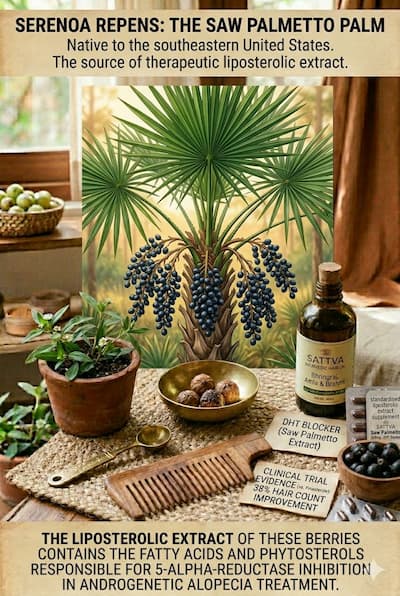
Serenoa repens — commonly known as saw palmetto — is a small, slow-growing palm native to the coastal plains of the southeastern United States, particularly Florida. It produces clusters of dark blue-to-black berries that are the source of the liposterolic extract used in clinical research. The plant has been used medicinally by Native American peoples for centuries, primarily for urinary and reproductive health, and entered mainstream Western medicine in the early 20th century through its use for benign prostatic hyperplasia (BPH) — a connection that is directly relevant to hair loss, since both BPH and androgenetic alopecia are driven by DHT.
The therapeutic component of saw palmetto is not the whole berry — it is the liposterolic extract, a standardised fraction rich in specific fatty acids and phytosterols that carry the 5-AR inhibitory activity. Raw berry powder, teas, or non-standardised preparations do not deliver the active fraction at the concentrations used in clinical research. This distinction is critical: the evidence base is for the liposterolic extract standardised to 85–95% fatty acids, not for saw palmetto in general.
| Scientific name | Serenoa repens (Bartram) Small |
| Family | Arecaceae (palm family) |
| Therapeutic form | Liposterolic extract of ripe berries — standardised to 85–95% total fatty acids |
| Established medical use | Benign prostatic hyperplasia (BPH) — same DHT pathway as AGA |
| Clinical hair loss dose | 320 mg/day of liposterolic extract (oral) |
| Primary target enzyme | 5-alpha-reductase type I and II |
| Key clinical evidence | Rossi et al. 2012 (RCT vs finasteride); Evron et al. 2020 (RCT, men + women) |
The Bioactive Compounds — What Is Actually Doing the Work
Saw palmetto's liposterolic extract is a complex mixture of fatty acids, phytosterols, and polyphenols — each contributing to its overall DHT-blocking and anti-inflammatory activity through distinct mechanisms.
🌿 Free Fatty Acids — The Primary 5-AR Inhibitors
The majority of saw palmetto's 5-alpha-reductase inhibitory activity is attributed to its free fatty acid fraction — specifically lauric acid, oleic acid, myristic acid, and linoleic acid working in concert. In vitro studies published in the Journal of Steroid Biochemistry and Molecular Biology demonstrate that these fatty acids inhibit 5-AR through competitive binding at the enzyme's active site — particularly the NADPH cofactor binding domain. Critically, saw palmetto's fatty acid mixture inhibits both 5-AR type I (predominantly found in the skin and scalp) and 5-AR type II (found in the hair follicle and prostate) — a broader inhibitory profile than finasteride, which primarily targets type II. This dual isoenzyme inhibition makes saw palmetto a more comprehensive 5-AR inhibitor at the tissue level than finasteride despite being less potent overall.
⚗️ Beta-Sitosterol — The Androgen Receptor Blocker
Beta-sitosterol is a phytosterol — a plant-derived sterol structurally similar to cholesterol — present in significant concentrations in the saw palmetto liposterolic extract. Its hair-relevant mechanism is distinct from the fatty acid fraction: while the fatty acids inhibit DHT production (at the 5-AR enzyme), beta-sitosterol inhibits DHT activity by competing with DHT for binding at the androgen receptor in the dermal papilla cell. This is a second, independent line of DHT-blocking action — and it means the combination of fatty acids and beta-sitosterol in the extract targets the DHT pathway at two sequential steps simultaneously. A separate randomised trial by Prager et al. (2002) published in the Journal of Alternative and Complementary Medicine demonstrated statistically significant improvement in self-assessed hair loss scores with a combination of beta-sitosterol and saw palmetto compared to placebo over 5 months.
🔬 Anti-inflammatory Polyphenols
Beyond DHT blocking, saw palmetto's liposterolic extract contains flavonoids and polyphenolic compounds — including ruscogenin and epicatechin derivatives — that exhibit anti-inflammatory activity at the scalp follicle. Androgenetic alopecia involves not just DHT-driven miniaturisation but a parallel chronic peri-follicular inflammatory component — microinflammation around the hair follicle bulge that accelerates the miniaturisation cascade and is increasingly recognised as an independent driver of progression. Saw palmetto's anti-inflammatory activity suppresses prostaglandin E2 (PGE2) production and inhibits 5-lipoxygenase (5-LOX), reducing the arachidonic acid cascade that drives follicular microinflammation. This anti-inflammatory mechanism is synergistic with the DHT-blocking fatty acids — addressing two distinct pathways simultaneously.
💊 Polysaccharides — Immune-Modulating Activity
The water-soluble fraction of the saw palmetto berry — which is not present in the liposterolic extract — contains polysaccharides with immunostimulatory and anti-inflammatory properties documented in preclinical studies. These compounds modulate the activity of macrophages and dendritic cells involved in the cutaneous inflammatory response. While the clinical relevance for hair loss is less directly established than the liposterolic fraction's DHT-blocking activity, the polysaccharide component may contribute to the scalp microenvironmental benefits of full-spectrum berry preparations (as opposed to pure liposterolic extracts). This is an area of ongoing research rather than a confirmed clinical benefit — but it suggests that whole-berry formulations may have a more complex mechanism than single-fraction extracts.
DHT and Androgenetic Alopecia — Why Blocking It Matters
To understand why saw palmetto works, it is essential to understand what DHT actually does to the hair follicle — and why interrupting this process at the earliest possible stage determines how much hair can be preserved.
The DHT–Hair Follicle Cascade: Step by Step
| Step | What Happens | Time Scale |
|---|---|---|
| 1. Testosterone → DHT | 5-alpha-reductase (type I at scalp skin; type II at hair follicle) converts circulating testosterone to DHT locally in the scalp tissue. DHT has approximately 5× the androgenic potency of testosterone at androgen receptors. | Continuous process in androgen-sensitive follicles |
| 2. DHT binds androgen receptor | DHT binds the androgen receptor (AR) in the dermal papilla cells — the mesenchymal cells that signal to the epithelial follicle matrix cells and control hair growth. AR expression in androgenetically susceptible follicles is genetically higher than in non-susceptible follicles. | Minutes to hours after DHT production |
| 3. Growth factor suppression | DHT-AR complex suppresses the production of anagen-promoting growth factors (IGF-1, VEGF) from dermal papilla cells and upregulates DKK-1 (Dickkopf-1), a Wnt pathway antagonist that directly inhibits anagen entry and promotes catagen. | Days to weeks of cumulative DHT exposure |
| 4. Anagen shortening | Each successive hair cycle produces a shorter anagen phase — meaning the hair grows for less time before entering catagen and shedding. Over multiple cycles, this shortening becomes progressively more pronounced, and the hair produced in each cycle is finer and shorter. | Months to years across multiple hair cycles |
| 5. Follicle miniaturisation | The follicle structure itself shrinks — the dermal papilla volume reduces, the follicle bulb diameter decreases, and the terminal hair follicle progressively converts to a vellus follicle producing fine, unpigmented, short hairs instead of visible terminal ones. | Years of progressive DHT exposure |
| 6. Point of no return | At a late stage — not yet fully characterised — follicles lose the dermal papilla cell volume required to produce even vellus hair. The follicle becomes permanently inactive. At this stage, DHT blocking, Minoxidil, and most natural treatments cannot recover growth. This is why early intervention is critical. | Advanced AGA — variable timing by individual |
The Clinical Evidence — What the Studies Actually Show
Saw palmetto has a more substantial evidence base for hair loss than almost any other natural ingredient — and being honest about both what the studies show and their limitations is essential for calibrated expectations.
Published: Journal of Alternative and Complementary Medicine, 2012 | Design: Randomised, double-blind, controlled trial | Duration: 24 months | N: 100 male patients with mild-to-moderate androgenetic alopecia
Groups: Saw palmetto 320mg/day liposterolic extract (n=50) vs finasteride 1mg/day (n=50)
Primary outcome — hair count improvement:
- Finasteride group: 68% of patients showed improvement in hair count at 24 months
- Saw palmetto group: 38% of patients showed improvement in hair count at 24 months
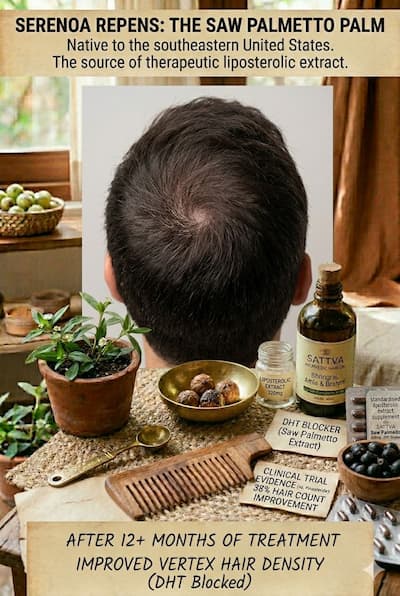
Secondary findings: Improvement was predominantly observed at the vertex (crown) in both groups. The study also found that saw palmetto-treated patients reported no significant sexual side effects, while 4% of the finasteride group reported sexual dysfunction during the trial period.
Honest interpretation: Finasteride produced approximately 1.8× better hair count improvement than saw palmetto. This is a real and clinically meaningful difference that should not be minimised. However, saw palmetto produced statistically significant improvement over baseline — it is not a placebo-equivalent. For patients who refuse finasteride due to side effect concerns, or who have tried finasteride and experienced sexual dysfunction, saw palmetto at 320mg/day is a genuinely evidenced alternative — not a weak substitute.
Limitation: Trial was conducted in male participants only; exclusively vertex AGA pattern; 24 months may not capture the full long-term comparative trajectory.
Published: Skin Appendage Disorders, 2020 | Design: Randomised, double-blind, placebo-controlled trial | Duration: 6 months | Participants: Both male and female patients with AGA
This trial evaluated saw palmetto (320mg/day) vs placebo in a mixed-gender cohort and assessed both objective hair density outcomes and patient-reported quality-of-life scores.
Key findings:
- Saw palmetto group showed statistically significant improvement in hair density compared to placebo at 6 months in both male and female participants
- Patient-reported satisfaction scores were significantly higher in the saw palmetto group than in the finasteride group from the Rossi 2012 trial — attributed primarily to the absence of sexual side effects and higher treatment tolerability
- Female participants showed improvements in hair density consistent with the male cohort, providing the first meaningful clinical data supporting saw palmetto use in female pattern hair loss
Honest interpretation: The Evron trial extends the evidence base to female AGA — an important gap addressed by the Rossi trial — and highlights that clinical outcomes measured by patient experience (not just hair count) may favour saw palmetto over finasteride when tolerability is factored in. This does not make saw palmetto the more potent DHT blocker — it makes it the more acceptable long-term option for a meaningful proportion of patients.
Published: Journal of Alternative and Complementary Medicine, 2002 | Design: Randomised, double-blind, placebo-controlled | Duration: 5 months | N: 19 male patients with mild-to-moderate AGA
This early trial evaluated the combination of saw palmetto extract and beta-sitosterol versus placebo in men with androgenetic alopecia. While the sample size is small, it was the first randomised controlled evidence specifically for saw palmetto in male AGA and remains frequently cited.
Key findings:
- 60% of participants in the treatment group were rated as improved by a blinded physician assessor
- 11% of the placebo group showed improvement (consistent with expected placebo rates for hair loss treatment trials)
- No significant adverse events were recorded in the treatment group
Honest interpretation: The small sample limits statistical power and generalisability. However, the trial's value is in confirming a signal — and its signal (60% improvement rate) is consistent with the direction of evidence from the larger Rossi 2012 and Evron 2020 trials. It also directly supports the combination of saw palmetto fatty acids and beta-sitosterol as more effective than either alone — the dual-mechanism argument for the whole liposterolic extract.
The majority of saw palmetto clinical evidence is for oral supplementation. Topical application — in serums, scalp drops, and hair oils — is increasingly common in commercial formulations, but the evidence base for topical delivery is smaller and more preliminary.
A key study by Chitvanich et al. demonstrated that topical saw palmetto extract (at standardised concentration) penetrated the scalp epidermis and reached the hair follicle in sufficient concentrations to achieve 5-AR inhibition at the follicle level — confirming that topical bioavailability is achievable with the right formulation. A 2020 clinical study evaluating a 0.005% saw palmetto serum versus 5% minoxidil solution found that the saw palmetto group showed improvements in hair density — though the comparison was not statistically significant versus minoxidil in the primary endpoint.
Honest interpretation: Topical saw palmetto is biologically plausible and has preliminary clinical support — but the evidence for oral supplementation at 320mg/day is substantially stronger. Topical formulations are a reasonable complementary approach (targeting the scalp directly without systemic exposure) but should not be substituted for oral supplementation when oral is tolerated. A combined oral + topical approach covering both systemic and local DHT production pathways is the most complete strategy.
Formulation caveat: The liposterolic extract is oil-soluble and requires a lipid-based vehicle (a quality oil or emulsified serum) for effective scalp penetration. Water-based serums with saw palmetto listed as an ingredient but without a lipid carrier have poor bioavailability and do not deliver the active fraction to the follicle effectively.
The Complete Evidence Landscape — At a Glance
| Study / Finding | Type | Key Finding | Strength |
|---|---|---|---|
| Rossi et al. 2012 — Saw Palmetto vs Finasteride J Alt Compl Med — RCT, n=100, 24 months |
Human RCT | 38% of saw palmetto patients improved in hair count vs 68% with finasteride; no sexual side effects in saw palmetto group; improvement predominantly at vertex | High — human RCT, comparative design |
| Evron et al. 2020 — Mixed-Gender RCT Skin Appendage Disorders — RCT, men + women |
Human RCT | Significant hair density improvement vs placebo in both sexes; patient-reported quality of life outcomes favoured saw palmetto over finasteride (tolerability-adjusted) | High — human RCT, includes women |
| Prager et al. 2002 — Beta-Sitosterol + Saw Palmetto RCT J Alt Compl Med — RCT, n=19, 5 months |
Human RCT (small) | 60% physician-rated improvement vs 11% placebo; established dual-mechanism (5-AR + AR blocking) combination rationale | Moderate — RCT with small sample |
| 5-AR Type I and II Dual Inhibition J Steroid Biochem Mol Biol — in vitro |
In vitro enzyme assay | Saw palmetto fatty acid mixture inhibits both 5-AR isoenzymes — broader inhibitory profile than finasteride (type II only); mechanism confirmed | Moderate — mechanism confirmed in vitro |
| Anti-inflammatory (5-LOX, PGE2) Multiple in vitro / animal studies |
In vitro + in vivo (animal) | Saw palmetto inhibits 5-lipoxygenase and reduces PGE2 — anti-inflammatory mechanisms relevant to peri-follicular microinflammation in AGA | Low-moderate — mechanism supported; scalp-specific human data limited |
| Topical Saw Palmetto — Serum vs Minoxidil Chitvanich et al. + 2020 clinical study |
Human clinical study | Follicle-level bioavailability confirmed; hair density improvement shown; not statistically superior to minoxidil in primary endpoint | Moderate — promising; oral evidence remains stronger |
| Serum DHT reduction Pharmacokinetic studies |
Human pharmacokinetic | Saw palmetto at 320mg/day does not significantly reduce serum DHT — activity is localised to tissue-level 5-AR inhibition, explaining the milder systemic side effect profile vs finasteride | High — clinically important mechanism distinction |
Saw Palmetto vs Finasteride — An Honest Comparison
This is the comparison that matters most for anyone considering saw palmetto for androgenetic alopecia. It requires honesty on both sides of the ledger:
| Feature | Saw Palmetto (320mg/day liposterolic extract) | Finasteride (1mg/day) |
|---|---|---|
| 5-AR inhibition type | Type I + Type II (dual isoenzyme) | Type II (primary); weak Type I |
| Mechanism breadth | 5-AR inhibition + androgen receptor blocking (beta-sitosterol) + anti-inflammatory | Selective 5-AR type II inhibition |
| Serum DHT reduction | Minimal — tissue-level action only | ~65–70% reduction in serum DHT |
| Hair count improvement (Rossi 2012 RCT) | 38% of patients improved | 68% of patients improved |
| Time to measurable effect | 6–12 months for density; 3–4 months for reduced shedding | 3–6 months for reduced shedding; 12 months for density improvement |
| Sexual side effects | Not documented at standard dose in published trials | 2–5% incidence; post-finasteride syndrome documented (debated prevalence) |
| Hormonal disruption risk | Minimal — no clinically significant serum hormone changes at 320mg/day | Significant serum DHT reduction; may affect PSA levels (relevant for prostate cancer screening) |
| Safety in women | Caution in pregnancy and women trying to conceive; otherwise usable with monitoring | Contraindicated in women of childbearing age; prohibited in pregnancy |
| Discontinuation effects | None documented — DHT returns to baseline, AGA progression resumes | Hair loss recurs on discontinuation; post-finasteride syndrome in some patients |
| Patient-reported satisfaction | Higher in tolerability-adjusted outcomes (Evron 2020) | Lower when side effects are factored into quality of life |
| Availability | OTC supplement; no prescription required | Prescription medication in most countries including India |
💡 Unsure whether your hair loss is DHT-driven androgenetic alopecia or another pattern? A correct diagnosis is the essential first step before choosing any DHT-blocking treatment.
Book Free Hair Consultation →How to Use Saw Palmetto for Hair Loss — Dosage, Form, and Protocol
The efficacy gap between a correctly dosed standardised saw palmetto extract and a cheaply formulated random saw palmetto product is vast. Here is what the evidence base actually specifies:
Dose: 320 mg per day of liposterolic extract, standardised to 85–95% total fatty acids. This is the dose used in the Rossi 2012 and Evron 2020 trials. It is typically divided as 160mg twice daily or 320mg once daily — both schedules are used in clinical practice.
With food: Always take saw palmetto with a meal containing dietary fat. The liposterolic extract is fat-soluble — its fatty acid active compounds require a lipid vehicle for intestinal absorption. Taking it on an empty stomach reduces bioavailability and increases GI discomfort.
Standardisation matters critically: The label must state liposterolic extract standardised to 85–95% fatty acids. Products listing "saw palmetto berry powder" or "saw palmetto fruit" without standardisation do not reliably deliver the therapeutic fraction at the correct dose. Cheaper products frequently fail this quality threshold.
Duration: Minimum 6 months for a meaningful efficacy assessment; long-term maintenance (indefinite) for sustained benefit. DHT returns to baseline within weeks of discontinuation, and AGA progression resumes.
Concentration: Clinical topical studies have used 0.005–0.1% saw palmetto extract in a lipid-based or emulsified vehicle. Higher concentrations are not necessarily more effective — bioavailability depends on the delivery vehicle and formulation chemistry, not just the active concentration.
Vehicle requirement: Saw palmetto's active fraction is oil-soluble. For scalp application, it must be delivered in a lipid-based carrier (a hair oil, a serum with lipid dispersion agents, or a liposomal emulsion). Water-based serums listing saw palmetto extract without a lipid carrier component are unlikely to deliver the active fraction to the follicle effectively.
Complementary, not substitutive: Topical application targets the scalp's local 5-AR enzymes directly. Oral supplementation delivers the active compounds systemically and at the follicle via the bloodstream. A combined oral + topical approach addresses both pathways simultaneously and is the most comprehensive protocol.
Application: Apply topical saw palmetto serum or oil to the scalp (not hair lengths) twice daily — morning and night — for consistent local 5-AR inhibition. No wash-off required; designed for leave-in scalp use.
- Pregnant women: 5-AR inhibitors carry theoretical risk of harm to a male fetus. Saw palmetto should not be used during pregnancy.
- Women trying to conceive: Discontinue saw palmetto before attempting pregnancy. The washout period is not precisely characterised — a 1-month gap is a conservative minimum.
- Men with prostate conditions: Saw palmetto has therapeutic activity in BPH — which means it may interfere with PSA monitoring used for prostate cancer screening. Consult a urologist before starting if you have an existing prostate diagnosis or are actively monitored.
- Blood-thinning medications: Saw palmetto has antiplatelet activity at higher doses. Patients taking warfarin, aspirin, or other anticoagulants should inform their physician before starting.
- Hormone-sensitive conditions: Given its androgenic pathway activity, anyone with hormone-sensitive conditions should discuss saw palmetto use with their treating clinician before starting.
The supplement market is saturated with saw palmetto products that do not meet the specification used in clinical research. Here is the quality checklist:
- ✅ States "liposterolic extract" on the label — not just "saw palmetto" or "saw palmetto berry"
- ✅ Standardised to 85–95% total fatty acids — this should be stated explicitly
- ✅ 160mg per capsule (to be taken twice daily) or 320mg per capsule (once daily) — total 320mg/day
- ✅ Supercritical CO2 extraction or hexane extraction (both produce a complete liposterolic fraction) — not simple water or alcohol extracts
- ✅ Third-party tested for potency verification
- ❌ Avoid: "saw palmetto powder," "whole berry," non-standardised extracts, or products without fatty acid standardisation
Why Saw Palmetto Works Better With These Ingredients
DHT is one driver of androgenetic alopecia — but not the only one. Saw palmetto addresses the hormonal pathway precisely. The ingredients below complete the picture by covering mechanisms it cannot address alone:
| Pairing | What the Partner Adds | Why the Combination Is Stronger |
|---|---|---|
| Saw Palmetto + Bhringraj | Bhringraj: Wnt/β-catenin pathway activation; directly promotes anagen entry in dormant follicles; 45% increase in hDPC proliferation (in vitro) | Saw palmetto blocks the DHT miniaturisation signal; Bhringraj actively pushes follicles toward growth. DHT blocking prevents further damage; Wnt activation works to reverse existing dormancy. Together: protection + active growth stimulation. |
| Saw Palmetto + Onion Oil (Quercetin) | Quercetin: potent 5-AR inhibitor with separately documented activity; catalase neutralises hydrogen peroxide at the follicle; organosulfur compounds support keratin synthesis | Dual 5-AR inhibition via different molecular binding sites — saw palmetto (fatty acid competitive inhibition) and quercetin (flavonoid competitive inhibition) — reduces the DHT burden more comprehensively than either alone. Catalase adds oxidative stress coverage that saw palmetto does not provide. |
| Saw Palmetto + Amla | Amla: tannin-based DHT blocking (androgen receptor pathway); richest natural Vitamin C source (antioxidant + iron absorption for hair nutrition); emblicanin A and B (unique antioxidants) | Three-level DHT blocking: saw palmetto inhibits 5-AR (DHT production); beta-sitosterol in saw palmetto blocks AR; Amla tannins further block AR. Redundant coverage at multiple steps of the DHT pathway reduces the chance of treatment escape. |
| Saw Palmetto + Pumpkin Seed Oil | Pumpkin seed oil: delta-7 sterols with documented 5-AR inhibitory activity; a 2014 RCT (Cho et al.) found 400mg/day pumpkin seed oil produced 40% increase in hair count vs 10% placebo | Two natural 5-AR inhibitors with separate published RCT data — complementary mechanisms reduce DHT production more completely than saw palmetto alone. This combination has been evaluated in clinical practice for moderate AGA where finasteride is declined. |
| Saw Palmetto + Zinc | Zinc: essential cofactor for 5-AR enzyme function; paradoxically, zinc deficiency both reduces hair growth AND allows 5-AR to operate less efficiently. Zinc supplementation normalises 5-AR activity to its baseline level. | Zinc ensures the enzymatic context in which saw palmetto's 5-AR inhibition operates is nutritionally sound. Without adequate zinc, the baseline 5-AR activity fluctuates in ways that confound saw palmetto's targeted inhibition. Optimal serum zinc (70–120 mcg/dL) is a prerequisite for consistent saw palmetto effectiveness. |
| Saw Palmetto + Minoxidil | Minoxidil: vasodilation of the scalp vasculature; KATP channel opening in dermal papilla; pushes follicles toward anagen through a completely distinct, non-hormonal pathway | Saw palmetto blocks DHT at the hormonal level; Minoxidil stimulates follicle activity at the vascular and cellular level. Completely non-overlapping mechanisms make the combination genuinely additive. This combination addresses both the hormonal cause and the vascular deficit simultaneously — the standard approach for moderate-to-severe AGA in clinical practice. |
📅 What to Expect — A Realistic Timeline for Saw Palmetto
Saw palmetto's results are governed entirely by the biology of the hair growth cycle. Here is what to realistically expect at each stage:
| Timeframe | What You May Notice | What's Happening Biologically |
|---|---|---|
| Week 1–4 | Likely nothing visible. Some people report a very slight reduction in scalp oiliness — a downstream effect of reduced local DHT on sebaceous gland activity. | Saw palmetto is accumulating at tissue level. Local 5-AR inhibition beginning to reduce scalp DHT concentration. Hair cycle does not visibly reflect treatment changes this quickly. |
| Week 4–12 | Potential reduction in daily hair fall count — fewer hairs in the shower drain or on the comb. This is the earliest positive signal and reflects follicles that had been pushed toward premature telogen now being stabilised. | Reduced DHT signalling begins reducing the rate at which follicles are pushed from anagen to catagen. Follicles already in telogen will still shed (telogen is 3 months — you cannot stop the shed of hairs that entered telogen before treatment). Reduced shedding reflects fewer new entries into premature telogen. |
| Month 3–6 | Noticeable reduction in shedding. Some users begin to notice short baby hairs at the hairline or parting — new anagen entries in follicles previously held in miniaturisation or dormancy. Hair may feel fuller or less sparse in thinning areas. | Full hair cycle response underway. Follicles that re-entered anagen 10–12 weeks ago are now producing hairs long enough to be visible at the scalp surface. DHT level at scalp tissue has been consistently reduced across the treatment period, allowing successive hair cycles to begin with a lower androgenic load. |
| Month 6–24 | Progressive improvement in density — particularly at the vertex (crown), which is the area most responsive in the clinical trials. Frontal hairline recession responds more slowly and may require additional treatment (Minoxidil, PRP). Sustained reduction in hair fall rate maintained. | Cumulative benefit of lower DHT burden across multiple successive hair cycles. Follicles that were in early-to-mid miniaturisation may begin producing progressively less miniaturised hairs as the androgenic load is consistently reduced. The Rossi 2012 trial ran for 24 months — the full benefit trajectory requires this time scale. |
| Discontinuation | Gradual return of hair fall over 3–6 months as scalp DHT returns to baseline. All benefit eventually reverses. Saw palmetto is a maintenance ingredient — not a course of treatment with permanent effect. | 5-AR inhibition ends; local DHT production returns to genetic baseline; androgenetic miniaturisation pathway resumes. This mirrors finasteride's discontinuation pattern. |
DHT Blocking in Total Restore Hair Oil — The Complete Approach
DHT blocking through topical scalp treatment works best when the DHT-blocking ingredients are delivered alongside actives that cover the mechanisms DHT blocking alone cannot address — particularly anagen activation (Bhringraj) and oxidative stress management (Amla, Onion Oil). Total Restore Hair Oil was formulated with exactly this multi-mechanism approach:
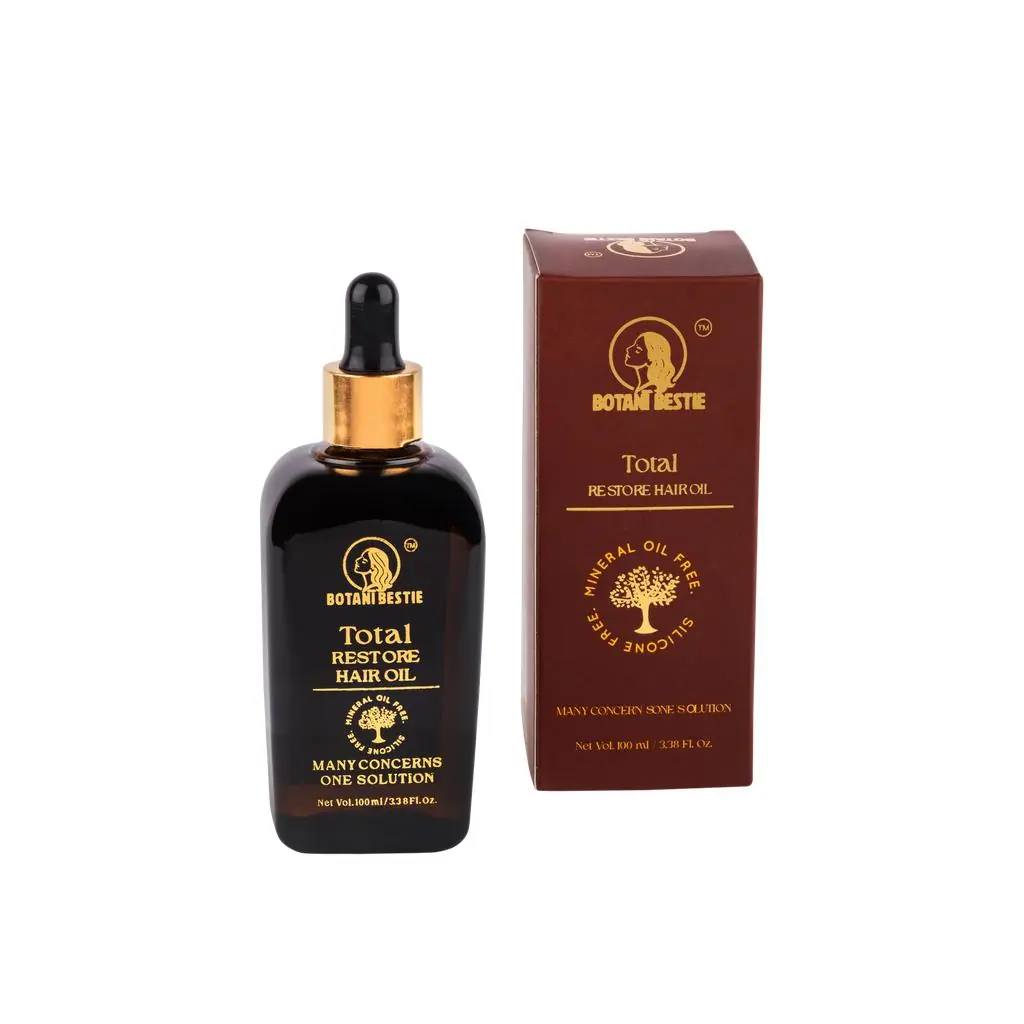
Total Restore Hair Oil — Multi-Mechanism DHT + Hair Growth Formula
Pre-Wash Scalp Treatment — 2–3× per week
- ✔ Onion Oil (Quercetin) — potent 5-AR inhibitor + catalase (H₂O₂ neutralisation) + organosulfur keratin support
- ✔ Amla — tannin-based androgen receptor blocking + richest natural Vitamin C + antioxidant protection
- ✔ Bhringraj — Wnt/β-catenin activation; directly pushes follicles into anagen; 5-AR inhibition via wedelolactone
- ✔ Castor Oil — ricinoleic acid PGD2 inhibition + antifungal + anti-inflammatory base
- ✔ Methi (Fenugreek) — DHT inhibition + Vitamins A, K, C + folic acid for follicle nutrition
- ✔ Brahmi — cortisol-modulating adaptogen; reduces stress-driven telogen effluvium
- ✔ Neem — antifungal (Malassezia control) + antibacterial (folliculitis prevention)
- ✔ 14+ carrier oils — sesame oil base maximises lipid-soluble active delivery to follicle; no mineral oil
How multi-mechanism topical treatment compares to a standalone DHT-blocker approach:
| Mechanism | Finasteride alone | Saw Palmetto alone | Total Restore Hair Oil |
|---|---|---|---|
| 5-alpha-reductase inhibition | ✅ Type II (potent) | ✅ Type I + II (moderate) | ✅ Quercetin + wedelolactone (multiple pathways) |
| Androgen receptor blocking | ❌ | ✅ Beta-sitosterol | ✅ Amla tannins |
| Wnt/β-catenin anagen activation | ❌ | ❌ | ✅ Bhringraj |
| PGD2 inhibition (prostaglandin pathway) | ❌ | ⚠ Indirect only | ✅ Castor oil ricinoleic acid |
| Oxidative stress / H₂O₂ neutralisation | ❌ | ❌ | ✅ Onion oil catalase |
| Scalp inflammation reduction | ❌ | ⚠ Partial (5-LOX) | ✅ Multiple herbs |
| Malassezia / dandruff control | ❌ | ❌ | ✅ Castor oil + Neem |
| Sexual side effect risk | ❌ 2–5% reported | ✅ None documented | ✅ None (topical) |
🎁 Is Your Hair Loss DHT-Driven? Get a Personalised Assessment.
Androgenetic alopecia is one of several hair loss patterns — and DHT-blocking treatment only works when DHT is actually the driver. Book a free personalised hair consultation with our in-house dermatologist to confirm the diagnosis, assess AGA stage, and get a treatment plan calibrated to your specific pattern and severity.
Book Free Hair Consultation → WhatsApp UsFrequently Asked Questions
The Verdict: The Natural DHT Blocker That Earned Its Evidence
Saw palmetto occupies a unique position in the hair loss treatment landscape: it is the only plant-derived DHT blocker with a published head-to-head randomised controlled trial against finasteride. Its result — 38% improvement in hair count versus finasteride's 68% — is honest in what it shows. It is less potent. It is also substantially safer.
For anyone with mild-to-moderate androgenetic alopecia who cannot tolerate finasteride's side effects, who is not ready for pharmaceutical 5-AR inhibition, or who wants to complement Minoxidil with a DHT-targeting mechanism — saw palmetto at 320mg/day of properly standardised liposterolic extract is the most evidence-supported natural option available.
The caveats matter too: it must be the standardised extract, not raw berry powder. It must be taken at the correct dose with food. It must be maintained long-term to sustain any benefit. And it works best as one piece of a multi-mechanism approach — DHT blocking paired with anagen activation, oxidative stress management, and scalp inflammation control — not as a standalone solution to a multi-factor problem.
Shop Total Restore Hair Oil → Free Hair Consultation"38% better is not 68% better — but it is evidence, not anecdote. In natural hair care, that distinction matters."
Ready to make the honest switch?
Our products are built on the same principles as every article we write — pure ingredients, real results, nothing to hide.
Explore Our Products