Thyroid & Hair Loss — How Hypothyroidism and Hyperthyroidism Damage Hair (And What to Do About It)
An estimated 42 million Indians live with thyroid disorders — and diffuse hair loss is one of the first and most persistent symptoms of both an underactive and an overactive thyroid. Yet the mechanisms are completely different, the tests that matter go beyond basic TSH, and hair recovery after treatment is slower than most people expect. This is the complete, honest science guide.
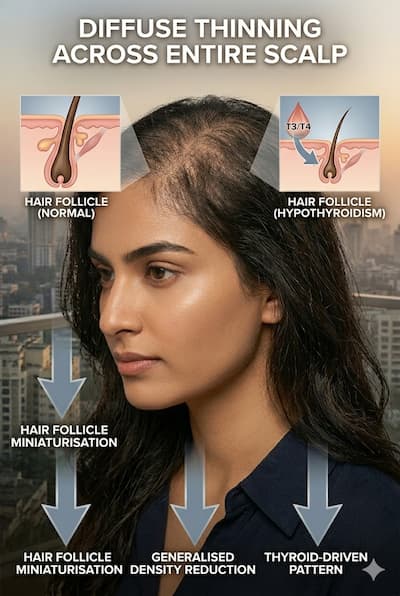
Thyroid dysfunction is one of the most common causes of diffuse, non-patterned hair loss — and one of the most frequently missed, because the hair loss often begins before other thyroid symptoms become obvious, and because the relationship between thyroid hormone levels and hair loss does not always track neatly with TSH values.
India has the world's largest absolute number of thyroid patients — an estimated 42 million cases, with women affected 8–10x more frequently than men, and with Hashimoto's autoimmune thyroiditis being the dominant cause of hypothyroidism. The same autoimmune background that drives Hashimoto's also significantly increases the risk of alopecia areata — meaning thyroid patients can have two simultaneous causes of hair loss operating through completely different mechanisms.
This guide explains exactly how hypothyroidism and hyperthyroidism each damage hair follicles, what tests are needed, what TSH and free hormone levels are actually needed for hair recovery (not just for being 'within range'), and how to support hair regrowth alongside medical treatment.
⚡ Thyroid Hair Loss — Quick Reference
| Feature | Hypothyroidism (Underactive) | Hyperthyroidism (Overactive) |
|---|---|---|
| Hair loss pattern | Diffuse thinning entire scalp; loss of outer eyebrow third | Diffuse thinning; fine, limp hair; rapid shedding |
| Mechanism | Insufficient T3/T4 → shorter anagen, longer telogen, reduced cell division in follicle matrix | Excess T3/T4 → accelerated, abbreviated cycling; micronutrient depletion from elevated metabolic rate |
| Other hair changes | Dry, brittle, coarse hair texture; slow growth rate | Fine, soft, silky hair; rapid growth but poor structural integrity |
| TSH | Elevated (usually >4.5 mIU/L) | Suppressed (usually <0.1 mIU/L) |
| Key tests beyond TSH | Free T3, Free T4, TPO antibodies, TgAb, ferritin | Free T3, Free T4, TSH receptor antibodies (TRAb), ferritin |
| Hair recovery after treatment | 6–18 months after optimal hormone levels achieved; temporary worsening in first 3–6 months is normal | 6–12 months after euthyroid state achieved; similar initial shedding increase |
How Thyroid Hormones Control the Hair Follicle Cycle
The hair follicle is a thyroid-hormone-sensitive organ. Thyroid hormone receptors — specifically thyroid hormone receptor alpha (TRα) — are expressed in the dermal papilla cells, hair matrix keratinocytes, and the outer root sheath. T3 (triiodothyronine), the most biologically active thyroid hormone, binds to these receptors and directly regulates:
Anagen Duration
T3 signals through TRα to extend and sustain the anagen (active growth) phase. Without adequate T3, anagen is abbreviated — follicles cycle faster but produce shorter, thinner hairs before entering telogen.
Matrix Cell Proliferation
Thyroid hormones stimulate proliferation of hair matrix keratinocytes — the cells responsible for producing the hair shaft. T3 deficiency directly reduces the division rate of these cells, producing thinner, weaker hair that grows more slowly.
Melanocyte Function
T3 regulates melanocyte activity in the hair bulb. Both hypothyroidism and hyperthyroidism can alter melanin production in hair, contributing to premature greying. Hypothyroidism is particularly associated with dull, lusterless hair and accelerated greying.
Hypothyroidism & Hair Loss — The Slow Drain
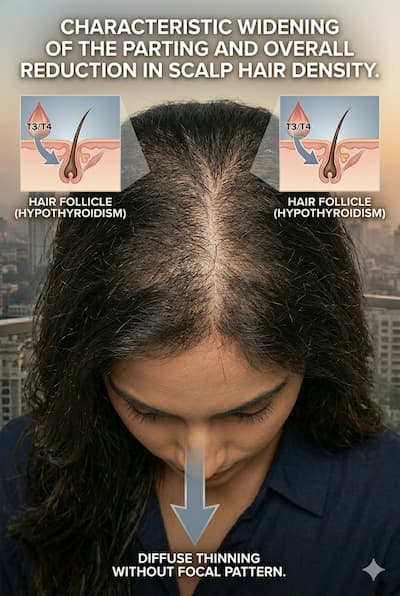
Hypothyroidism — insufficient thyroid hormone production — disrupts hair follicle biology through multiple simultaneous mechanisms. The result is a gradual, diffuse thinning of the entire scalp that develops over months, often well before the classic hypothyroid symptoms (fatigue, weight gain, cold intolerance) become obvious enough to prompt investigation.
The Hypothyroid Hair Loss Mechanism
- Shortened anagen phase: Inadequate T3 signalling through TRα causes premature anagen termination. Follicles spend less time in active growth and more time in resting or shedding phases.
- Impaired matrix cell proliferation: Lower metabolic rate (from insufficient thyroid hormone) reduces the energy available for the high-demand cell division of the hair matrix. Hair grows more slowly and produces a thinner shaft.
- Altered hair shaft protein composition: T3 regulates keratin gene expression. Hypothyroidism results in altered keratin synthesis — producing structurally weaker hair that is dry, brittle, and prone to breakage before it even reaches the shedding phase.
- Associated nutritional deficiencies: Hypothyroidism impairs gastric acid production, reducing absorption of iron, zinc, and B12 from the diet. Many hypothyroid patients have co-existing nutritional deficiencies that independently drive additional hair loss — creating a compounded effect.
The Outer Eyebrow Sign — A Diagnostic Clue
A distinctive clinical sign of hypothyroid hair loss is the loss of the lateral (outer) third of the eyebrows — sometimes called the 'Queen Anne's sign.' This occurs because the eyebrow follicles have a particularly short anagen phase and are among the first follicle populations to be affected by thyroid hormone deficiency. If you notice thinning or complete loss of the outer eyebrows alongside diffuse scalp thinning, hypothyroidism is a strong diagnostic possibility and thyroid function tests should be the first investigation.
Hashimoto's Thyroiditis — The Most Common Cause in India
The majority of hypothyroidism in India is caused by Hashimoto's thyroiditis — an autoimmune condition in which the immune system produces antibodies (anti-TPO, anti-thyroglobulin) that attack and destroy thyroid tissue. Hashimoto's creates an additional layer of complexity for hair loss:
Hashimoto's and Alopecia Areata — The Autoimmune Connection
Patients with Hashimoto's thyroiditis have a significantly elevated risk of alopecia areata — an autoimmune condition in which the immune system attacks hair follicles directly, causing patchy or extensive hair loss that is completely separate from the thyroid's hormonal effect on the hair cycle. These two conditions share a common autoimmune background (dysregulation of regulatory T cells) and frequently co-occur. A Hashimoto's patient can have both diffuse telogen effluvium from hypothyroidism AND patchy alopecia areata from the autoimmune component — simultaneously, and requiring different treatments. If you have Hashimoto's and your hair loss pattern is patchy rather than purely diffuse, request evaluation for alopecia areata.
Even euthyroid patients (TSH within normal range) with elevated TPO antibodies can experience autoimmune-driven hair loss. In this scenario, managing the autoimmune activity — not just TSH — is the relevant intervention.
Hyperthyroidism & Hair Loss — The Opposite Problem
While hypothyroidism slows the hair cycle, hyperthyroidism accelerates it — but acceleration does not mean improvement. An over-driven hair cycle produces abbreviated, thinner hairs and eventually pushes more follicles into simultaneous telogen, causing the same diffuse shedding pattern despite the opposite hormonal state.
| Mechanism | What Happens | Hair Effect |
|---|---|---|
| Accelerated metabolic rate | Every cell process runs faster — including the hair cycle. Anagen phases are shorter; follicles cycle more rapidly through growth and rest. | Fine, silky hair that grows quickly but is structurally weak and has a shortened lifespan. Rapid synchronisation of large numbers of follicles into telogen produces diffuse shedding. |
| Micronutrient depletion | Hyperthyroid metabolism diverts iron, zinc, B vitamins, and amino acids at extraordinary rates to fuel systemic metabolic acceleration. Hair follicles are outcompeted for these resources by organs with higher metabolic priority. | Secondary nutritional deficiency hair loss co-exists with the direct hormonal effect — compounding the shedding. |
| Elevated cortisol (stress response) | The hyperadrenergic state of hyperthyroidism elevates cortisol, which inhibits the anagen phase of hair follicles through glucocorticoid receptor signalling in the dermal papilla. | Additional telogen effluvium layer on top of the primary hyperthyroid hair loss mechanism. |
| Graves' disease — autoimmune component | Graves' disease (the most common cause of hyperthyroidism) involves TSH-receptor antibodies — an autoimmune condition that, like Hashimoto's, elevates alopecia areata risk. | Patchy alopecia areata can co-exist with the diffuse hyperthyroid shedding in Graves' patients. |
Testing Beyond TSH — What Actually Matters for Hair
TSH is the standard first-line thyroid test — and it is a reasonable screening tool. But TSH alone is insufficient for understanding thyroid hair loss, for several reasons:
TSH (thyroid-stimulating hormone) is produced by the pituitary gland in response to thyroid hormone levels. High TSH indicates the pituitary is pushing the thyroid to produce more hormone (hypothyroidism); low TSH indicates the pituitary is suppressing production (hyperthyroidism).
The limitation: TSH 'within the normal range' (0.5–4.5 mIU/L) does not mean your thyroid hormone levels are optimal for hair follicle function. Evidence suggests that for hair recovery in hypothyroid patients, TSH below 2.0 mIU/L produces better outcomes than any value within the wide normal range. A TSH of 4.2 mIU/L is technically normal — but associated with ongoing hypothyroid symptoms including hair loss in a significant proportion of patients.
Target for hair recovery in hypothyroidism: Discuss with your endocrinologist targeting TSH of 1.0–2.0 mIU/L, not merely within the normal range.
T4 (thyroxine) is the main hormone produced by the thyroid gland. It is largely inactive until converted to T3 (triiodothyronine) — the active form that actually binds TRα receptors in the hair follicle. Some patients have normal TSH and T4 but impaired T4-to-T3 conversion, resulting in low free T3 and ongoing hair loss. This is called 'low T3 syndrome' and is not detected by TSH alone.
Standard levothyroxine (synthetic T4) treatment does not always correct low T3, because conversion depends on deiodinase enzymes that can be impaired by inflammation, selenium deficiency, and other factors. Some patients require combination T4/T3 therapy (liothyronine) to correct persistent low T3 — this is a specialist decision but is relevant for patients with ongoing hair loss despite normal TSH on levothyroxine.
Anti-thyroid peroxidase antibodies (TPO Ab) and anti-thyroglobulin antibodies (TgAb) are markers of autoimmune thyroid disease. Positive antibodies confirm Hashimoto's (in hypothyroidism) or Graves' (in hyperthyroidism) and indicate that the autoimmune component is active.
Critically: elevated TPO antibodies in a patient with normal TSH (euthyroid Hashimoto's) can still cause hair loss through the autoimmune pathway — specifically by co-existing alopecia areata or through the local inflammatory effect of thyroid autoimmunity. This is a common scenario in India that is routinely missed when only TSH is tested.
Ferritin: Both hypo and hyperthyroidism impair iron absorption and metabolism. Concurrent iron deficiency (low ferritin) is extremely common in thyroid patients — often responsible for a significant additional layer of hair loss on top of the thyroid-driven component. Target ferritin above 70 ng/mL.
Selenium: Selenium is an essential cofactor for the deiodinase enzymes that convert T4 to active T3. Selenium deficiency impairs T4-to-T3 conversion and has its own association with autoimmune thyroid disease. India has regions of selenium-poor soils; testing serum selenium and supplementing 100–200 mcg/day (from selenomethionine) if deficient can improve both thyroid function and hair quality.
Zinc and B12: Both are commonly co-depleted in thyroid patients due to the metabolic effects of thyroid dysfunction on gut absorption and micronutrient utilisation. A comprehensive panel as described in our nutritional deficiency guide is appropriate for any thyroid patient with ongoing hair loss despite treatment.
💡 Thyroid levels 'normal' but still losing hair? Our dermatologist reviews your complete thyroid panel and builds a hair recovery plan that accounts for your specific thyroid picture.
Book Free Hair Consultation →Hair Recovery After Thyroid Treatment — The Realistic Timeline
Starting levothyroxine or antithyroid treatment often produces an initial worsening of hair shedding — sometimes dramatically. This is not a sign that the treatment is wrong. As thyroid levels normalise, the follicles that were locked in an extended telogen phase (in hypothyroidism) or an accelerated cycling pattern (in hyperthyroidism) begin to re-synchronise. This mass re-synchronisation releases large numbers of telogen hairs simultaneously. The shedding peaks at approximately 4–8 weeks after treatment initiation and then progressively declines as the follicles re-establish healthy cycling. Continue treatment; inform your doctor of the shedding but do not stop the medication based on this predictable phase.
If thyroid levels are approaching optimal (TSH 1.0–2.0 mIU/L for hypothyroid patients), daily shedding will normalise by months 3–6. Fine new hairs become visible at the hairline and parting. This phase requires patience and continued treatment compliance — interrupting medication at this stage is one of the most common causes of relapse and prolonged recovery. Re-test thyroid function at 6–8 weeks after any dose change to confirm levels are optimal.
New anagen hairs, growing at approximately 1 cm/month, become visible at 6 months as 6 cm of new growth. Density visibly improves in the parting and at the temples. Full density recovery is typically not complete until 12–18 months after optimal hormone levels are achieved and maintained. The degree of recovery depends on: how long the thyroid dysfunction was untreated (longer untreated = more follicle miniaturisation), co-existing nutritional deficiencies corrected simultaneously, and whether autoimmune alopecia areata is a concurrent component.
Some thyroid patients achieve normal hormone levels but retain residual hair thinning. The most common reasons: (1) co-existing untreated nutritional deficiency (most often iron deficiency — ferritin below 40 ng/mL — that was never tested or corrected); (2) co-existing androgenetic alopecia (genetic pattern hair loss) that was unmasked or accelerated by the thyroid condition; (3) co-existing autoimmune alopecia areata not separately treated; (4) free T3 remains low despite normal TSH and T4, impaired by selenium deficiency or conversion issues. A full work-up addressing all four is appropriate for any thyroid patient with persistent hair loss on treatment.
Topical Support During Thyroid Hair Recovery
Topical hair care cannot replace thyroid hormone optimisation — but during the recovery phase, scalp-applied actives can meaningfully reduce additional stressors on the follicle and support the transition of reactivating follicles back into anagen.
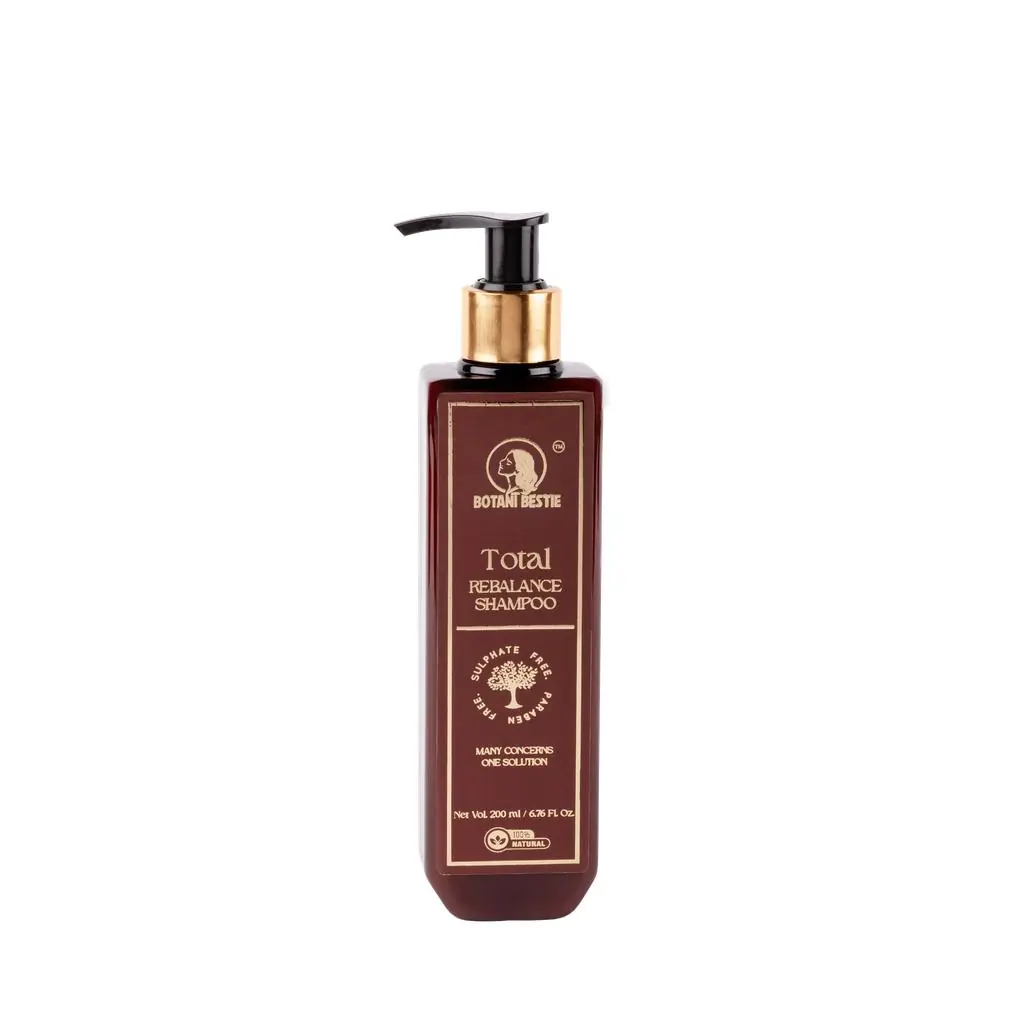
Total Rebalance Shampoo
Gentle Cleanse — 2–3x weekly
Thyroid-affected scalps are often sensitised — the hypothyroid scalp is dry, itchy, and prone to inflammation; the hyperthyroid scalp is often oily and vulnerable to seborrheic inflammation. A sulphate-free, pH-balanced formula prevents the scalp barrier disruption that compounds the follicle stress of thyroid-driven shedding. Rice water (inositol repairs cuticle damage), Bhringraj (adapts to scalp needs; 5α-reductase inhibition is relevant when DHT sensitivity is co-existing), and EGCG from green tea (anti-inflammatory; reduces scalp prostaglandin D2 that inhibits anagen) are the key actives during the recovery phase.
Shop Total Rebalance Shampoo →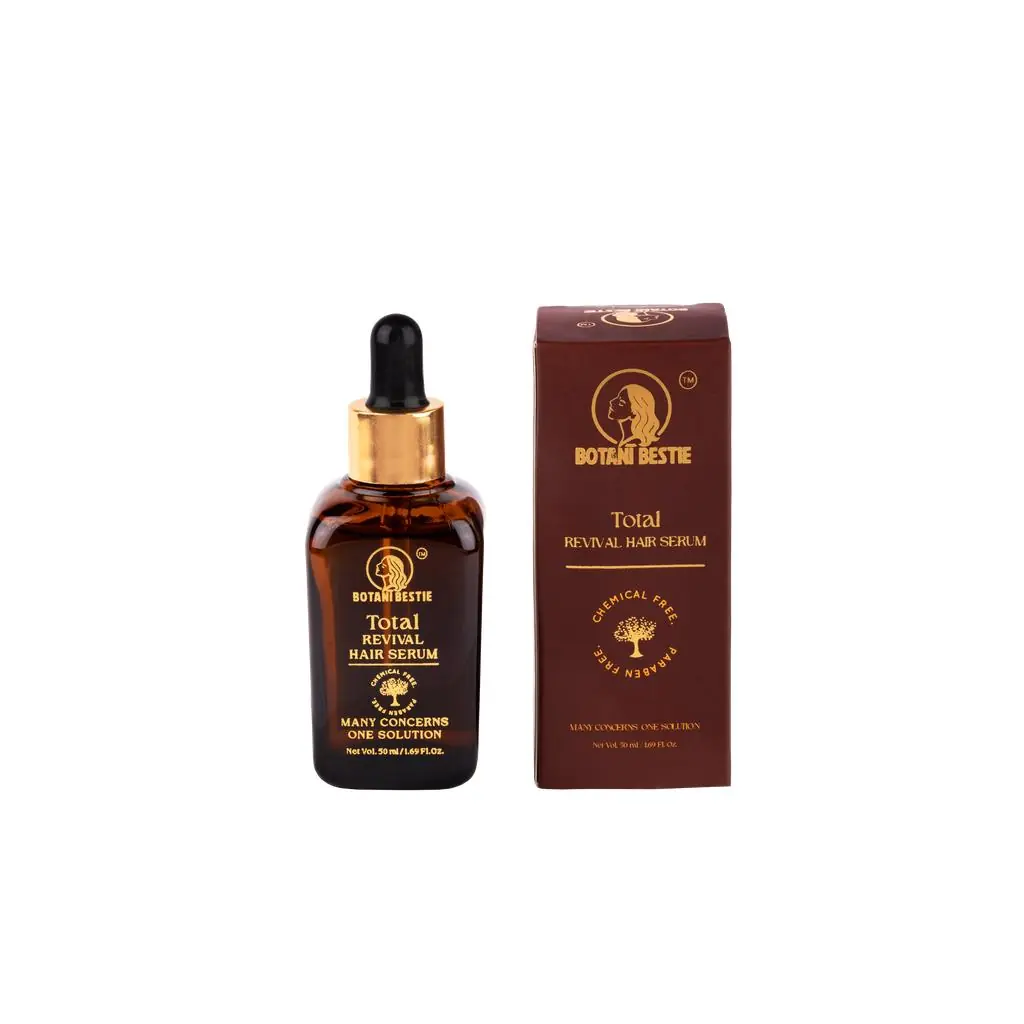
Total Revival Hair Serum
Daily Scalp Serum — AM or PM
As thyroid levels normalise, dormant follicles receive the hormonal signal to re-enter anagen — but the local follicle growth environment may remain suboptimal. Redensyl (DHQG + EGCG: activates hair follicle stem cells in the bulge region, documented clinical superiority over minoxidil in anagen promotion), Procapil (anchors the follicle's connective tissue attachment — prevents the loose follicle-matrix connection that causes traction shedding during the recovery phase), and Anagain (Ana:Tel ratio improver) provide the local biotech signals that support the thyroid-prompted re-entry into anagen. Apply daily to the scalp in the recovery phase.
Shop Total Revival Hair Serum →Thyroid-Related Hair Loss? Get a Targeted Assessment
Our in-house dermatologist reviews your thyroid panel — TSH, free T3/T4, antibodies, and associated nutritional tests — and builds a hair recovery protocol that addresses every contributing factor, not just TSH. No purchase required.
Book Free Consultation → WhatsApp UsFrequently Asked Questions
The Bottom Line: TSH Alone Is Not Enough — Optimise Everything
Thyroid hair loss is complex because the thyroid system interacts with the hair follicle at multiple levels: direct hormonal signalling through TRα receptors, indirect effects through metabolic rate and micronutrient depletion, and autoimmune pathways that can cause concurrent alopecia areata entirely independent of hormone levels.
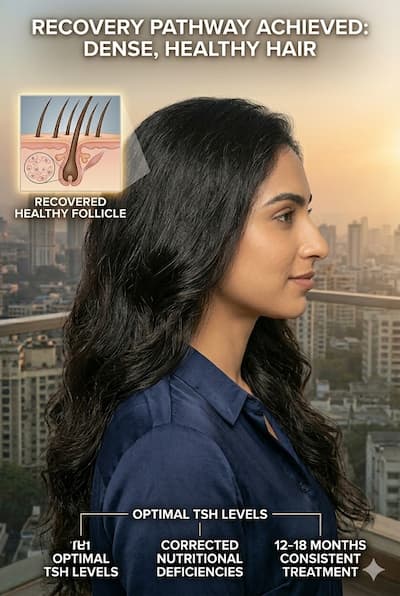
Getting TSH 'within range' is the start, not the finish. The goal is TSH below 2.0 mIU/L, free T3 in the upper half of normal, TPO antibodies ideally trending down, and ferritin above 70 ng/mL — all simultaneously. Only then do the follicles receive the full complement of hormonal and nutritional signals required for healthy cycling.
The timeline is non-negotiable: 6–18 months of maintained optimal levels for full hair recovery. But the recovery, when the conditions are right, is real and often complete.
Shop Total Revival Hair Serum → Free Hair Consultation"The thyroid is the conductor. When it is off-key, every organ feels it — but the hair follicle feels it first."
Ready to make the honest switch?
Our products are built on the same principles as every article we write — pure ingredients, real results, nothing to hide.
Explore Our Products