Hyaluronic Acid for Skin — What It Does and Why Indian Skin Needs It
Hyaluronic acid can hold 1,000 times its weight in water. It is one of the most validated skincare ingredients in dermatology. But in India's climate extremes — from coastal humidity to dry northern winters and air-conditioned offices — it can work brilliantly or backfire completely depending on how you use it.
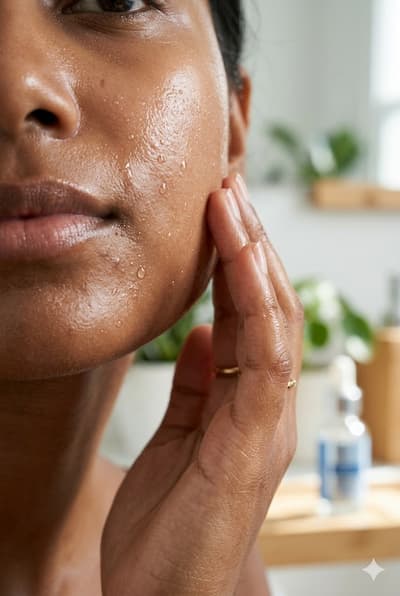
Hyaluronic acid (HA) is the most searched skincare ingredient globally — and one of the most misunderstood. The marketing around it is simple and compelling: "holds 1,000 times its weight in water, makes skin plump and dewy." The science is more nuanced.
The molecule size of HA determines where in the skin it works. The environmental humidity determines whether it draws water into skin or pulls it out. The layering order determines whether it delivers any benefit at all.
For Indian skin — which spans Fitzpatrick types III–VI, faces UV exposure of index 8–12 for much of the year, and lives in one of the most climatically varied countries in the world — getting HA right is both important and specific. This guide covers all of it.
What Hyaluronic Acid Actually Is
Hyaluronic acid is a glycosaminoglycan — a long-chain polysaccharide — that is naturally produced by the body in skin, joints, eyes, and connective tissue. In healthy young skin, the dermis and epidermis contain substantial amounts of HA, keeping the skin matrix hydrated, elastic, and structured. Dermal fibroblasts produce HA continuously; it is degraded and replaced every 1–2 days.
From the age of 25, HA production in skin begins to decline — with a measurable reduction of 50% by age 50. UV exposure, smoking, and pollution accelerate this decline. The result is visibly less plump, thinner, more lined skin that recovers less quickly from environmental stress.
How HA Works: The Humectant Mechanism
HA is a humectant — it attracts water molecules from the environment (transepidermal from the dermis, or from ambient humidity) and binds them in the skin tissue. Each HA molecule can form hydrogen bonds with up to 1,000 water molecules, creating a gel-like hydrated matrix. This makes skin appear plumper, lines appear shallower, and skin texture appear smoother — not by changing skin structure, but by increasing water content.
Topical HA also reduces transepidermal water loss (TEWL) — the evaporation of water from skin to air — by creating a temporary hydrophilic film on the surface. This is distinct from occlusive moisturisers (which physically block evaporation) — HA's water-holding ability keeps the film hydrated rather than blocking evaporation physically.
The Most Important Thing Nobody Tells You: Molecule Size Matters
Not all hyaluronic acid in a product is equivalent. The molecular weight (MW) of HA determines how deep it penetrates — and therefore what it actually does in skin. Products that do not specify MW are typically using only one size, missing significant benefit.
Above 1,000 kDa
Where it works: Outermost skin surface (stratum corneum)
What it does: Forms a moisture-holding film on the skin surface; immediate plumping and hydration visible; reduces TEWL; provides tactile softness and dewiness.
Best for: Immediate visible effect, dry skin types, anyone who wants quick results.
50–300 kDa
Where it works: Deeper epidermis (spinous + basal layers)
What it does: Penetrates further into the epidermis; hydrates lower cell layers; supports keratinocyte function; helps repair a compromised skin barrier from the inside of the epidermis.
Best for: Dry or damaged skin barrier, dehydration at depth, anti-ageing.
The salt form
Where it works: Surface to mid-epidermis
What it does: The salt form of HA — smaller and more stable than HA, penetrates slightly better. Most skincare products use sodium hyaluronate rather than pure HA due to its stability. Equally effective.
Best for: All-purpose hydration; is the most common form in serums and moisturisers.
How India's Climate Affects Hyaluronic Acid — The Critical Variable
This is the section most HA guides skip — and it is the most relevant for anyone in India. HA is a humectant, which means it draws moisture from whatever source is available. In high humidity, it draws from the air. In low humidity, it draws from the dermis. The consequence is dramatically different.
| Region / Season | Typical Humidity | HA Performance | What to Do Differently |
|---|---|---|---|
| Mumbai, Chennai, Kochi, Kolkata (year-round) | 65–90% | Excellent — draws moisture from humid air efficiently; skin stays hydrated throughout the day. | Lightweight moisturiser is sufficient after HA. Avoid heavy occlusives — can cause pilling in high humidity. |
| Delhi, Jaipur, Lucknow (monsoon / summer) | 60–80% | Good — humidity adequate for HA to draw from air. | Standard application: damp skin + HA serum + light moisturiser. Sunscreen over all. |
| Delhi, Jaipur, Chandigarh (November–February) | 20–35% | Problematic if applied to dry skin — HA draws moisture from dermis and then it evaporates into dry air, increasing dryness. Classic "HA made my skin drier" complaint. | Apply on damp skin (mist face first), immediately follow with a richer moisturiser with ceramides or squalane to seal. Never apply HA and leave bare skin in winter. |
| Air-conditioned offices / flights (anywhere in India) | 20–30% | Same as dry climate — AC removes humidity. Same precautions apply. | Keep a facial mist in your desk/bag. Reapply moisturiser mid-day if skin feels tight. |
| Bangalore, Pune (most of the year) | 50–65% | Very good — moderate humidity, HA performs predictably. | Standard routine works. Slightly richer moisturiser in December–January if humidity dips. |
What Hyaluronic Acid Does Not Do (Common Myths)
Myth: HA fades dark spots
HA is a humectant — it has no melanin-inhibiting activity. It does not fade PIH, melasma, or any form of pigmentation. Dark spot treatment requires tyrosinase inhibitors (niacinamide, Vitamin C, licorice) or chemical exfoliants (salicylic acid, AHA). Well-hydrated skin does look brighter — but that is a hydration glow, not spot fading.
Myth: HA has anti-ageing effects equivalent to retinol
HA hydrates — this makes fine lines and wrinkles appear less visible because plumped skin reflects light differently. But it does not increase collagen synthesis, does not accelerate cell turnover, and does not reverse photoageing. For actual anti-ageing at the structural level, retinol and Vitamin C (collagen precursor) are required. HA and retinol are complementary, not equivalent.
Myth: More HA layers = more hydration
Applying three different HA products does not provide three times the hydration. There is a saturation point in the skin's water-holding capacity. Using one well-formulated HA serum with multiple molecular weights is more effective than layering multiple single-MW products.
Myth: HA irritates acne-prone skin
HA does not cause acne or irritation. It is non-comedogenic, non-irritating, and has no exfoliating action. The confusion comes from serums that contain HA alongside irritating or comedogenic co-ingredients. Pure HA or sodium hyaluronate is appropriate for acne-prone skin and can improve the compromised skin barrier that makes acne-prone skin more reactive.
How to Use Hyaluronic Acid in an Indian Skin Routine
- Gentle face wash — removes overnight sebum without stripping. A pH-balanced cleanser preserves your skin's natural acid mantle, which is important for HA absorption.
- Vitamin C serum (optional, if using) — apply on damp skin. Thinnest, most water-soluble active. Allow 60 seconds to absorb.
- Hyaluronic acid serum — apply on damp skin (spritz water mist if your face dried). Smooth over face and neck. Allow 30–60 seconds.
- Moisturiser — seals the hydration. Choose lightweight gel-cream in humid months; richer cream with ceramides in dry months. This step is not optional with HA — without a sealant, moisture evaporates.
- Sunscreen — SPF 30–50+ PA++++. Indian UV index makes daily SPF non-negotiable for Fitzpatrick III–VI skin prone to PIH.
- Gentle face wash — removes sunscreen, pollution, and daytime sebum.
- Active serums (niacinamide, retinol, AHA — if using) — apply before HA. Actives go on closest to clean skin for maximum penetration.
- Hyaluronic acid serum — on damp skin, after actives. HA's hydration buffers any potential irritation from actives like retinol or AHAs — this is a key reason to layer HA after retinol rather than before.
- Night moisturiser — can be richer than daytime. A ceramide-based night cream over HA maximises barrier repair overnight.
This is the least discussed but most practically important point. A harsh face wash (SLS-based, high pH) strips natural moisturising factors (NMF) and disrupts the skin barrier with every wash. A disrupted barrier loses water faster — TEWL increases. This means that even a well-applied HA serum loses its benefit faster because the impaired barrier cannot retain the water HA attracted.
A gentle, pH-balanced face wash — ideally one that does not strip the NMF — is the prerequisite for HA working consistently. This is why Total Radiance Face Wash is formulated around gentle, pH-balanced cleansing: it removes what needs to be removed without disrupting the skin's water-retention capacity that HA depends on.
Total Radiance Face Wash
pH-balanced, gentle cleansing — the foundation for effective HA application. Does not strip skin barrier or natural moisturising factors.
Hyaluronic Acid vs Other Hydrating Ingredients
| Ingredient | Type | Mechanism | Best For | Can Combine? |
|---|---|---|---|---|
| Hyaluronic Acid | Humectant | Draws and binds water in skin | Surface to mid-epidermal hydration; all skin types | Yes — with everything |
| Glycerin | Humectant | Draws water, smaller molecule than HA | Deep epidermal hydration; budget HA alternative | Yes — with HA (complementary) |
| Niacinamide | Barrier strengthener | Increases ceramide production; strengthens tight junctions | Barrier repair, pore appearance, dark spots, oil control | Yes — excellent with HA |
| Ceramides | Occlusives + barrier lipids | Restores lipid bilayer in stratum corneum; reduces TEWL | Damaged barrier, eczema, dry sensitive skin | Yes — apply over HA to seal |
| Squalane | Emollient / Occlusive | Seals moisture; mimics skin's natural squalene | Sealing HA moisture in; lightweight oil step | Yes — apply over HA |
| Aloe Vera | Humectant + soothing | Natural HA-like polysaccharides; anti-inflammatory | Soothing irritated skin; lightweight hydration; India's natural HA alternative | Yes — Aloe + HA is a natural-forward hydration stack |
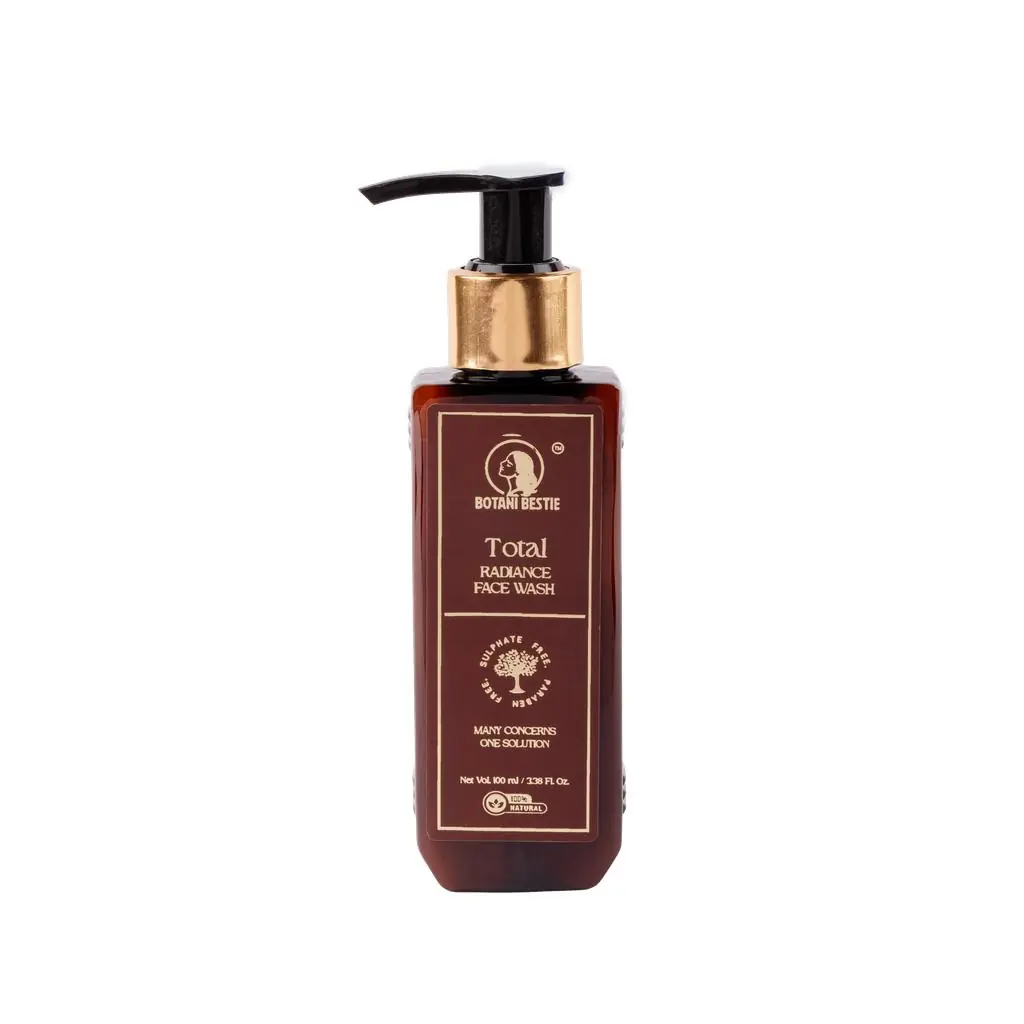
Total Radiance Face Wash
by Botani Bestie — pH-balanced brightening cleanser
The foundation of any effective HA routine. Formulated with Salicylic Acid (gentle exfoliation, unclogs pores), Niacinamide (barrier strengthening, dark spot control), Vitamin C (brightening), and Turmeric (anti-inflammatory) in a gentle, pH-balanced base. Does not strip natural moisturising factors — ensures your skin barrier remains intact for HA to work optimally.
- pH-balanced formula — preserves skin acid mantle
- No SLS — does not strip skin barrier or moisture retention capacity
- Salicylic Acid for pores + Niacinamide for barrier — the right preparation for HA application
- Works for acne, dark spots, and pigmentation alongside its cleansing role
Frequently Asked Questions
"In coastal India, HA is effortless. In dry-season Delhi, it needs sealing. The ingredient is the same — only the application needs adapting."
Ready to make the honest switch?
Our products are built on the same principles as every article we write — pure ingredients, real results, nothing to hide.
Explore Our Products