Best Hair Oil for Hair Growth in India (2025) — What the Ingredient Lists Actually Say
India's hair oil market is one of the largest in the world — and one of the most marketing-saturated. Most products are predominantly mineral oil or coconut oil with Ayurvedic herb names on the label and trace-level actives inside. This guide tells you how to read the label, what actives have actual clinical evidence, and what to actually look for before you buy.
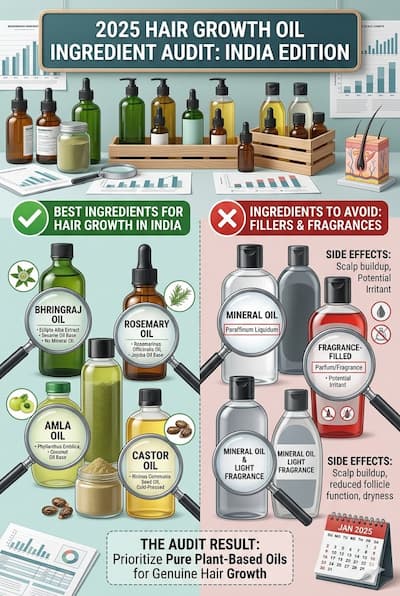
The Indian hair oil market is worth thousands of crores and growing. The average Indian consumer encounters dozens of options — from budget coconut and mineral oil blends to premium Ayurvedic formulations priced at ₹500–₹2000 per bottle. Most are bought on the strength of celebrity endorsements, traditional familiarity, or "100 herbs" marketing claims.
Here is the honest reality: the first three to five ingredients in any cosmetic formulation make up 80–90% of the product by weight. If those positions are occupied by mineral oil (paraffinum liquidum), plain coconut oil, or fragrance, every "active" herb listed after them is present at concentrations too low to have a meaningful physiological effect on the hair follicle.
For hair oil to promote growth — rather than simply condition the hair shaft — it needs to deliver growth-active compounds to the scalp at concentrations proven to affect follicle biology. This requires both the right actives and the right base oil to carry them. Neither mineral oil nor plain coconut oil qualifies as an effective carrier for scalp-targeting growth actives.
This guide decodes the ingredient label so you can evaluate any oil in 60 seconds — and identifies the five actives with the strongest clinical evidence for hair growth in the Indian context.
The 5 Ingredients That Actually Promote Hair Growth in Oils
These are not traditional claims — each has published clinical or mechanistic evidence for hair follicle activity at scalp-achievable concentrations:
🌿 Bhringraj (Eclipta prostrata)
INCI name to look for: Eclipta prostrata extract / Eclipta alba extract
Mechanisms: Promotes hair follicle dermal papilla cell proliferation; mild 5α-reductase inhibition (reduces DHT conversion at follicle level); anti-inflammatory via wedelolactone (reduces perifollicluar cytokine load); extends anagen phase duration.
Evidence: 2009 Journal of Ethnopharmacology study: Bhringraj extract produced comparable hair follicle density improvement to Minoxidil 2% in some pre-clinical parameters. Multiple human studies showing reduced hair fall with consistent use.
Meaningful concentration: Should appear before the 1% threshold on the ingredient list (before preservatives like Phenoxyethanol or Tocopherol at high position numbers)
🌲 Rosemary (Rosmarinus officinalis)
INCI name to look for: Rosmarinus officinalis leaf oil / Rosmarinus officinalis leaf extract
Mechanisms: Inhibits 5α-reductase (blocking DHT at the follicle); increases scalp microcirculation via carnosic acid activation; anti-inflammatory; promotes dermal papilla cell proliferation.
Evidence: The gold standard — a published RCT (Skinmed, 2015) compared Rosemary oil head-to-head with Minoxidil 2% over 6 months. Both groups showed equivalent hair count improvement. Rosemary group had significantly less scalp itching and dryness.
Note: Rosemary leaf oil (essential oil) and Rosemary extract have different profiles. Both are beneficial; extract is gentler for sensitive scalps.
🍃 Amla (Phyllanthus emblica)
INCI name to look for: Phyllanthus emblica fruit extract / Emblica officinalis extract
Mechanisms: Emblicanin A & B antioxidants protect follicles from oxidative stress; Vitamin C content supports collagen in the follicle dermal sheath; documented anagen phase extension in clinical setting.
Evidence: 2024 triple-blind RCT confirmed Amla supplementation significantly increases anagen-to-telogen ratio in women with androgenetic alopecia — the most recent and strongest clinical data for any Ayurvedic ingredient.
Meaningful concentration: Higher in the ingredient list = higher concentration. Amla listed as one of the first five to eight ingredients indicates therapeutically relevant inclusion.
🛢️ Castor Oil (Ricinus communis)
INCI name to look for: Ricinus communis seed oil
Mechanisms: Ricinoleic acid has documented antifungal activity against Malassezia globosa and M. restricta (reducing scalp inflammation that suppresses hair growth); its viscous film supports scalp barrier integrity; may modulate prostaglandins involved in hair growth signalling.
Evidence: J. Am. Oil Chemists' Society study confirms antifungal activity. Widely used in evidence-based hair care formulations. Unlike coconut or olive oil, it is NOT a Malassezia substrate — making it safe for dandruff-prone scalps.
Usage note: Best used as part of a pre-wash treatment blend; pure castor oil alone can be difficult to rinse out completely without the right shampoo.
🍵 Brahmi + Green Tea EGCG
INCI names: Bacopa monnieri extract (Brahmi); Camellia sinensis leaf extract (Green Tea)
Mechanisms: Brahmi: contains bacosides and alkaloids that promote scalp microcirculation and reduce scalp oxidative stress; traditional Ayurvedic use for hair thickening supported by emerging clinical data. Green Tea EGCG: a 2025 ScienceDirect study found EGCG promotes dermal papilla cell proliferation via VEGFA pathway; also sebum-regulating and anti-inflammatory at the follicle level.
Best used as: Complementary actives in a multi-mechanism formula alongside Bhringraj and Rosemary — they address different pathways simultaneously, creating a broader intervention against hair fall.
The 4 Ingredients That Signal a Filler Product
🚫 When these appear in positions 1–3 of the ingredient list, the product is primarily a filler — regardless of what the marketing says:
| Ingredient | What It Is | Why It's a Filler for Hair Growth |
|---|---|---|
| Mineral Oil (Paraffinum Liquidum) |
Petroleum derivative; inert occlusive agent | Coats hair shaft cosmetically; zero follicle penetration; no growth actives; no antifungal activity; cannot deliver herb extracts to the scalp |
| Perfume / Fragrance / Parfum | Synthetic fragrance blend | No hair benefit; common contact allergen and scalp sensitiser; can trigger the same inflammation pathway as Malassezia; any hair oil with fragrance in top 10 is prioritising smell over function |
| Dimethicone / Silicone derivatives | Synthetic silicone polymer | Creates instant shine by coating the hair shaft; has no follicle benefit; builds up with repeated use, eventually dulling the hair and potentially blocking follicle openings on the scalp; creates dependency (hair looks dull without it) |
| "Ayurvedic blends" listed last | Herb extracts at trace concentration | If 15–20 herb names appear clustered at the end of a 25+ ingredient list, each is present at <0.1% — below any clinically meaningful concentration. This is marketing decoration, not formulation. A longer ingredient list is not better. |
How to Read a Hair Oil Label in 60 Seconds
Cosmetic ingredients are listed in descending order of concentration (INCI convention, required in India under BIS standards). This single rule gives you all the information you need:
The first five ingredients make up 80–90% of the formula. If you see Paraffinum Liquidum (mineral oil) as #1 or #2, this is a mineral-oil-base product — every herb listed after it is present in trace quantities. If you see Cocos nucifera (Coconut) oil as #1, the product is a coconut oil base — which is fine for a conditioner but not ideal for a growth-oriented scalp treatment (oleic acid feeds Malassezia). The ideal positions 1–3 for a growth oil: sesame oil (Sesamum indicum), castor oil (Ricinus communis), or a named carrier blend without mineral oil.
Look for: Eclipta prostrata (Bhringraj), Rosmarinus officinalis (Rosemary), Phyllanthus emblica (Amla), Bacopa monnieri (Brahmi), Camellia sinensis (Green Tea), Nardostachys jatamansi (Jatamansi). These should appear in the first half of the ingredient list — before preservatives like Phenoxyethanol or BHT — to indicate meaningful concentration. A product listing 20 herb names all after the preservatives is presenting them at functionally irrelevant concentrations.
Fragrance / Parfum appearing anywhere in a scalp-applied product is a concern for scalp sensitivity. Fragrance is a known contact allergen; applied to an already-inflamed or Malassezia-stressed scalp, it can worsen the inflammatory cycle. A well-formulated growth oil achieves its sensory profile through the natural aroma of its active ingredients (Rosemary, castor, Bhringraj) — not through added fragrance. If you are prone to scalp irritation, itching, or dandruff, always choose fragrance-free.
A 40-ingredient oil is not four times better than a 10-ingredient oil. Each additional ingredient at trace concentration dilutes the formula without adding functional benefit. More importantly, 40 herb names in a label often means 40 extracts at 0.01% — which is marketing, not formulation. A tightly formulated oil with 8–12 thoughtfully chosen actives at meaningful concentrations is typically more effective than a "100 herbs" product where the first ingredient is mineral oil and each herb is present at homeopathic levels.
India's Hair Oil Categories — What the Ingredient Patterns Actually Say
We cannot audit individual brand ingredient lists on your behalf — brands change formulations and concentrations without notice. But we can identify the ingredient patterns that define common product categories in India's hair oil market, so you know what to look for on any label:
| Product Category | Typical Ingredient Pattern | Base Oil | Growth Actives? | Verdict |
|---|---|---|---|---|
| Budget mineral oil blends (mass-market, ₹50–150 range) |
Paraffinum liquidum #1–2, Cocos nucifera, fragrance, trace herb extracts at end | Mineral oil | No — actives are decorative | Conditioning only; no growth benefit |
| Mid-range "Ayurvedic" blends (₹150–400 range) |
Sesame or coconut base, 10–15 herb names (often including Bhringraj, Amla), sometimes includes mineral oil, fragrance present | Sesame or Coconut | Partial — depends on position of herb extracts; fragrance reduces scalp tolerance | Better base; check herb position and fragrance |
| Premium Ayurvedic / clinical oils (₹400–800 range) |
Named carrier oils as base, Bhringraj or Rosemary in top-10 positions, INCI-labelled extracts, often no mineral oil | Sesame, Castor, or blend | Yes — if actives are in first half of list | Good — verify active positions on specific product's label |
| Salon serum-type oils (₹600–2000 range) |
Cyclopentasiloxane or Dimethicone dominant, some biotech actives (Redensyl/Procapil), lightweight texture | Silicone | Minimal scalp benefit; shine-focused | Shine product marketed as growth oil |
| Botani Bestie Total Restore Hair Oil | Sesame + Castor base, Bhringraj (top-6 position), Amla, Neem, Brahmi, Green Tea EGCG, Jatamansi, Rosemary. No mineral oil. No fragrance. No silicone. | Sesame + Castor (antifungal + barrier) | Full multi-mechanism growth stack | Comprehensive Ayurvedic active formula |
What Type of Oil Is Right for Your Hair Issue?
Priority actives: Castor oil (ricinoleic acid antifungal), Neem (azadirachtin antifungal), Tea Tree extract. Avoid: Coconut oil and olive oil as primary scalp base — oleic acid feeds Malassezia. Sesame base is appropriate. The Bhringraj-Castor-Neem combination specifically addresses both the Malassezia scalp issue (antifungal actives) and the hair fall (growth stimulation + anti-inflammatory) simultaneously.
Priority actives: Bhringraj (5α-reductase inhibition), Rosemary (DHT + microcirculation), Saw Palmetto extract if included. Combine the oil with a Redensyl/Procapil-containing serum for stem-cell-level support that an oil cannot provide. The DHT pathway requires consistent, long-term use of blocking actives — results at 3–6 months are typical with the right ingredients.
Priority: sesame or Amla-based oils for shaft moisture and barrier restoration. Apply to lengths as well as scalp. Avoid heavy castor oil on lengths (creates buildup without proper rinsing). Argan or sesame on lengths with a Bhringraj-Amla blend on the scalp — this combination addresses both the breakage issue (shaft conditioning) and the growth issue (follicle nutrition) simultaneously.
Choose lightweight carrier oils (sesame, jojoba) rather than heavy ones (castor alone, coconut). Apply only to scalp sections, not all-over. Use as a 30-minute pre-wash treatment only — never leave overnight. An oily scalp still benefits from scalp-active ingredients (Bhringraj, Neem, Green Tea EGCG) — the goal is not to add more oil but to deliver the active compounds. Thorough washing after the treatment is essential to prevent sebum buildup that would worsen oiliness.
💡 Not sure which oil ingredients are right for your specific hair fall pattern? Our dermatologist can help you identify the right actives for your case.
Book Free Consultation →Total Restore Hair Oil — The Ingredient Breakdown
Every ingredient in Total Restore Hair Oil serves a specific, clinically supported function. No mineral oil. No fragrance. No filler herbs at trace concentration:
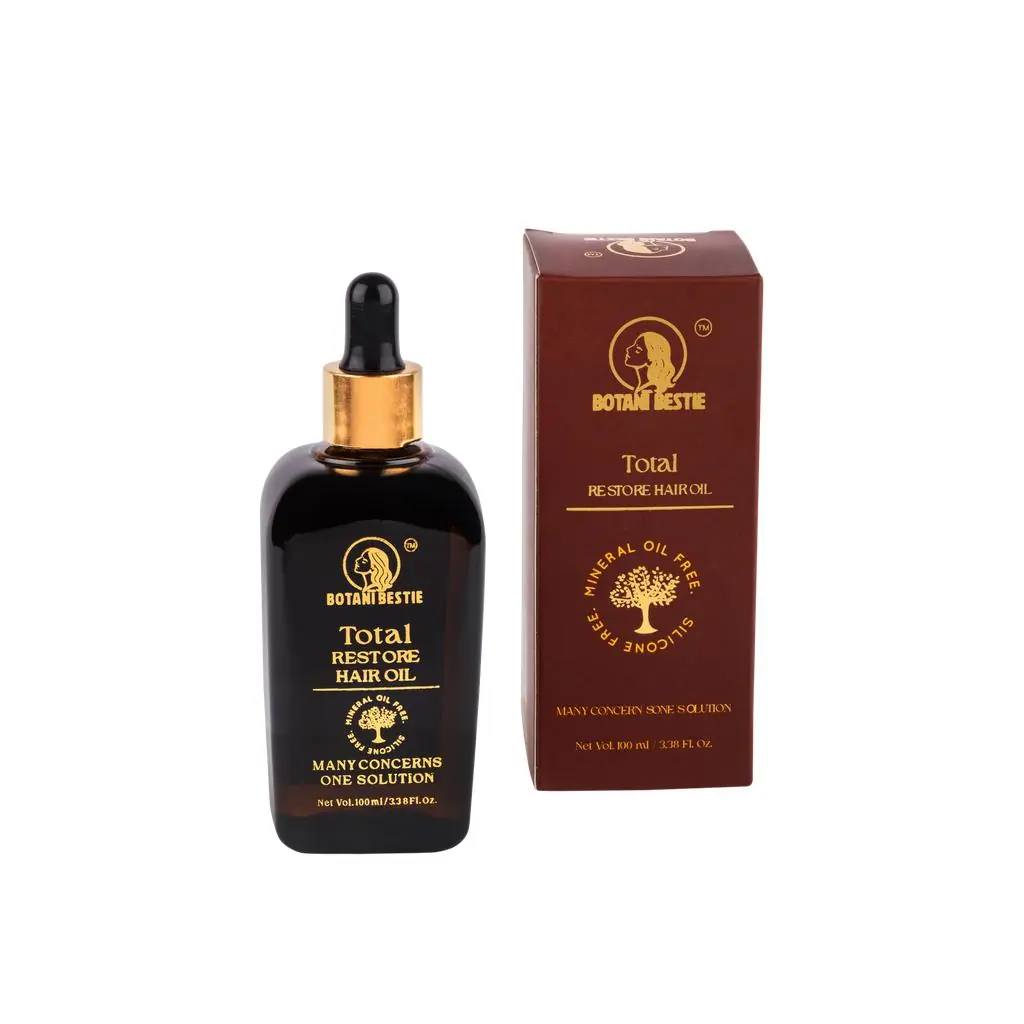
Total Restore Hair Oil
Pre-Wash Scalp Treatment — 2–3× per week
| Ingredient | Function |
|---|---|
| Sesame oil base | Antifungal lignans; barrier-supporting; UV protective; not a Malassezia substrate |
| Castor oil | Ricinoleic acid antifungal vs Malassezia; scalp barrier film |
| Bhringraj extract | 5α-reductase inhibition; dermal papilla cell proliferation; anagen extension |
| Amla extract | Anagen phase extension (2024 RCT); antioxidant follicle protection |
| Neem extract | Azadirachtin antifungal against Malassezia; scalp microbiome balance |
| Brahmi extract | Scalp microcirculation; antioxidant; traditional thickening evidence |
| Green Tea EGCG | Dermal papilla cell proliferation via VEGFA; sebum regulation; anti-inflammatory |
| Jatamansi | Melanocyte protection; anti-stress at scalp level; traditional anti-greying activity |
| Rosemary extract | DHT blocking + microcirculation (clinical RCT vs Minoxidil 2%) |
Why the base oil matters as much as the actives
A sesame + castor base was chosen specifically because both have functional scalp benefits (antifungal activity via sesamol and ricinoleic acid) while being appropriate carriers for the herb extracts above. Unlike mineral oil — which cannot penetrate the scalp and cannot deliver actives — sesame and castor oils interact with the scalp surface biologically. This means every active in the formula has a realistic route to the follicle, not just the hair shaft surface.
How to use for best results
- Apply to scalp sections 30–60 minutes before washing
- Perform a 5-minute scalp massage
- Wrap in warm towel for 15 minutes to enhance penetration
- Wash out with Total Rebalance Shampoo
- Use 2–3× per week consistently for 3–6 months
Know Exactly What You're Putting on Your Scalp
Total Restore Hair Oil lists every ingredient with its INCI name and the function it serves. No "proprietary blend" hiding. No mineral oil. No synthetic fragrance. Just the actives your scalp needs to support the hair growth cycle — nothing more.
Shop Total Restore Hair Oil → WhatsApp UsFrequently Asked Questions
The Bottom Line: The Label Tells the Truth
The ingredient list is the most honest part of any hair oil product — it cannot legally lie about what is in the formula or in what order. Learning to read it takes two minutes and saves you from spending money on products that are cosmetically identical to plain mineral oil at three times the price.
The five growth actives with the strongest clinical evidence — Bhringraj, Rosemary, Amla, Castor oil, and Green Tea EGCG — are all Ayurvedic or traditional ingredients that modern science has now validated. They are not exotic or difficult to source. The question is whether they appear in the formula at meaningful concentrations or as label decoration.
An oil that delivers these actives at effective concentrations in the right base — without mineral oil, silicone, or synthetic fragrance — is the honest answer to "best hair oil for hair growth in India." Read the label. The formula doesn't lie.
Shop Total Restore Hair Oil → Free Consultation"The best hair oil is not the one with the most herbs on the label — it is the one with the right herbs at the right concentration."
Ready to make the honest switch?
Our products are built on the same principles as every article we write — pure ingredients, real results, nothing to hide.
Explore Our Products