Foods for Hair Growth — What Indian Hair Actually Needs: The Nutrition-Follicle Guide (2025)
Hair is made of keratin protein — and Indian vegetarian diets are frequently too low in the amino acids that build it. Before any oil or serum can work, the follicle needs iron, zinc, protein, and Vitamin D arriving via the bloodstream. Here is the honest, Indian-diet-specific guide to what your hair actually needs from your plate — and what most people are chronically short of.
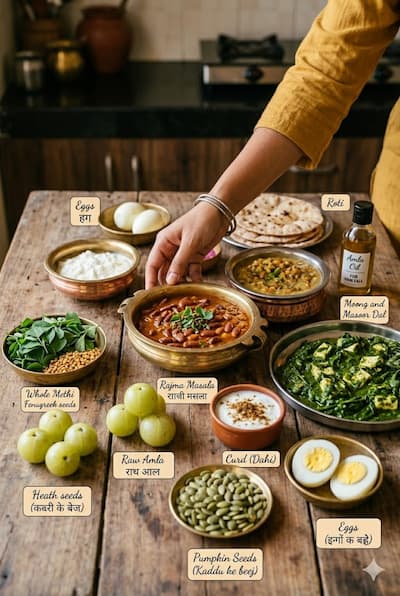
India has among the highest rates of hair fall complaints in Asia — and also some of the most common nutritional deficiencies in the world. These two facts are directly connected. Iron deficiency anaemia affects approximately 50% of Indian women. Vitamin D deficiency affects 70–80% of Indians despite living in one of the world's most sun-rich countries. Protein intake is chronically inadequate in a large proportion of vegetarian Indian diets.
The hair follicle is one of the most metabolically demanding tissues in the human body. It requires a continuous supply of oxygen, amino acids, trace minerals, and vitamins delivered via the bloodstream to maintain its rapid cell division cycle. When any of these inputs falls below threshold — even temporarily — the follicle responds by entering its resting phase early and shedding. This is the biological basis of nutritional hair fall.
No oil, serum, or topical treatment can compensate for a follicle that is not receiving adequate nutrition at the root. This guide covers the specific nutrients Indian hair needs, which are most commonly deficient, and exactly which foods — in the Indian diet — provide them most effectively.
⚡ Hair Nutrition — Quick Reference for Indian Diets
| Nutrient | Role in Hair Growth | India-Specific Risk | Best Indian Food Sources |
|---|---|---|---|
| Protein | Hair is 95% keratin — protein is the raw material | High — vegetarian diets frequently inadequate in total amount and amino acid completeness | Dal + rice (complete), eggs, paneer, curd, rajma, chana, soya |
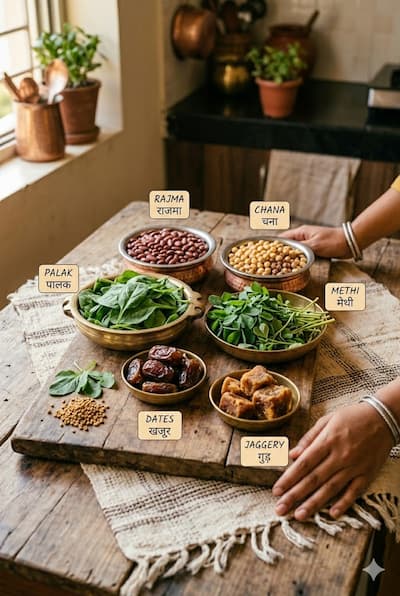
| Iron (Ferritin) | Required for follicle cell proliferation in anagen phase | Very high — 50% of Indian women are iron deficient; vegetarians at greater risk | Rajma, chana, methi, palak, lentils, dates, jaggery + Vitamin C |
| Zinc | Keratin synthesis, sebum regulation, DHT inhibition | Moderate — phytates in plant foods reduce zinc absorption by 40–50% | Pumpkin seeds, sesame (til), cashews, chana, paneer, eggs |
| Vitamin D | VDR receptors in follicle essential for anagen cycling | Very high — 70–80% of Indians deficient despite year-round sun | Eggs, fatty fish, fortified milk; morning sunlight; often supplementation needed |
| Omega-3 | Anti-inflammatory; reduces scalp inflammation driving shedding | Moderate — vegetarians lack EPA/DHA; ALA conversion is poor | Walnuts, flaxseeds (alsi), mustard oil; fatty fish (salmon, mackerel) for non-veg |
| Biotin (B7) | Cofactor for keratin synthesis enzymes | Low — deficiency is rare; most Indian diets provide adequate biotin | Eggs, peanuts, almonds, sweet potato — already present in most diets |
Why the Follicle Needs Nutrition Before Anything Else Works
Hair is not a passive structure. Each follicle is a miniature organ that undergoes continuous cycling — anagen (active growth, lasting 2–6 years), catagen (brief regression), and telogen (resting, followed by shedding and restart). The matrix cells at the base of the anagen follicle divide faster than almost any other cell type in the body, with a doubling time of approximately 24–72 hours. This rate of cell division is metabolically very expensive.
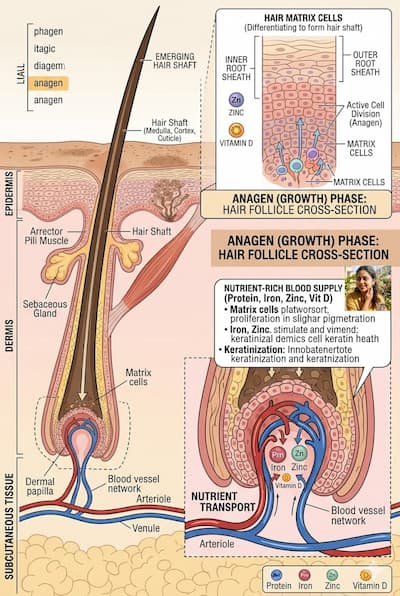
The Nutritional Supply Chain to Your Follicle
Every follicle is supplied by a dedicated capillary network at the dermal papilla — the bulge at the base of the follicle where matrix cells receive oxygen and nutrients from the blood. The hair shaft itself is built from the raw materials delivered by this blood supply:
- Amino acids (from dietary protein) are assembled into keratin chains — the structural protein that makes up 95% of the hair shaft. No amino acids = no keratin = no hair shaft production.
- Iron is required for ribonucleotide reductase — the enzyme that drives DNA replication in rapidly dividing matrix cells. Iron deficiency slows or stops matrix cell division, shortening or ending the anagen phase.
- Zinc is a cofactor for over 300 enzymes, several of which are essential for keratin protein assembly and follicle cell growth regulation.
- Vitamin D binds to VDR (Vitamin D Receptor) expressed in the follicle outer root sheath — a step directly required for initiating the anagen phase. Follicles without adequate VDR signalling fail to enter or maintain anagen.
When any of these inputs falls critically short, the follicle's response is consistent and predictable: it exits anagen early and enters telogen. After a 2–3 month telogen period, the hair sheds — producing the diffuse, all-over hair loss pattern of telogen effluvium. The shedding is the visible endpoint of a nutritional deficiency that began 2–4 months earlier.
The 3-Month Lag — Why Diet Changes Take Time to Show in Hair
There is a consistent and frustrating delay between the cause and the effect in nutritional hair fall. When a deficiency begins, follicles are pushed into telogen over the following weeks. Those follicles then remain in the resting phase for 2–3 months before shedding. This means you see the hair fall from a deficiency that started 3 months ago — not from what you ate last week.
The same lag applies in reverse: correcting a nutritional deficiency produces improvements in follicle cycling immediately, but visible reduction in shedding takes 2–3 months, and visible new hair density at the scalp takes 4–6 months. Patience is built into the biology of hair recovery.
Protein — The Most Critical and Most Commonly Deficient Nutrient
Hair is 95% keratin — a fibrous structural protein composed primarily of the amino acids cysteine, serine, glutamic acid, and leucine. The follicle must synthesise new keratin continuously during anagen at the rate required to grow approximately 1–1.5cm of hair per month. This requires a steady and adequate supply of dietary protein.
How Much Protein Does Hair Actually Need?
The general recommendation for hair health is 0.8–1.2g of protein per kilogram of body weight per day. For a 60kg adult, this means 48–72g of protein daily. For individuals with significant hair fall, the higher end (1.0–1.2g/kg) is appropriate during the recovery period.
The Indian vegetarian protein challenge is real and specific. It has two components:
- Total quantity: Many Indian meals are protein-sparse. A typical lunch of rice, dal (thin watery variety), and sabzi might provide only 10–15g of protein. Three meals at this level gives 30–45g — well below the 55–72g target for a 60kg adult. Dal is nutritious, but portion sizes, dal-to-water ratios, and meal composition often mean the actual protein consumed is far lower than assumed.
- Amino acid completeness: Plant proteins are individually "incomplete" — each lacks one or more essential amino acids at adequate levels. Rice lacks lysine. Dal lacks methionine. Wheat lacks lysine. Eaten separately, none provides all the essential amino acids hair keratin synthesis requires. Eaten together (dal + rice, or rajma + roti), they complement each other to create a complete amino acid profile. This combination principle is essential for vegetarian hair nutrition — eating any single plant protein source exclusively will leave amino acid gaps.
Best Indian Protein Sources for Hair
| Food | Protein (per 100g) |
|---|---|
| Soybean (dry) | 36g ⭐ |
| Rajma (cooked) | 9g |
| Chana dal (cooked) | 8.9g |
| Moong dal (cooked) | 7.5g |
| Paneer (full fat) | 18g |
| Curd (Greek-style) | 10g |
| Egg (1 whole) | 6g |
| Almonds | 21g |
| Peanuts | 26g |
| Tofu (firm) | 8g |
Iron — India's Most Common Deficiency and the Most Missed Hair Loss Cause
Iron deficiency is the single most common nutritional deficiency worldwide, and India has among the highest rates globally: approximately 50% of Indian women are estimated to be iron deficient, and a significant proportion of these have hair fall as a direct consequence.
The Ferritin Threshold Nobody Tells You About
This is the most important and most consistently missed point in iron and hair fall conversations. Standard blood tests check haemoglobin — a measure of anaemia. The haemoglobin cut-off for anaemia in women is approximately 12g/dL. Many women with hair fall are told their iron is "normal" because haemoglobin is normal.
But hair health depends on serum ferritin — the iron storage protein — not haemoglobin. And the ferritin threshold relevant to hair follicle function is approximately 70 ng/mL — far above the anaemia-defining cut-off of 12 ng/mL. A woman with haemoglobin of 12.5g/dL and serum ferritin of 15 ng/mL is not technically anaemic — but her ferritin is at 20% of the level required for normal follicle cycling.
If you are investigating hair fall with blood tests, always ask specifically for serum ferritin — not just haemoglobin, not just iron. A ferritin between 12 and 70 ng/mL indicates iron stores that are adequate for red blood cell production but insufficient for optimal follicle function.
Heme vs Non-Heme Iron — The Absorption Gap
Iron from food comes in two forms: heme iron (from animal products — meat, fish, poultry) and non-heme iron (from plant foods — dal, spinach, rajma, dates). Their absorption rates are dramatically different:
- Heme iron absorption: 15–35% (efficient, relatively unaffected by other dietary components)
- Non-heme iron absorption: 2–20% (highly variable — significantly reduced by tea, coffee, calcium, and phytates; significantly enhanced by Vitamin C)
For vegetarian Indians relying entirely on non-heme iron, this absorption gap means the iron on the plate is not the iron that reaches the follicle. Two practical strategies close most of this gap:
Pair Iron with Vitamin C
Vitamin C (ascorbic acid) converts non-heme iron from its ferric form (poorly absorbed) to its ferrous form (well absorbed) in the gut, increasing absorption by 2–6x. Practical combinations:
- Rajma with tomato-based gravy (tomatoes are high in Vitamin C)
- Palak dal with a squeeze of lemon
- Methi with amla chutney
- A glass of nimbu pani (lemon water) with an iron-rich meal
- Guava or amla eaten alongside iron-rich foods
Avoid These with Iron-Rich Meals
These common Indian habits significantly reduce non-heme iron absorption:
- Tea with meals: Tannins in chai bind iron and reduce absorption by 60–70%. Wait 1–2 hours after an iron-rich meal before having chai.
- Coffee with meals: Similar effect to tea; chlorogenic acid in coffee also reduces iron absorption.
- Calcium supplements with meals: Calcium competes with iron for the same intestinal transporter. Take calcium supplements at least 2 hours apart from iron-rich meals.
- Phytic acid-heavy foods: Whole grains and legumes contain phytates — soaking and sprouting dal and legumes before cooking reduces phytate content by 30–60% and meaningfully increases iron bioavailability.
Best Indian Iron Sources for Hair
| Food | Iron Content (per 100g) | Absorption Enhancer | Notes |
|---|---|---|---|
| Rajma (kidney beans, cooked) | 2.9mg | Tomato-based gravy | Also high in protein and zinc — excellent all-round hair food |
| Lentils / Masoor dal (cooked) | 3.3mg | Lemon squeeze | Among the most iron-dense legumes; quick-cooking; soak before cooking |
| Methi (fenugreek) leaves | 1.9mg raw | Eaten with tomato or amla | Also beneficial for hair topically; high in protein relative to other greens |
| Palak (spinach, cooked) | 3.6mg | Lemon; tomato | Also high in oxalates — pair with Vitamin C to offset oxalate-iron binding |
| Chana (chickpeas, cooked) | 2.9mg | Amchur or tomato in chana masala | Versatile — dal, chaat, or sabzi; also rich in zinc |
| Dates (khajoor) | 0.9mg per date | Eat with amla | Easy, portable, iron + natural sugars — good between-meal iron source |
| Jaggery (gur) | 11mg per 100g | — | Significant iron content; use in place of refined sugar where possible |
Zinc — The Follicle's Repair Mineral
Zinc is a cofactor for over 300 enzymes in the human body, with multiple functions directly relevant to hair growth: it is required for keratin protein synthesis, sebaceous gland regulation (which keeps the follicle channel healthy), inhibition of 5α-reductase (the enzyme that converts testosterone to DHT — the primary driver of pattern hair loss), and follicle cell division during anagen.
Signs of zinc deficiency in hair include diffuse hair shedding, slow growth rate, thinning of the hair shaft, and in severe cases a dry, flaky scalp. Zinc deficiency is common enough in Indian vegetarian diets to be a clinically significant cause of hair fall.
Why Vegetarians Are at Greater Zinc Risk
Plant foods contain zinc — but also contain phytates (phytic acid), which bind zinc and prevent its absorption in the gut. The net result: the same 10mg of zinc from plant sources is absorbed at roughly 40–50% the efficiency of 10mg from animal sources. To achieve equivalent absorbed zinc, vegetarians need to consume significantly more dietary zinc than non-vegetarians — and few do.
Soaking, sprouting, and fermenting legumes and grains reduces phytate content by 30–60%, substantially improving zinc bioavailability. Eating these foods in their soaked or sprouted form rather than whole and unsoaked makes a meaningful difference to actual zinc absorption.
🎃 Pumpkin Seeds
7.8mg zinc per 100g
Among the best plant zinc sources available; also provide omega-3 fatty acids. A small handful (30g) daily provides approximately 40–50% of daily zinc requirement. Can be eaten raw, roasted, or ground into chutney.
🌿 Sesame (Til)
7.8mg zinc per 100g
Used in tilgul, chutney, and cooking — already part of many Indian diets seasonally. Also rich in calcium. Roasted sesame has higher phytate reduction than raw. Tahini (sesame paste) is an easy addition to food.
🥜 Cashews
5.6mg zinc per 100g
Among the most zinc-dense nuts; also rich in magnesium and healthy fats. A practical daily snack. Like all nuts, soaking cashews overnight slightly reduces phytate content and improves zinc bioavailability.
Vitamin D — The Indian Paradox
India is one of the most sun-rich countries on Earth. Yet 70–80% of Indians have insufficient Vitamin D levels — one of the highest prevalence rates globally. This paradox has several causes: dark clothing that covers most of the body, indoor lifestyle patterns, melanin (which reduces UV-driven Vitamin D synthesis in the skin), and the fact that midday sun — when UV intensity is highest and Vitamin D synthesis most efficient — is when most Indians actively avoid sun exposure.
How Vitamin D Deficiency Causes Hair Fall
The hair follicle outer root sheath and dermal papilla cells express VDR — the Vitamin D Receptor. Vitamin D binding to VDR is required for the follicle to initiate and sustain the anagen growth phase. When Vitamin D levels fall below approximately 30 ng/mL (the clinical sufficiency threshold), VDR signalling is insufficient, anagen initiation fails, and follicles remain stuck in telogen — causing the resting-phase hair to shed without being replaced by new anagen growth.
Clinical studies show a consistent association between low Vitamin D levels (<20 ng/mL) and telogen effluvium, female pattern hair loss, and alopecia areata. Correcting Vitamin D deficiency — typically to levels of 40–60 ng/mL — is associated with meaningful improvement in hair density and shedding in deficient individuals.
Getting Vitamin D in India — The Practical Guide
☀️ Morning Sunlight
10–20 minutes of direct sunlight on arms and legs between 10am–2pm (when UVB is present) produces meaningful Vitamin D in the skin. Darker skin requires longer exposure than lighter skin for the same synthesis rate. Sunscreen partially blocks Vitamin D synthesis — brief unprotected morning sun on the arms (not the face) before applying SPF is a practical compromise.
🍳 Food Sources (Limited)
Very few foods are significant natural Vitamin D sources: egg yolks (approximately 40 IU per yolk), fatty fish like salmon, sardines, and mackerel (400–700 IU per 100g), and Vitamin D-fortified milk or curd (varies by brand, typically 100–200 IU per serving). It is extremely difficult to achieve adequate Vitamin D from food alone — even with regular egg and fatty fish consumption.
💊 Supplementation (Often Necessary)
Given the extreme prevalence of Vitamin D deficiency in India and the dietary limitations on food sources, supplementation is often the only practical way to correct Vitamin D levels. Standard supplementation is 1,000–2,000 IU of Vitamin D3 (cholecalciferol) daily for maintenance, or higher doses (4,000–8,000 IU) under medical supervision for correction of deficiency. Always test serum 25(OH)D before and 3 months after starting supplementation.
Omega-3 Fatty Acids — The Anti-Inflammatory Hair Nutrient
Omega-3 fatty acids reduce systemic and scalp-specific inflammation — and scalp inflammation is a contributing driver of hair shedding in multiple conditions, from seborrheic dermatitis to androgenetic alopecia to telogen effluvium. The omega-3 fatty acids most relevant to hair health are EPA and DHA — the long-chain forms found directly in fatty fish and fish oil.
Plant-based omega-3 (ALA, from flaxseeds, walnuts, and mustard oil) is converted to EPA and DHA in the body — but at very low efficiency: approximately 5–15% of ALA converts to EPA, and less than 1% converts to DHA. Vegetarian Indians relying on plant-based ALA for their omega-3 intake are typically not achieving the EPA and DHA levels that provide meaningful anti-inflammatory benefit for the scalp.
Best Plant Omega-3 Sources for Vegetarians
- Flaxseeds (alsi): 2.3g ALA per tablespoon — the richest plant omega-3 source. Grind before eating; whole seeds pass through undigested.
- Walnuts (akhrot): 2.6g ALA per 30g serving. Easy daily snack; also provide zinc and Vitamin E.
- Mustard oil: High in ALA compared to refined oils; traditional use in Indian cooking provides meaningful omega-3 intake.
- Algal oil supplements: Derived from the algae that fish eat — provides direct EPA and DHA without animal products. The most effective omega-3 option for strict vegetarians.
Best Non-Vegetarian Omega-3 Sources
- Salmon: 2,000–2,500mg EPA+DHA per 100g — the most EPA/DHA-dense commonly available fish
- Mackerel (bangda): 2,600mg EPA+DHA per 100g — widely available and affordable across India
- Sardines (tarli): 1,500mg EPA+DHA per 100g — excellent value; regularly eaten in coastal Indian cooking
- Rohu / Catla: Lower EPA/DHA than cold-water fish but still meaningful omega-3 content for freshwater fish commonly eaten in eastern India
2–3 servings of fatty fish per week provides the omega-3 intake associated with anti-inflammatory benefits for scalp health.
Biotin — The Most Overhyped Hair Supplement (An Honest Assessment)
Biotin (Vitamin B7) deserves its own section specifically because of the gap between its market popularity and its clinical evidence base. Biotin supplementation is a multi-hundred-million dollar global industry — and most of the people buying it do not need it.
What the Evidence Actually Shows About Biotin and Hair
Biotin is a cofactor for carboxylase enzymes involved in fatty acid synthesis and amino acid metabolism — and disruption of these pathways causes the brittle hair and nails associated with biotin deficiency. In people who are genuinely biotin-deficient, supplementation does improve hair and nail quality. This is where the clinical evidence ends.
True biotin deficiency is genuinely rare in people eating a varied diet. Biotin is found in eggs, peanuts, almonds, sweet potato, lentils, and sunflower seeds — foods that are all regular parts of most Indian diets. The clinical cases of biotin deficiency that have been documented involve prolonged consumption of raw egg whites (which contain avidin, a protein that blocks biotin absorption), specific rare inherited metabolic disorders, or prolonged IV feeding without biotin supplementation.
The honest bottom line: If you eat a varied diet including any of the above foods, your biotin levels are almost certainly adequate. Biotin supplementation in people with normal biotin levels does not increase hair growth rate, hair density, or shaft diameter in controlled clinical trials. If you are spending money on supplements for hair fall, the nutrients far more likely to be deficient — and therefore far more likely to produce a real result — are iron (as ferritin), Vitamin D, zinc, and protein.
One practical caveat: High-dose biotin supplementation (10,000 mcg and above) can interfere with thyroid hormone blood tests, causing false readings. If you are on biotin supplements and getting blood tests, inform your doctor and stop biotin 48 hours before testing.
The Indian Diet Reality Check — Common Deficiency Patterns and How to Fix Them
The most challenging nutritional hair fall pattern in India involves the convergence of multiple deficiencies in a single person — which is common in strict vegetarians who do not actively plan their nutrition. A typical profile: low-protein diet (dal-rice-sabzi meals with insufficient dal portion), iron deficiency with ferritin below 30 ng/mL (non-heme iron sources with tea consumed at meals), Vitamin D deficiency (70–80% Indian background rate), and zinc insufficiency (phytate-bound plant zinc not adequately absorbed).
Each of these individually can cause hair fall. Together, they create a compounded deficit that produces severe, diffuse shedding that is easily mistaken for genetic hair loss. The distinguishing feature: nutritional deficiency hair fall is almost entirely reversible when the deficiencies are identified and corrected. Genetic pattern hair loss is not.
What to test: Serum ferritin (not just haemoglobin), serum 25(OH)D, serum zinc, and a complete blood count. These four tests, interpreted together, identify the specific nutritional gaps driving hair fall in most Indian women with diffuse shedding.
This is not a diet plan — it is an illustration of how a standard Indian day of eating can be structured to address the most common nutritional gaps relevant to hair health, without any unusual or expensive foods.
- Morning (with sunlight exposure for 15 min on arms): 2 whole eggs (protein + Vitamin D + zinc) with a glass of fortified milk or curd (calcium + fortified Vitamin D). Or: poha made with sprouted moong (protein + iron) with a squeeze of lemon (Vitamin C for iron absorption).
- Mid-morning snack: A handful of mixed nuts — almonds, walnuts, pumpkin seeds (protein + zinc + omega-3 ALA). Alternatively, a small portion of curd (protein + calcium).
- Lunch (the most iron-critical meal): Rajma or masoor dal (iron + protein) + rice (complete amino acids) + palak sabzi or tomato-based gravy (Vitamin C for iron absorption). Avoid chai for 1 hour after this meal.
- Afternoon: Amla (fresh or powder) — Vitamin C + antioxidants. Alternatively, guava or orange.
- Dinner: Chana dal or moong dal (protein + zinc + iron) + roti (complete amino acids with dal) + a vegetable containing Vitamin C (tomatoes, bell pepper, broccoli if available). Non-vegetarians: mackerel or sardine curry provides direct EPA/DHA omega-3 + iron + zinc.
- Before bed: Haldi milk (if using fortified milk, adds Vitamin D). A date or two (small iron boost).
This day of eating, maintained consistently, provides approximately: 60–70g protein, 20–25mg iron (with enhanced absorption from consistent Vitamin C pairing), 10–12mg zinc, and meaningful amounts of omega-3 ALA — addressing the four most common nutritional gaps in Indian vegetarian hair fall.
Certain groups have predictably higher nutritional hair fall risk and should investigate specific deficiencies proactively:
- Postpartum women: Pregnancy dramatically depletes iron, zinc, and protein stores. Combined with the hormonal shift at delivery, this creates the most severe nutritional hair fall most women ever experience. See our guide on postpartum hair fall.
- Women with heavy menstruation: Monthly iron loss through menstruation creates a chronic iron deficit that never fully corrects between cycles. Ferritin chronically low; a cycle of ongoing iron deficiency hair fall without knowing why.
- Women with PCOS: Insulin resistance in PCOS impairs iron absorption; many PCOS patients are simultaneously iron-deficient and protein-deficient. See our guide on PCOS and hair fall.
- Students and professionals with poor meal regularity: Skipped meals, canteen food, and high-stress lifestyles dramatically reduce the quality and quantity of nutrition reaching the follicle — particularly protein and iron.
- Strict Jain vegetarians: Avoiding root vegetables (including many iron and zinc-rich foods) and all animal products requires particularly deliberate nutritional planning to prevent deficiencies.
💡 Not sure which nutritional deficiency is driving your hair fall? Our dermatologist can review your bloodwork and build a targeted diet + treatment plan.
Book Free Hair Consultation →Nutrition Inside, Support Outside — Products That Work With Your Diet
No topical product can replace adequate dietary nutrition — a follicle that is not receiving iron, protein, and Vitamin D from the bloodstream cannot be rescued by oil applied at the scalp surface. But once the nutritional foundation is in place, topical products that support follicle function from the outside — improving scalp microcirculation, reducing inflammation, and strengthening the hair shaft — meaningfully accelerate the recovery that nutrition alone is producing.

Total Restore Hair Oil
Pre-Wash Scalp Oil — 2–3x Weekly
Amla provides the highest natural Vitamin C content of any Indian ingredient — supporting collagen synthesis around the follicle and complementing dietary iron absorption at the scalp surface. Bhringraj stimulates dermal papilla cells and reduces the scalp inflammatory environment that accelerates hair fall during nutritional recovery. Redensyl directly activates hair follicle stem cells for follicle regeneration. Jatamansi protects melanocyte function against the oxidative stress that accompanies dietary deficiency states. The complete external support partner to the internal nutritional foundation you are building through diet.
Shop Total Restore Hair Oil →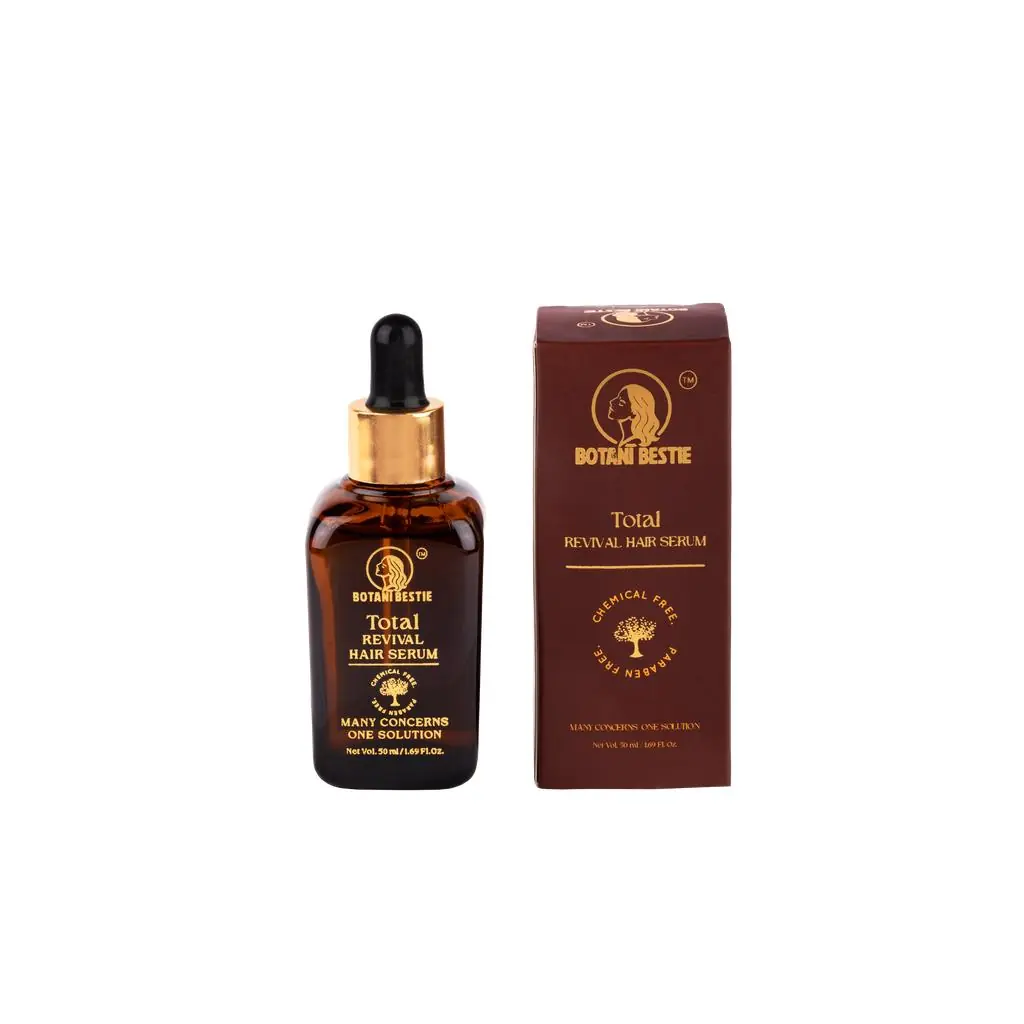
Total Revival Hair Serum
Leave-In Scalp Serum — Daily Application
While diet corrects the internal supply chain deficit, this serum addresses follicle reactivation from the outside. Redensyl (DHQG + EGCG) targets hair follicle stem cells in the outer root sheath — directly promoting the return to anagen that nutritional correction is also driving. Anagain (from organic pea sprouts) mimics dermal papilla signalling to extend anagen duration. Procapil (biotinyl-GHK + apigenin) improves scalp microcirculation and reduces follicle miniaturisation. Applied to the scalp daily as a leave-in serum — no rinsing required.
Shop Total Revival Hair Serum →Investigate the Root Cause — Not Just the Symptom
Nutritional deficiency hair fall — iron, Vitamin D, zinc, or protein — is one of the most completely reversible causes of hair loss when identified and corrected. But it requires identifying which specific deficiency is present, at what severity, and building a diet and supplementation plan to address it — alongside the right topical support for the scalp. Our dermatologist does all of this in a single consultation. No purchase required.
Book Free Hair Consultation → WhatsApp UsFrequently Asked Questions
The Bottom Line — Feed the Follicle First
Hair oils, serums, and shampoos work — but they work with a functioning follicle. A follicle that is not receiving adequate protein, iron, zinc, and Vitamin D via the bloodstream is not capable of maintaining anagen growth regardless of what is applied to the scalp surface. Nutrition is not an alternative to topical treatment. It is the prerequisite.
For Indian vegetarian women especially: the combination of low total protein, low ferritin, Vitamin D deficiency, and phytate-bound zinc is extremely common and extremely underdiagnosed. Blood tests for serum ferritin, 25(OH)D, and zinc — interpreted with hair-specific thresholds, not just population norms — reveal the cause in most cases of diffuse, unexplained hair fall.
Fix the nutritional foundation. Support it with the right topical products. And give the biology the time it requires. Hair recovery is slow — the follicle cycle does not rush — but nutritional hair fall is one of the most completely reversible conditions in dermatology when the cause is correctly identified.
Shop Total Restore Hair Oil → Free Hair Consultation"No oil can rescue a follicle that the bloodstream is starving. Feed it first. Then support it."
Ready to make the honest switch?
Our products are built on the same principles as every article we write — pure ingredients, real results, nothing to hide.
Explore Our Products